There is a moment in writing when a word stops working. You have used changeover once already, and now it is sitting in the next sentence too, looking awkward. Or maybe the word just does not match the tone of what you are writing. Too mechanical. Too plain. Not quite right.
This article gives you 32+ real alternatives, grouped by meaning, explained with enough context to help you choose confidently. Not a word dump. A working guide.
What “Changeover” Actually Means
Changeover describes a move from one system, method, state, or person to another. It is usually planned. It usually has a clear before and after. The word itself sits in neutral territory, neither positive nor negative, neither urgent nor slow.
That neutrality is useful, but it is also why writers often need something with a little more character.
Quick-Access Another Word for Changeover Table (32+ Words)
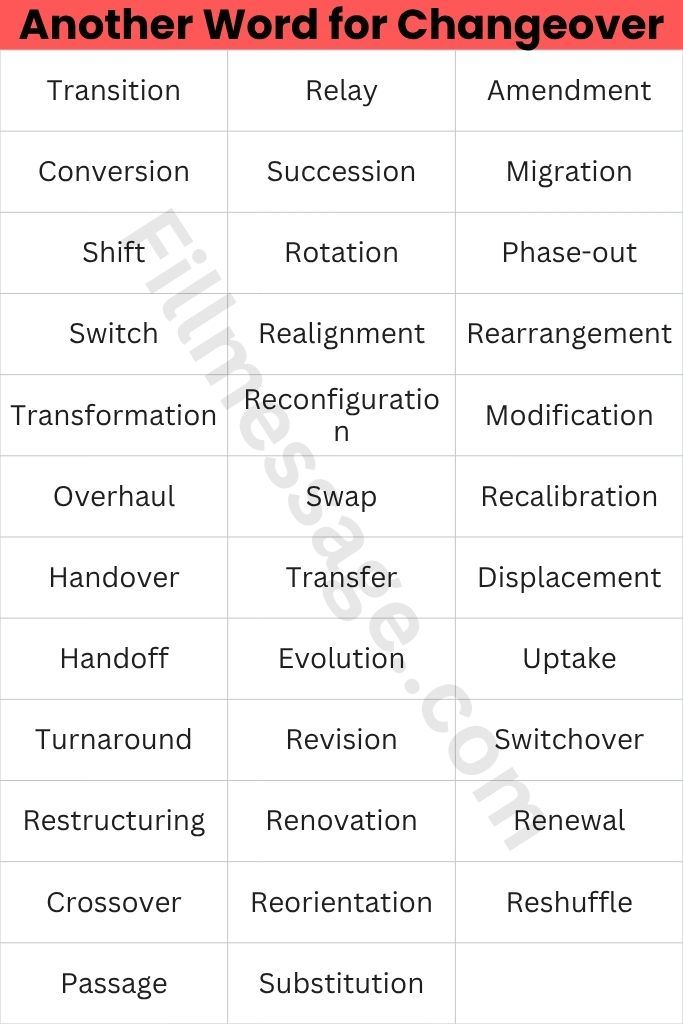
| Word | Tone | Best Used When |
| Transition | Neutral, formal | Change unfolds gradually over time |
| Conversion | Technical, definitive | A system or format changes completely |
| Shift | Casual, broad | Direction or focus changes |
| Switch | Direct, informal | One thing replaces another quickly |
| Transformation | Vivid, emphatic | The result looks entirely different |
| Overhaul | Strong, practical | Something gets rebuilt significantly |
| Handover | Professional | Control or responsibility transfers |
| Handoff | Casual, team-based | Work passes between people informally |
| Turnaround | Results-focused | Performance or direction reverses |
| Restructuring | Corporate, formal | An organization or system is redesigned |
| Crossover | Context-specific | One domain blends into another |
| Passage | Literary, soft | Movement through a period of change |
| Relay | Sequential | One phase or person passes to the next |
| Succession | Orderly, formal | One thing officially follows another |
| Rotation | Cyclical | Roles or positions cycle regularly |
| Realignment | Strategic | Priorities or direction are reoriented |
| Reconfiguration | Technical | Parts or elements are rearranged |
| Swap | Informal, fast | A quick like-for-like exchange |
| Transfer | Neutral | Movement of ownership, role, or control |
| Evolution | Gradual, positive | Change builds naturally over time |
| Revision | Deliberate, careful | Something is corrected or updated |
| Renovation | Physical, practical | A space or system is renewed |
| Reorientation | Directional | Focus or approach shifts significantly |
| Substitution | Precise, formal | One element replaces a specific other |
| Amendment | Legal, formal | A rule, policy, or document is updated |
| Migration | Technical, modern | Data or users move from one platform to another |
| Phase-out | Process-focused | Something is removed gradually |
| Rearrangement | Mild, structural | Elements reorganize without full removal |
| Modification | Careful, limited | Specific parts change, not everything |
| Recalibration | Analytical, precise | Something is adjusted back to the correct setting |
| Displacement | Clinical, neutral | One thing is pushed out by another |
| Uptake | Adoption-focused | A new method or practice is accepted |
| Switchover | Technical, operational | A live system flips to a backup or replacement |
| Renewal | Fresh, optimistic | Something is restarted or refreshed |
| Reshuffle | Organizational | Roles or positions are redistributed |
Changeover Synonym Meaning Clusters: Not All Changes Are Equal
This is where most synonym lists fall short. They give you the words but not the logic. Here is how to think about these 35 alternatives in groups.
Scale: Small vs. Large
Some words describe targeted changes with limited scope:
Modification, revision, recalibration, amendment, adjustment all point to something specific being corrected or updated. The overall structure stays in place.
Then there are words that describe wholesale change:
Overhaul, transformation, restructuring, renovation suggest the whole system, space, or organization changed significantly. Using a small-scale word for a large change understates what happened. Going the other way overstates it and loses credibility.
Speed: Fast vs. Gradual
Switch, swap, switchover, handoff all carry a sense of immediacy. There is not much time between the old and the new.
Evolution, passage, transition, phase-out imply the change happened over time. Nobody flipped a switch. It unfolded.
This distinction matters most in journalism, business reports, and historical writing, where the pace of change is often as important as the change itself.
Tone: Neutral vs. Charged
Some of these words are emotionally neutral. Transfer, substitution, reconfiguration just describe what happened with no feeling attached.
Others carry weight. Transformation signals something remarkable. Turnaround implies things were going badly first. Evolution suggests things got better naturally. Displacement can feel cold or even unsettling.
Pick based on the feeling you want the reader to walk away with.
Direction: Forward, Lateral, or Reversed
Succession, evolution, progression all imply forward movement.
Reorientation, realignment, reshuffle suggest a lateral change, a new direction rather than an improvement.
Turnaround is the only word in this list that implies reversal. Things were going one way, now they go another. Do not use it unless that reversal element is real.
Another Word for Changeover Sentence Rewrites: The Same Idea, Four Different Impressions
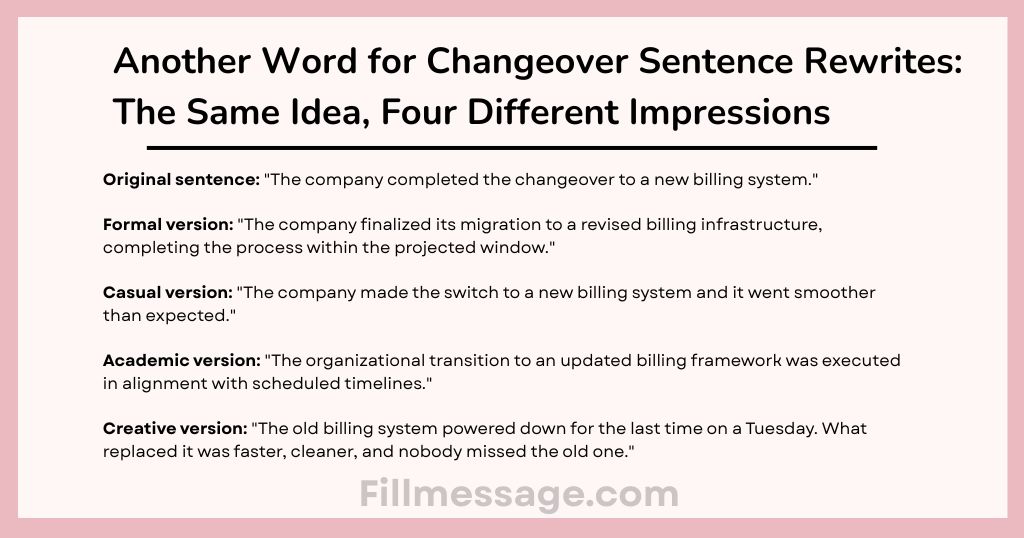
Original sentence: “The company completed the changeover to a new billing system.”
Formal version: “The company finalized its migration to a revised billing infrastructure, completing the process within the projected window.”
Casual version: “The company made the switch to a new billing system and it went smoother than expected.”
Academic version: “The organizational transition to an updated billing framework was executed in alignment with scheduled timelines.”
Creative version: “The old billing system powered down for the last time on a Tuesday. What replaced it was faster, cleaner, and nobody missed the old one.”
Same event. Four completely different reader impressions. The formal version signals preparation and control. The casual one signals ease. The academic one signals methodology. The creative one makes the reader feel something.
The word you choose does not just describe the change. It frames how readers understand it.
Another Word for Changeover Formal vs. Informal: Matching the Right Word to the Right Context
Professional emails and reports: Transition, handover, conversion, restructuring, succession, transfer. These signal planning and professionalism. They belong in board presentations, policy documents, and stakeholder updates.
Technical writing and documentation: Migration, reconfiguration, switchover, substitution, phase-out, modification. These are precise without sounding stiff. They tell the reader exactly what changed and how much.
Storytelling and creative writing: Passage, transformation, evolution, crossover, renewal. These carry emotional texture. They suggest something felt, not just something executed.
Team communication and internal notes: Handoff, swap, reshuffle, rotation, realignment. These are practical and clear without needing to sound formal.
Words to keep out of formal contexts: swap and handoff both work well in conversation but can sound too light in official documents or client-facing writing.
Read more – 36+ Another Word for Speech: The Right Word for Every Situation
Common Mistakes Writers Make
Overusing “transformation.” It is a strong word. When every update becomes a transformation, the word loses its meaning fast. Save it for changes that are genuinely dramatic and complete.
Confusing “transition” and “conversion.” A transition suggests a period of gradual adjustment. A conversion is definitive and often immediate. You convert a file. You transition through a career change. They are not the same.
Choosing longer words just to sound more formal. Reconfiguration is precise and useful in the right place. But if you just moved two people to different desks, rearrangement is cleaner and more honest.
Using “turnaround” for any kind of change. It specifically implies reversal. If things were fine and you simply upgraded something, turnaround is the wrong word. It implies something was broken or failing first.
Treating “switchover” and “switch” as identical. A switch is a general informal word. A switchover is a technical term used specifically when a live system or process flips to a replacement, often in IT, broadcasting, or engineering. Using switchover in casual writing can sound unnecessarily technical.
Using “overhaul” for minor updates. An overhaul means something was significantly rebuilt. If you updated a logo color, that is not an overhaul. That is a revision or a modification.
Changeover Synonym Related Words That Often Get Confused
These are not synonyms of changeover, but they appear in the same conversations and are easy to mix up.
Disruption points to change that interrupts or destabilizes. A changeover can be smooth. A disruption almost never is. In modern business writing, disruption is sometimes used to mean bold innovation, but it always carries an element of friction.
Reform is change driven by a belief that something was wrong. It carries moral or political weight that changeover does not. You reform a broken system. You do not reform a software platform.
Departure is directional. It describes moving away from something rather than adopting something new. Use it when the focus is on what is being left behind.
Progression implies things are getting better, not just different. Changeover is neutral about outcomes. Progression is not.
Replacement is close to changeover but more focused on the object being removed. The emphasis is on what is gone, not on the process of changing.
Read also – 27+ Another Word for Resistance: The Right Word for Every Situation
Frequently Asked Questions
Is “transition” always a safe substitute for “changeover”?
In most general writing, yes. But in manufacturing, engineering, or sports, changeover has a specific operational meaning, often referring to setup time between production runs or side changes in tennis. In those contexts, transition is too vague. Use switchover, handoff, or the field-specific term instead.
When does “migration” work and when does it not?
Migration is well-suited to technology and data contexts: moving users from one platform to another, shifting databases, transferring files at scale. Outside of technical writing, it can sound odd. “The team completed a migration to a new office policy” would raise eyebrows.
What is the difference between “handover” and “handoff”?
Nearly the same thing. Handover is more common in British English and formal professional settings. Handoff is more common in American English and tends to feel team-based and casual. Match the context and the audience.
Can “reshuffle” be used outside of organizational contexts?
It is mostly used for roles, positions, and team structures. Using it for a physical rearrangement or a process change can sound slightly off. In those cases, rearrangement or reconfiguration is a cleaner choice.
Choosing the Right Word
Before you replace changeover, ask two things: how large was the change, and how fast did it happen?
Large and complete: reach for conversion, overhaul, transformation, or restructuring.
Fast and practical: switch, swap, switchover, or handoff will serve you better.
Gradual and deliberate: transition, evolution, or phase-out fit the pace.
Organizational or role-based: succession, reshuffle, rotation, or realignment are your clearest options.
The right word is the one that matches what actually happened. Not the one that sounds most impressive.

Marco Jr. is Author at fillmassage.com,
He explores the world of words and their meanings, helping readers understand language clearly. Passionate about explanations that guide and inform, he creates insightful content that educates, engages, and supports curious minds every day.