Writers overuse deeper without realizing it. It slips into essays, emails, and stories because it feels like it adds meaning. But when the same word carries four different jobs in one paragraph, it stops doing any of them well.
“A deeper understanding.” “A deeper connection.” “Deeper analysis.” “Go deeper into the cave.” Same word. Completely different ideas. That’s the problem.
This guide gives you 41 Another Word for Deeper, grouped by meaning, with examples that show exactly when each one works and when it doesn’t.
What “Deeper” Actually Does in a Sentence
Before picking a synonym, know what deeper is doing. It works across four core meanings:
- Physical distance going down or inward
- Stronger emotional closeness or connection
- More serious intellectual thinking or analysis
- Greater knowledge or understanding
The synonym you need depends entirely on which of these four meanings is active in your sentence.
41 Another Word for Deeper: Quick-Access Table
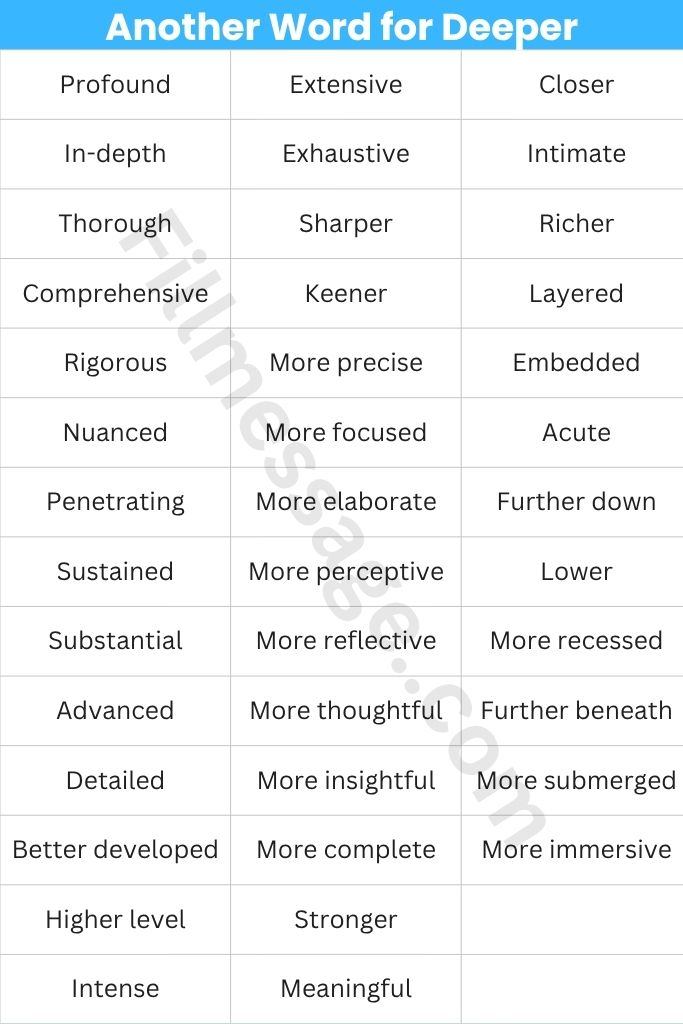
Organized by context so you can find the right word fast.
| Word/Phrase | Tone | Best Used For |
| Profound | Formal/elevated | Understanding, emotional impact |
| In-depth | Neutral/academic | Research, essays, analysis |
| Thorough | Neutral/professional | Reviews, explanations |
| Comprehensive | Formal | Reports, coverage |
| Rigorous | Academic | Methods, standards |
| Nuanced | Formal/academic | Arguments, interpretation |
| Penetrating | Formal/literary | Insight, critical analysis |
| Sustained | Academic | Long-term inquiry, effort |
| Substantial | Formal | Evidence, support, change |
| Advanced | Neutral | Skills, knowledge, stage |
| Detailed | Neutral | Descriptions, explanations |
| Extensive | Neutral | Research, experience |
| Exhaustive | Formal | Study, review, coverage |
| Sharper | Moderate | Insight, focus, reasoning |
| Keener | Moderate | Awareness, judgment |
| More precise | Neutral | Language, measurement |
| More focused | Neutral | Study, attention, effort |
| More elaborate | Moderate | Plans, structure, description |
| More perceptive | Moderate | Observation, judgment |
| More reflective | Moderate | Writing, thinking, tone |
| More thoughtful | Warm/professional | Responses, communication |
| More insightful | Moderate | Reviews, analysis |
| More rigorous | Academic | Research, process |
| Better developed | Neutral | Ideas, systems, skills |
| More complete | Neutral | Understanding, picture |
| Higher level | Neutral | Skill, thinking, discussion |
| Stronger | Conversational | Arguments, feelings, ties |
| Intense | Conversational | Emotions, focus, effort |
| Meaningful | Warm/relational | Connections, moments |
| Closer | Casual/relational | Relationships, alignment |
| Intimate | Relational | Conversations, personal settings |
| Richer | Creative/warm | Meaning, experience, detail |
| Layered | Creative | Themes, character, story |
| Embedded | Neutral/technical | Problems, habits, beliefs |
| Acute | Moderate | Sharpness, urgency, awareness |
| Further down | Literal | Physical space |
| Lower | Literal | Physical position |
| More recessed | Literal | Physical space, architecture |
| Further beneath | Literal | Underground, layers |
| More submerged | Literal | Water, physical depth |
| More immersive | Creative/experiential | Learning, experience, storytelling |
Another Word for Deeper Meaning Clusters: Which Word Goes Where
Understanding and Knowledge
This is the most common use of deeper in writing. “A deeper understanding.” “A deeper grasp.” It’s overused to the point of feeling hollow.
Profound works when the understanding genuinely changes how someone thinks. Not just knowing more, but seeing differently. Reserve it for real impact.
In-depth is sharper in essays and reports. It signals careful, structured thinking. In academic writing, “an in-depth analysis” almost always reads better than “a deeper analysis.”
Thorough fits practical contexts: training documents, instructional writing, professional reviews. It’s clear and trusted without feeling stiff.
Exhaustive is stronger than thorough. Use it when a review or study leaves no stone unturned. It implies completeness above intensity.
Advanced works when the knowledge has moved to a higher stage, not just gone further into the same level.
Broader is worth knowing here too. It’s not a synonym for deep, but writers confuse them. Broad means wide range. Deep means serious intensity. They pull in different directions. Don’t swap them.
Emotional Closeness and Relationships
“A deeper connection” appears in personal essays, social media captions, and self-help writing more than almost any other phrase. It has become a reflex. Most of the time, a more specific word does the job better.
Stronger bond works when two people have built something through shared effort or time. It suggests durability, not just warmth.
Meaningful relationship shifts focus from how intense the connection feels to how much it matters. That’s a real difference.
Closer friendship is simple and natural. In casual writing, this will often outperform any fancier option.
Intimate understanding fits moments when people genuinely know each other in a private, personal way. It carries warmth and implies earned trust.
Richer works well in creative or personal writing when you want to describe a connection that has grown fuller, not just stronger.
Serious Thinking and Analysis
Essays, research papers, and critical writing lean on “deeper analysis,” “deeper inquiry,” and “deeper exploration.” Each of these has a better option.
Rigorous signals disciplined, methodical, careful thinking. It’s one of the strongest choices in academic writing.
Penetrating implies the thinking cuts through assumptions and surface explanations. Strong in literary criticism and intellectual essays.
Nuanced is the right word when the argument holds complexity, when more than one truth is present at once. It’s specific and it carries real meaning.
Sustained inquiry works when the exploration happens over time, not just when someone looks harder once. This is useful in academic and research contexts.
Sharper fits when the focus or reasoning has become more precise and targeted, not just more intense.
More perceptive works when a person or observation sees something others miss. It’s underused and often more accurate than deeper.
Physical Depth
Not every use of deeper is abstract. Sometimes a cave is literally deeper. A well goes further down. In these cases, abstract synonyms are wrong. Use:
- Further down
- Lower
- More recessed
- Further beneath
- More submerged
These are plain and accurate. Don’t force an emotional or intellectual word into a physical sentence.
Another Word for Deeper in Sentence Rewrites: Seeing the Difference
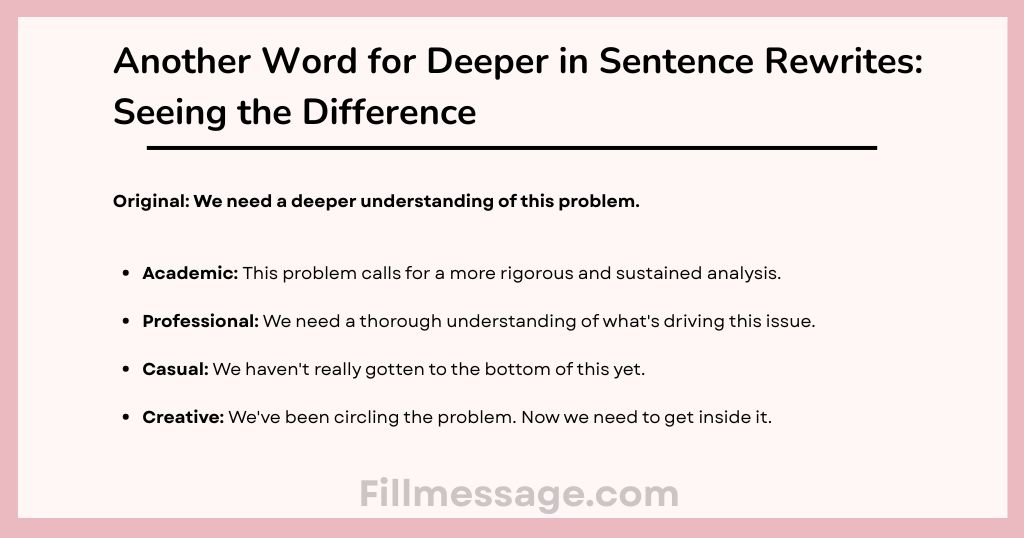
Original: We need a deeper understanding of this problem.
- Academic: This problem calls for a more rigorous and sustained analysis.
- Professional: We need a thorough understanding of what’s driving this issue.
- Casual: We haven’t really gotten to the bottom of this yet.
- Creative: We’ve been circling the problem. Now we need to get inside it.
Original: They developed a deeper connection over the years.
- Warm/relational: Their friendship grew into something genuinely meaningful over time.
- Professional: They built a stronger working relationship through years of collaboration.
- Literary: What began as courtesy became something neither of them could easily explain.
Original: The essay needs deeper analysis.
- Academic: The essay would benefit from more penetrating and nuanced analysis.
- Direct: The essay doesn’t go far enough. It needs to move past the obvious.
Original: This is a deeper issue than it looks.
- Professional: This issue is more embedded and complex than it first appears.
- Conversational: This problem goes further back than most people realize.
Original: He has a deeper awareness of the situation.
- Formal: He has a keener and more perceptive awareness of the situation.
- Casual: He sees things about this situation that others tend to miss.
Notice how the rewrites don’t just swap a word. They change the angle, rhythm, and confidence of the sentence. That’s what a precise synonym does.
Read also: 41+ Another Word for On Time: Real Alternatives That Actually Fit
Another Word for Deeper Formal vs. Casual: Which Words Belong Where
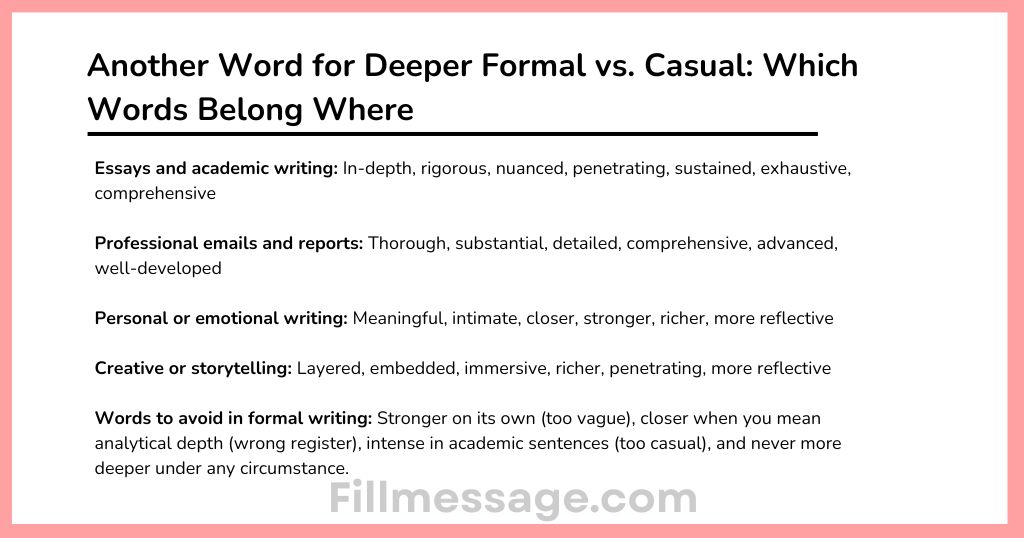
Essays and academic writing: In-depth, rigorous, nuanced, penetrating, sustained, exhaustive, comprehensive
Professional emails and reports: Thorough, substantial, detailed, comprehensive, advanced, well-developed
Personal or emotional writing: Meaningful, intimate, closer, stronger, richer, more reflective
Creative or storytelling: Layered, embedded, immersive, richer, penetrating, more reflective
Words to avoid in formal writing: Stronger on its own (too vague), closer when you mean analytical depth (wrong register), intense in academic sentences (too casual), and never more deeper under any circumstance.
Common Mistakes about Synonyms for Deeper
“More deeper” is always wrong. Deeper already means “more deep.” It’s a double comparative. This error shows up often in informal writing and it damages credibility immediately.
Swapping deep for broad. These are not the same. “A broader understanding” means knowing more topics. “A deeper understanding” means knowing one thing more seriously. Choosing the wrong one changes your meaning entirely.
Overusing profound. It’s formal, it sounds weighty, and writers lean on it too heavily. In a business email or a practical explanation, thorough is almost always the cleaner choice.
Forcing emotional words into analytical sentences. “A more meaningful analysis” sounds warm but reads as imprecise in academic writing. Rigorous or nuanced is clearer and more trusted there.
Using abstract words for physical depth. A cave being “more profound” instead of “further down” is simply the wrong word in the wrong place.
Synonyms for Deeper Related Words Worth Knowing
These are close to some synonyms above but carry their own distinct meaning:
Acute describes sharpness or urgency. An acute awareness. An acute problem. It implies something is sharp and immediate, not just serious. Underused and often highly precise.
Extensive suggests range, not depth. Extensive research covers a wide area. Deep research goes far into one. Know which you mean.
Embedded is the right word when something is rooted in a system, belief, or habit and hard to remove. “The problem is embedded in the structure” is more specific than deeper in almost every sentence.
Immersive works when experience or learning pulls someone fully into something. Good for creative writing, education, and storytelling. It describes engagement from the inside.
Sustained implies consistent effort over time, not just intensity in a moment. “Sustained focus” is different from “intense focus.” One holds. The other spikes.
Read more:
37+ Another Word for Saddest: Better Words for Different Kinds of Sadness
38+ Another Word for Proud: Choose the Right One Every Time
FAQs about Another Word for Deeper
What is the best synonym for “deeper understanding” in an essay?
In-depth understanding or thorough understanding fit most essays cleanly. If the insight is genuinely significant and changes how something is seen, profound understanding works. Don’t use it for routine analysis.
Can I use “more deeper” in writing?
No. It’s a grammatical error every time. Write deeper alone, or choose a different word like more thorough or more profound.
How do I replace “deeper connection” without sounding clichéd?
Use stronger bond, closer relationship, or more meaningful friendship. Or skip the label entirely and describe what the connection looks like. “They knew each other in a way that took years to build” says more than “a deeper connection” ever does.
Is “profound” too formal for everyday writing?
Usually yes. Save it for moments of genuine weight: a discovery that changes a worldview, an emotional experience that shifts something permanent. For practical sentences, thorough or in-depth will read more naturally.
The Practical Takeaway
One question cuts through all of this: what kind of depth do you actually mean?
If it’s thinking or analysis, reach for in-depth, rigorous, or nuanced. If it’s emotion or closeness, try meaningful, stronger, or intimate. If it’s formal writing, comprehensive or profound holds up. If it’s physical, stay literal.
The right word doesn’t just fit the sentence. It makes the sentence work harder than it did before.

Marco Jr. is Author at fillmassage.com,
He explores the world of words and their meanings, helping readers understand language clearly. Passionate about explanations that guide and inform, he creates insightful content that educates, engages, and supports curious minds every day.