You are mid-sentence. Something incredible just happened in your story, your essay, or your report. And the only word that comes to mind is “eye-opening.” It works. But it also feels like every other writer’s go-to. Familiar. Safe. A little flat.
The problem is not the meaning. It is the repetition. When a word gets used too often, readers stop feeling it. They read past it.
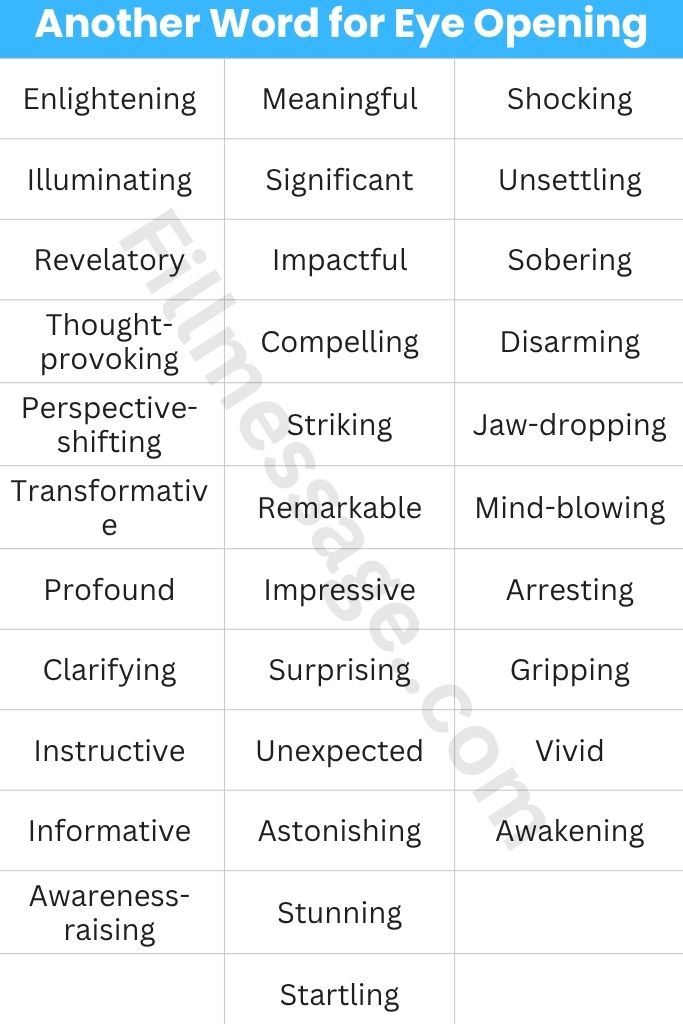
This guide gives you 33 real Another Word for Eye Opening, organized by tone and purpose, with enough context to actually make a choice. Not just a list you skim and forget.
What Eye-Opening Actually Means
It describes a moment, fact, or experience that shifts how someone understands something. The person knew something before. Now they know it differently, or more completely, or for the first time. The feeling sits between surprise and understanding. It is discovery with emotional weight.
All 33 Another Word for Eye Opening: Quick-Access Table
| Word | Tone | Best Used When |
| Enlightening | Warm, formal | Something teaches and improves understanding |
| Illuminating | Neutral, clear | A complex topic becomes easier to grasp |
| Revelatory | Strong, formal | A hidden truth gets exposed |
| Thought-provoking | Intellectual | It makes the reader think deeply |
| Perspective-shifting | Reflective | It changes how someone views a situation |
| Transformative | Deep, serious | It causes lasting personal change |
| Profound | Weighty, literary | The impact goes beneath the surface |
| Clarifying | Soft, helpful | Confusion becomes understanding |
| Instructive | Neutral | It teaches a direct and useful lesson |
| Informative | Plain | It delivers useful facts without drama |
| Awareness-raising | Purposeful | It draws attention to an overlooked issue |
| Meaningful | Warm | It carries personal or emotional value |
| Significant | Neutral, formal | It matters and deserves notice |
| Impactful | Strong | It creates a clear and lasting effect |
| Compelling | Persuasive | It pulls the reader in and holds attention |
| Striking | Moderate | It stands out and cannot be ignored |
| Remarkable | Positive | It goes beyond what was expected |
| Impressive | Positive | It earns genuine respect or admiration |
| Surprising | Light, neutral | The outcome was not expected |
| Unexpected | Neutral | It catches someone off guard |
| Astonishing | Bold | The reaction borders on disbelief |
| Stunning | Strong | It is impressive and slightly overwhelming |
| Startling | Abrupt | It arrives suddenly and demands attention |
| Shocking | Intense | It disturbs or alarms the reader |
| Unsettling | Dark, uneasy | It reveals something uncomfortable |
| Sobering | Grave | The truth is heavy and hard to ignore |
| Disarming | Soft, catching | It opens the reader through honesty or simplicity |
| Jaw-dropping | Very casual | The reaction is pure astonishment |
| Mind-blowing | Casual, expressive | The impact feels extreme |
| Arresting | Sharp, literary | It stops you completely and holds attention |
| Gripping | Visceral | You cannot look away or stop reading |
| Vivid | Sensory | The experience is sharp and memorable |
| Awakening | Conceptual | It marks a turning point in understanding |
Another Word for Eye Opening Grouped by What They Actually Do
Words That Expand Understanding (1–11)
These focus on the knowledge side of eye-opening. Something teaches. A view grows wider.
Enlightening, illuminating, revelatory, clarifying, instructive, informative, thought-provoking, awareness-raising, perspective-shifting, transformative, profound.
Use these when the discovery improves someone. The experience is not just surprising. It builds something in the reader or character.
Example: The lecture was illuminating. Not dramatic, not shocking. It simply untangled three years of confusion in forty minutes.
Example: Reading those case studies was perspective-shifting. The argument I had defended for months suddenly had a hole I could not explain away.
Words That Carry Emotional Weight (12–21)
These sit in the middle. They mix surprise with significance. The moment matters and it also feels something.
Meaningful, significant, impactful, compelling, striking, remarkable, impressive, surprising, unexpected, astonishing.
Use these when the experience has both information and feeling. A speech that changes a room. A photograph that changes an opinion.
Example: The results were striking. Not just statistically. Morally.
Example: Her comeback was unexpected, but what made it remarkable was how quietly she did it.
Words That Hit Hard or Disturb (22–30)
These are for moments that knock something loose. Discovery that is not comfortable. Truth that arrives like cold water.
Stunning, startling, shocking, unsettling, sobering, disarming, jaw-dropping, mind-blowing, arresting.
Use these when the discovery is not pleasant or when the force of the moment needs to be felt by the reader.
Example: The report was sobering. Not interesting. Not informative. It described a failure that everyone in the room had contributed to.
Example: The footage was unsettling precisely because it was so ordinary.
Eye Opening Words That Describe the Experience Itself (31–33)
Gripping, vivid, awakening.
These are slightly different. They describe how something feels to be inside the experience rather than what it produces.
Example: The memoir was gripping from page one, but the chapter about her mother felt like a genuine awakening.
Eye Opening synonyms Tone Intensity: Softest to Strongest
If you picture a volume dial, this is how these words sit:
Quietest: clarifying, informative, instructive, meaningful, surprising, unexpected
Middle range: enlightening, illuminating, striking, remarkable, significant, thought-provoking, compelling
Stronger: revelatory, transformative, profound, impactful, astonishing, stunning, startling
Loudest: shocking, jaw-dropping, mind-blowing, arresting, gripping
Match the volume to the moment. A research paper stays in the quiet to middle range. A personal narrative can move into stronger territory. A blog post or social caption can reach the loudest tier without it feeling out of place.
Read also: 26+ Another Term for Life Changing: Find the Right Word for Every Moment
Another Word for Eye Opening in Sentence Rewrites: Same Idea, Different Effect
Original: The documentary was eye-opening.
- Formal essay: The documentary offered a revelatory account of events that mainstream coverage had largely overlooked.
- Academic: The film provided an illuminating framework for examining media representation across different cultural contexts.
- Personal/narrative: I went in expecting a standard recap. I came out needing to sit quietly for a while. Some things you cannot unknow.
- Casual: That documentary genuinely floored me. I did not expect to care that much, and then suddenly I did.
Original: The statistics were eye-opening.
- Report/professional: Several findings proved striking, particularly the data points related to income disparity across rural regions.
- Journalism: The numbers were sobering. One in three respondents had never encountered the policy directly affecting their housing.
- Creative/narrative: The figures were quiet on the page. No drama, no emphasis. Just numbers that rewrote what I thought I understood.
- Casual: Those statistics? Genuinely jaw-dropping. Nobody expected those percentages to be that close.
Original: It was an eye-opening experience.
- Formal: The experience proved profoundly instructive, surfacing assumptions I had carried without examination.
- Personal: It changed something. Not loudly. The kind of change that only becomes obvious a few weeks later.
- Academic: The encounter functioned as a clarifying moment, repositioning how participants engaged with the broader theoretical debate.
- Casual: That whole week was mind-blowing in a way I still cannot fully describe.
Eye Opening synonyms For Essay Writing Specifically
Academic writing has its own rules. Some words on this list carry too much casual energy for a formal paper. Here is a clear breakdown:
Safe for essays: illuminating, revelatory, enlightening, thought-provoking, instructive, significant, clarifying, profound
Use with care in essays: striking, compelling, unexpected, meaningful
Avoid in formal essays: jaw-dropping, mind-blowing, mind-bending, gripping
Revelatory is a strong essay choice that not many writers use. It signals precision. It tells the reader that something was not just interesting but genuinely exposed a truth. That specificity reads well in academic contexts.
When the Discovery Is Not Good News
Eye-opening usually reads as positive. But sometimes what gets revealed is uncomfortable, damaging, or alarming. The word you choose should reflect that honestly.
| Feeling | Better Word |
| Heavy and hard | Sobering |
| Disturbing | Unsettling |
| Alarming | Startling or shocking |
| Uncomfortably honest | Disarming |
| Reveals a failure | Revealing, in a critical sense |
Using “enlightening” to describe something dark creates a tone mismatch. It sounds like you are thanking someone for bad news. Sobering or unsettling carries the honesty the moment needs.
Eye Opening Words That Look Similar but Are Not Interchangeable
Surprising vs. Startling
Surprising is mild. You did not expect it, but it passes. Startling is physical, almost like a jolt. Use startling when the moment arrives abruptly and shakes something loose.
Enlightening vs. Illuminating
Enlightening implies warmth and growth. It feels like wisdom arrived. Illuminating is more neutral. A dark room got brighter. In scientific writing, illuminating fits better. In personal reflection, enlightening feels more natural.
Profound vs. Transformative
Something can be profound without changing you. A thought can sit in your mind, deep and heavy, and still leave you exactly where you were. Transformative means something shifted. A belief changed. A behavior changed. They are not the same.
Astonishing vs. Remarkable
Astonishing pushes toward disbelief. The reaction crosses a line. Remarkable means it stood out clearly and deserves acknowledgment. A remarkable result is excellent. An astonishing one makes you question whether it is real.
Gripping vs. Compelling
Gripping is almost physical. You cannot put it down. Compelling is intellectual. The argument or story pulls you forward through logic or investment. A gripping thriller and a compelling argument both hold attention, but through completely different forces.
Eye Opening synonyms Related Words Worth Knowing
Revelation (noun): When you need to name the moment rather than describe it. “It was a revelation” carries the same meaning as “it was eye-opening” but feels more deliberate.
Awakening (noun/adjective): Slightly more internal. An awakening happens inside a person. It is eye-opening that leaves a permanent mark.
Discovery: More neutral and factual. Used when something was found rather than felt.
Insight: Narrower in scope. Insight is a specific understanding. Eye-opening is broader. A single insight can be part of a larger eye-opening experience.
Realization: The moment of understanding itself. Not the cause but the result. “The experience brought a realization” rather than “the experience was a realization.”
Read also:
27 Another Word for Campaign: Right Word, Right Context
36+ Another Word for Risk: Choose the Right One Every Time
FAQ’s
What is the best formal replacement for eye-opening in an essay?
Revelatory and illuminating are the two strongest choices. Revelatory works when something exposes a truth. Illuminating works when something adds clarity to a complex subject. Both read as precise and academic without sounding stiff.
Can eye-opening carry a negative meaning?
Technically yes, but in practice most readers read it as positive. If the discovery is uncomfortable, heavy, or alarming, sobering, unsettling, or startling will communicate the actual tone much more accurately. Using eye-opening for dark moments can feel accidentally cheerful.
What is the difference between enlightening and illuminating?
Enlightening carries warmth. It suggests wisdom and growth. Illuminating is more clinical. It simply means something made a topic easier to see or understand. In academic writing, illuminating is safer. In personal writing, enlightening feels more human.
Is mind-blowing appropriate in professional writing?
No. Mind-blowing belongs in casual and informal contexts: blogs, social media, conversational content. In professional reports, presentations, or academic papers, it can undermine an otherwise strong argument. Use impactful, significant, or striking instead.
Final Takeaway
Eye-opening is not a weak word. It just does not do enough work on its own anymore. After years of overuse, it has become background noise.
The 33 words in this guide each do something slightly different. Revelatory exposes. Sobering weighs. Arresting stops. Disarming catches off guard. Transformative changes.
Your job is to find the one that matches what actually happened in your sentence. The right word does not just replace eye-opening. It makes the sentence sharper, more honest, and more memorable than it was before.

Marco Jr. is Author at fillmassage.com,
He explores the world of words and their meanings, helping readers understand language clearly. Passionate about explanations that guide and inform, he creates insightful content that educates, engages, and supports curious minds every day.