You know the feeling: you write “life-changing,” read the sentence again, and it feels weaker than the moment you are trying to describe. The word is correct, but it has become so common that it often loses its impact.
Finding the right Another Term for Life Changing depends on what actually happened. Was it a positive breakthrough, a painful loss, or a moment that changed your direction?
This guide helps you choose words that sound natural, match your meaning, and make your writing more honest. You’ll find options for personal stories, professional writing, and everyday conversations.
What the Word Really Carries
“Life-changing” points to something that genuinely shifts the direction or quality of a person’s life. The before and after look different. That’s the core idea.
But here’s what most synonym lists miss: the word is tonally neutral by definition, yet writers almost always use it positively. That gap causes real problems when the change you’re describing was painful, messy, or complicated.
The right replacement depends on three things: the direction of the change (good, bad, or mixed), the formality of your writing, and how much emotional weight you want to carry.
26+ Another Term for Life Changing: Full Reference Table
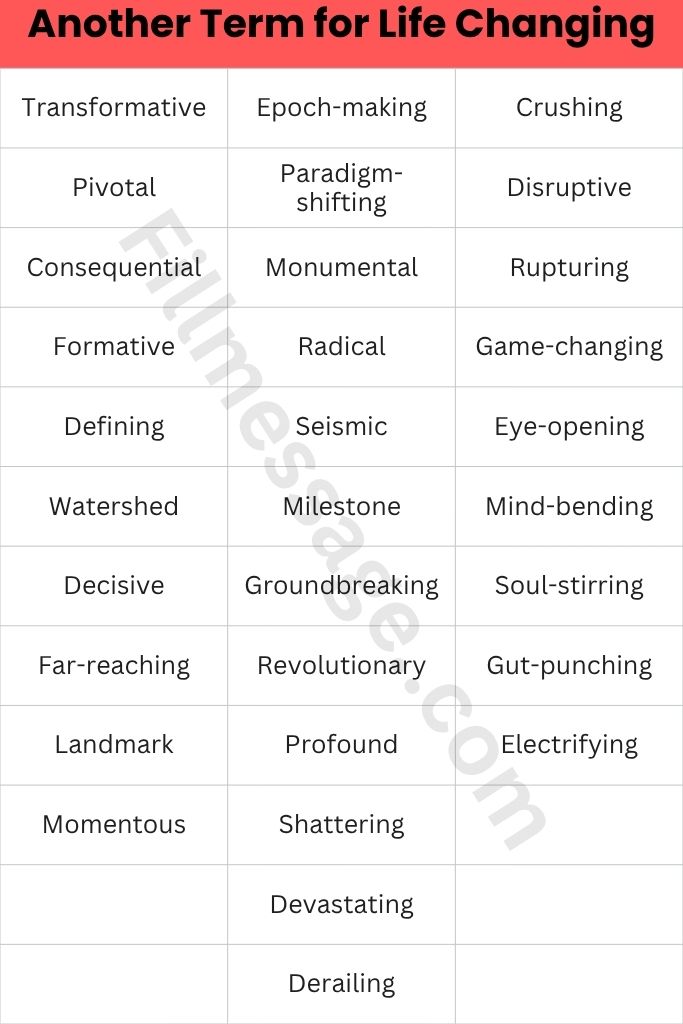
| Word/Phrase | Tone | Best Used When |
| Transformative | Positive / Neutral | Deep personal growth or healing |
| Pivotal | Neutral | A clear turning-point moment |
| Consequential | Neutral | Effects matter more than feelings |
| Formative | Neutral | Experiences that shaped who you became |
| Defining | Neutral | Captures identity or direction |
| Watershed | Neutral | A before-and-after dividing line |
| Decisive | Neutral | A moment that locked in a direction |
| Far-reaching | Neutral | Effects that spread wide and last long |
| Landmark | Positive / Neutral | Recognized, significant turning point |
| Momentous | Formal / Positive | Major events with lasting importance |
| Epoch-making | Formal | Large-scale or historical significance |
| Paradigm-shifting | Formal | Changes how entire systems are understood |
| Monumental | Formal / Positive | Scale and weight, often public or historical |
| Radical | Neutral / Strong | Root-level, fundamental change |
| Seismic | Strong / Neutral | Massive, unexpected shift |
| Milestone | Positive | Marker of progress or achievement |
| Groundbreaking | Positive | First of its kind, new territory |
| Revolutionary | Positive / Neutral | Breaks sharply from the old way |
| Profound | Positive / Neutral | Deep, meaningful, lasting impact |
| Shattering | Negative | Change that breaks something apart |
| Devastating | Negative | Painful change with lasting loss |
| Derailing | Negative | Knocked plans or life off course |
| Crushing | Negative | Change driven by loss or grief |
| Disruptive | Negative / Neutral | Breaks the current pattern or system |
| Rupturing | Negative | Sudden, damaging break from what was |
| Game-changing | Casual / Positive | Major practical shift, informal writing |
| Eye-opening | Casual / Positive | Changed how someone sees something |
| Mind-bending | Casual | Surprise-driven shift in understanding |
| Soul-stirring | Emotional / Positive | Deep emotional or spiritual impact |
| Gut-punching | Casual / Negative | A painful moment that hits hard emotionally |
| Electrifying | Casual / Positive | Exciting, high-energy positive shift |
That’s 31 options. Now here’s how to actually choose between them.
Another Term for Life Changing Meaning Clusters: Group by Purpose, Not Alphabet
Deep Change at the Root Level
Transformative, radical, paradigm-shifting, seismic, revolutionary
These words say something changed at the foundation, not just on the surface. The way a person thinks, operates, or sees the world shifted. Use them when a surface-level synonym would feel dishonest.
“The fellowship wasn’t an opportunity. It was transformative in ways she’s still processing three years later.”
Turning-Point Moments
Pivotal, watershed, decisive, defining, formative
These point to a specific moment or period in time. A line in the story. Before this, one path. After it, another. They work well in personal essays, career writing, and narrative storytelling.
“That failed launch turned out to be the watershed moment that pushed the whole team to rethink everything.”
Formal Significance
Momentous, consequential, far-reaching, landmark, epoch-making, monumental
Calmer and more measured. These say the event mattered, and its effects didn’t fade quickly. Strong for journalism, academic writing, professional reports, and anything where emotional language would weaken credibility.
“The merger was consequential in ways the analysts hadn’t fully modeled.”
Painful or Negative Change
Shattering, devastating, derailing, crushing, disruptive, rupturing
Writers often soften painful change with neutral words out of habit. It weakens the writing. When something genuinely broke a person’s life apart, use a word that doesn’t flinch.
“The diagnosis was shattering. Not just medically. It changed how she thought about every future plan she had made.”
Casual and Conversational
Game-changing, eye-opening, mind-bending, gut-punching, electrifying, soul-stirring
Punchy, human, and direct. These belong in blog posts, personal essays, social content, and emails between people who know each other. Drop them the moment your writing turns formal.
“That documentary was genuinely eye-opening. Changed the way I think about food completely.”
Another Term for Life Changing Sentence Rewrites: Same Idea, Four Different Results
Base sentence: “Moving abroad was a life-changing experience.”
Formal: “Relocating internationally proved to be a formative period that reshaped both her professional perspective and personal priorities.”
Casual: “Moving abroad cracked her worldview wide open. She came back a different person.”
Academic: “International relocation functions as a consequential developmental experience, often producing lasting shifts in identity and cultural perspective.”
Narrative/creative: “She packed two suitcases and left. What came back, three years later, barely resembled the person who left.”
Each version carries the same core truth. But they land differently, create different trust levels, and suit different readers. That’s the entire point of choosing carefully.
Base sentence: “Losing the business was life-changing.”
Honest/emotional: “Losing the business was crushing. It didn’t just cost money. It cost the version of himself he thought he was building.”
Professional: “The collapse proved to be a decisive turning point, redirecting both his financial strategy and long-term career path.”
Narrative: “Nothing before or after that day belonged in the same category. It was defining in the hardest possible way.”
Another Term for Life Changing Positive vs. Negative
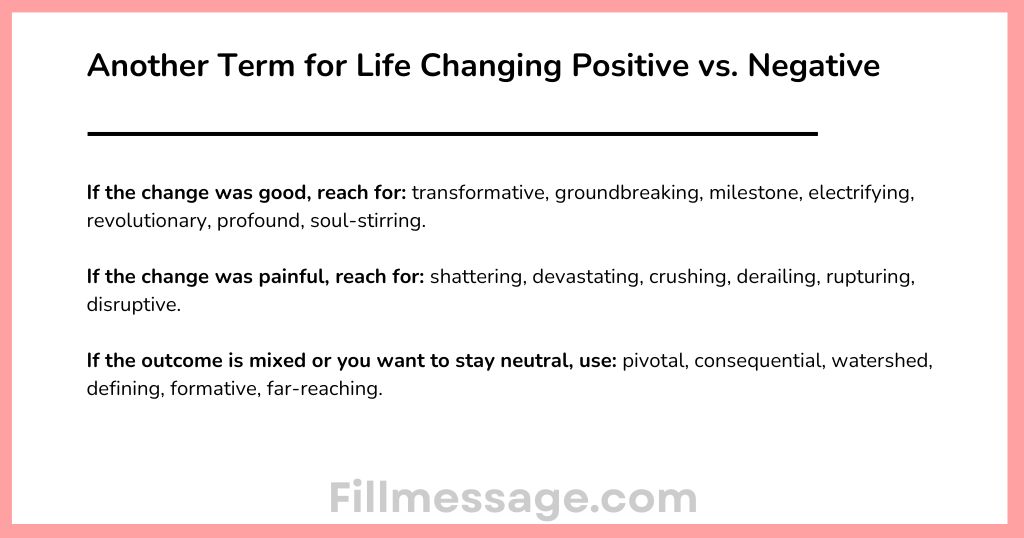
This is the most practical question to ask before choosing your word.
If the change was good, reach for: transformative, groundbreaking, milestone, electrifying, revolutionary, profound, soul-stirring.
If the change was painful, reach for: shattering, devastating, crushing, derailing, rupturing, disruptive.
If the outcome is mixed or you want to stay neutral, use: pivotal, consequential, watershed, defining, formative, far-reaching.
Forcing a positive word onto a painful story feels dishonest to readers. Forcing a negative word onto a hopeful moment undercuts it. Neutral words give you control without committing to either.
Grammar: The One-Word-or-Two Question
Plenty of searches ask whether “life changing” is one word, two words, or hyphenated. Here’s the clean answer.
Hyphenate it before a noun: a life-changing decision.
No hyphen after a verb: The decision was life changing.
This same rule applies to most compound adjectives in English, including many of these alternatives. A game-changing idea. The idea was game changing. Consistent and simple once you know it.
Mistakes That Quietly Weaken Your Writing
Stretching “transformative” onto small things. If someone started journaling twice a week, that’s a good habit, not a transformative shift. Overuse kills the word’s power fast.
Swapping “devastating” for “disappointing.” Devastating implies lasting loss that echoes through a person’s life. Disappointment fades. They are not the same, and using them interchangeably signals careless writing.
Using “game-changing” in formal writing. In a research paper, business proposal, or professional report, it undercuts your tone immediately. Switch to consequential or far-reaching.
Assuming all these words are interchangeable. They’re not. Pivotal marks a turning point. Profound marks depth of impact. Momentous marks scale. Each one is doing a specific job.
Defaulting to “life-changing” in academic contexts. It reads as vague and casual. Formal writing deserves more precision.
Another Term for Life Changing Related Words Worth Keeping Nearby
Significant is broader and milder. It says something mattered without claiming life-level impact. Use it when the importance is real but the scale is smaller.
Meaningful focuses on emotional resonance rather than scale. A conversation can be meaningful without being seismic.
Impactful has become overused in professional settings, similar to how “life-changing” wore out in everyday speech. Still correct, just tired.
Formative is genuinely underused. It works especially well for childhood, early career, and identity-shaping periods. It carries no false positivity and reads as thoughtful.
Monumental leans toward public or historical scale. Better for events that affected many people than for personal moments.
Read more:
32+ Another Word for Changeover: Precise Synonyms for Every Context
29+ Another Word for Humility: Synonyms That Actually Fit Your Writing
FAQ’s about Another Term for Life Changing
What single word can replace “life-changing” in almost any context?
Pivotal is the safest all-purpose option. It stays neutral, signals importance, marks a turning point, and works across formal, casual, and creative writing without sounding forced.
Can I use “transformative” for a painful experience?
Yes. Transformative means deep change, not good change. A loss, illness, or failure can be transformative. If you want the reader to understand it was difficult, build that context around the word rather than switching to something weaker.
Is “life-altering” the same as “life-changing”?
Almost, but not quite. “Life-altering” tends to feel more clinical and measured. You’ll see it often in medical, legal, and psychological writing. “Life-changing” feels more personal and everyday. The distinction is subtle but worth knowing in formal contexts.
When should I avoid synonyms entirely?
When you can show the change instead of naming it. “She walked in uncertain and walked out like someone who finally knew” does more work than “it was a transformative experience.” The right synonym earns its place when context has already been built.
The Practical Takeaway
“Life-changing” isn’t a bad word. It’s an overexposed one. When everything is life-changing, nothing is.
Before you reach for a replacement, ask three questions: Was the change positive, negative, or neutral? How formal is this piece of writing? How much emotional weight does this moment actually deserve?
Answer those honestly and the right word becomes obvious. Consequential for measured formal weight. Shattering for real pain. Pivotal when you want neutrality with significance. Transformative when growth is the honest story.
Pick the word that earns the moment. Everything else follows.

Marco Jr. is Author at fillmassage.com,
He explores the world of words and their meanings, helping readers understand language clearly. Passionate about explanations that guide and inform, he creates insightful content that educates, engages, and supports curious minds every day.