You have written the word “campaign” three times in two paragraphs. You notice it. Your reader notices it too. But finding the right replacement is not as simple as grabbing the first synonym you find. Campaign covers elections, charity drives, military history, and Instagram ads. One word doing four jobs means one replacement word will not always work.
This guide gives you all 27 Another Word for Campaign, grouped by meaning, with tone guidance and real rewrite examples so you leave knowing exactly which word fits where.
What “Campaign” Really Means
A campaign is an organized, goal-directed effort that unfolds over time. It is not a single action. It implies planning, direction, and momentum toward a defined outcome. The tone is neutral by default. Context does all the shifting. A military campaign feels heavy. A social media campaign feels light. A charity campaign feels hopeful. Same word, completely different weight.
Quick-Access Another Word for Campaign Table
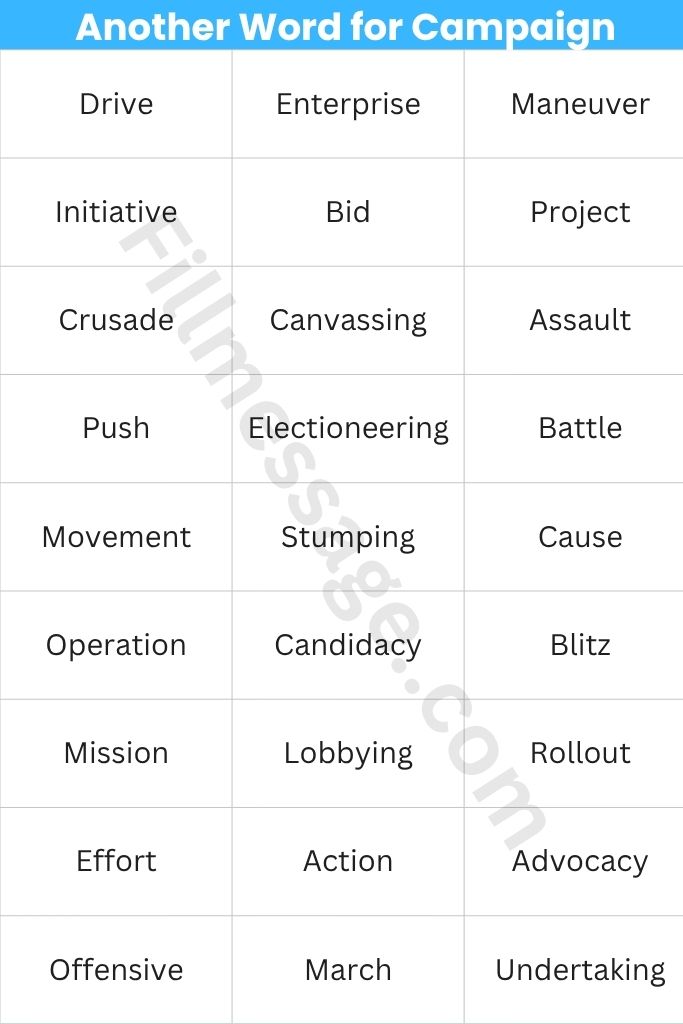
| Word | Tone | Best Used When |
| Drive | Energetic, focused | A short, purposeful push toward a goal |
| Initiative | Formal, deliberate | Planned organizational or policy efforts |
| Crusade | Passionate, intense | Fighting for a deeply held belief |
| Push | Informal, urgent | A temporary burst of concentrated effort |
| Movement | Collective, emotional | People organizing around shared values |
| Operation | Structured, precise | Military or coordinated tactical action |
| Mission | Idealistic, purposeful | A values-led effort with clear intent |
| Effort | Neutral, general | Any attempt without heavy structure |
| Offensive | Aggressive, forceful | Military advance or bold business action |
| Enterprise | Ambitious, large-scale | A significant organized undertaking |
| Bid | Competitive, targeted | An attempt to win or secure something specific |
| Canvassing | Political, direct | Gathering votes or opinions in person |
| Electioneering | Political, formal | Activities specifically aimed at winning elections |
| Stumping | Political, informal | Travel-based speech-making for voter support |
| Candidacy | Political, factual | The status of being an election contender |
| Lobbying | Political, persuasive | Influencing decision-makers directly |
| Action | Broad, active | Any organized step moving toward a goal |
| March | Determined, forward | A steady advance, literal or figurative |
| Maneuver | Strategic, calculated | A careful tactical move in any field |
| Project | Neutral, structured | A defined plan with scope and deadline |
| Assault | Aggressive, concentrated | A focused attack or high-pressure push |
| Battle | Struggle-focused | Effort involving clear resistance or conflict |
| Cause | Values-driven | An ongoing belief or principle being championed |
| Blitz | Fast, intense | A short, concentrated burst of activity |
| Rollout | Corporate, modern | Launching something in planned stages |
| Advocacy | Supportive, rights-focused | Speaking up systematically for a group or issue |
| Undertaking | Formal, serious | A complex, planned task requiring commitment |
Another Word for Campaign Grouped by Context: Where Each Word Actually Belongs
Political Campaigns synonyms: Six Words That Split One Big Idea
The word “campaign” in politics usually tries to cover everything at once: the announcement, the travel, the speeches, the door-knocking, the fundraising. Breaking it into parts gives your writing more precision.
Candidacy (15) is the state of being a contender. You announce your candidacy. It refers to the position itself, not the activity around it.
Electioneering (13) covers the active work of winning votes. It carries a slightly formal, old-world flavor. Journalists and historians use it comfortably.
Canvassing (12) means the direct, person-to-person work: knocking on doors, making phone calls, gathering signatures. It is one piece of a campaign, not a replacement for the whole thing.
Stumping (14) comes from 19th-century American politics, when candidates spoke from tree stumps at town gatherings. Today it describes travel-based speech-making. Informal, but widely understood.
Lobbying (16) is narrower. It targets decision-makers specifically, not the general public. A campaign reaches voters. Lobbying reaches lawmakers.
Candidature sits close to candidacy. It is the more formal version used in British English and international political writing. Same core meaning, slightly more elevated register.
If you write about politics regularly, these six alone will sharpen your copy more than any general synonym list.
Military Campaign synonyms Context: Five Words With Real Distinctions
Operation (6) is the cleanest modern replacement for a military campaign. It sounds planned, coordinated, and professional. Armed forces and journalists covering conflict both reach for this word naturally.
Offensive (9) refers to the attacking side of a military effort. It carries urgency and force. Do not use it casually unless you want that aggressive energy to transfer to your reader.
Maneuver (19) suggests cleverness over force. It implies strategic thinking, movement, and adaptation. A general who maneuvers is outthinking the enemy, not just overpowering them.
Assault (21) is concentrated and time-limited. It describes a specific, intense attack rather than a prolonged effort. In military writing it is precise. Outside that context, use it with care.
March (18) works best in historical military writing where physical troop movement is literal. In modern or figurative writing, it describes a steady, determined advance toward something.
Marketing and Business Campaign synonyms: Six Alternatives That Fit Modern Work
This is where “campaign” gets overused the worst. Every email series, product launch, and promotional post becomes a campaign. The word stops meaning anything specific.
Drive (1) is the most versatile replacement here. It keeps the energy and focus of campaign without the political or military baggage. A summer drive, a membership drive, a safety drive. All natural.
Rollout (25) works specifically for launches happening in stages. A product rollout, a feature rollout, a policy rollout. It signals careful sequencing, which campaign does not.
Blitz (24) suggests intensity over duration. Short, fast, concentrated. An advertising blitz runs for two weeks and hits hard. A campaign runs for three months and builds steadily.
Initiative (2) lifts the tone. It sounds deliberate, strategic, and executive-level. Use it in reports, proposals, and professional communications where “campaign” might sound too informal or sales-heavy.
Push (4) is the informal counterpart to initiative. Use it in internal conversations, casual content, or spoken contexts. It sounds energetic without being dramatic.
Project (20) works when the effort has a defined scope, clear deliverables, and a deadline. Unlike a campaign, a project implies structure and accountability. It fits corporate environments well.
Social and Charitable Work Campaign synonyms: Four Words With Heart
Crusade (3) carries genuine emotional weight. It signals that the person believes in the cause deeply enough to fight for it. Use it when the stakes are high and the passion is real. Overuse makes it hollow.
Movement (5) is broader than a campaign. It involves many people, builds over time, and rarely has a clean endpoint. A campaign is something you run. A movement is something you join.
Cause (23) is not a direct action word but it captures the reason behind the effort. You can reference someone’s cause as a way of describing the campaign without repeating the word.
Advocacy (26) applies when the goal is to represent and speak for a specific group or issue systematically. Common in healthcare, legal, and nonprofit writing. It implies ongoing commitment, not a single push.
General-Purpose Alternatives: Words That Cross Contexts
Mission (7) carries idealism and direction. It works in nonprofit, military, and corporate writing alike. A mission implies values, not just tactics.
Effort (8) is the most neutral word on this list. It does not suggest scale, duration, or structure. Use it to downplay something or when specifics do not matter yet.
Enterprise (10) signals scale and ambition. It is better suited to large, complex efforts than small ones. You would not call a week-long fundraiser an enterprise.
Bid (11) adds competition. It implies someone is trying to win something against others. An election bid, a takeover bid, a bid for public trust.
Action (17) is broad and energetic. It works when the emphasis is on doing rather than planning. Collective action, coordinated action, immediate action.
Battle (22) implies resistance. Something or someone is pushing back. Use it when the effort faces clear opposition, not just challenges.
Undertaking (27) is formal and weighty. It signals that what follows requires serious commitment. It works in legal, academic, and official writing where campaign might sound too casual.
Read also: 38+ Another Word for Proud: Choose the Right One Every Time
Another Word for Campaign in Sentence Rewrites: The Same Idea, Four Different Feels
Original: The organization ran a campaign to reduce food packaging waste.
- Formal: The organization launched a structured initiative to reduce food packaging waste.
- Casual: The organization kicked off a big push against wasteful food packaging.
- Creative: The organization threw itself into a crusade against packaging that nobody needed.
- Academic: The organization undertook a coordinated effort to address waste generated by food packaging.
Notice how “initiative” implies a boardroom approved it. “Push” sounds like it started Monday. “Crusade” signals belief. “Effort” stays completely neutral.
Original: The senator ran a campaign across rural districts.
- News writing: The senator launched a statewide drive through rural districts.
- Political analysis: The senator’s electioneering focused heavily on rural constituencies.
- Historical writing: The senator’s canvassing of rural districts proved decisive.
Original: The army launched a campaign in the northern region.
- Military report: The army launched a coordinated operation across the northern region.
- Fiction: He ordered a sweeping offensive that would push through the north before winter.
- Historical: The general’s march through the northern territories took six weeks.
Common Mistakes Writers Make With Campaign synonyms
Using “war” as a synonym. It is listed in many synonym tools. It is not accurate. A campaign is one effort within a war. Calling a marketing strategy a “war” is dramatic, almost always unintentionally.
Using “effort” when you need specificity. Effort is too vague for formal writing. It does not signal scale, intent, or duration. A grant proposal that calls something an “effort” sounds underprepared.
Treating “assault” as neutral. Outside military and sports writing, assault carries connotations of violence or alarm. A “customer retention assault” would puzzle most professional readers.
Assuming “movement” and “campaign” are the same. A campaign has a goal and a timeline. A movement is broader, longer, and often leaderless. Civil rights was a movement. A voter registration weekend was a campaign inside it.
Swapping “project” when you need momentum. A project has a scope document. A campaign has urgency and passion. Using project in place of campaign flattens the emotional energy of what you are describing.
Campaign synonyms Related Words That Often Appear Nearby
These are not campaign synonyms, but they appear frequently in the same writing context.
Strategy is the plan that sits behind a campaign. You design a strategy, then execute a campaign.
Agenda is a list of goals, often with political meaning. Narrower than a campaign, and more structured.
Outreach describes the act of making contact with people, usually in nonprofit or marketing work. It is part of a campaign, not the campaign itself.
Propaganda is content produced in service of a campaign, often with a manipulative intent. It has a negative charge and should never be used neutrally.
Read more:
41 Another Word for Deeper: The Right Word for Every Context
37+ Another Word for Saddest: Better Words for Different Kinds of Sadness
FAQ’s
Can “drive” replace “campaign” in a professional email?
Almost always yes. A membership drive, a safety drive, or a recruitment drive all sound natural and professional. It also feels more action-focused than campaign, which can sound like it needs a committee behind it.
Is “crusade” too strong for nonprofit writing?
Match it to the emotional stakes. For human rights or environmental justice work, crusade fits. For a local bake sale fundraiser, it is too heavy. The word should reflect the real intensity of the work.
When is “movement” wrong and “campaign” right?
Use campaign when there is a defined goal, a timeline, and measurable outcomes. Use movement when the effort is collective, ongoing, and not controlled by a single organization.
When should you just keep “campaign” and not replace it?
When your audience expects the word. Political journalists, advertising professionals, and military historians use campaign precisely because it carries shared meaning in their fields. Replacing it with something unusual might confuse more than it clarifies.
The Practical Takeaway
Before you swap “campaign” for anything on this list, identify which version of the word you are actually using. Is it political? Military? Commercial? Charitable? That answer narrows your real choices from 27 down to five or six.
Then ask what signal you want to send. “Initiative” tells readers someone planned this carefully. “Crusade” tells them someone believes in it. “Blitz” tells them it will be fast and intense. “Movement” tells them others are already involved.
The best synonym is not the most impressive one. It is the one that makes your reader feel exactly what you intended, without them stopping to notice the word choice at all.

Marco Jr. is Author at fillmassage.com,
He explores the world of words and their meanings, helping readers understand language clearly. Passionate about explanations that guide and inform, he creates insightful content that educates, engages, and supports curious minds every day.