Most people never question the word “proud.” It shows up in graduation speeches, birthday cards, text messages, and journal entries without a second thought. But here’s the thing: proud is doing a lot of heavy lifting for a word with so many different emotional directions.
Sometimes it means deep personal satisfaction. Sometimes it’s warm admiration for someone else. And sometimes, depending on how it lands, it sounds uncomfortably close to arrogance. That gap between meanings is exactly where word choice gets interesting, and where the right synonym can completely change how your sentence feels.
This guide gives you 38+ real alternatives, organized by meaning so you can actually use them.
What Makes “Proud” Complicated
The word sits at a crossroads. It can be generous or self-serving, quiet or loud, sincere or smug. A father watching his daughter cross a stage and a person bragging about their salary can both technically be described as “proud.” That range is what makes it slippery.
Before picking a replacement, decide which version of proud you actually mean:
- Warm pride directed at someone else
- Personal satisfaction in your own achievement
- Quiet dignity and self-respect
- Negative pride: arrogance, vanity, smugness
Each cluster needs different words.
The Full Another Word for Proud: 38+ Options
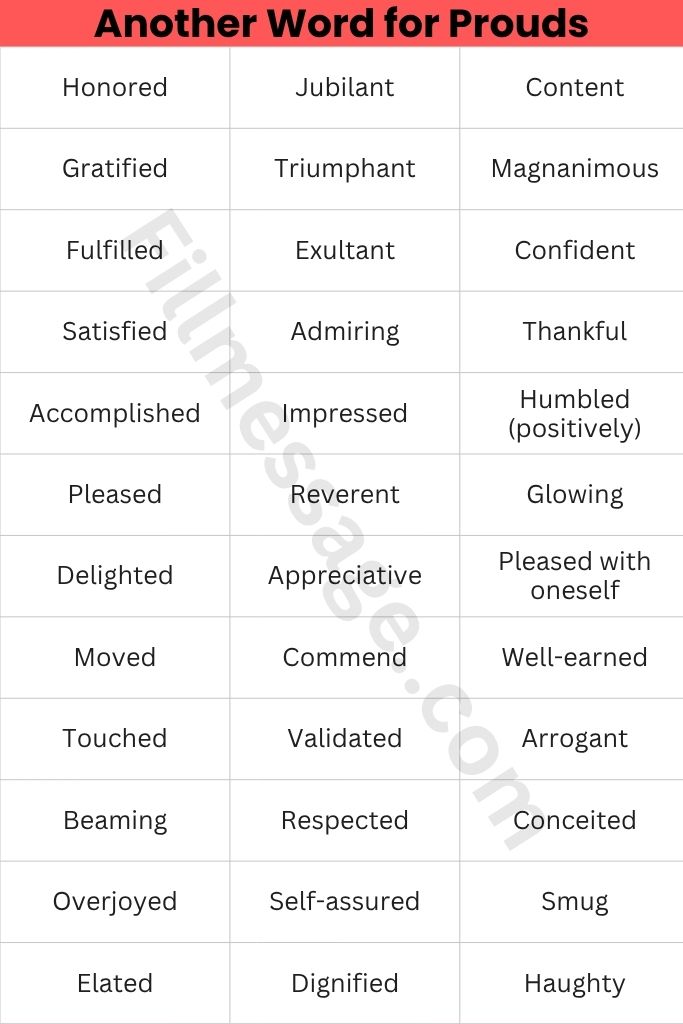
| Word / Phrase | Tone | Best Used When |
| Honored | Warm, sincere | An achievement touches you personally |
| Gratified | Reflective, calm | Your effort produced something meaningful |
| Fulfilled | Deep, emotional | A long personal goal finally reached |
| Satisfied | Grounded, steady | Quiet contentment after completing something |
| Accomplished | Confident, forward | Describing personal growth or success |
| Pleased | Gentle, positive | Mild but genuine approval |
| Delighted | Warm, joyful | Celebrating someone else’s win genuinely |
| Moved | Tender, heartfelt | An achievement touched you emotionally |
| Touched | Soft, personal | A quiet emotional response to someone’s effort |
| Beaming | Visual, radiant | That visible, undeniable joy on someone’s face |
| Overjoyed | Bright, emotional | Pure happiness in response to great news |
| Elated | Energetic, high | Overwhelming joy about an achievement |
| Jubilant | Celebratory, full | Major wins worth full celebration |
| Triumphant | Bold, victorious | Overcoming something genuinely difficult |
| Exultant | Intense, joyful burst | Bursting pride after a hard-fought victory |
| Admiring | Respectful, outward | You genuinely respect what someone else did |
| Impressed | Responsive, genuine | Someone surprised you in the best way |
| Reverent | Deep, near-sacred | Awe-filled respect for an extraordinary act |
| Appreciative | Gracious, warm | You value deeply what someone did or became |
| Commend | Formal, approving | Recognizing work in a professional setting |
| Validated | Personal, relieved | Your effort or worth has finally been seen |
| Respected | Relational | Your value has been acknowledged by others |
| Self-assured | Quiet confidence | Healthy belief in your own abilities |
| Dignified | Composed, reserved | Carrying yourself with quiet self-respect |
| Content | Gentle, peaceful | Soft satisfaction in being enough |
| Magnanimous | Noble, generous | Proud but gracious, giving credit openly |
| Confident | Neutral to positive | Belief in your skills without showing off |
| Thankful | Outward, gracious | Directing credit away from yourself |
| Humbled (positively) | Sincere, grounded | Proud but softened by genuine modesty |
| Glowing | Warm, expressive | Radiating visible happiness about something |
| Pleased with oneself | Casual, personal | Quiet internal satisfaction, nothing showy |
| Well-earned | Affirming | Acknowledging that success was deserved |
| Arrogant | Negative, critical | Believing yourself better than everyone else |
| Conceited | Negative, irritating | Excessive self-admiration that alienates others |
| Smug | Negative, quiet | Irritating self-satisfaction, usually subtle |
| Haughty | Negative, cold | Looking down on others with visible disdain |
| Vain | Negative, shallow | Obsessed with image, reputation, or appearance |
| Boastful | Negative, loud | Showing off in ways that make others uncomfortable |
| Puffed up | Negative, informal | Inflated ego, often used with mild humor |
| Self-important | Negative, formal-ish | Taking oneself far too seriously |
Proud Synonym Meaning Clusters: Which Group Do You Need?
Another Word for Proud of Someone Else
This is the most searched version. You want to express genuine admiration without accidentally sounding like you’re grading someone.
“Proud of you” is fine between a parent and child. But between friends, colleagues, or equals, it can carry an unintended hierarchy. You become the judge. They become the one being evaluated.
These alternatives shift that dynamic:
- Moved by what you did centers their action, not your approval.
- Deeply impressed keeps attention on their achievement.
- I admire what you’ve become speaks to character, not performance.
- Watching you get here genuinely touched me removes evaluation entirely.
For proud parents specifically, words like beaming, overjoyed, and glowing show the emotion physically rather than just naming it. That almost always reads better.
For proud of someone in a professional context, commend, appreciate, and respect all carry weight without feeling too personal.
Another Word for Proud of Yourself
This is where word choice gets subtle. Saying “I’m proud of myself” is healthy. But some alternatives communicate the feeling with more precision.
- Accomplished names what happened.
- Fulfilled says something deeper was completed.
- Satisfied with my progress stays grounded and honest.
- I earned this is clean, direct, and carries no arrogance.
For a proud moment in a speech or story, “milestone,” “defining point,” or “hard-won achievement” all outperform the phrase. They give the reader something specific to picture.
Quiet, Dignified Pride
Sometimes proud isn’t about an achievement at all. It’s about how someone carries themselves. That version needs different words entirely.
Dignified, self-assured, composed, and poised all capture the sense of inner steadiness that proud sometimes points toward. These work especially well in character descriptions or when writing about someone who handles success with real grace.
Magnanimous belongs here too. It’s the word for a person who wins without shrinking others. That’s a very specific, admirable kind of pride, and it rarely gets named accurately.
Negative Pride
Arrogant, conceited, smug, haughty, vain, boastful, puffed up, and self-important all describe pride as a flaw. They are not interchangeable; each has its own flavor.
Smug is quieter than boastful. Haughty implies looking down at people. Conceited tends to be more about self-image. Arrogant is the broadest and strongest of the group.
Use these only when criticism is your actual intention. One wrong choice here and your meaning flips entirely.
Another Word for Proud Sentence Rewrites: Same Feeling, Sharper Words
Original: I’m proud of you.
- Heartfelt message: What you did took real courage, and watching you do it moved me more than I expected.
- Between equals: That was genuinely impressive. You earned every bit of it.
- Professional note: I want to formally acknowledge the quality of your work here. It reflects serious dedication.
- Creative writing: She didn’t say proud. She just looked at him the way people do when words fall short.
Original: She was proud of her work.
- Formal: She held her work in high regard, and rightly so.
- Casual: She knew it was good. That feeling settled in quietly.
- Academic: Her sense of professional accomplishment was grounded in measurable effort.
- Narrative: Something in her shoulders changed when she read it back. It was hers, and it was right.
Original: His parents were proud.
- Understated: His parents stood a little straighter the moment his name was called.
- Direct emotion: They were overjoyed in the way only years of hoping can produce.
- Simple and human: His parents beamed. They didn’t need to say a word.
Each of these rewrites does something the original doesn’t. It gives the reader a feeling rather than just a label.
Another Word for Proud Formal vs. Informal: Placement Matters
In professional emails, reports, or recommendations: Honored, gratified, commend, accomplished, respected, and self-assured all fit. They hold authority without sounding emotional in a way that undermines the message.
Skip: beaming, touched, moved, glowing. Real feelings, wrong setting.
In personal messages, cards, or speeches: Beaming, moved, delighted, overjoyed, touched, and admiring all carry warmth. They breathe. They feel personal because they are.
Skip: gratified, commend, dignified. Technically accurate but oddly stiff in emotional contexts.
In creative writing and storytelling: The strongest move is usually to show pride through behavior rather than naming it. But when you need the direct word, try: triumphant, fulfilled, exultant, validated, or glowing. Each one is more specific than “proud” and carries its own visual energy.
Mistakes That Are Easy to Make
Swapping “confident” for “proud.” They’re related but not the same. Confidence is about belief in ability. Pride is about response to achievement or connection. “She felt confident about her son finishing medical school” loses all the emotional warmth. It needs “moved” or “overjoyed” instead.
Using “humble” as a simple antonym. Humble is the opposite of arrogant pride, but not the opposite of warm, satisfied pride. You can genuinely be both proud and humble at the same time. They aren’t enemies. “Humbly proud” or “quietly honored” captures that mix accurately.
Making “proud of you” sound like evaluation. This is subtle but worth noticing. Between equals, saying “I’m proud of you” positions you as the one granting approval. If that’s not the dynamic you want, choose language that centers what they did: “what you achieved here is remarkable” keeps the focus where it belongs.
Using “accomplished” too often. It’s a strong word that loses power quickly with repetition. Rotate it with fulfilled, gratified, or satisfied depending on the emotional texture of the moment.
Choosing a negative synonym by accident. This is the biggest category error. Smug, haughty, and conceited are synonyms for a type of proud, but they are insults, not compliments. If your sentence is meant to be warm, none of these belong anywhere near it.
Proud Synonym Related Words Worth Distinguishing
Validation captures pride that comes specifically after being doubted. It’s satisfaction with a specific history behind it. Much more precise than “proud” when that history matters.
Reverence is a step beyond admiration. It suggests something almost extraordinary about what was witnessed. Save it for moments that genuinely deserve that weight.
Exultant is joy at full volume after a real struggle. More intense than elated. Best for writing about hard-fought victories, not everyday wins.
Magnanimous is pride at its most generous. A person who succeeds and immediately shares the credit. It’s rare enough to be worth naming precisely when you see it.
Poise sits near dignified pride but specifically describes how it looks from the outside, how someone carries themselves under pressure or in the spotlight.
Read more:
26+ Words for Another World: Synonyms, Tones, and How to Use Them Right
26+ Another Word for Meticulous: Real Alternatives That Actually Fit
41+ Another Word for On Time: Real Alternatives That Actually Fit
FAQ’s about Proud Synonym
Is there a word for proud that doesn’t feel parental?
Yes. Admiring, moved by, and impressed by all shift the dynamic. They describe your emotional response rather than placing you as the evaluator of someone else’s performance. These work between equals without the hierarchy that “proud of you” sometimes implies.
What’s the real difference between fulfilled and satisfied?
Satisfied means something went the way you hoped. Fulfilled means something deeper in you was completed, usually tied to a long personal goal or a core value. Fulfilled carries more emotional weight. Use it for the moments that actually changed something in you.
What is the opposite of proud?
It depends on which version of proud you mean. The opposite of arrogant pride is humble or modest. The opposite of healthy, warm pride is ashamed, deflated, or disappointed. Using the wrong antonym can completely reverse your intended meaning, so check which direction your sentence is pointing first.
What’s a better way to say “proud moment”?
“Milestone” works in professional and formal writing. “Defining moment” works in speeches and personal essays. “A hard-won achievement” adds texture and effort. “A moment worth remembering” works when the tone is reflective rather than triumphant. Each one says something more specific than “proud moment,” which tends to blur together in any kind of writing.
The Practical Takeaway
“Proud” isn’t a bad word. It just rarely needs to be the only one.
When you’re writing to or about someone else, ask whether you want to sound approving or genuinely moved. One creates distance. The other closes it.
When you’re writing about yourself, decide whether the feeling is quiet satisfaction or deep fulfillment. They live in different places emotionally.
When the pride is negative, name it exactly: smug, arrogant, haughty, or conceited all do different work. Pick the one that matches the character, not just the category.
The right word doesn’t just replace “proud.” It makes the sentence say what you actually meant.

Marco Jr. is Author at fillmassage.com,
He explores the world of words and their meanings, helping readers understand language clearly. Passionate about explanations that guide and inform, he creates insightful content that educates, engages, and supports curious minds every day.