You typed “speech” again. Third time in two paragraphs. You know it sounds repetitive, but nothing else feels quite right. Talk? Address? Presentation? They all mean something slightly different, and picking the wrong one changes the whole tone of your writing.
That’s the real issue. “Speech” is not a single, fixed idea. It stretches across situations, from a president addressing a nation to a nervous student presenting a project. The right replacement depends on context, tone, and who’s doing the speaking.
This article gives you 36+ options, organized by meaning, with enough explanation to help you choose confidently.
What “Speech” Actually Means (And Why One Synonym Never Fits)
At its simplest, speech means spoken words delivered to someone. But the word quietly covers three different ideas:
- A formal public talk (a graduation speech)
- The way someone speaks (her speech was clear and slow)
- Spoken language itself, as opposed to writing (speech vs. text)
Each meaning calls for a different synonym. That’s why this article groups words by what they actually do, not just by alphabetical order.
Quick-Access Another Word for Speech List
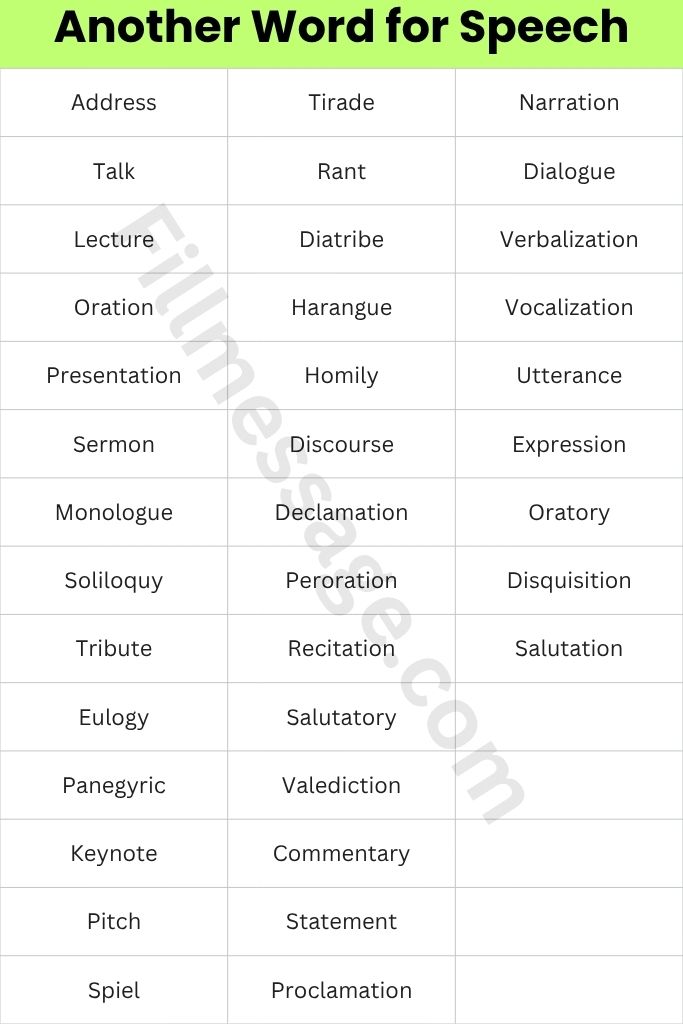
| Word | Tone | Best Used When |
| Address | Formal | A leader speaks to a crowd or institution |
| Talk | Neutral | General spoken message, any setting |
| Lecture | Educational | Teaching in a structured format |
| Oration | Elevated | A powerful, polished public delivery |
| Presentation | Professional | Structured talk, often with visuals |
| Sermon | Religious/Moral | A message with spiritual or ethical weight |
| Monologue | Neutral/Dramatic | One person speaks at length, no back-and-forth |
| Soliloquy | Literary | Inner thoughts spoken aloud, usually on stage |
| Tribute | Warm | Honoring someone through spoken words |
| Eulogy | Solemn | Honoring someone who has passed away |
| Panegyric | Formal/Elevated | Elaborate praise, written or spoken |
| Keynote | Formal/Featured | The main talk at a conference or event |
| Pitch | Persuasive | Selling or convincing in a short burst |
| Spiel | Informal | A practiced, rehearsed sales-style talk |
| Tirade | Negative/Intense | A long, angry, one-sided outburst |
| Rant | Negative/Emotional | Emotional venting, often repetitive |
| Diatribe | Bitter/Critical | Targeted criticism, spoken or written |
| Harangue | Forceful/Negative | A lecturing, aggressive spoken attack |
| Homily | Reflective | A short moral or spiritual talk |
| Discourse | Academic/Formal | Extended, reasoned spoken or written argument |
| Declamation | Forceful/Rhetorical | A dramatic, expressive public delivery |
| Peroration | Formal | The closing section of a longer speech |
| Recitation | Performed | Delivering memorized text aloud |
| Salutatory | Ceremonial | A welcoming or opening speech |
| Valediction | Ceremonial | A farewell speech, often at graduation |
| Commentary | Informational | Real-time spoken explanation of events |
| Statement | Direct/Brief | A clear, intentional spoken message |
| Proclamation | Authoritative | A formal public announcement |
| Narration | Storytelling | Speaking to guide a story or event |
| Dialogue | Conversational | A two-way spoken exchange |
| Verbalization | Psychological | Putting inner thoughts into spoken words |
| Vocalization | Technical | The physical act of producing sound or speech |
| Utterance | Neutral/Linguistic | A single spoken word, phrase, or sentence |
| Expression | Broad | Communicating through spoken words or tone |
| Oratory | Artistic | The skill and art of public speaking |
| Disquisition | Academic | A long, formal spoken or written investigation |
| Salutation | Greeting | Opening words spoken to welcome an audience |
Speech Synonym Grouped by Meaning
Another Word for Formal Public Talk Speech
Address is the closest replacement for “speech” in most formal settings. A mayor gives an address. A president gives an address. It signals authority, intention, and a real audience.
Oration lifts the word higher. It implies not just a talk, but a masterfully delivered one. When someone calls a speech an oration, they’re saying it was skillfully crafted and powerfully performed.
Keynote is event-specific. It’s the featured speech that opens or anchors a conference, summit, or ceremony. The keynote speaker sets the tone for everything else.
Declamation adds drama. It suggests expressive, forceful delivery, often in a formal or theatrical setting. A declamation is less about content and more about how boldly that content is delivered.
Salutatory is narrower still. It’s the welcoming speech at a ceremony, traditionally delivered by a high-ranking student or official. Not widely used outside formal academic or civic events.
Valediction is its counterpart, the farewell speech at the close of a ceremony. Where salutatory opens, valediction closes.
Another Word for Teaching and Explaining Speech
Lecture carries structure and expertise. A professor lectures. A doctor lectures at a symposium. The word implies the speaker knows more than the audience and is passing that knowledge forward. It can sometimes feel one-sided, which is worth noting.
Presentation softens that dynamic. It suggests a structured talk with visuals, usually in a workplace or academic setting where the audience is expected to engage. More collaborative in feel than a lecture.
Discourse is broader and more intellectual. It’s not just a talk; it’s a sustained, reasoned examination of a subject. Philosophers have discourse. Academics engage in discourse. Writers use it more than event planners do.
Disquisition goes even further into formal territory. It refers to a thorough, methodical investigation presented in speech or writing. Rarely heard in casual conversation but appears in literary and scholarly contexts.
Commentary is real-time explaining. A sports announcer provides commentary. A documentary narrator provides commentary. It runs alongside events rather than standing alone as a prepared speech.
Another Word for Honoring and Praising Speech
Tribute honors someone while they are alive to receive it. A retirement party. A lifetime achievement award. Warm, public, intentional.
Eulogy is specifically for loss. It honors someone who has died. Sliding “eulogy” into a context where the person is still living creates an awkward, unintended meaning.
Panegyric is elaborate, formal praise, often in writing as much as speech. It appears in literary history more than modern conversation, but it’s the right word when you want to suggest highly crafted admiration.
Peroration is more structural than celebratory. It’s the closing section of a formal speech, often the most emotional and memorable part. A skilled speaker saves their strongest point for the peroration.
Another Word for Anger, Criticism, and Force Speech
These words carry strong negative weight. Use them only when the emotion is real.
Tirade is a long, intense burst of anger aimed at something or someone specific. It implies loss of control and one-sidedness.
Rant is more informal. It often suggests the speaker is repeating themselves, being unreasonable, or speaking more for emotional release than communication.
Diatribe is angrier in focus. It’s sharp, targeted criticism, often bitter in tone. A politician might issue a diatribe against a rival’s policy. A critic might write a diatribe against a filmmaker.
Harangue adds aggression. It’s a forceful, lecturing attack, sometimes self-righteous in tone. The speaker haranguing someone isn’t just angry; they feel they have the right to be.
Using any of these to describe a calm, measured speech is a serious tone error that will mislead your reader immediately.
Alone on Stage or in Thought
Monologue is widely understood. One person speaks at length, without interruption or dialogue. Used in theater, film, stand-up comedy, and everyday writing.
Soliloquy is more specific. It’s a monologue where a character speaks their private thoughts aloud, usually when they believe themselves to be alone. The form comes from theater. Outside of dramatic contexts, monologue is almost always the better choice.
Another Word for Religious and Moral Talks Speech
Sermon is the standard word for a formal religious speech. A pastor delivers a sermon. A priest delivers a sermon. But the word also travels outside religion: “He launched into a sermon about punctuality” implies a self-righteous, extended lecture.
Homily is softer. It’s a short, reflective moral talk, usually within a religious service. A homily tends to be more personal and conversational than a full sermon.
Short and Persuasive Another Word for Speech
Pitch is sharp and goal-oriented. An entrepreneur pitches to investors. A writer pitches to an editor. It’s short, intentional, and designed to move someone toward a decision.
Spiel is the more informal, sometimes skeptical version. A salesperson’s spiel is a practiced routine. It can carry a slightly negative tone, suggesting the speaker has said this many times before and might not fully mean it.
Brief or Functional Spoken Messages Speech Synonym
Statement is clean and direct. A spokesperson issues a statement. A witness gives a statement. It’s intentional, often short, and usually factual.
Proclamation goes more formal. An authority proclaims something, officially and publicly. It’s declarative rather than conversational.
Utterance zooms in to the smallest unit. A single word, phrase, or sentence spoken aloud. Linguists and therapists use this word often. In creative writing, it adds a quiet intimacy: Her only utterance was his name.
Salutation covers opening words only. The greeting spoken before a speech begins. Warm, brief, and audience-facing.
Another Word for Spoken Language and Expression Speech
Oratory is not a speech itself but the skill behind great speeches. A politician known for oratory is known for how powerfully they speak, not just what they say.
Verbalization means putting a thought into spoken form. Used often in psychology and therapy. Not a synonym for a public speech, but for the act of speaking one’s thoughts.
Vocalization is even more technical. It refers to the physical production of sound. Relevant in music, linguistics, and speech therapy, not for describing a talk at a conference.
Expression is the broadest option on this list. It covers any form of communicating meaning, spoken, written, or physical. Use it when you want to describe how something was said rather than what was said.
Dialogue shifts the dynamic from one-to-many to one-to-one. A dialogue is a conversation, not a speech. If interaction is happening, dialogue fits. If one person holds the floor entirely, it does not.
Narration means guiding an audience through a story or sequence. A narrator at a ceremony. A documentary voice-over. Not a standalone speech but a spoken structure that holds other content together.
Another Word for Speech in Sentence Rewrites to See the Difference
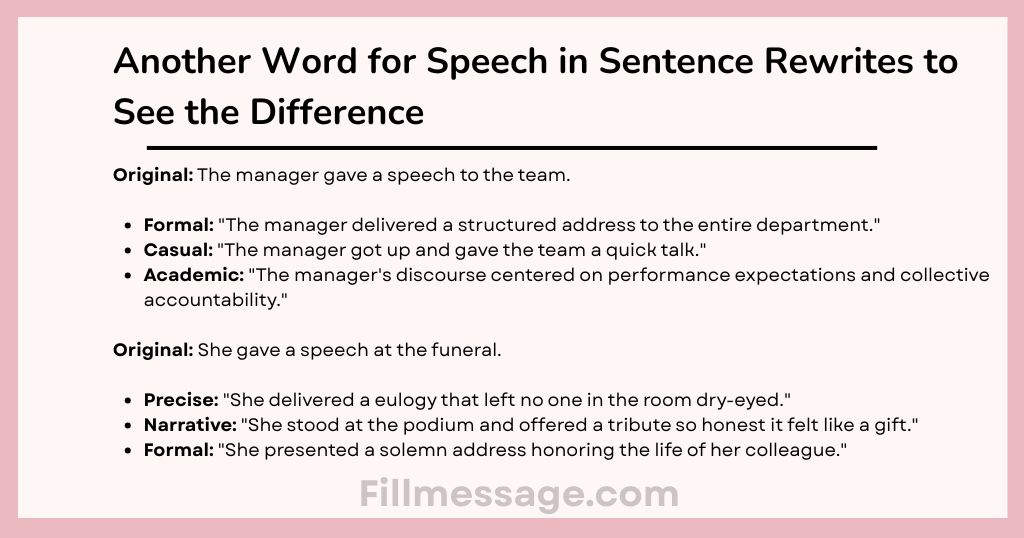
Original: The manager gave a speech to the team.
- Formal: “The manager delivered a structured address to the entire department.”
- Casual: “The manager got up and gave the team a quick talk.”
- Academic: “The manager’s discourse centered on performance expectations and collective accountability.”
Original: She gave a speech at the funeral.
- Precise: “She delivered a eulogy that left no one in the room dry-eyed.”
- Narrative: “She stood at the podium and offered a tribute so honest it felt like a gift.”
- Formal: “She presented a solemn address honoring the life of her colleague.”
Original: He gave an angry speech about the delays.
- Accurate: “He launched into a tirade about the missed deadlines.”
- Informal: “He went on a full rant in front of the whole office.”
- Neutral: “He issued a pointed statement expressing frustration with the repeated delays.”
Each version creates a different picture of the speaker. The word you choose does more than swap meaning; it shapes how readers feel about the person speaking.
Another Word for Speech Formal vs. Informal: Where Each Word Belongs
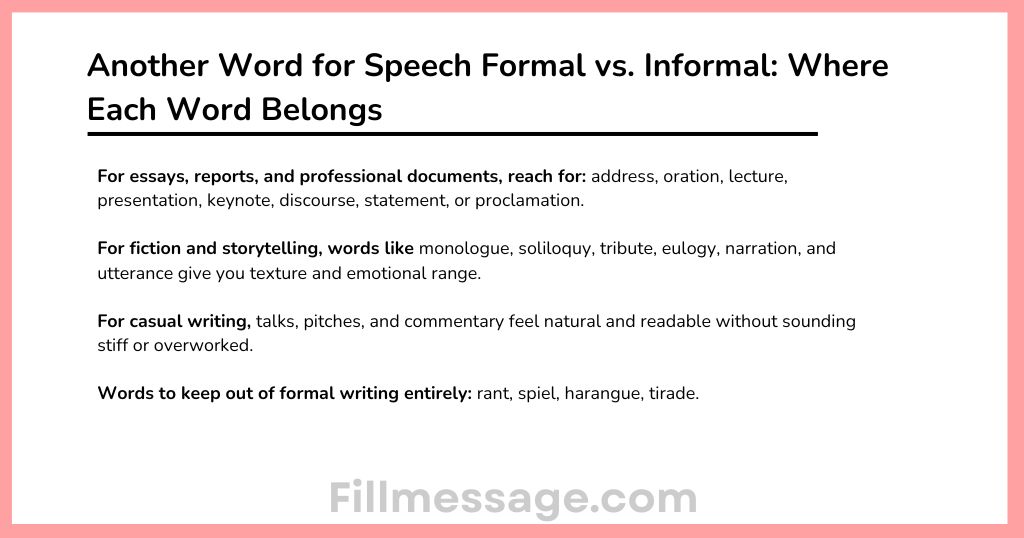
For essays, reports, and professional documents, reach for: address, oration, lecture, presentation, keynote, discourse, statement, or proclamation.
For fiction and storytelling, words like monologue, soliloquy, tribute, eulogy, narration, and utterance give you texture and emotional range.
For casual writing, talks, pitches, and commentary feel natural and readable without sounding stiff or overworked.
Words to keep out of formal writing entirely: rant, spiel, harangue, tirade. Even if used descriptively, they carry a judgment that may not be appropriate for professional or academic contexts.
Speech Synonym Common Mistakes Worth Avoiding
Eulogy for a living person. A eulogy is for someone who has died. Using it at a retirement party or birthday event is technically wrong and emotionally confusing.
Oration for a short talk. An oration implies craftsmanship and length. A five-minute office update is not an oration, even if the speaker enjoyed it.
Soliloquy outside theater. In everyday writing, monologue is the right word. Soliloquy belongs in dramatic or literary contexts where inner thought is being performed.
Discourse as a fancy word for talk. Discourse implies sustained reasoning. Replacing “He gave a talk on budgeting” with “He gave a discourse on budgeting” makes it sound like a philosophy seminar.
Verbalization as a synonym for speech. Verbalization describes the act of converting a thought into words, not the speech itself. A therapist encourages verbalization. A conference host announces a speech.
Related Words That Belong Nearby
Rhetoric: The strategy and technique behind persuasive speaking. Not a type of speech, but what makes a speech work.
Diction: The specific words a speaker chooses. You can have excellent diction within a poor speech.
Elocution: The physical skill of speaking clearly, covering pronunciation, pace, and tone. Related to speech but focused on delivery technique.
Intonation: The rise and fall of a speaker’s voice. It affects meaning even when the words stay the same.
Enunciation: How precisely and clearly a person forms individual sounds. Often confused with elocution, which is broader.
Read more:
Another Word for Racist: 27+ Better Alternatives for Different Situations
29+ Another Word for Humility: Synonyms That Actually Fit Your Writing
FAQ’s about Speech Synonym
Is “address” always more formal than “speech”?
Usually, yes. An address implies the speaker holds some authority and is speaking to a defined group, whether a nation, a graduating class, or a committee. A speech can be formal or informal. An address rarely stays casual.
What is the difference between a rant and a tirade?
A rant is emotional, repetitive, and often unfocused. A tirade is more directed, sustained, and usually aimed at a specific target. Both are negative, but a tirade sounds more deliberate.
Can “commentary” replace “speech” in most sentences?
No. Commentary runs alongside events in real time. It is not a prepared, standalone speech. You provide commentary on a game; you deliver a speech at a banquet.
Which word works best for a short inspirational talk?
It depends on setting. In a workplace, “talk” or “presentation” works. At a ceremony, “address” fits. In a personal or religious setting, “homily” captures the reflective, brief quality well. “Pitch” works if the goal is to motivate action quickly.
How to Choose Without Overthinking It
Ask three things before you pick a word.
Who is speaking? A leader, a teacher, a grieving friend, an angry customer? The speaker’s role shapes the word.
What is the purpose? Informing, inspiring, criticizing, praising, persuading? Purpose changes everything.
What is the setting? A formal stage, a classroom, a funeral, a sales floor? Context is the final filter.
Run your options through those three questions and the right word will almost always surface. Good writing is not about finding a fancier synonym. It is about finding the most accurate one.

Marco Jr. is Author at fillmassage.com,
He explores the world of words and their meanings, helping readers understand language clearly. Passionate about explanations that guide and inform, he creates insightful content that educates, engages, and supports curious minds every day.