You’re revising a paragraph and “having” keeps showing up. You try to swap it out, but every replacement feels forced. That’s not a vocabulary problem. That’s a meaning problem.
“Having” does several different jobs depending on the sentence. The word that replaces it has to match the right job, not just sound similar. Once you understand that, choosing the right synonym becomes simple.
What Makes “Having” Tricky to Replace
It’s one of the most flexible words in English. In one sentence it signals ownership. In the next it describes an experience. Then it appears again showing a feature, a feeling, or a condition.
That’s why a single replacement never works for every case. The sentence decides which synonym fits.
Quick-Reference Another Word for Having list (50+ Alternatives)
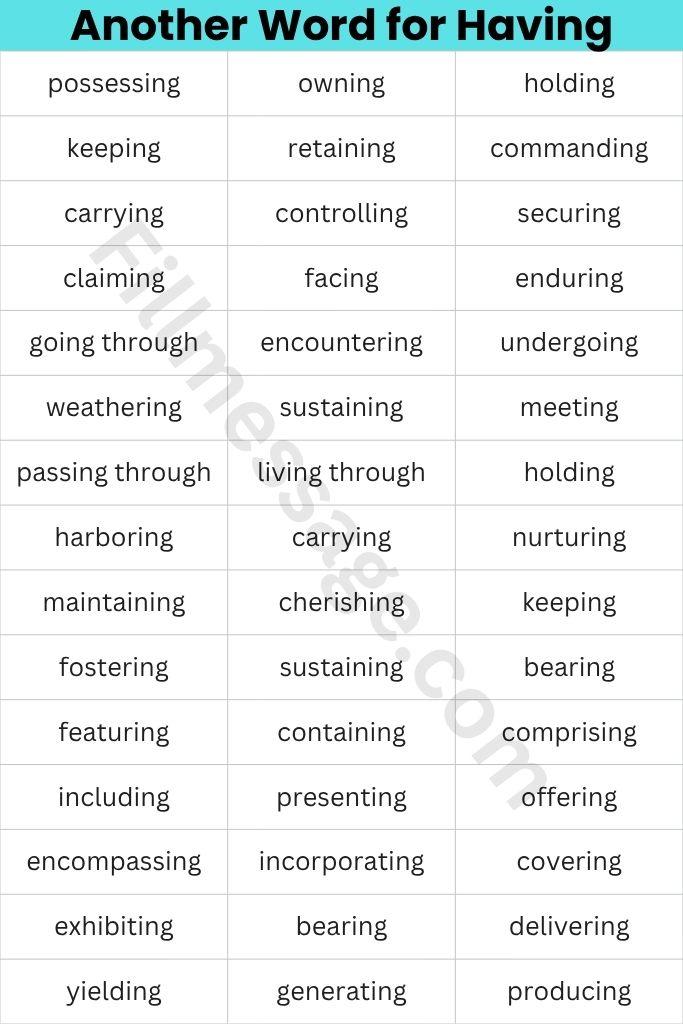
| Category | Synonyms | Tone |
| Ownership / Possession | possessing, owning, holding, keeping, retaining, commanding, carrying, controlling, securing, claiming | Neutral to formal |
| Experience / Going Through | facing, enduring, going through, encountering, undergoing, weathering, sustaining, meeting, passing through, living through | Neutral to serious |
| Feelings / Beliefs / Thoughts | holding, harboring, carrying, nurturing, maintaining, cherishing, keeping, fostering, sustaining, bearing | Formal / literary |
| Features / Including | featuring, containing, comprising, including, presenting, offering, encompassing, incorporating, covering, exhibiting | Formal / written |
| Producing / Giving | bearing, delivering, yielding, generating, producing, bringing forth | Formal / literary |
| Allowing / Accepting | permitting, tolerating, granting, accepting, approving, admitting, authorizing, sanctioning | Formal |
| Enjoying / Savoring | relishing, savoring, enjoying, tasting, delighting in, appreciating | Warm / casual |
| Maintaining a State | keeping, sustaining, retaining, preserving, upholding, continuing | Neutral |
| Taking Part | engaging in, participating in, taking part in, joining, involving oneself in | Neutral to formal |
That gives you 50+ alternatives. But the table only tells you half the story. The next section tells you how to actually use them.
Having synonym Meaning Clusters: The Differences That Matter
Another Word for Having Ownership and Possession
When “having” means someone owns or holds something, these are your strongest options: owning, possessing, holding, retaining, commanding, controlling.
They are not identical. Owning is direct and final. Holding suggests something more temporary, something that could change hands. Commanding implies power or scale. Retaining hints that keeping it required effort.
So “having influence” works better as wielding influence or commanding influence, not owning influence, which sounds odd.
Another Word for Having Experience and Difficulty
This is where writers most often grab the wrong word.
Enduring always carries hardship. Use it for something difficult, not pleasant.
Encountering feels sudden or unexpected. Good for obstacles or surprises.
Weathering suggests something tough being survived. It implies resilience.
Going through is the most neutral and natural. Fits almost any experience without adding extra weight.
“Having a hard time” becomes facing a hard time or going through a rough stretch, not possessing a hard time, which makes no sense.
Another Word for Having Feelings, Beliefs, and Inner States
This category matters most in essays and formal writing.
Harboring works for uncomfortable or hidden feelings, like doubt, resentment, or suspicion.
Nurturing suggests a growing feeling, often hope, curiosity, or ambition.
Fostering is close to nurturing but slightly more intentional, often used in professional or academic writing.
Maintaining fits neutral long-term states, a viewpoint, a habit, or a stance.
“Having doubts” becomes harboring doubts. Cleaner and more precise. “Having hope” becomes nurturing hope or holding onto hope, depending on your tone.
Another Word for Having Features and Qualities
In descriptive writing, “having” often signals that something includes a feature or quality. These replacements work better in that role: featuring, containing, comprising, including, offering, encompassing, incorporating.
“A city having good transport links” reads flat in formal writing. A city featuring strong transport links or a city offering reliable connections is sharper and more credible.
Another Word for Having Producing and Delivering
In formal or literary contexts, “having” sometimes means producing or giving something. For this: bearing, delivering, yielding, generating, producing.
“Having a child” becomes bearing a child in formal or literary writing. “Having results” becomes yielding results or producing results in professional writing.
Having synonym in Sentence Rewrites: Four Real Examples
Seeing the replacements in action matters more than memorizing a list.
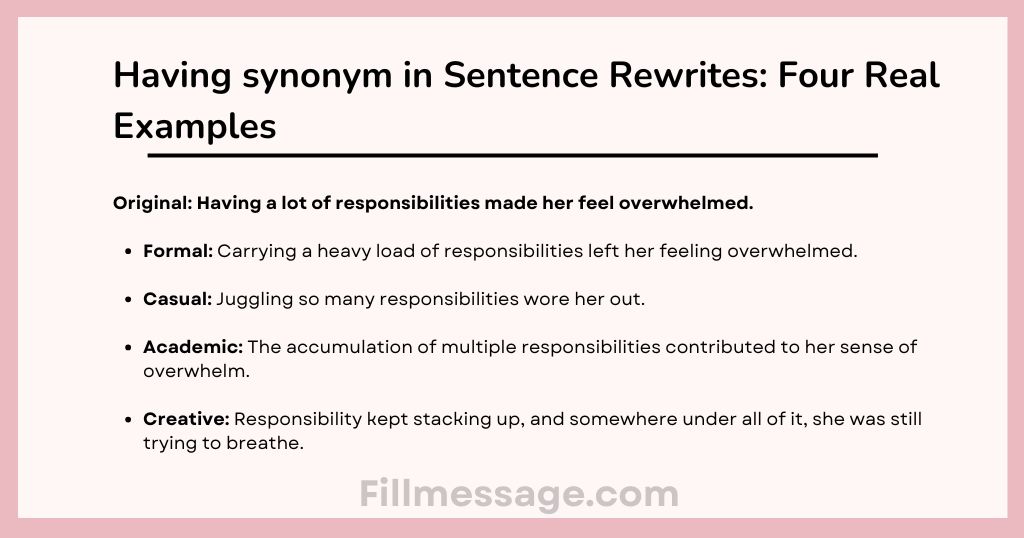
Original: Having a lot of responsibilities made her feel overwhelmed.
- Formal: Carrying a heavy load of responsibilities left her feeling overwhelmed.
- Casual: Juggling so many responsibilities wore her out.
- Academic: The accumulation of multiple responsibilities contributed to her sense of overwhelm.
- Creative: Responsibility kept stacking up, and somewhere under all of it, she was still trying to breathe.
Original: He is having trouble finishing the report.
- Formal: He is struggling to complete the report.
- Casual: He can’t seem to get the report done.
- Academic: He is encountering significant difficulty in completing the report.
- Creative: The report sat open on his screen, untouched, going nowhere.
Original: They are having a meeting tomorrow.
- Formal: They are convening a meeting tomorrow.
- Casual: They’re meeting up tomorrow.
- Academic: A formal session is scheduled for the following day.
Original: She is having second thoughts.
- Formal: She is harboring reservations.
- Casual: She’s not so sure anymore.
- Academic: She is experiencing significant uncertainty regarding the decision.
- Creative: Something kept pulling her back before she could fully commit.
Another Word for Having in an Essay
Repeated “having” in an essay is one of the clearest signs of lazy revision. These are the strongest formal substitutes:
- possessing for skills, qualities, or attributes
- holding for opinions, records, or positions
- bearing for responsibility or consequence
- sustaining for long-term conditions
- comprising for content or components
- experiencing for challenges, growth, or setbacks
- maintaining for ongoing habits or stances
Instead of: Having the right skills is important for leadership.
Try: Possessing the right skills forms the foundation of effective leadership.
That one change lifts the whole sentence. The idea feels more grounded and deliberate.
Having Synonym Formal: What Works in Professional Writing
In business emails, reports, and professional documents, tone matters as much as meaning.
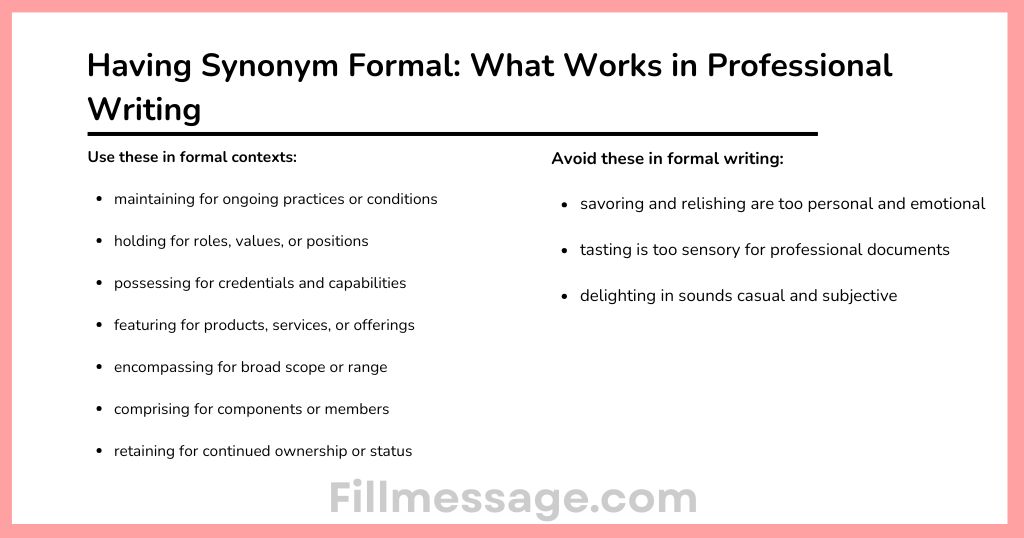
Use these in formal contexts:
- maintaining for ongoing practices or conditions
- holding for roles, values, or positions
- possessing for credentials and capabilities
- featuring for products, services, or offerings
- encompassing for broad scope or range
- comprising for components or members
- retaining for continued ownership or status
Avoid these in formal writing:
- savoring and relishing are too personal and emotional
- tasting is too sensory for professional documents
- delighting in sounds casual and subjective
A product description saying “having five features” reads flat. Featuring five capabilities sounds intentional and professional.
Common Mistakes to Avoid Having synonym
Using enduring for positive experiences. It always implies hardship. “Enduring a beautiful sunset” sounds wrong because the word carries weight.
Replacing “having” without adjusting the grammar. Some synonyms change what follows. “Having a role” becomes playing a role, not possessing a role. The verb shift brings a grammar shift with it.
Over-replacing. Not every “having” needs to go. Sometimes it’s the most natural choice. Replacing it just for the sake of variety can make writing feel stiff and unnatural.
Picking formal words for casual writing. Retaining ownership belongs in a legal document. In a blog post or message, it reads awkward and cold.
Assuming synonyms are always interchangeable. Enduring and experiencing both replace “having” in some sentences, but they carry different weight. Mixing them up without thinking changes the meaning of the sentence.
Having synonym Related Words That Often Work Better
These aren’t direct synonyms but they frequently produce stronger sentences than a straight swap.
Wielding suits power, skill, or influence. “Wielding authority” hits harder than “having authority.”
Bearing is formal and serious. It works well with responsibility, cost, or consequence.
Boasting is casual to moderate. Use it when something has an impressive feature. “The venue boasts a rooftop terrace.” Skip it if the tone needs to stay humble.
Carrying is versatile. It works for both physical things and emotional weight across different tones.
Sitting on is informal, used when someone has something but hasn’t acted on it yet. “She’s sitting on a strong idea.”
Holding is one of the most flexible words here. Opinions, positions, records, and conversations can all be held.
Read more:
36+ Another Word for Destiny: Synonyms That Actually Fit Your Writing
32+ Another Word for Chaos: Pick the Right Word Every Time
FAQs about Having synonym
Can “possessing” replace “having” every time?
No. It fits ownership and qualities but breaks down with experiences. “Possessing a bad morning” is not a sentence anyone would write.
Is “experiencing” always safe for emotions and events?
It’s reliable but can feel clinical. It works in formal writing. In storytelling, you’d often want something warmer and more specific.
Why does replacing “having” sometimes make the sentence worse?
Because the real issue is usually sentence structure, not the word itself. A weak sentence needs rebuilding, not just a synonym swap.
What’s the fastest fix for “having” in a formal essay?
Reframe around a stronger verb. Instead of “students having critical thinking skills,” write “students who possess critical thinking skills” or even better, “critical thinking equips students to.” The sentence stops leaning on “having” entirely.
The Takeaway
“Having” earns its place in everyday speech. The problem starts when it repeats, when it blurs meaning, or when a more precise word is sitting right there unused.
The fix is not grabbing any word from a list. It’s asking what “having” is doing first, then choosing a replacement that does that specific job more clearly.
Ownership: reach for possessing or holding.
Experience: try facing or going through.
Features: use featuring or comprising.
Feelings: pick harboring, nurturing, or maintaining.
Choose for meaning. Variety follows naturally after that.

Marco Jr. is Author at fillmassage.com,
He explores the world of words and their meanings, helping readers understand language clearly. Passionate about explanations that guide and inform, he creates insightful content that educates, engages, and supports curious minds every day.