You’ve typed “chaos” three times in two paragraphs. You know it’s a problem. So you open a thesaurus, grab the first word you see, drop it in, and the sentence feels worse than before.
That’s not a synonym problem. That’s a context problem.
“Chaos” is one of those words that carries a hundred different situations inside it. A toddler’s bedroom. A city under protest. A mind that won’t slow down. Each one needs a different word. Handing a writer a random list of synonyms without explaining the differences is like handing someone a toolbox and saying “good luck.”
This article fixes that. You’ll get 32+ alternatives, grouped by meaning, with tone guidance and real sentence examples.
What Makes “Chaos” Hard to Replace
At its core, chaos means a complete loss of order or control. But it’s emotionally flexible. It can feel terrifying or energizing. It can describe a physical space or an internal state. It can be temporary or permanent.
That flexibility is exactly why one synonym never works for every sentence.
The Full Another Word for Chaos List (32+ Words)
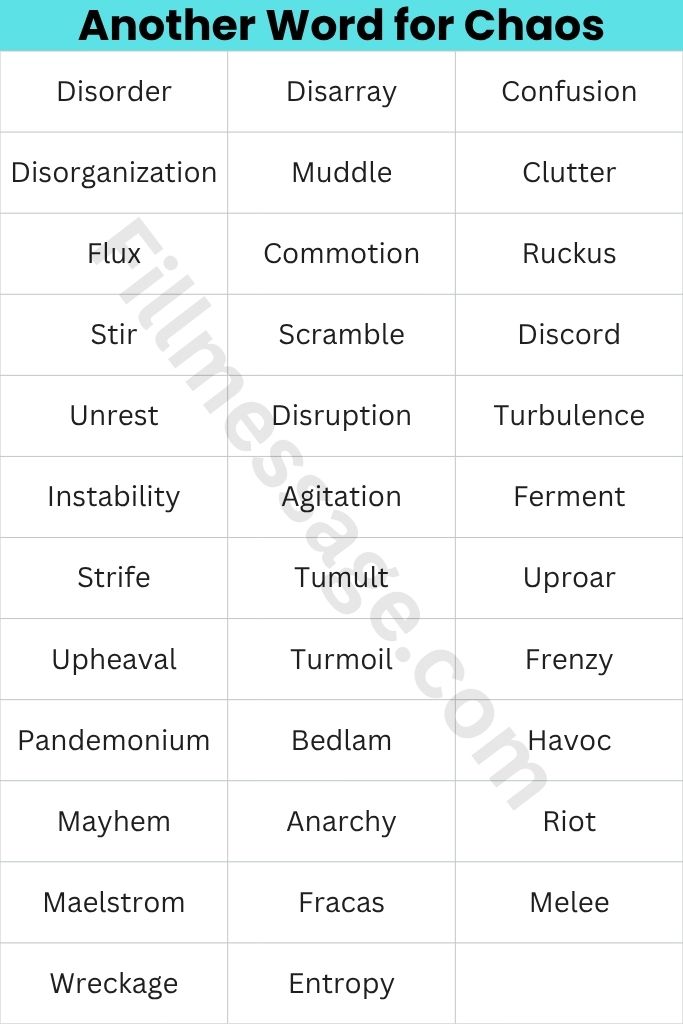
| Word | Tone Level | Works Best For |
| Disorder | Neutral | General loss of structure |
| Disarray | Mild | Messy spaces, mild disruption |
| Confusion | Soft | Mental mix-up, unclear situations |
| Disorganization | Neutral/Formal | Poor planning or structure |
| Muddle | Soft/Informal | Light confusion, things jumbled |
| Clutter | Mild/Physical | Physical mess only |
| Flux | Neutral | Constant change, not always negative |
| Commotion | Moderate | Brief noisy disturbance |
| Ruckus | Casual | Light, noisy disturbance |
| Stir | Casual/Mild | Small social disturbance |
| Scramble | Active/Moderate | Rushed, disorganized movement |
| Discord | Social/Moderate | Conflict between people or groups |
| Unrest | Quiet/Serious | Simmering social tension |
| Disruption | Moderate/Formal | Interruption of normal flow |
| Turbulence | Moderate/Figurative | Unstable periods, rough patches |
| Instability | Formal | Unsafe or unreliable conditions |
| Agitation | Emotional | Inner restlessness, surface-level anxiety |
| Ferment | Figurative | Ideas or tension brewing beneath the surface |
| Strife | Social/Sharp | Conflict-driven disorder between people |
| Tumult | Formal/Strong | Loud external disorder in groups |
| Uproar | Vocal/Public | Group reaction, crowd noise |
| Upheaval | Strong | Major, sweeping disruption or change |
| Turmoil | Intense/Emotional | Deep emotional or political unrest |
| Frenzy | Emotional/Strong | Wild, rushed, panicked energy |
| Pandemonium | Loud/Dramatic | Crowd scenes, public breakdown |
| Bedlam | Noisy/Strong | Loud, uncontrollable situations |
| Havoc | Strong/Negative | Damage, destruction, serious harm |
| Mayhem | Very Strong | Violent or wildly uncontrolled breakdown |
| Anarchy | Political/Extreme | Total collapse of authority or law |
| Riot | Extreme/Public | Violent group disorder |
| Maelstrom | Literary/Extreme | Swirling, overwhelming chaos |
| Fracas | Informal/Dramatic | Noisy argument or fight |
| Melee | Physical/Dramatic | Confused, disorganized fight or crowd |
| Wreckage | Physical/Aftermath | What remains after destruction |
| Entropy | Scientific/Figurative | Slow, unavoidable breakdown of order |
Chaos synonym Meaning Clusters: Where Each Word Actually Lives
This is the section most synonym articles skip. A list of words means nothing if you don’t know which situation they belong to.
Mild Chaos: Messiness Without Crisis
Disarray, clutter, muddle, disorganization, confusion, flux
These are your low-stakes words. The situation is off, but nobody’s in danger. Things are just untidy or unclear.
“The conference room was in disarray after the meeting” works perfectly. Swap in “mayhem” and suddenly it sounds like furniture was thrown.
Use these when the chaos is manageable and temporary.
Another Word for Social and Emotional Chaos
Turmoil, agitation, unrest, discord, strife, ferment
These don’t describe physical spaces. They describe feelings, relationships, and communities. You can’t photograph turmoil. You sense it.
A person processing grief lives in turmoil, not havoc. A community divided by a local decision experiences discord, not bedlam. The word has to match the human experience behind the situation.
Another Word for Loud and Visible Chaos
Pandemonium, bedlam, uproar, tumult, commotion, ruckus, fracas, melee
Noise is the defining quality here. Something happened, and people reacted loudly. These are crowd words, event words, scene-setting words.
A stadium erupts into pandemonium. A town hall breaks into uproar. A school hallway after the bell is pure commotion. A small argument that got out of hand? Fracas fits well.
Another Word for Destructive Chaos
Havoc, mayhem, wreckage, riot
Real harm lives in these words. Not mess. Not noise. Damage.
Havoc is what a flood leaves behind. Mayhem describes what happened during a violent confrontation. Wreckage is the physical evidence afterward. Riot is when a group has gone beyond protest into destruction.
Don’t use these for small inconveniences. It dilutes their force.
Power and System Collapse
Anarchy, instability, upheaval, volatility, disruption
These belong to politics, economies, and organizations. They describe systems breaking down, not moments falling apart.
A government doesn’t fall into bedlam. It collapses into anarchy. A market doesn’t become a muddle. It enters volatility. These words carry institutional weight.
Another Word for Literary and Figurative Chaos
Maelstrom, entropy, turbulence, ferment
Writers reach for these when the situation needs metaphorical depth. Entropy suggests slow, irreversible breakdown. Maelstrom places the reader inside something swirling and overwhelming. Turbulence borrows from physics to describe any rough, unpredictable period.
“The family had drifted into entropy” says more in five words than a full paragraph of explaining could.
Another Word for Chaos in a Negative Sense
When you want the word to land hard and dark, these carry the most weight:
- Mayhem implies violence or uncontrolled harm
- Havoc suggests serious destruction, usually physical
- Anarchy means authority has completely disappeared
- Maelstrom creates a sense of being swept under
- Bedlam conveys frightening, uncontrollable noise and disorder
The key is proportionality. “The filing room was in mayhem” sounds absurd. “The city was in mayhem after the blackout” lands correctly.
Another Word for Chaos in a Positive or Neutral Sense
Some chaos is generative. Startups run on it. Creative teams celebrate it. The best brainstorming sessions are loud, scattered, and unorganized. That kind of chaos has its own vocabulary.
- Flux feels alive and open. Things are shifting, and that’s not automatically bad.
- Ferment suggests ideas or energy building beneath the surface, like culture in motion.
- Frenzy can read as thrilling urgency rather than panic, depending on context.
- Turbulence in the right sentence becomes a growth period, not a crisis.
“The studio was in creative frenzy all week” feels electric. That same word in a different sentence sounds dangerous. Context does everything here.
Another Word for Chaos By Starting Letter (When Rhythm Matters)
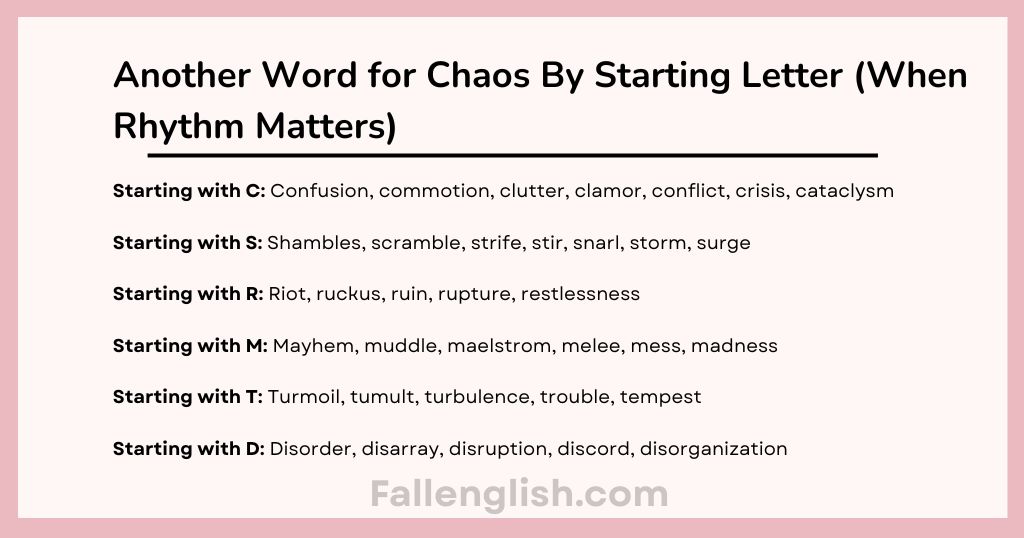
Sometimes you need a word that fits a specific syllable count or letter for stylistic reasons.
Starting with C: Confusion, commotion, clutter, clamor, conflict, crisis, cataclysm
Starting with S: Shambles, scramble, strife, stir, snarl, storm, surge
Starting with R: Riot, ruckus, ruin, rupture, restlessness
Starting with M: Mayhem, muddle, maelstrom, melee, mess, madness
Starting with T: Turmoil, tumult, turbulence, trouble, tempest
Starting with D: Disorder, disarray, disruption, discord, disorganization
Another Word for Chaos in Sentence Rewrites: Same Idea, Different Energy
Original: The office was in chaos after the system crashed.
- Formal: The system failure created widespread disruption across all departments.
- Casual: Everything fell apart the second the system went down.
- Storytelling: By noon, what had been a functioning office had dissolved into total disarray, and nobody seemed to know where to start.
Original: The news caused chaos across the city.
- Formal: The announcement triggered significant social unrest throughout the region.
- Journalistic: Pandemonium followed within minutes of the report going public.
- Literary: The city didn’t react to the news. It convulsed.
Original: She felt chaos inside her head.
- Emotional/Direct: Her thoughts were in turmoil and wouldn’t settle.
- Creative: There was a kind of quiet maelstrom behind her eyes that she couldn’t name.
- Conversational: Her mind was a complete muddle all morning.
Notice how the synonym choice shifts not just the word but the entire tone of the sentence. That’s the real skill.
Chaos synonym Formal vs. Informal: What Goes Where
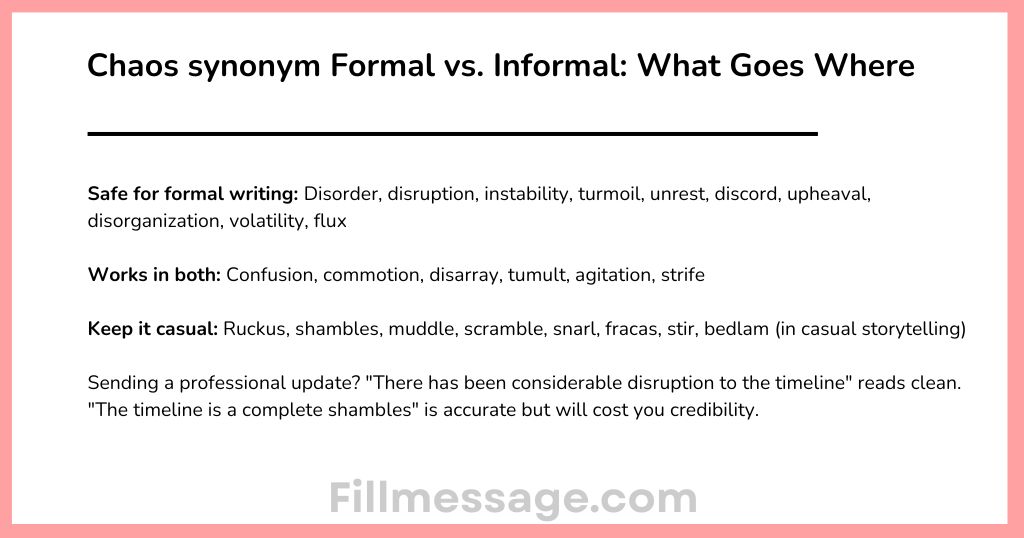
This matters most when you’re writing for a specific audience.
Safe for formal writing: Disorder, disruption, instability, turmoil, unrest, discord, upheaval, disorganization, volatility, flux
Works in both: Confusion, commotion, disarray, tumult, agitation, strife
Keep it casual: Ruckus, shambles, muddle, scramble, snarl, fracas, stir, bedlam (in casual storytelling)
Sending a professional update? “There has been considerable disruption to the timeline” reads clean. “The timeline is a complete shambles” is accurate but will cost you credibility.
Common Mistakes With Chaos synonym Words
Anarchy is not just disorder. It specifically means the absence of governing authority. Using it to describe a chaotic kitchen is dramatic overreach.
Turmoil and tumult are not the same. Turmoil tends to be internal or emotional. Tumult is external and loud. A grieving person feels turmoil. A crowd creates tumult.
Havoc needs something to damage. “The children wreaked havoc on the garden” works. “The children wreaked havoc on the schedule” is a stretch unless real consequences followed.
Flux is not negative by itself. Many writers treat it as a synonym for breakdown, but flux simply means ongoing change. It’s neutral until context gives it a negative charge.
Mayhem is not a metaphor word. It loses credibility in figurative contexts. Save it for situations with real, serious disruption.
Related Words That Often Get Confused With Chaos synonym
Crisis sits near chaos but isn’t the same. A crisis is a turning point that demands action. Chaos is the state. You can have a crisis without chaos, and chaos without a clear crisis.
Turbulence borrows from physics. In everyday language, it works for any rough, unstable stretch, in relationships, business, travel, politics. It doesn’t imply destruction, just instability.
Volatility is more specific. It describes unpredictable swings, up or down. Mostly used in finance and mood contexts, but increasingly common in political writing.
Disruption has become a business word. It now often means intentional change, not just a breakdown. Be careful using it to mean pure chaos because readers may read it as strategic.
Entropy is borrowed from science and works beautifully in figurative writing. It suggests slow, inevitable breakdown rather than sudden chaos. Great for describing long-term decline.
Chaos Synonyms vs. Their Opposites
| Synonym | Opposite |
| Disorder | Order |
| Turmoil | Peace |
| Havoc | Calm |
| Anarchy | Governance |
| Pandemonium | Silence |
| Disarray | Structure |
| Unrest | Stability |
| Discord | Harmony |
| Flux | Steadiness |
| Upheaval | Continuity |
Knowing the antonym sharpens your feel for the word. If you’re writing toward resolution, the antonym tells you where the sentence is heading.
Read also:
33+ Another Word for Myself: Every Alternative You Actually Need
36+ Another Word for Destiny: Synonyms That Actually Fit Your Writing
FAQs about Chaos synonym
Is “bedlam” still usable in modern writing?
Yes. It originally came from a real hospital name in London, but it’s fully functional in contemporary writing, especially in storytelling and journalism. It sounds vivid without being pretentious. Use it for loud, uncontrollable scenes.
Can “entropy” work outside science writing?
Absolutely, and it often works better there. “The partnership had slowly collapsed into entropy” captures something no other word quite does. Just know that science-minded readers will notice the borrowing, which is usually a good thing.
What’s the single safest replacement for “chaos” in formal writing?
Disorder or disruption. Both are neutral, widely understood, and appropriate across almost every professional context without sounding dramatic.
When should you just keep the word “chaos”?
When you need something that feels total, unspecified, and uncontrolled without pointing to noise, violence, or politics in particular. “Chaos” is the most emotionally open word on this list. Sometimes that openness is exactly the right choice.
How to Choose Without Overthinking It
Ask yourself three quick questions before picking a synonym.
Is it physical or emotional? Physical chaos leans toward disarray, havoc, wreckage, clutter. Emotional chaos leans toward turmoil, agitation, ferment, discord.
Is it loud or quiet? Loud chaos reaches for pandemonium, bedlam, uproar, tumult. Quiet chaos fits unrest, instability, entropy, flux.
How serious is it? Mild situations deserve mild words. Muddle, confusion, disorganization. Serious situations earn mayhem, anarchy, maelstrom.
Match the word to the weight of the moment. That’s the whole skill.

Marco Jr. is Author at fillmassage.com,
He explores the world of words and their meanings, helping readers understand language clearly. Passionate about explanations that guide and inform, he creates insightful content that educates, engages, and supports curious minds every day.