You may need Another Word for Speculation when your writing starts to sound repetitive or too uncertain. The best replacement depends on what you really mean: a reasoned idea, a casual guess, a future prediction, or a risky decision. Words such as inference, hypothesis, hunch, and estimate are not interchangeable. This guide helps you choose a natural word that matches your meaning, audience, and level of confidence.
What “Speculation” Actually Means (Keep It Simple)
Speculation means forming an idea or opinion without solid proof. It sits somewhere between a wild guess and a reasonable conclusion. It carries a slightly uncertain tone, sometimes neutral, sometimes negative depending on who is reading it.
It can refer to thought (mental speculation) or financial risk (market speculation). Both uses matter, and the alternatives differ based on which meaning you need.
Quick Another Word for Speculation Reference Table
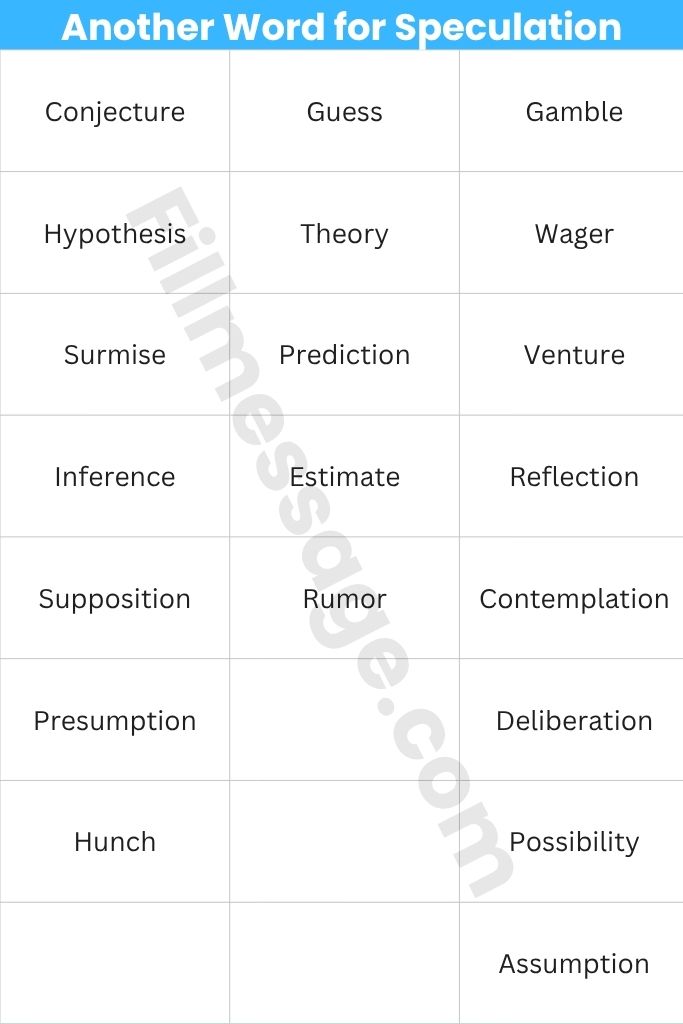
| Word | Tone | Best Context |
| Conjecture | Neutral to formal | Academic writing, analysis |
| Hypothesis | Formal | Science, research |
| Surmise | Slightly formal | Reporting, investigation |
| Inference | Formal | Logic, law, analysis |
| Supposition | Formal | Essays, formal speech |
| Presumption | Formal | Legal, professional |
| Hunch | Casual | Conversation, storytelling |
| Guess | Very casual | Everyday speech |
| Theory | Neutral | General writing |
| Prediction | Neutral | Business, journalism |
| Estimate | Neutral | Data, finance |
| Rumor | Negative | News, gossip context |
| Gamble | Slightly negative | Risk, finance |
| Wager | Neutral to informal | Risk decisions |
| Venture | Neutral | Business, bold actions |
| Reflection | Thoughtful | Essays, personal writing |
| Contemplation | Thoughtful | Literary, personal |
| Deliberation | Formal | Law, decision-making |
| Possibility | Neutral | Planning, options |
| Assumption | Neutral to negative | Logic, debate |
The 30 Would Synonym, Grouped by Meaning
The alternatives split into five clear meaning clusters. This matters. Using “gamble” when you meant “hypothesis” sends a completely different message.
Cluster 1: Thoughtful Guessing (Based on Reasoning)
These words mean you have some evidence or logic behind your thinking. They are more credible than a pure guess.
Conjecture
Used when someone draws a conclusion from incomplete data. Fits academic writing well. “The findings remain conjecture until peer-reviewed.”
Hypothesis
Stronger than conjecture. It implies the idea can be tested. Used in science, research, and structured arguments. “The team built a hypothesis around customer behavior patterns.”
Surmise
A quieter word. It means you formed an opinion using limited clues. “She surmised that the delay was tied to the budget freeze.”
Inference
Means you reached a conclusion by connecting the dots from available facts. Works well in legal, analytical, or investigative writing. “The audit report contained several key inferences.”
Supposition
Slightly more formal than assumption. It signals a working belief without confirmed proof. “The strategy rested on a fragile supposition.”
Presumption
Implies something accepted as probably true but not yet confirmed. Often used in law or formal discussions. “The presumption of guilt was challenged early in the trial.”
Cluster 2: Casual Guessing (Low Evidence, Informal Tone)
These words feel lighter. They are not backed by logic or data. Use them in informal writing, dialogue, or casual communication.
Guess
The most basic form. No pretense of logic. “My guess is the project gets pushed to next month.”
Hunch
An instinct. It feels personal and intuitive. “He had a hunch the deal would fall through, and he was right.”
Guesswork
Used when there is almost no reliable basis. It often signals frustration or skepticism. “Predicting user behavior without analytics is pure guesswork.”
Assumption
Dangerous word in professional writing. It implies you accepted something as true without checking. “The entire forecast was built on a shaky assumption.”
Cluster 3: Predictions and Possibilities
These words look forward. They focus on what might happen, not what might be true right now.
Prediction
A statement about a likely future outcome. It sounds more confident than speculation. “The quarterly prediction held up better than expected.”
Possibility
Open-ended. Does not commit to anything. “A leadership change is one possibility the board discussed.”
Estimate
Implies a calculated approximation. More grounded than speculation. “The cost estimate puts the project at around $80,000.”
Theory
Broader than hypothesis. Often used loosely to mean an idea or interpretation. “One theory is that the drop in engagement happened after the redesign.”
Cluster 4: Risk-Taking and Financial Speculation
When “speculation” relates to bold decisions or financial risk, this cluster applies.
Gamble
Means you took a risk with an uncertain outcome. Slightly negative. “Releasing the product before testing was a clear gamble.”
Wager
Similar to gamble but sounds slightly more calculated. “The expansion into new markets was a wager on future demand.”
Venture
Focuses on the boldness of the action. “Their entry into the streaming market was an ambitious venture.”
Bet
Casual and direct. Works well in business commentary. “Betting on a single supplier proved costly.”
Risk
The broadest word here. Means exposure to potential loss. “The merger came with considerable financial risk.”
Chance
Lighter than risk. Implies uncertainty without necessarily a negative outcome. “There is a real chance the policy shifts in Q3.”
Cluster 5: Deep Thinking and Reflection
Sometimes speculation is less about guessing and more about deep thought. These words fit philosophical, personal, or literary writing.
Reflection
Thoughtful consideration of a topic. Looks backward more than forward. “The article is a sincere reflection on how markets respond to fear.”
Contemplation
Slower, more focused thought. Often peaceful or serious. “The decision required genuine contemplation, not a rushed answer.”
Deliberation
Active, careful thinking or discussion before a decision. “After extended deliberation, the committee chose to delay.”
Meditation
Deep mental engagement with a subject. Often used in literary writing. “The novel reads as a meditation on grief and uncertainty.”
Consideration
Practical thought applied to a problem. “The proposal received careful consideration before being declined.”
Another Word for Speculation in Rewriting Sentences: Before and After
Weak sentence using “speculation”: “The report is just speculation.”
Formal version: “The findings remain unverified and rely heavily on conjecture.”
Casual version: “Honestly, it’s a lot of guesswork without solid data behind it.”
Academic version: “The conclusions drawn appear to rest on unsubstantiated assumptions.”
Creative version: “The whole report felt like chasing shadows, built on nothing firmer than a hunch.”
Each rewrite changes the tone and the reader’s trust level. The formal version sounds careful. The creative version sounds vivid. Pick based on who is reading.
Another example: “There is a lot of market speculation right now.”
Business email version: “Market conditions remain unpredictable, and current estimates carry significant uncertainty.”
Casual version: “Nobody really knows what the market will do. It’s mostly guessing at this point.”
News/journalism version: “Analysts are divided, with several competing theories on where prices are heading.”
Formal Another Word for Speculation vs Informal: Choosing for Your Context
If you are writing a professional email, reach for inference, presumption, or estimate. They sound grounded.
If you are writing an academic essay, hypothesis, conjecture, and supposition are your safest options.
If you are writing a story or blog post, hunch, theory, or reflection keep things human and readable.
Words to avoid in formal writing:
- Guesswork (too dismissive)
- Hunch (too casual)
- Bet (sounds flippant)
- Rumor (implies unverified gossip)
Common Mistakes Writers Make
Mixing up hypothesis and theory
A hypothesis is a specific, testable idea. A theory in science is actually well-supported. In casual writing, “theory” is looser. Know your context before using either.
Using assumption without realizing the risk
“Assumption” can make the writer look careless. It signals something was accepted without checking. Use “supposition” if you want something that sounds more considered.
Treating inference and guess as the same
They are not. An inference follows from evidence. A guess does not. If someone infers something, they reasoned their way there. If someone guesses, they did not.
Overusing conjecture in casual writing
It sounds stiff in a blog post or personal message. Save it for analytical or academic pieces.
Confusing rumor with possibility
A rumor involves people spreading unverified information. A possibility is just an open outcome. Very different implications.
Related Another Word for Speculation Worth Knowing
Intuition: Knowing something without clear reasoning. Stronger feeling than a hunch, often personal and hard to explain.
Projection: Usually used in business or finance. It means a calculated forecast based on current data.
Notion: A loose, informal idea. Less committed than a theory. “I have a notion that this trend will reverse.”
Postulation: A formal word for putting forward an idea as a basis for argument. Close to hypothesis but used more in philosophy.
Forecast: A structured, data-based prediction. More professional than speculation and carries higher credibility.
Read more:
33 Another Word for Wholeheartedly: Synonyms That Actually Fit
Another Word for Would: 34 Alternatives That Actually Work
The Practical Takeaway
Most people reach for “speculation” because it is familiar. That is fine. But familiarity can work against you when precision matters.
Here is how to decide quickly:
- Need to sound analytical? Use conjecture or inference
- Writing about risk? Use gamble, venture, or wager
- Want to sound cautious but credible? Use estimate or projection
- Writing something personal or reflective? Use reflection or contemplation
- Keeping it simple and conversational? Hunch or theory will work just fine
The right word does not just replace “speculation.” It shapes how confident, careful, or bold your writing sounds. That is always worth the extra second of thought.

Marco Jr. is Author at fillmassage.com,
He explores the world of words and their meanings, helping readers understand language clearly. Passionate about explanations that guide and inform, he creates insightful content that educates, engages, and supports curious minds every day.