Some words wear out their welcome fast. “Wholeheartedly” is one of them. It sounds sincere the first time. By the third time in the same paragraph, it starts to feel hollow, like a filler word pretending to carry weight.
Writers, students, and professionals hit this wall constantly. You want to say you’re fully committed, genuinely supportive, or deeply devoted, but “wholeheartedly” keeps showing up because nothing else feels strong enough.
The truth is, several words do the job better, depending on what you actually mean. Some carry more warmth. Some sound more professional. Some hit harder emotionally. This article breaks all of that down clearly.
What “Wholeheartedly” Really Means
It means giving something your complete attention, effort, or support, without holding back any part of yourself. There is no reluctance in it. No hidden doubt. The emotional weight is high. The tone is sincere and committed.
That is why swapping it carelessly can make your sentence feel wrong.
Quick-Access Another Word for Wholeheartedly Table

| Word | Tone | Best Used When |
| Earnestly | Warm, serious | Showing genuine effort or concern |
| Fervently | Passionate, intense | Expressing strong belief or feeling |
| Devotedly | Loyal, emotional | Describing dedication to a person or cause |
| Resolutely | Firm, determined | Showing decision-making or standing ground |
| Unreservedly | Open, complete | Offering full support without conditions |
| Ardently | Deep, emotional | Romantic or passionate commitment |
| Zealously | Energetic, driven | Active and enthusiastic dedication |
| Sincerely | Honest, mild | Professional or polite contexts |
| Profoundly | Deep, thoughtful | Emotional or intellectual impact |
| Passionately | Strong, visible | Creative or personal expression |
| Fully | Neutral, clear | Clean, direct writing |
| Genuinely | Honest, grounded | Authentic emotion without drama |
| Completely | Direct, simple | Formal agreement or support |
| Thoroughly | Careful, detailed | Process-focused or academic writing |
| Unconditionally | Total, emotional | Love, family, or loyalty |
| Devotionally | Spiritual, committed | Faith or deep dedication contexts |
| Soulfully | Emotional, personal | Creative or reflective writing |
| Keenly | Alert, eager | Interest or enthusiasm without intensity |
| Solidly | Steady, reliable | Support or agreement with strength |
| Faithfully | Loyal, consistent | Long-term commitment or trust |
Wholeheartedly Synonym Breaking Down the Meaning Clusters
Not every synonym means the same thing. “Wholeheartedly” sits at the center, but the words around it pull in different directions.
Intensity: Mild to Strong
Some words carry softer energy:
- Sincerely
- Genuinely
- Keenly
- Solidly
These work when you do not want to sound overly dramatic. Saying “I sincerely support this decision” lands professionally without sounding like a speech.
On the stronger end:
- Fervently
- Ardently
- Passionately
- Devotedly
These words bring heat. They suggest a feeling that is hard to ignore. Use them when the emotion is real and the moment calls for it.
Commitment: Steady vs Active
Some words describe a quiet, steady form of commitment:
- Faithfully
- Unconditionally
- Devotedly
- Solidly
Others suggest active, visible effort:
- Zealously
- Energetically
- Thoroughly
- Resolutely
If someone is quietly loyal over years, “faithfully” fits. If they are pushing hard every day to make something happen, “zealously” or “resolutely” says it better.
Emotional vs Professional
In professional writing, emotional words can feel out of place. For emails, reports, and proposals, choose:
- Fully
- Completely
- Sincerely
- Genuinely
- Thoroughly
For storytelling, personal essays, or heartfelt communication, these work better:
- Soulfully
- Ardently
- Passionately
- Unconditionally
Another Word for Wholeheartedly in Sentence Rewrites: Seeing the Difference
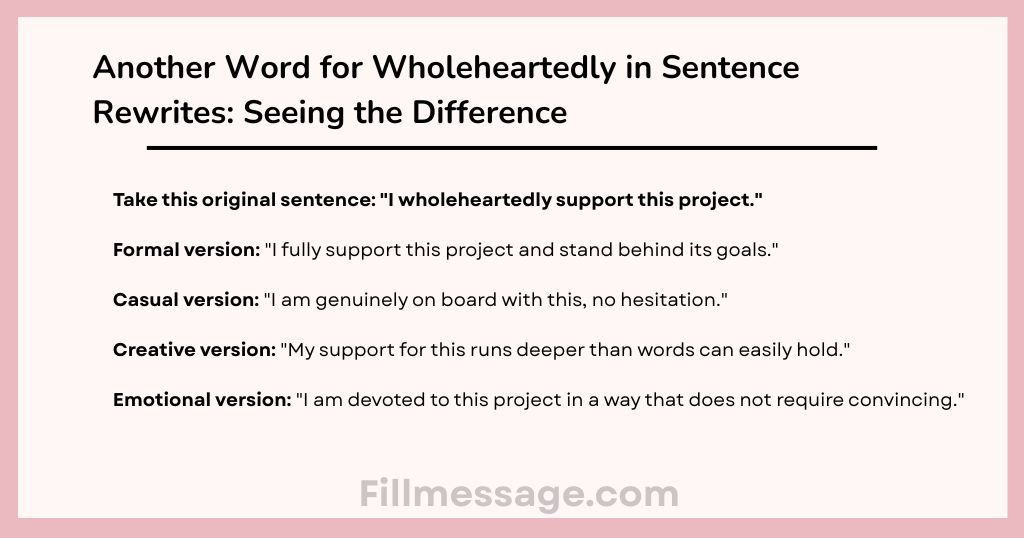
Take this original sentence: “I wholeheartedly support this project.”
Formal version: “I fully support this project and stand behind its goals.”
Casual version: “I am genuinely on board with this, no hesitation.”
Creative version: “My support for this runs deeper than words can easily hold.”
Emotional version: “I am devoted to this project in a way that does not require convincing.”
Each version keeps the same core meaning but changes how the reader feels about it. The formal version builds trust. The casual version sounds approachable. The creative version creates texture. The emotional version shows personal investment.
Now try this sentence: “She wholeheartedly believed in her team.”
Professional: “She placed complete confidence in her team’s ability to deliver.”
Storytelling: “She believed in them the way you believe in something before the proof arrives.”
Direct: “Her trust in her team was total. No doubts. No backup plan.”
You see how replacing one word opens the sentence into something more specific and more human.
Formal Another Word for Wholeheartedly vs Informal: Choosing the Right Register
For professional emails:
- Fully
- Sincerely
- Completely
- Genuinely
Example: “We fully endorse this recommendation and look forward to moving ahead.”
For essays and academic writing:
- Resolutely
- Thoroughly
- Profoundly
- Unreservedly
Example: “The committee resolutely upheld its position throughout the review process.”
For storytelling and personal writing:
- Ardently
- Devotedly
- Passionately
- Soulfully
Example: “She ardently protected what she had built.”
Avoid using in formal writing:
- Soulfully (too personal)
- Keenly (can sound mild or British-formal in certain contexts)
- Zealously (can suggest obsession depending on tone)
Common Mistakes Writers Make
Using “earnestly” when you mean urgency, not sincerity. Earnestly means genuinely and with serious intent. It does not always mean urgently. “She earnestly warned them” reads differently from “She urgently warned them.” Pick based on meaning, not feel.
Treating “fervently” and “passionately” as identical. Both carry heat, but “fervently” often connects to belief or cause. “Passionately” connects to action or emotion. A person argues fervently. A person creates passionately. Small difference, real impact.
Overusing “fully” and “completely” as replacements. They are safe, yes. But repeated use makes writing feel flat. Rotate. Let other words do the heavy lifting sometimes.
Choosing “zealously” without checking the tone. Zealous behavior can sound admirable or alarming depending on context. “She zealously promoted the brand” works. “He zealously watched over her” sounds controlling. Read the full sentence before landing on it.
Mistaking “unconditionally” as only emotional. It works in professional writing too. “The organization unconditionally commits to transparency” reads well and carries real weight.
Related Another Word for Wholeheartedly Worth Knowing
These are not direct synonyms but sit close enough to matter in writing:
Conviction (noun): The strong belief behind an action. “She spoke with conviction” suggests she was not just agreeing, she meant it deeply.
Dedication (noun): Long-term commitment shown through action. More about behavior over time than a single moment.
Resolve (noun/verb): A firm decision to do something. “He resolved to finish” means he made up his mind, fully.
Zeal (noun): Strong energy aimed at a goal. Slightly old-fashioned but powerful in the right sentence.
Devotion (noun): Deep loyalty, often emotional or spiritual. Warmer than dedication.
Commitment (noun): A promise backed by action. More neutral, works in nearly every context.
Read also:
Another Word for In Turn: 35 Alternatives That Actually Work
15 Another Word for Blue: Precise Alternatives for Every Writing Context
FAQ’s
Can I use “unreservedly” in a formal apology?
Yes, and it works very well. “We unreservedly apologize for the confusion this caused” is direct, complete, and professional. It signals no excuses, which is exactly what a formal apology needs.
Is “ardently” too old-fashioned for modern writing?
Not at all. It appears in journalism, literary fiction, and personal essays regularly. It sounds elevated, not outdated. Use it when you want a word that does not show up in every other paragraph someone reads that day.
What is the difference between “devotedly” and “faithfully”?
“Devotedly” carries more emotional warmth. “Faithfully” is steadier and more consistent but slightly cooler in tone. A parent supports a child devotedly. An employee fulfills their duties faithfully. Both suggest loyalty, but the emotion level differs.
Is “passionately” too strong for a cover letter?
It depends on the field. In creative industries, arts, or advocacy roles, it fits naturally. In finance or legal writing, it may read as excessive. “Fully committed” or “deeply invested” carries similar weight with more professional restraint.
Choosing the Right Word: A Simple Way to Think About It
Before picking a synonym, ask yourself three things:
- How strong is the emotion in this sentence?
- Who is the audience: personal or professional?
- Is the commitment about feeling, belief, or action?
If the feeling is intense, go for fervently, ardently, or passionately.
If the context is professional, choose fully, sincerely, or completely.
If you are describing a long-term commitment, devotedly or faithfully both serve well.
If you want to show firm determination, resolutely or unreservedly land cleanly.
No synonym is universally better than “wholeheartedly.” Each one shifts the weight slightly. That shift is the whole point. The right word does not just replace the original. It makes the sentence more precise than it was before.

Marco Jr. is Author at fillmassage.com,
He explores the world of words and their meanings, helping readers understand language clearly. Passionate about explanations that guide and inform, he creates insightful content that educates, engages, and supports curious minds every day.