You may use Another Word for In Turn when a sentence starts sounding repetitive or when the phrase does not quite express what you mean. The best replacement depends on the job “in turn” is doing.
Sometimes it shows order. Sometimes it means taking turns, responding, or showing a result. Choosing a more exact phrase can make your writing clearer without making it sound overly formal or forced.
What Does “In Turn” Actually Mean?
At its core, “in turn” means one thing following another, either in sequence, in response, or through shared participation. But those three uses feel different. Sequential order is about arrangement. Response is about reaction. Shared participation is about fairness or rotation. Treating them all the same creates fog in your writing.
Tone-wise, “in turn” sits in neutral territory. It works in casual writing and formal writing alike, which is both its strength and its trap.
Quick-Access Another Word for In Turn Table
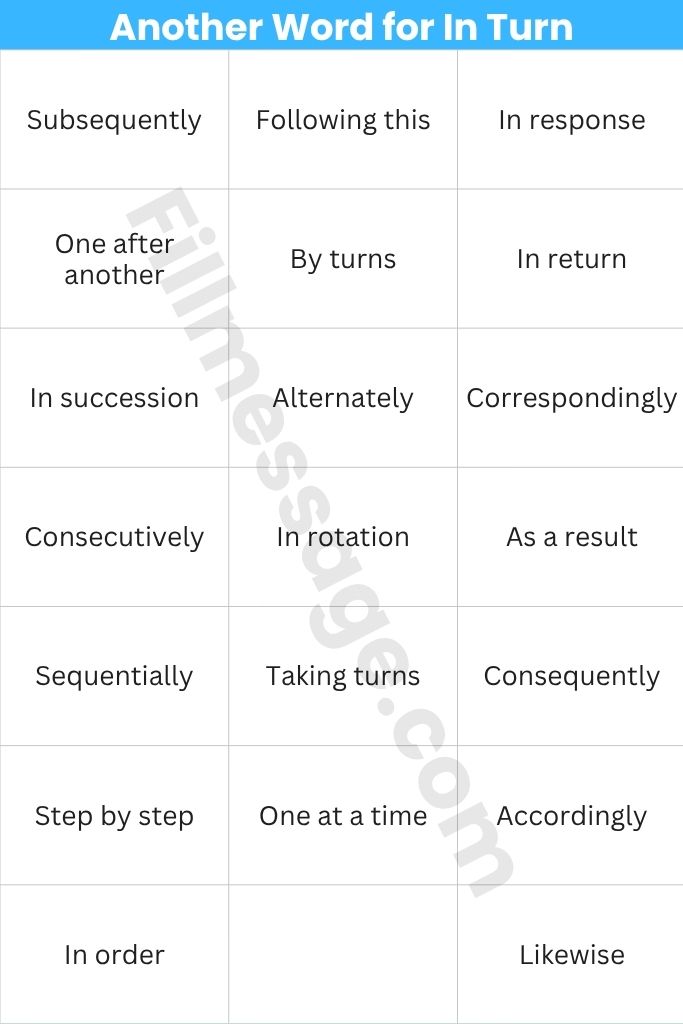
Here are 20 natural alternatives, organized by meaning and tone. Each one earns its place.
| Alternative | Meaning Cluster | Tone | Best Used When |
| Subsequently | Sequential | Formal | Events follow logically |
| One after another | Sequential | Neutral | Listing actions or events |
| In succession | Sequential | Formal | Repeated occurrences in a row |
| Consecutively | Sequential | Formal/Academic | Uninterrupted sequence |
| Sequentially | Sequential | Neutral/Technical | Steps, processes, data |
| Step by step | Sequential | Casual | Instructions or gradual progress |
| In order | Sequential | Neutral | Organized review or list |
| Following this | Sequential | Conversational | Moving from one point to next |
| By turns | Shared participation | Neutral | Two or more people rotating |
| Alternately | Shared participation | Neutral | Switching between two things |
| In rotation | Shared participation | Neutral/Formal | Organized group participation |
| Taking turns | Shared participation | Casual | Everyday shared action |
| One at a time | Shared participation | Casual | Preventing overlap |
| In response | Reaction/Return | Neutral | Reacting to something said or done |
| In return | Reaction/Return | Neutral | Reciprocal action |
| Correspondingly | Reaction/Return | Formal | Parallel or matching actions |
| As a result | Causal | Neutral | Clear cause and effect |
| Consequently | Causal | Formal | Formal cause-and-effect writing |
| Accordingly | Causal | Formal | Action based on new information |
| Likewise | Parallel action | Neutral | Mirroring behavior or action |
In Turn Synonym Breaking Down the Three Meanings
Writers get into trouble when they treat “in turn” as one-size-fits-all. It isn’t. These three clusters each need their own set of replacements.
In Turn Synonym When You Mean “One After Another”
This is about order. Things happen in a line. Events unfold. People speak. Steps proceed.
“Subsequently” works well here when the sequence is logical and the writing is formal. “Following this” is softer and fits conversational prose. “One after another” gives a visual sense of motion that works well in storytelling.
Example shift:
Original: Each speaker presented their work in turn.
Rewrite: Each speaker presented their work one after another, the room growing quieter with each passing minute.
The rewrite doesn’t just replace the phrase. It adds movement.
When You Mean “Taking Turns”
This cluster is about shared participation. Everyone gets a go. It’s fair, organized, rotating.
“By turns” is slightly more literary than “taking turns,” which reads as casual and spoken. “In rotation” fits workplace writing: teams sharing responsibilities, staff covering shifts. “Alternately” works when exactly two parties are switching.
Example shift:
Original: The managers handled client calls in turn.
Rewrite: The managers handled client calls in rotation, each taking a full week before passing responsibility along.
The second version tells the reader something about how the system actually works.
In Turn Synonym When You Mean “In Response” or “In Return”
This is the most commonly misread cluster. Writers use “in turn” when they mean one action sparked another. But “in turn” here can feel vague.
“In response” is cleaner when a reaction is direct. “In return” works when there’s an exchange or reciprocity. “Consequently” is your pick when you want to make the cause-and-effect chain explicit.
Example shift:
Original: She offered help, and he, in turn, offered his.
Rewrite: She offered help. He offered his in return, no hesitation.
The rewrite removes the hovering clause and makes the reciprocity land harder.
Another Word for In Turn in Sentence Rewrites Across Four Tones
Take one base sentence and watch what tone can do.
Base: The committee members spoke in turn.
Formal: Each committee member addressed the board in succession, adhering to the predetermined order.
Casual: They each took turns speaking, one after another, until everyone had said their piece.
Academic: Committee members responded sequentially, a structure designed to ensure equitable participation.
Creative: One by one they spoke, voices rising and falling like something being handed from person to person around a fire.
None of these rewrites are better than the others in absolute terms. Each one fits a different context. That’s the point.
Read more: 15 Another Word for Solar Flares: Precise Alternatives for Writers and Curious Minds
Formal Another Word for In Turn vs. Informal: Knowing the Register
If you’re writing an academic paper or legal document, reach for: in succession, consecutively, sequentially, subsequently, accordingly.
If you’re writing a business email or professional report: in rotation, correspondingly, in response, following this.
If you’re writing fiction, personal essays, or everyday content: one after another, by turns, step by step, in return, taking turns.
Words to avoid in formal contexts: “taking turns” (too childlike), “one by one” (too slow for professional pace), “step by step” (instructional, not argumentative).
Mistakes Writers Actually Make
Mistaking “respectively” for “in turn.” These two are not the same. “Respectively” matches two lists in parallel order. “Tom and Maya chose pasta and salad, respectively” means Tom chose pasta, Maya chose salad. You cannot replace “in turn” with “respectively” unless you have two matching lists. This mistake appears more often than you’d think, especially in academic writing.
Using “consequently” when you mean sequence, not cause. If five people each speak, the third person speaking is not a consequence of the second. It’s a sequence. “Consequently” adds a causal weight that isn’t there. Use “subsequently” or “following this” instead.
Leaning on “in turn” as a connector. Some writers use “in turn” to link ideas the way others use “therefore” or “furthermore.” But “in turn” doesn’t carry argumentative logic. It carries order or reciprocity. Using it as a general connector muddies your reasoning.
Overusing “alternately” when you mean “alternatively.” These two are genuinely different words. “Alternately” means switching back and forth. “Alternatively” means here’s another option. Mixing them up is one of those small errors that trained readers notice immediately.
Related Another Word for In Turn Worth Knowing
Reciprocal (adjective): describes a mutual relationship rather than a single moment of exchange. Use it when describing ongoing dynamics, not one-time responses.
Progressive (adjective): suggests gradual forward movement, useful when sequence implies growth or change.
Staggered (adjective): implies deliberate spacing, often used in scheduling or timing contexts. Staggered shifts, staggered deadlines.
Serial (adjective): ordered and repeated, often in technical or formal contexts. Different from “consecutive” because it implies a pattern, not just proximity.
Iterative (adjective): recurring with improvement or change each time. Common in academic and technical writing where processes repeat with refinement.
Read also:
25 Another Word for Legit: The Right Word for Every Situation
Another Word for Out of Control: 28 Alternatives That Actually Fit
Making the Right Call
Sequential order needs “subsequently,” “in succession,” or “one after another.” Shared participation needs “in rotation,” “by turns,” or “alternately.” Reciprocal reaction needs “in return” or “in response.” Cause and effect needs “consequently” or “accordingly.”
Match the word to the meaning you actually intend. That’s the whole skill. Not finding a fancier synonym, but finding the precise one. When you do, the sentence stops drawing attention to itself and just works.

Marco Jr. is Author at fillmassage.com,
He explores the world of words and their meanings, helping readers understand language clearly. Passionate about explanations that guide and inform, he creates insightful content that educates, engages, and supports curious minds every day.