There’s a moment every writer hits where “would” starts to feel worn out. You read your draft back and see it five times in a paragraph. It sounds flat. Repetitive. Sometimes it even sounds weak when you needed something confident.
The problem is not that “would” is a bad word. It’s that writers often reach for it by habit, even when a sharper, more precise option exists. Swapping it correctly changes how your sentence lands, how formal it sounds, and how clearly your meaning comes through.
This guide breaks down 34 real alternatives, organized by what they actually do so you can pick the right one.
What “Would” Actually Does
“Would” is a modal verb. It handles several jobs at once:
- Expressing a condition (“I would go if I could”)
- Describing past habits (“She would wake up early every morning”)
- Making polite requests (“Would you pass the salt?”)
- Talking about future events from a past point (“He said he would call”)
- Showing preference (“I would rather stay home”)
Because it does so many things, no single synonym replaces it in every context. You have to match the replacement to the specific job “would” is doing in that sentence.
Quick Reference: 34 Another Word for Would at a Glance
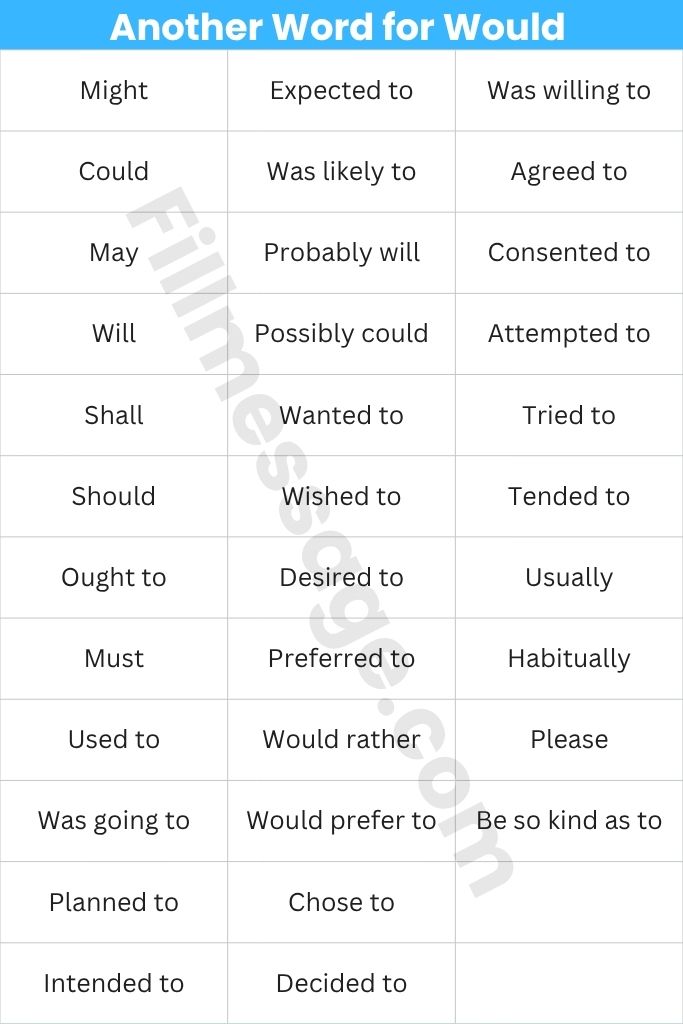
| Alternative | Best Used For | Tone |
| Might | Uncertain possibility | Neutral |
| Could | Ability or possibility | Neutral |
| May | Formal possibility | Formal |
| Will | Definite future | Direct |
| Shall | Formal suggestion | Very formal |
| Should | Advice or expectation | Moderate |
| Ought to | Strong moral duty | Firm |
| Must | Necessity or certainty | Strong |
| Used to | Repeated past habit | Casual/neutral |
| Was going to | Past intention | Neutral |
| Planned to | Definite past plan | Neutral |
| Intended to | Purpose or aim | Neutral/formal |
| Expected to | Anticipated outcome | Neutral |
| Was likely to | Past probability | Neutral |
| Probably will | Probable outcome | Casual |
| Possibly could | Uncertain ability | Casual |
| Wanted to | Past desire | Casual |
| Wished to | Formal desire | Formal |
| Desired to | Strong or formal desire | Formal |
| Preferred to | Choice or preference | Neutral |
| Would rather | Personal preference | Casual |
| Would prefer to | Polite preference | Polite |
| Chose to | Deliberate decision | Neutral |
| Decided to | Firm decision | Direct |
| Was willing to | Readiness or consent | Neutral |
| Agreed to | Acceptance | Neutral |
| Consented to | Formal permission | Formal |
| Attempted to | Trying something | Neutral |
| Tried to | Effort or attempt | Casual |
| Tended to | Typical behavior | Neutral |
| Usually | Regular past behavior | Casual |
| Habitually | Repeated action | Formal |
| Please | Polite command | Casual/formal |
| Be so kind as to | Very polite request | Very formal |
Would Synonym Grouped by Meaning: Use These, Not Just Any of Them
1. Possibility and Uncertainty
When “would” signals something that might happen, these carry the same weight:
- Might – softer uncertainty (“It might work out”)
- Could – possible ability or outcome (“We could reschedule”)
- May – formal or official possibility (“The results may vary”)
- Probably will – leaning toward yes, but not certain (“She probably will agree”)
- Possibly could – even more hesitant (“The fix possibly could help”)
The real difference here is confidence level. “May” sounds official. “Might” sounds unsure. “Could” sits in the middle.
2. Past Habits and Repeated Actions
This is one area where writers often miss the better word. “Would” for past habits can be replaced with:
- Used to – best for things that no longer happen (“He used to run every morning”)
- Tended to – shows a pattern without stating it stopped (“She tended to overthink things”)
- Usually – simple and clean for regular behavior (“They usually arrived late”)
- Habitually – more formal, fits professional or academic writing (“The process habitually failed under pressure”)
Note: “used to” implies the habit is over. “Usually” does not carry that implication. This is a common mix-up.
3. Past Intentions That Did Not Happen
These replace “would” when someone planned something but it fell through:
- Was going to – clear implication of a broken plan (“She was going to reply but forgot”)
- Planned to – more deliberate, suggests a real plan existed (“They planned to launch in spring”)
- Intended to – formal and purposeful (“He intended to address the concerns”)
- Wanted to – shows desire, not necessarily a plan (“I wanted to call you back”)
4. Decisions and Willingness Would Synonym
When “would” reflects a choice someone made, these are more precise:
- Chose to – active and deliberate (“She chose to stay quiet”)
- Decided to – firm resolution (“He decided to leave early”)
- Was willing to – consent or readiness (“They were willing to compromise”)
- Agreed to – acceptance of something proposed (“She agreed to help out”)
- Consented to – formal, often used in legal or medical contexts (“The board consented to the changes”)
5. Requests and Polite Phrases
“Would you…” is one of the most common polite forms in English. Replacements include:
- Please – direct and simple (“Please send the report”)
- Could you – slightly less formal than “would you” (“Could you check this again?”)
- Be so kind as to – very formal, used in letters or official writing (“Would you be so kind as to confirm receipt?”)
- Shall we – for suggestions rather than requests (“Shall we move on to the next point?”)
6. Advice, Duty, and Expectation
These replace “would” when expressing what someone should do or what is expected:
- Should – the most common swap for advice (“You should back up your files”)
- Ought to – slightly stronger moral weight (“You ought to inform them directly”)
- Must – no room for debate (“This must be reviewed before publishing”)
- Will – used when an outcome is almost certain (“The process will take three days”)
Another Word for Would in Sentence Rewrites: Seeing the Difference in Action
Seeing alternatives in full sentences makes the choice clearer.
Original: “She would call every Sunday without fail.”
- Formal: “She habitually called every Sunday without exception.”
- Casual: “She used to call every Sunday, no matter what.”
- Academic: “Her behavior reflected a consistent pattern of weekly contact.”
- Creative: “Every Sunday, the phone rang, predictable as clockwork.”
Original: “He said he would finish the project by Friday.”
- Professional email: “He confirmed he intended to complete the project by Friday.”
- Casual: “He told me he planned to wrap it up by Friday.”
- Direct: “He promised delivery by Friday.”
Original: “Would you like me to review that for you?”
- Polite/formal: “Shall I review that for you?”
- Casual: “Want me to take a look?”
- Very formal: “I would be glad to review this on your behalf, should you wish.”
Each version delivers the same core message. But the word choice shapes how confident, warm, distant, or professional the sentence feels.
Formal Another Word for Would vs. Casual: Where Each Alternative Belongs
If you are writing a professional email or report:
- Use: intended to, consented to, was willing to, shall, ought to
- Avoid: wanted to, used to (too conversational), probably will (too vague)
If you are writing casual conversation or dialogue:
- Use: might, could, used to, tried to, wanted to, probably will
- Avoid: habitually, consented to, desired to (too stiff)
If you are writing academic or formal essays:
- Use: may, habitually, tended to, was likely to, was expected to
- Avoid: usually, wanted to, be so kind as to (not appropriate for academic tone)
If you are writing fiction or creative work:
- Use: chose to, tried to, was going to, used to
- These carry more emotional weight and character voice than neutral options like “intended to”
Common Mistakes to Watch For
Mixing up “used to” and “would” for past habits
Both work for repeated past actions. But “used to” also works for past states (“I used to be shy”). “Would” does not work the same way. You cannot say “I would be shy” to mean a past state. This is where the swap fails.
Using “may” when you mean “might”
“May” often implies permission or formal possibility. “Might” suggests lower probability. In formal writing, the distinction matters more than people realize. “The merger may proceed” reads differently from “the merger might proceed.”
Treating “shall” as a straight swap for “will”
“Shall” carries suggestion or invitation in questions (“Shall we go?”). As a replacement for future “would,” it can sound old-fashioned or overly ceremonial in casual contexts.
Overusing “should” as a generic replacement
“Should” implies obligation or advice. If you use it to replace a conditional “would,” the meaning shifts. “I would go if invited” is not the same as “I should go if invited.”
Related Another Word for Would Worth Knowing
These are not direct synonyms for “would” but they work closely with it:
- Might have – past possibility that did not happen (“She might have called, but we will never know”)
- Could have – past ability or missed opportunity (“They could have warned us”)
- Should have – past regret or criticism (“He should have checked first”)
- Was about to – very close past intention, interrupted (“I was about to reply when the meeting started”)
Each of these paired forms handles a slightly different shade of meaning. They are worth learning alongside the core list.
Read also:
15 Another Word for Blue: Precise Alternatives for Every Writing Context
33 Another Word for Wholeheartedly: Synonyms That Actually Fit
FAQ’s about Would Synonym
Is “could” always a safe replacement for “would”?
Not always. “Could” emphasizes ability or possibility. “Would” often signals intention or habit. In “she would help if asked,” swapping in “could” changes the meaning from willingness to capability. Check what the sentence is really saying before making the swap.
Can I use “will” instead of “would” in formal writing?
“Will” is more direct and confident than “would.” In formal writing, this can actually be an improvement when you want to sound assured rather than tentative. But in conditionals (“I would go if…”), “will” does not work. The sentence structure matters.
Why does “used to” feel different from “would” even though both describe past habits?
“Used to” signals that the habit has ended. “Would” in past habit context does not carry that finality on its own. It just describes repeated action. This is why “used to” often feels more personal or nostalgic, while “would” stays more neutral.
When is “ought to” better than “should”?
“Ought to” carries a slightly stronger moral or ethical tone. It works well when the duty is obvious or universally agreed upon. “Should” is softer and more open to debate. In formal documents or ethical discussions, “ought to” signals that something is clearly the right thing to do, not just a suggestion.
The Takeaway
“Would” is flexible, which makes it easy to overuse. The fix is not avoiding it entirely. It is knowing what specific job it is doing in each sentence and picking the word that does that job more precisely.
For past habits, reach for “used to” or “tended to.” For formal requests, try “shall” or “please.” For advice, “should” or “ought to” will serve you better. For intentions, “planned to” or “intended to” carry more weight.
Once you match the replacement to the meaning, your writing gets cleaner without any extra effort.

Marco Jr. is Author at fillmassage.com,
He explores the world of words and their meanings, helping readers understand language clearly. Passionate about explanations that guide and inform, he creates insightful content that educates, engages, and supports curious minds every day.