Most writers reach for “integrity” out of habit. It fits, it sounds serious, it carries weight. But repeat it three times on one page and something happens — the word flattens. Readers stop feeling it.
The bigger issue? “Integrity” means different things depending on where you use it. A person’s moral integrity, the integrity of a bridge, the integrity of a dataset — three completely different ideas wearing the same word. Swapping them carelessly causes real confusion. This guide gives you 38+ Another Word for Integrity organized by meaning, tone, and context so you always reach for the right one.
What the Word Actually Holds
Integrity isn’t just honesty. It’s wholeness. In people, it means living by your values consistently, even privately, even when it costs something. In physical structures, it means unbroken and load-bearing. In data and science, it means uncorrupted, accurate, and repeatable.
Three meanings. Three separate replacement pools. Most synonym lists ignore this. This one doesn’t.
Quick-Access Another Word for Integrity Table
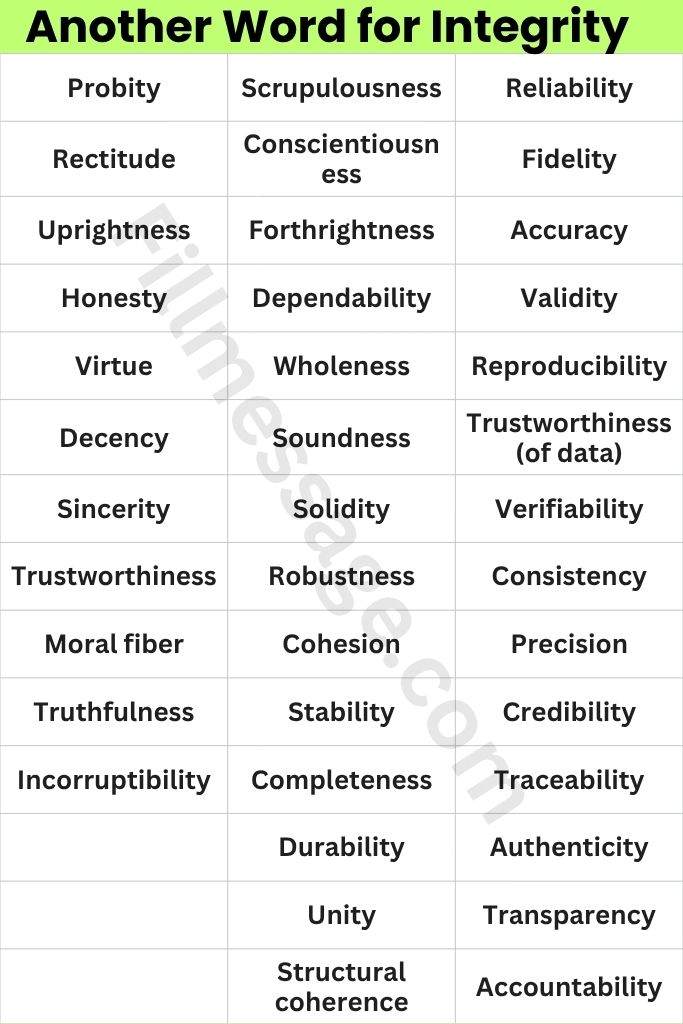
| Word | Tone | Best Context |
| Probity | Formal | Legal, institutional, ethics writing |
| Rectitude | Formal | Essays, moral arguments, literature |
| Uprightness | Neutral-formal | Character profiles, narrative writing |
| Honesty | Everyday | Any general audience writing |
| Virtue | Positive | Admirable personal qualities |
| Decency | Warm | Emotional, human-centered writing |
| Sincerity | Personal | Genuine character, heartfelt contexts |
| Trustworthiness | Professional | Leadership, work, relationships |
| Moral fiber | Idiomatic | Storytelling, opinion pieces |
| Truthfulness | Moral | Personal honesty in any register |
| Incorruptibility | Strong-formal | Politics, power, high-stakes ethics |
| Scrupulousness | Precise | Detail-oriented ethical conduct |
| Conscientiousness | Neutral | Work ethic, thoroughness, care |
| Forthrightness | Direct | Open, transparent communication |
| Dependability | Warm-professional | Reliability of a person over time |
| Wholeness | Neutral | Systems, bodies, ideas, inner state |
| Soundness | Technical | Engineering, logic, legal evaluation |
| Solidity | Physical | Material strength, firm structure |
| Robustness | Technical | Systems or structures under pressure |
| Cohesion | Academic | Unified structure or argument |
| Stability | Neutral | Consistent structure or system |
| Completeness | Neutral | Nothing missing, fully formed |
| Durability | Physical | Long-lasting physical resistance |
| Unity | Conceptual | Parts forming one functioning whole |
| Structural coherence | Technical | Internal consistency of a system |
| Reliability | Scientific | Repeatable results, consistent data |
| Fidelity | Precise | Exact data reproduction, no corruption |
| Accuracy | Scientific | Correctness of measurements or facts |
| Validity | Academic | Research methods, logical soundness |
| Reproducibility | Research | Same results under same conditions |
| Trustworthiness (of data) | Technical | Confidence in dataset or output |
| Verifiability | Research | Can be independently confirmed |
| Consistency | Data/Research | Uniform results across trials |
| Precision | Scientific | Exactness of measurement |
| Credibility | Broad | Believable, backed by evidence |
| Traceability | Technical | Auditable, trackable data or process |
| Authenticity | Broad | True to original form or nature |
| Transparency | Communication | Open, verifiable, nothing hidden |
| Accountability | Behavioral | Answerable for actions and outcomes |
Integrity Synonym Meaning Clusters: Where Each Word Actually Belongs
Moral and Ethical Character Integrity Synonym
This cluster is about people — their values, choices, and conduct when no one is watching.
Probity is the most formal here. It implies integrity that has been tested, not just assumed. Courts use it. Ethics boards use it. If you’re writing about someone in a position of institutional trust, probity fits better than any casual alternative.
Rectitude suggests someone guided by a firm moral code. It’s slightly literary. You’d find it in essays, biographical writing, or serious editorial pieces. It describes principled behavior rather than just good intentions.
Incorruptibility is strong. It says this person cannot be bought, threatened, or slowly worn down. Use it when the stakes are high and the pressure is real — political writing, whistleblower narratives, historical profiles.
Scrupulousness focuses on care and exactness in ethical decisions. It’s less about grand moral stands and more about never cutting corners, never letting small dishonesty slide.
Conscientiousness is softer. It fits workplace writing, performance reviews, and character references. It says: this person takes their responsibilities seriously.
Decency is the warmest word in this cluster. It doesn’t demand perfection — it says this person treats others right. Brilliant in human-interest writing, personal essays, and emotional storytelling.
Forthrightness adds directness to the mix. Someone forthright doesn’t just have good values, they communicate them openly. They say the difficult thing clearly.
Moral fiber is idiomatic, slightly old-fashioned, and exactly right in narrative or editorial writing. It suggests tested character, not just claimed character.
Physical Wholeness — Objects, Structures, Bodies Integrity Synonym
When you’re writing about anything you can touch, build, or break, moral synonyms sound wrong. These words do the actual work here.
Soundness is the most versatile in this cluster. Engineers check for structural soundness. Doctors assess the soundness of a patient’s constitution. Legal writers evaluate the soundness of a contract. It’s precise, trusted, and context-appropriate.
Solidity leans into physical strength. It says: this thing is dense, firm, built to hold weight. Best for writing about materials, foundations, or objects under load.
Robustness implies resistance to stress. A robust structure doesn’t just hold, it handles force. A robust system doesn’t fail when one part gets strained. Strong in engineering and systems writing.
Durability adds a time element. Not just strong now, but strong over time. Use it when longevity matters: materials science, product writing, construction.
Stability is useful when you’re describing something that holds its form under varying conditions. Geological writing, structural assessment, even emotional health writing uses this well.
Unity works when you’re describing parts that function as one. An object with unity doesn’t have weak seams or disconnected sections. It holds together as a single working thing.
Completeness is clean and direct. Nothing is missing. Every part is present and functioning. Works for physical objects, documents, and systems equally well.
Data, Science, and Research Integrity Synonym
This is the cluster most general synonym tools get wrong. Using moral or structural words in data contexts sounds imprecise at best, unprofessional at worst.
Fidelity is about exact reproduction. Data fidelity means the information arrived exactly as it was sent, nothing altered, nothing dropped. Audio fidelity means the sound matches the original recording. Use it when accuracy of reproduction is the specific concern.
Reliability means consistent performance across repeated conditions. A reliable dataset gives you the same result whether you run the test today or next month. Essential in scientific writing, quality control, and research methodology.
Validity asks: does this actually measure what it claims to measure? A valid test isn’t just consistent, it’s measuring the right thing. Central in psychology, education research, and clinical studies.
Reproducibility is the most specific word in this group. It means an independent researcher, using the same methods, gets the same result. This is a foundational concept in biology, chemistry, and any empirical field. Don’t replace it with “reliability” — they mean related but distinct things.
Verifiability says the claim can be checked. It can be confirmed by someone else using available evidence. Strong in philosophy of science and data governance writing.
Traceability is a data management term. It means every step in a process or data point can be tracked back to its source. Used in auditing, laboratory science, and quality assurance.
Credibility is broader. It works in journalism, research, and everyday writing. It asks: can this be believed and backed up?
Another Word for Integrity in Sentence Rewrites: Watching the Words Work
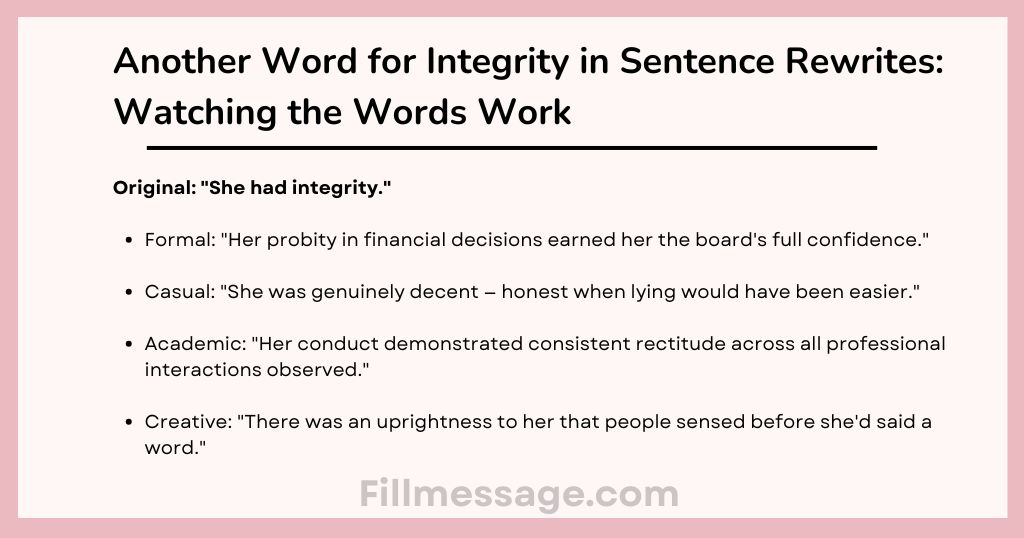
Original: “She had integrity.”
- Formal: “Her probity in financial decisions earned her the board’s full confidence.”
- Casual: “She was genuinely decent — honest when lying would have been easier.”
- Academic: “Her conduct demonstrated consistent rectitude across all professional interactions observed.”
- Creative: “There was an uprightness to her that people sensed before she’d said a word.”
Each version says something slightly different. “Probity” implies her integrity was tested. “Decent” makes her human. “Rectitude” makes her principled. “Uprightness” makes her quietly trustworthy. Same origin, four different portraits.
Original: “We must protect the integrity of the data.”
- Scientific: “Ensuring data fidelity and reproducibility across all trial phases is non-negotiable.”
- Technical: “Reliability checks must be completed before any dataset enters the analysis pipeline.”
- Academic: “The validity and accuracy of collected data must be preserved throughout the research process.”
Original: “The integrity of the building was at risk.”
- Engineering: “Structural soundness assessments were ordered immediately following the tremors.”
- Practical: “The robustness of the foundation became the central concern for the engineering team.”
- Formal report: “A comprehensive evaluation of the building’s stability and cohesion was conducted.”
Another Word for Integrity Formal vs. Informal: Knowing What Fits Where
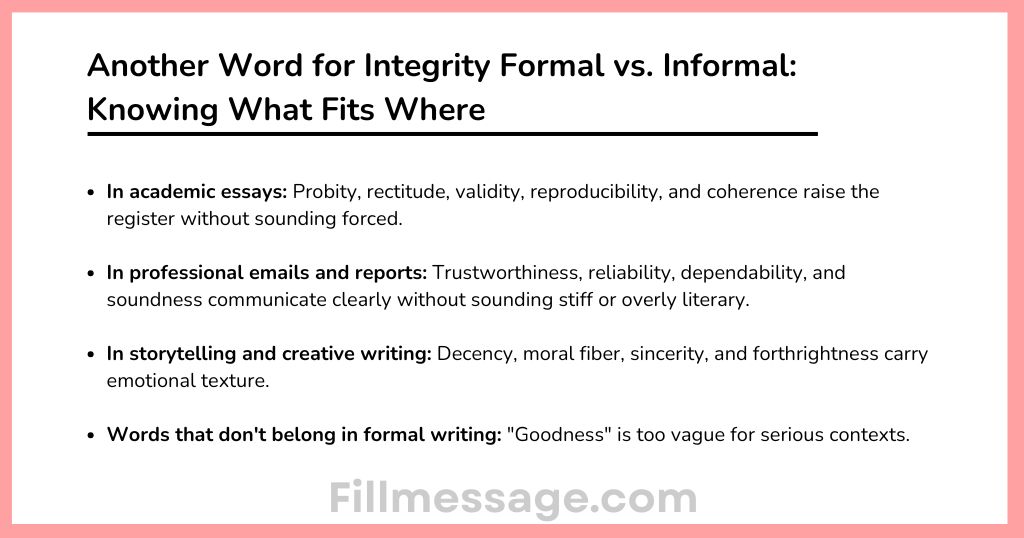
In academic essays: Probity, rectitude, validity, reproducibility, and coherence raise the register without sounding forced. They show precision.
In professional emails and reports: Trustworthiness, reliability, dependability, and soundness communicate clearly without sounding stiff or overly literary.
In storytelling and creative writing: Decency, moral fiber, sincerity, and forthrightness carry emotional texture. They feel like real people talking, not definitions walking.
Words that don’t belong in formal writing: “Goodness” is too vague for serious contexts. “Niceness” carries no professional weight. “Moral character” repeated more than once in a short piece becomes noise.
Mistakes That Undermine Good Writing
Mixing domain-specific words across contexts. “The honesty of the bridge” isn’t just awkward, it’s imprecise. Say “structural soundness” or “load-bearing stability.” Domain matters more than most writers realize.
Treating close synonyms as identical. Probity is tested, formal, almost legal. Decency is warm and human. Using probity in a casual piece about a neighbor sounds cold. Using decency in a legal ethics document sounds weak. The register has to match the room.
Overloading “trustworthiness” in leadership content. When every paragraph circles back to the same word, readers stop registering it. Rotate with dependability, reliability, or soundness of judgment to keep the writing alive.
Confusing research synonyms. Reliability and reproducibility overlap but are not the same. Reliability is consistency within a study. Reproducibility is what happens when an outside researcher tries to replicate the findings. In biology and lab science writing, this distinction matters.
Using antonyms carelessly. Corruption and dishonesty work against moral integrity. Fragility and instability work against structural integrity. Data corruption works against data integrity. The antonym has to match the type of integrity you started with.
Related Words That Often Travel With Integrity
Accountability is what integrity looks like when external pressure arrives. Integrity is internal. Accountability is how you respond when others can see you.
Transparency is integrity made visible in communication. You can be privately honest but publicly vague. Transparency closes that gap.
Consistency is integrity extended through time. Doing the right thing once is a good choice. Doing it repeatedly, across different conditions, is closer to what integrity actually means.
Authenticity overlaps with integrity but focuses inward. Integrity asks: am I being good? Authenticity asks: am I being true to myself? Both matter, but they’re answering different questions.
These four words frequently appear alongside integrity in leadership writing, research ethics, and personal development content. Knowing their edges helps you use each one exactly where it belongs.
Read more:
Another Word for Having: 50+ Synonyms That Actually Fit Your Writing
40+ Another Word for Care: The Right Word for Every Situation
FAQ’s about Another Word for Integrity
1. What is the best another word for integrity in everyday writing?
For most situations, honesty, trustworthiness, decency, and uprightness are the easiest and most natural choices. Pick the one that matches your sentence instead of using the same word every time.
2. Are honesty and integrity the same?
Not exactly. Honesty means telling the truth, while integrity is broader. It includes honesty, strong values, fairness, and doing the right thing even when no one is watching.
3. Which synonym works best in professional or business writing?
Words like trustworthiness, probity, dependability, and accountability work well in professional writing because they sound clear, respectful, and precise without being overly formal.
4. Can I use the same synonym for people, buildings, and data?
No. The context matters. Use words like probity or decency for people, soundness or stability for structures, and reliability, validity, or fidelity for research and data.
Final Thought
The right synonym for integrity doesn’t just fill the space left by the original word. It adds something sharper — a clearer sense of what kind of wholeness you mean, what tone fits the context, and what the reader should actually take away.
Use probity when honesty has been earned and tested. Use soundness when something physical needs to hold. Use fidelity when data must arrive exactly as it left. Use decency when you want the word to land in someone’s chest, not just their mind.
That’s what word choice actually does. It doesn’t just describe — it decides how something is understood.

Marco Jr. is Author at fillmassage.com,
He explores the world of words and their meanings, helping readers understand language clearly. Passionate about explanations that guide and inform, he creates insightful content that educates, engages, and supports curious minds every day.