Word choice shapes how people receive your message. When you write about race and racism, the word you pick either clarifies your point or blurs it. “Racist” is direct and necessary, but it is not always the most precise option. A remark, a hiring decision, a law, and a person’s core belief system are all different things. They deserve different words.
This guide gives you 27+ Another Word for Racist, grouped by meaning, with tone guidance and real sentence examples so you can choose confidently every time.
What the Word Actually Covers
“Racist” describes a belief, behavior, or system that treats people unequally based on race, usually in a harmful way. It carries serious emotional weight. It applies to people, language, actions, and entire institutions. That range is exactly why a single replacement rarely works across all situations.
Quick-Access: 27+ Another Word for Racist
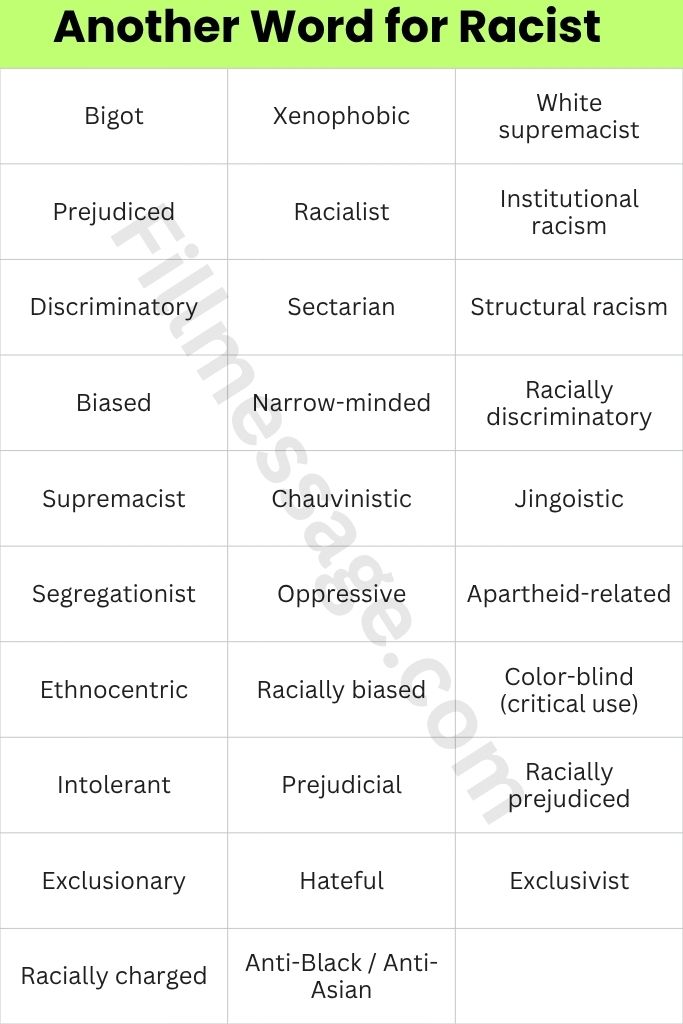
| Word or Phrase | Tone | Best Used For |
| Bigot | Strong, personal | Person with fixed racial hatred |
| Prejudiced | Moderate | Person or behavior showing unfair assumptions |
| Discriminatory | Formal, neutral | Actions, policies, hiring, or treatment |
| Biased | Mild to moderate | Subtle or unconscious racial unfairness |
| Supremacist | Very strong | Belief that one race is superior |
| Segregationist | Formal, historical | Person or policy enforcing racial separation |
| Ethnocentric | Academic | Viewing other cultures as inferior to one’s own |
| Intolerant | Mild to moderate | Rejection of racial difference |
| Exclusionary | Formal | Policies or systems that shut people out |
| Xenophobic | Moderate to strong | Hostility toward outsiders or foreigners |
| Racialist | Formal, rare | Someone who assigns fixed traits to races |
| Sectarian | Formal | Identity-based division including racial lines |
| Narrow-minded | Mild, casual | Resistance to accepting people who differ |
| Chauvinistic | Moderate | Blind loyalty to one group over all others |
| Oppressive | Strong, systemic | Systems or structures causing racial harm |
| Racially biased | Formal | Actions or words showing racial unfairness |
| Prejudicial | Formal, legal | Influencing judgment unfairly by race |
| Hateful | Emotional, strong | Speech or content designed to demean by race |
| Racially charged | Careful, neutral | Language carrying racial tension |
| Anti-Black / Anti-Asian | Direct, specific | Racism targeting one particular racial group |
| White supremacist | Very specific | Ideology asserting white racial dominance |
| Institutional racism | Systemic, formal | Racial inequality embedded in organizations |
| Structural racism | Academic, systemic | Deep societal patterns of racial harm |
| Racially discriminatory | Formal, legal | Unequal treatment documented at policy level |
| Jingoistic | Political | Extreme nationalism with racial contempt |
| Apartheid-related | Historical | Formally enforced legal racial separation |
| Color-blind (critical use) | Ironic, analytical | Denying race to avoid accountability |
| Racially prejudiced | Moderate, formal | Person or statement shaped by racial bias |
| Exclusivist | Formal, rare | Belief that one group deserves exclusive status |
Another Word for Describing a Racist Person
The word “racist” applied to a person is an identity claim. Sometimes that is exactly right. Other times, you are describing someone whose behavior reflects bias without knowing the full depth of their beliefs. These distinctions matter in writing.
Bigot suits someone with rigid, unapologetic hatred. It implies the person has heard other views and rejected them.
Supremacist is stronger and more specific: it signals a belief in racial hierarchy, not just discomfort or dislike. Use it only when that ideology is clearly present.
Prejudiced person works when bias seems rooted in upbringing, ignorance, or cultural conditioning rather than deliberate hatred. It is less of a verdict and more of an observation.
Intolerant is softer still, useful when the person resists difference but has not demonstrated open hostility.
Segregationist belongs in political or historical writing. It describes someone who actively supports racial separation, whether in 1960s policy debates or contemporary discussions of school segregation.
Another Word for Describing Racist Behavior or Language
A racially harmful comment does not always mean the speaker holds a defined ideology. When your focus is the act, not the full identity of the person, these words do better work.
Discriminatory is the most versatile formal choice here. It fits speech, actions, hiring decisions, and patterns of treatment equally well.
Biased is useful for subtle or unconscious unfairness, though it can understate deliberate harm if used carelessly.
Racially charged describes language that carries racial tension without being overtly hateful. It is a careful word, good for journalism.
Hateful applies when content is designed specifically to demean or dehumanize.
Prejudicial fits legal or formal contexts where you are arguing that something unfairly influenced a judgment or outcome.
Another Word for Describing a Racist Policy or System
This is where many writers reach for “racist” when a more precise term would be stronger. Policies do not hold beliefs; they produce outcomes. The language should reflect that.
Institutional racism names the way organizations can produce racially unequal results even without intending to.
Structural racism goes wider, pointing to long-term patterns across society, not just one institution. Both terms are standard in academic and policy writing.
Discriminatory policy is direct and usable in any formal writing.
Exclusionary captures systems or rules that effectively block certain racial groups.
Oppressive works when you want to name the harm caused, not just the mechanism.
Another Word for Racist in Sentence Rewrites: Seeing the Difference
Original: “His comment was racist.”
- Formal: “His remark was racially discriminatory.”
- Journalistic: “The comment drew criticism for its racial bias.”
- Academic: “The statement reflected ethnocentric assumptions embedded in his framing.”
- Careful/neutral: “His words were racially charged and widely condemned.”
Original: “She is racist.”
- Formal: “She holds racially prejudiced views.”
- Legal context: “She demonstrated discriminatory behavior on racial grounds.”
- Narrative writing: “Her words revealed a deep intolerance toward people of other races.”
- Direct: “She is a bigot whose bias consistently targets people by race.”
Original: “The policy was racist.”
- Academic: “The policy reflected structural racism in both design and application.”
- Journalistic: “The policy produced racially discriminatory outcomes.”
- Advocacy: “The policy was built on exclusionary racial assumptions.”
- Formal/legal: “The policy was found to be racially prejudicial in its effects.”
Original: “That joke was racist.”
- Direct: “That joke was racially prejudiced.”
- Analytical: “That joke reinforced harmful racial stereotypes through humor.”
- Blunt: “That joke was bigoted and caused real offense.”
- Critical writing: “The joke functioned as racially charged content dressed as comedy.”
Each rewrite does something different. The academic version names the thinking pattern. The journalistic version centers the reaction. The legal version focuses on demonstrable effect. Picking the right one is not about softening the truth; it is about targeting your meaning precisely.
Another Word for Racist Formal vs. Casual: What Fits Where
Academic or research writing: structural racism, institutional racism, ethnocentric, racially discriminatory, prejudicial, racially biased. These terms have scholarly grounding and hold up under citation-style argument.
Professional or workplace writing: discriminatory, exclusionary, racially prejudiced, biased. Keep it precise and evidence-based. Avoid emotionally loaded words unless documenting a clear pattern.
Storytelling and creative writing: bigoted, intolerant, hateful, prejudiced. These words give characters real dimension. Showing behavior rather than labeling it is often even more effective in fiction.
Words to avoid in formal writing: “narrow-minded” understates serious harm. “Jingoistic” applies to nationalism more than race unless both are explicitly present. “Color-blind,” used without critical framing, creates confusion rather than clarity.
Common Mistakes to Avoid Racist Synonym
Using “prejudiced” as a universal swap. Prejudice applies to age, gender, religion, and more. When you mean race specifically, either say so or use a more targeted term like “racially prejudiced.”
Using “biased” for deliberate harm. Bias implies it might be unconscious. When the behavior is intentional, “biased” understates it. “Discriminatory” or “hateful” is more accurate.
Calling a system “bigoted.” Bigotry is personal. Systems reflect practices, not beliefs. Use “institutionally racist,” “structurally discriminatory,” or “racially exclusionary” instead.
Confusing “xenophobic” with “racist.” Xenophobia is about fear of outsiders or foreigners. It overlaps with racism but is not the same. A person can be racist toward someone of the same nationality. Be precise.
Treating “ethnocentric” as mild racism. Ethnocentrism is a specific cognitive pattern. It is not a gentler version of racist. Using it loosely weakens the analytical point you are trying to make.
Using “racially charged” to avoid accountability. This phrase describes tension or implication. When something is plainly racist, calling it “racially charged” can soften accountability in a misleading way.
Racist Synonym Related Words Worth Knowing
These are not synonyms but appear frequently in the same conversations. Knowing the difference strengthens your writing.
Stereotype is an oversimplified assumption about a group. Racist behavior often uses stereotypes, but a stereotype does not always rise to the level of racism on its own.
Colorism is discrimination based on skin tone, often within the same racial group. It overlaps with racism but operates differently and deserves its own label.
Nativism is the preference for native-born citizens over immigrants. It has strong racial dimensions but is rooted in national identity rather than race alone.
Implicit bias refers to unconscious preferences or assumptions that affect judgment. It is useful in clinical or workplace writing to name low-level racial unfairness without asserting deliberate intent.
Racial profiling describes a specific act: making decisions about someone based on race, most often in policing or security contexts. It is a subset of discriminatory behavior, not a synonym for racism itself.
Read also:
38+ Another Word for Access: Pick the Right Word Every Time
Another Word for Home: 41+ Alternatives for Every Meaning and Situation
FAQs about Another Word for Racist
Is “bigot” a direct synonym for “racist”?
Not exactly. A bigot holds stubbornly intolerant views toward any group, whether defined by race, religion, or something else. If you use “bigot” to mean racist, the racial meaning may get lost. “Racial bigot” is clearer when race is the focus.
Can a policy be racist if nobody intended harm?
Yes. This is where “structural racism” or “discriminatory outcome” becomes the right language. Intent and impact are different things. When writing about policies, focusing on documented outcome rather than assumed motive produces more accurate and defensible language.
When is “discriminatory” stronger than “racist”?
In legal and institutional writing, “discriminatory” often carries more formal weight because it connects to documented behavior and legal standards. “Racist” is a moral charge. “Discriminatory” can be a legal one. Both are valid, but they work differently.
Is “racially charged” just a softer way of saying racist?
Sometimes, yes. When something is clearly racist, “racially charged” can sound like avoidance. The phrase is accurate when describing language that implies racial tension without being explicit. When the meaning is unambiguous, name it directly.
Final Thought
The most useful alternative is always the most precise one. Start by identifying the category: person, behavior, language, policy, or system. Then match the word to that category and the tone your writing requires.
“Racist” is not a weak word. There are times it is the clearest, most honest option. But when your meaning is more specific, these 27+ alternatives give you the precision to say exactly what you mean, and that precision is what makes writing credible.

Marco Jr. is Author at fillmassage.com,
He explores the world of words and their meanings, helping readers understand language clearly. Passionate about explanations that guide and inform, he creates insightful content that educates, engages, and supports curious minds every day.