Most writers don’t have a problem with the word “resistance.” They have a problem with using it three times in two paragraphs and not knowing what to reach for instead.
Or they’re writing something tender and “resistance” sounds like a military report. Or something technical where “resistance” feels too vague. The word does a lot of jobs, but it can’t do all of them well at the same time.
That’s the real reason you’re here. Not just a list, but the right word for the right moment.
What Makes This Word Tricky to Replace
“Resistance” is unusual because it works across completely different worlds: emotion, politics, physics, medicine, relationships, and storytelling. A synonym that fits one world can sound completely wrong in another.
That’s why a random thesaurus list often fails writers. You need to know not just what the word means, but where it lives.
Quick-Access Another Word for Resistance Table
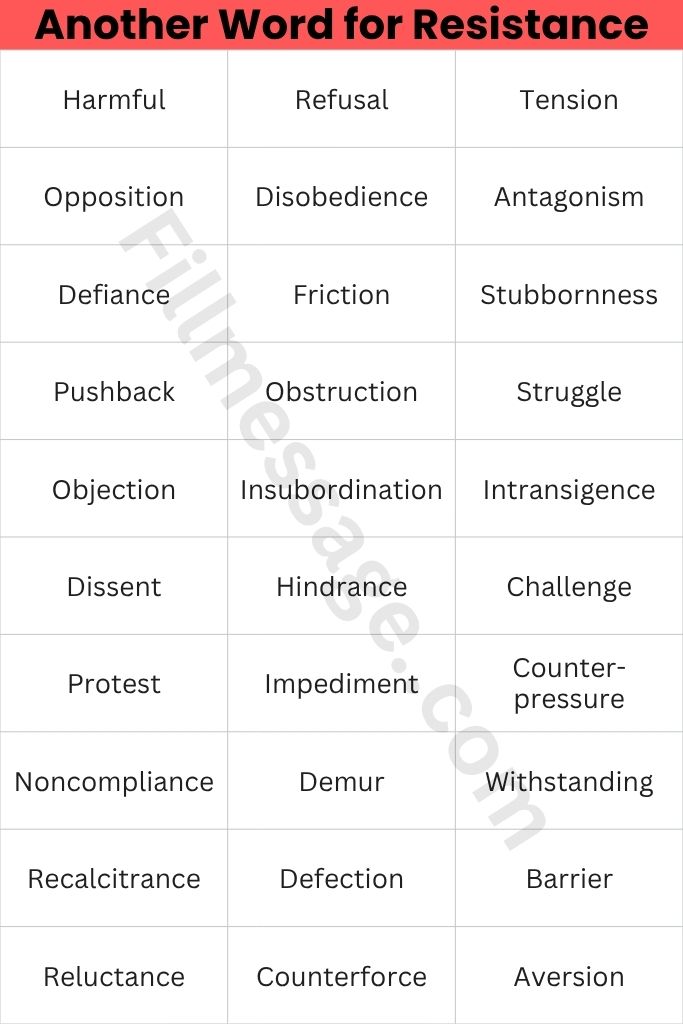
| Word | Tone | Best Used When |
| Opposition | Formal, neutral | Essays, debates, policy writing |
| Defiance | Bold, charged | Refusing authority openly and knowingly |
| Pushback | Casual, direct | Workplace talk, everyday conversations |
| Objection | Polite, formal | Disagreeing with a proposal or idea |
| Dissent | Intellectual, formal | Disagreeing with a group or majority view |
| Protest | Public, expressive | Voiced or visible group opposition |
| Noncompliance | Clinical, neutral | Medical, legal, policy rule-breaking |
| Recalcitrance | Strong, formal | Stubborn refusal in legal or academic writing |
| Reluctance | Soft, internal | Hesitation, not wanting to act |
| Refusal | Blunt, clear | Saying no directly and firmly |
| Disobedience | Critical, behavioral | Breaking rules or ignoring expectations |
| Friction | Subtle, figurative | Low-level ongoing tension between people |
| Obstruction | Firm, structural | Something blocking progress intentionally |
| Insubordination | Hierarchical | Refusing to follow a superior’s direction |
| Hindrance | Mild, descriptive | Something slowing things down passively |
| Impediment | Neutral, formal | A barrier slowing movement or progress |
| Demur | Quiet, polite | A gentle hesitation or soft refusal |
| Tension | Atmospheric, subtle | Underlying conflict not yet spoken aloud |
| Antagonism | Hostile, active | Ongoing unfriendliness or active opposition |
| Stubbornness | Informal, personal | Refusing to shift position without reason |
| Struggle | Emotional, physical | Fighting through difficulty or pressure |
| Intransigence | Political, uncompromising | Refusing to negotiate or budge at all |
| Challenge | Open, neutral | Testing or questioning authority or ideas |
| Counter-pressure | Situational | When one force actively works against another |
| Withstanding | Resilient, active | Enduring force without breaking or giving in |
| Defection | Sharp, specific | Abandoning a cause or switching sides |
| Barrier | Structural, figurative | Something physically or mentally blocking the way |
| Counterforce | Technical, neutral | A force working directly against another |
| Aversion | Psychological | A deep internal resistance to something |
Another Word for Resistance Meaning Clusters: Where Each Word Actually Belongs
This is where most synonym lists fall short. Dumping 30 words without explaining the differences between them doesn’t help a writer choose. Here’s how these words actually sort themselves.
The Internal, Emotional Layer
Some resistance lives entirely inside a person. They’re not fighting anyone. They’re just not ready, not willing, or quietly afraid.
Reluctance fits this space best. It’s personal and soft. “She felt reluctance about the move” puts the reader inside her experience.
Demur is even gentler, almost old-fashioned in feel. Someone who demurs isn’t being difficult. They’re pausing, questioning quietly before they respond.
Aversion goes deeper. It’s not just hesitation; it’s an almost instinctive pull away from something. “He had a strong aversion to confrontation” tells you something about who this person is.
Stubbornness is internal resistance with an edge of irrationality. The person knows they might be wrong and doesn’t care. It works best in casual or personal writing.
The Bold, Outward Layer
When resistance becomes visible, it changes character entirely.
Defiance is the loudest word in this group. It carries attitude and intention. Someone who is defiant knows what’s expected and is choosing something else on purpose.
Protest is public defiance. It involves voice, action, presence. A protest isn’t private.
Dissent is more intellectual. A scientist might dissent from the dominant theory. A judge writes a dissenting opinion. It’s disagreement expressed through reasoning rather than action.
Insubordination is specific to hierarchy. It only exists when someone refuses an instruction from a person above them. Outside that structure, the word doesn’t quite work.
The Structural, Systemic Layer
Sometimes resistance isn’t a person at all. It’s a system, a barrier, a force.
Obstruction suggests something blocking a path, often with intent. It appears naturally in legal language: obstruction of justice, obstruction of progress.
Impediment is more neutral. It’s a barrier, but not necessarily a hostile one. A stutter is an impediment. A bureaucratic process can be an impediment.
Hindrance is the softest of the three. It’s more about slowing things down than stopping them outright.
Friction works beautifully when the opposition is ongoing and low-level. Two colleagues who never quite get along create friction. It rarely signals one dramatic moment; it signals accumulated tension.
The Political and Formal Layer
Opposition is the safest formal swap for resistance in most essay and report writing. It’s neutral, widely understood, and never feels out of place in academic or professional contexts.
Recalcitrance is stronger and more specific. It signals not just disagreement but a determined, almost prideful refusal to cooperate. It fits legal writing, political analysis, and formal essays well.
Intransigence signals total unwillingness to compromise. Politicians describe opposing parties as intransigent during failed negotiations. It’s a serious word with a serious tone.
Noncompliance is clinical and measured. Healthcare workers, policymakers, and legal professionals use it when someone isn’t following required guidelines. It describes behavior without assigning emotion.
Another Word for Resistance Sentence Rewrites: Watch the Word Do Different Work
Original: “There was resistance to the new policy.”
- Formal: “The policy encountered significant opposition from department heads.”
- Casual: “People really pushed back when the new policy dropped.”
- Academic: “Implementation was undermined by widespread noncompliance among key stakeholders.”
- Creative: “The new policy hit like a wall nobody had agreed to build.”
Original: “He showed resistance to changing his approach.”
- Formal: “He demonstrated clear reluctance to revise his methodology.”
- Casual: “He dug in and wouldn’t hear it.”
- Emotional: “Something in him shut down the moment anyone suggested a different way.”
Original: “The community’s resistance blocked the project.”
- Neutral: “Community friction created significant delays in the project timeline.”
- Direct: “The community’s refusal to cooperate stalled the project entirely.”
- Formal: “Sustained opposition from local stakeholders obstructed forward progress.”
In the emotional rewrite above, notice there’s no synonym at all. Sometimes describing the feeling beats naming it.
Read more – Another Word for Forever: 43+ Alternatives That Actually Fit Your Writing
Another Word for Resistance Formal vs. Casual: Placement Guide
Getting the register right matters as much as getting the meaning right.
Formal writing (essays, reports, legal, academic): opposition, dissent, noncompliance, recalcitrance, objection, impediment, intransigence, antagonism
Everyday and professional conversation: pushback, refusal, friction, reluctance, stubbornness, challenge
Storytelling and creative writing: defiance, tension, struggle, aversion, withstanding, barrier, counterforce
Handle with care in formal contexts:
- “Pushback” reads as too casual for academic papers or legal documents
- “Stubbornness” carries personal judgment and can sound unprofessional
- “Friction” is excellent figuratively but can confuse technical readers expecting a literal meaning
Common Mistakes That Change Your Meaning
Defiance vs. reluctance. These are not the same intensity. Defiance is active and proud. Reluctance is quiet and uncertain. A nervous person who avoids something is reluctant. A person who stares authority down and walks away is defiant. Swapping them accidentally changes your character’s entire personality.
Obstruction applied to people. Obstruction usually describes systems, processes, or things. Calling a person “an obstruction” is possible but sounds cold and deliberately distancing. In legal writing, that coldness is intentional. In personal or narrative writing, it can feel strange.
Protest vs. dissent. Protest is physical and visible. You march, you speak, you show up. Dissent is expressed through reasoning and recorded disagreement. A professor dissents in writing. A crowd protests in the street. The actions are different enough that the words shouldn’t be swapped freely.
Friction as a serious-conflict word. Friction signals something ongoing and low-level. If the situation you’re describing is explosive or has serious consequences, friction undersells it significantly. A legal battle is not friction. A heated argument between colleagues might be.
Struggle vs. defiance. Struggle focuses on effort and difficulty. Defiance focuses on choice and attitude. A person can struggle without choosing it. Defiance is always a choice.
Related Words That Live Near Resistance
These aren’t synonyms but they frequently appear in the same conversations and get confused with resistance-type words.
Resilience: Often mistaken for resistance. Resistance is pushing back against something. Resilience is recovering after it hits you. A resilient person bends. A resistant person holds firm. Different responses to the same pressure.
Compliance: The direct opposite of resistance. Knowing this word sharpens your understanding of the whole spectrum. When resistance breaks down, compliance begins.
Persistence: Resistance pushes back. Persistence pushes forward. One holds a position, the other keeps moving toward a goal. Writers sometimes blur these when describing determined characters.
Suppression: What happens to resistance when it’s overpowered or silenced. Useful in political, historical, or psychological contexts.
Endurance: Surviving pressure over time. Closer to resilience than resistance, but worth separating. Endurance doesn’t always involve pushing back; it involves lasting.
Read also:
46+ Another Word for Division: Right Word, Right Place
47+ Another Word for Toxic: Synonyms That Actually Fit the Situation
FAQs about Another Word for Resistance
Is “opposition” always a safe replacement for “resistance” in essays?
Usually yes, especially in formal academic writing. But watch for one difference: opposition tends to involve another party actively working against something. Resistance can be internal and individual. “She felt opposition” sounds strange. “She felt resistance” makes natural sense.
Can “pushback” work in a professional email?
It depends on the workplace culture. In tech, creative industries, or casual environments, pushback is completely normal and widely understood. In traditional or highly formal industries, lean toward “objection” or “reservations” instead.
What’s the real difference between defiance and disobedience?
Defiance is about attitude. It’s knowing, deliberate, and often proud. Disobedience is the act itself, the not-following of rules, without necessarily implying attitude behind it. A child can be disobedient by accident or fear. Defiance requires intent.
When should you just keep “resistance” and not replace it?
When it’s genuinely the most accurate word and you haven’t used it recently in the same passage. Resistance is a solid, precise word in the right context. Replace it when your meaning is more specific, when the tone doesn’t quite land, or when repetition is the problem.
How to Choose Quickly
When you’re stuck mid-sentence, run through this fast:
- Is the resistance internal and emotional? Use reluctance, aversion, or demur.
- Is it bold and visible? Use defiance, protest, or dissent.
- Is it structural or systemic? Use obstruction, impediment, or friction.
- Is it formal writing? Use opposition, noncompliance, or recalcitrance.
- Is it interpersonal and ongoing? Use tension, friction, or antagonism.
- Is it a flat refusal? Use refusal, rejection, or pushback.
Read the new word out loud in your sentence. If it sounds natural and doesn’t change the meaning you intended, you’ve found the right one. If something feels slightly off, it usually is.

Marco Jr. is Author at fillmassage.com,
He explores the world of words and their meanings, helping readers understand language clearly. Passionate about explanations that guide and inform, he creates insightful content that educates, engages, and supports curious minds every day.