You typed regulate and it felt wrong. Too stiff, too official, or just repeated one too many times. The word works, but it doesn’t always work well. A policy document and a personal essay need different language, even when the idea is the same.
Below are 44 real alternatives, sorted by meaning so you can find the right one fast.
What “Regulate” Actually Covers
At its core, regulate means to control, adjust, or oversee something so it stays within acceptable boundaries. It implies an ongoing process, not a single action. It sits somewhere between command and suggest, carrying quiet authority without aggression.
The challenge is that regulate stretches across very different situations. A thermostat regulates temperature. A government regulates industry. A parent regulates bedtime. Each needs a different word when you want precision.
All 44 Another Word for Regulate, Organized by Meaning
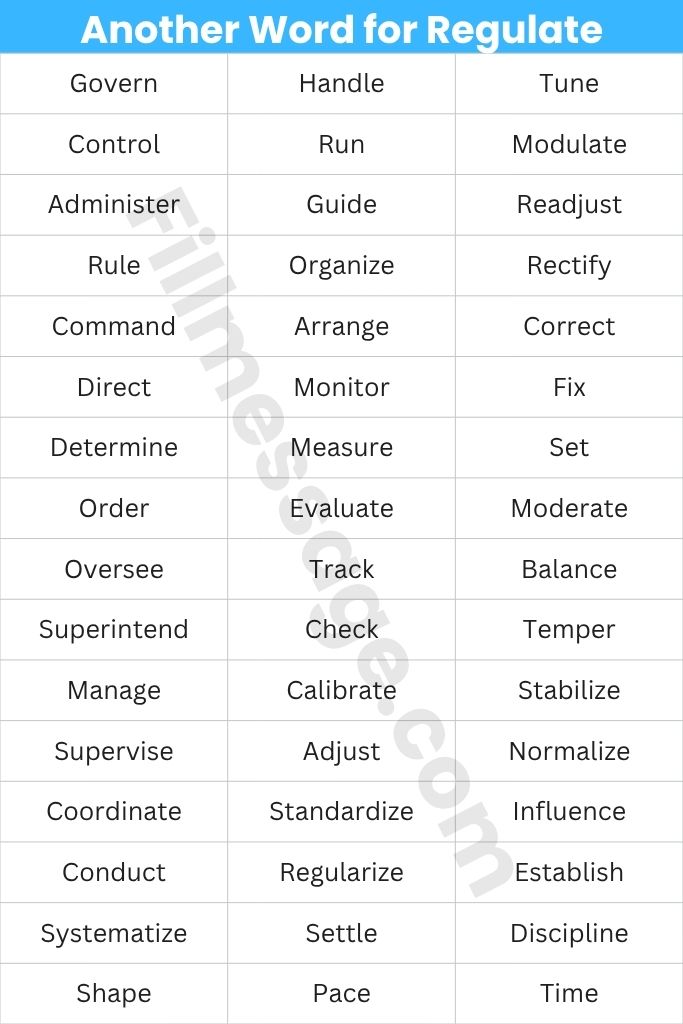
Instead of one long list, here they are grouped by what regulate actually means in each context. This is where most articles fall short by just dumping words without separation.
When Regulate Means: Authority and Control
These carry real power. Use them when someone or something holds formal or practical authority over a situation.
| Word | Tone | Best Used When |
| Govern | Formal | Laws, institutions, boards |
| Control | Neutral/firm | Direct authority over a system |
| Administer | Institutional | Managing official programs or systems |
| Rule | Strong/authoritative | Historical, legal, or forceful contexts |
| Command | Directive | Military, formal leadership |
| Direct | Clear/professional | Guiding behavior or workflow |
| Determine | Decisive | Deciding outcomes or setting conditions |
| Order | Authoritative | Commanding structure or sequence |
| Oversee | Supervisory | Watching with accountability |
| Superintend | Formal/rare | Formal oversight, less commonly used today |
Govern is the strongest fit when rules come from a structured system. “The agency governs food labeling” implies law-level authority. Control is more direct and personal. Administer suits institutions where someone manages a system fairly. Rule sounds forceful and works better in historical writing than modern business contexts.
When Regulate Means: Supervision and Management
These words describe the act of watching over, running, or handling ongoing activity.
| Word | Tone | Best Used When |
| Manage | Professional | Business operations, teams, projects |
| Supervise | Hands-on | Closely watching work in progress |
| Coordinate | Collaborative | Aligning multiple people or parts |
| Conduct | Procedural | Running experiments, reviews, operations |
| Handle | Casual/informal | Everyday problem management |
| Run | Informal | Operations, departments, daily tasks |
| Guide | Advisory | Direction without hard authority |
| Organize | Structural | Arranging things into working order |
| Arrange | Practical | Setting things in place or sequence |
Manage is the most versatile here but gets overused quickly. Coordinate implies multiple moving parts working together. Supervise is more hands-on than oversee, suggesting close proximity. Handle works in casual writing but loses credibility in formal reports.
When Regulate Means: Observation and Tracking
Sometimes regulate just means watching something carefully over time to make sure it stays on course.
| Word | Tone | Best Used When |
| Monitor | Observational | Tracking conditions, systems, or progress |
| Measure | Analytical | Quantifying and checking levels |
| Evaluate | Assessmental | Judging performance or status |
| Track | Informal/practical | Following progress over time |
| Check | Simple/direct | Quick or routine verification |
Monitor is the cleanest swap here. It implies continuous observation without necessarily intervening. Doctors monitor patients. Servers monitor traffic. It stays accurate without overpromising action. Measure works when numbers matter. Track is more casual and works well in project or fitness contexts.
When Regulate Means: Adjustment and Fine-Tuning
This group covers situations where regulate means making a correction, setting something precisely, or refining a process.
| Word | Tone | Best Used When |
| Calibrate | Technical/precise | Exact setting using reference standards |
| Adjust | Practical/everyday | Small, general corrections |
| Tune | Technical/light | Precision with a slightly creative feel |
| Modulate | Specialized | Controlled variation in signal, voice, or systems |
| Readjust | Corrective | A second or repeated correction |
| Rectify | Formal/corrective | Fixing a specific error or imbalance |
| Correct | Clear/direct | Broadly fixing something off-track |
| Fix | Informal | Quick corrections in casual contexts |
| Set | Simple | Establishing a value or condition |
Calibrate is the most specific. It suggests deliberate, skilled adjustment against a standard. “The technician calibrated the sensor” tells you exactly what happened. Adjust is the everyday version: looser, broader, still accurate. Tune lands between them, common in tech and audio contexts. Rectify works when something was clearly wrong and now it’s been corrected formally.
When Regulate Means: Keeping Things Stable or Balanced
These words describe the act of preventing extremes, maintaining equilibrium, or keeping a system steady.
| Word | Tone | Best Used When |
| Moderate | Balanced/softening | Preventing excess in either direction |
| Balance | Equilibrium | Two competing forces that must stay even |
| Temper | Subtle/softening | Reducing intensity in tone or action |
| Stabilize | Restorative | Returning something to a steady state |
| Normalize | Corrective | Bringing back to a standard range |
| Standardize | Procedural | Making consistent across a system |
| Regularize | Systemic | Making processes uniform after inconsistency |
| Systematize | Structural | Building organized, repeatable procedures |
Moderate shines when something risks going too far in any direction. A moderator keeps a debate fair. A thermostat moderates temperature. Temper is more subtle, often used for emotions or communication tone. “She tempered her response” implies restraint without full suppression. Stabilize focuses on restoring calm after instability, slightly different from ongoing regulation.
When Regulate Means: Shaping or Influencing Direction
These are softer synonyms where regulate implies gradual influence rather than hard control.
| Word | Tone | Best Used When |
| Shape | Figurative | Policy, habits, culture forming over time |
| Influence | Indirect | Affecting direction without full control |
| Establish | Foundational | Setting up a structure or rule |
| Settle | Calm/resolving | Bringing stability to disputes or conditions |
| Discipline | Behavioral | Managing conduct or reinforcing standards |
| Pace | Time-based | Controlling speed or rhythm of activity |
| Time | Scheduling | Controlling when something happens |
Shape works when you want to show gradual, deliberate influence. “These policies shape industry behavior” feels more natural than “regulate behavior” in analytical writing. Pace is underused and specific: it controls the speed of something, not just whether it happens. “She paced the team through the deadline” implies smart timing management.
Read also: Another Word for Culminating: 38 Alternatives That Actually Fit
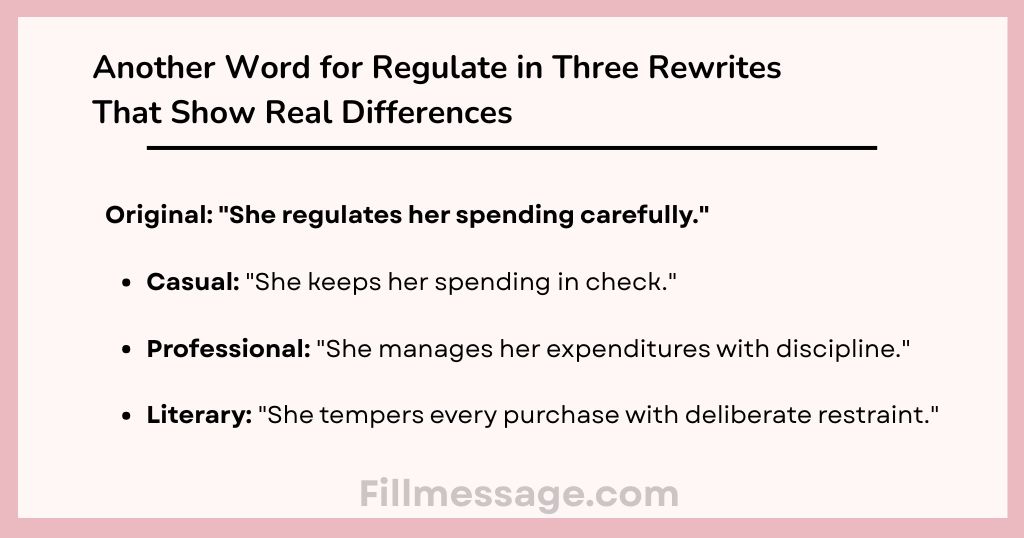
Another Word for Regulate in Three Rewrites That Show Real Differences
Original: “The government will regulate emissions from factories.”
- Formal/legal: “The government will govern emission standards across all manufacturing facilities.”
- Technical: “The government will monitor and calibrate emission levels at each facility.”
- Policy writing: “The government will establish clear limits to control factory emissions.”
Notice that govern raises the authority level. Monitor and calibrate breaks the action into specific steps. Establish focuses on the creation of a rule rather than the enforcement of one.
Original: “She regulates her spending carefully.”
- Casual: “She keeps her spending in check.”
- Professional: “She manages her expenditures with discipline.”
- Literary: “She tempers every purchase with deliberate restraint.”
Keeps in check feels human. Manages with discipline reads well in a profile or bio. Tempers adds personality and tone.
Original: “The body regulates blood pressure naturally.”
- Clinical: “The body stabilizes blood pressure through several automatic mechanisms.”
- Educational: “The body monitors and adjusts blood pressure continuously.”
- Simple: “The body keeps blood pressure balanced on its own.”
Here, regulate was vague. Breaking it into monitors and adjusts tells the reader more precisely what the body actually does.
Read also: 35 Another Word for Articulation: Precise Alternatives for Every Context
Mistakes Worth Avoiding on Regulate Synonym
Swapping “monitor” for “regulate” when action is implied. Monitoring is watching. Regulating includes responding. If someone is supposed to act on what they see, monitor alone undersells the responsibility.
Using “moderate” when authority is the real idea. Moderate softens. It’s the wrong word when firm control is the point. A judge doesn’t moderate a sentence. They determine it.
Treating “manage” and “govern” as identical. Manage is operational; govern is structural. A team leader manages daily work. A board governs the organization’s direction. The difference matters in formal writing.
Overloading “control.” It’s accurate in many contexts, but repeated control, controlled, controlling in one paragraph starts sounding rigid. Rotate with oversee, manage, or administer to avoid that effect.
Picking “standardize” when you mean “organize.” Standardize creates a consistent rule or format across many things. Organize arranges what already exists. “We standardized the form” means everyone now uses the same version. “We organized the forms” just means they were sorted.
Related Another Word for Regulate That Often Get Confused
Enforce sits next to regulate but is reactive. You enforce a rule after someone breaks it. Regulation is proactive; enforcement follows violation.
Restrict narrows options within a system. Regulate creates the whole framework. A policy might regulate an industry while restricting one specific behavior within it.
Limit sets a cap or boundary. Regulate manages behavior within a broader range. Limiting screen time sets a number. Regulating it involves guidelines, consistency, and follow-through.
Constrain implies external pressure that forces boundaries. It has a passive feel compared to regulate, which suggests deliberate management.
Choosing the Right Word: Final Thought
Three quick questions narrow it down every time.
Is someone holding active authority, or just watching? Authority needs govern, control, or administer. Watching needs monitor or oversee.
Is this a one-time correction or an ongoing system? One-time: adjust, calibrate, or rectify. Ongoing: manage, govern, or standardize.
What tone does your reader expect? Formal registers need different words than casual ones. Match the register before picking the synonym.
Answer those three, and the right word usually becomes obvious.

Marco Jr. is Author at fillmassage.com,
He explores the world of words and their meanings, helping readers understand language clearly. Passionate about explanations that guide and inform, he creates insightful content that educates, engages, and supports curious minds every day.