Finding Another Word for Inclusion is not just about avoiding repetition. It is about choosing a word that matches your meaning. Sometimes you are writing about people feeling welcome. Other times you are describing something being added to a document, project, or system. The right word helps your message feel natural and clear.
This guide explains the best alternatives in simple language, shows when each one works, and helps you avoid common word-choice mistakes. Whether you are writing for school, work, or everyday communication, you will find the right fit without guessing.
What the Word Actually Carries
Inclusion means being made part of something larger. That “something” could be a team, a classroom, a contract clause, or a database. The emotional weight shifts dramatically depending on which version you mean.
In social contexts, inclusion implies welcome, dignity, and active participation. In technical or structural contexts, it simply means something has been added or incorporated. One word, two very different jobs.
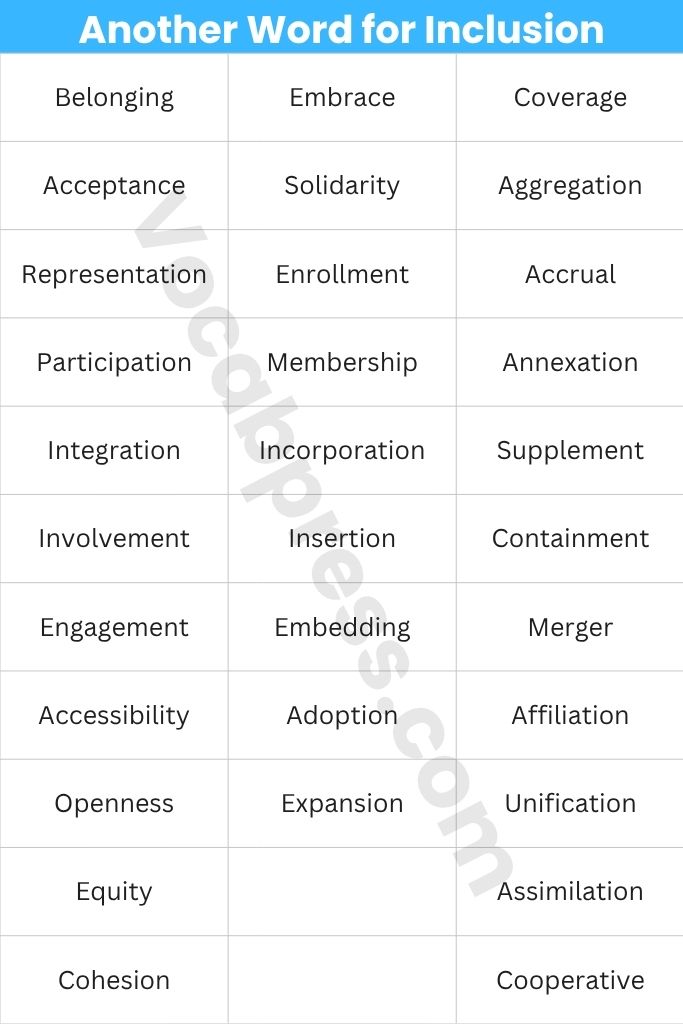
Quick-Access Another Word for Inclusion Table
| Word | Tone | Best Used When |
| Belonging | Warm, emotional | Describing how people feel inside a space |
| Acceptance | Gentle, human | Someone is welcomed as they are |
| Representation | Formal, values-driven | Visibility of underrepresented groups |
| Participation | Neutral, active | Measuring engagement or voice |
| Integration | Structural, neutral | Merging groups or systems together |
| Involvement | Casual to formal | Active roles in decisions or projects |
| Engagement | Dynamic | Emotional connection to a group or cause |
| Accessibility | Practical, policy | Removing barriers to entry |
| Openness | Light, cultural | Describing a mindset or environment |
| Equity | Ethical, formal | Fairness in systems and outcomes |
| Cohesion | Unifying | Groups staying connected as one whole |
| Embrace | Warm, action | Welcoming diverse ideas or people |
| Solidarity | Advocacy | Actively supporting others |
| Enrollment | Procedural | Formally bringing someone into a group |
| Membership | Organizational | Being officially part of a group |
| Incorporation | Formal, structural | Adding something into a plan or document |
| Insertion | Precise, editorial | Adding content to a specific point in text |
| Embedding | Strategic, deep | Making something a permanent core part |
| Adoption | Formal, decisive | Officially accepting a practice or policy |
| Expansion | Growth-focused | Widening scope or reach |
| Coverage | Technical, policy | Falling under a rule or benefit |
| Aggregation | Data, analytics | Combining multiple inputs into one set |
| Accrual | Financial, formal | Gradual addition over time |
| Annexation | Legal, territorial | Formal addition of units or regions |
| Supplement | Additive, neutral | Something added to complete a whole |
| Containment | Technical | Something held within a larger system |
| Merger | Organizational | Two or more groups combining officially |
| Affiliation | Associative | Formal connection to a group or body |
| Unification | Broad, structural | Bringing separate parts into one |
| Assimilation | Cultural, cautionary | Absorbing into a dominant group |
| Cooperative | Collaborative | Working jointly as part of a shared group |
Group 1: Inclusion Synonyms (Social and Belonging Context)
These fifteen words belong in writing about people, culture, community, workplaces, and relationships. They carry human weight.
1. Belonging
This goes one step further than inclusion. Inclusion says you are allowed here. Belonging says you are wanted here. That gap matters enormously in people-centered writing.
Use it when the goal isn’t just presence but genuine connection. “A culture of belonging” tells readers something real is happening emotionally, not just procedurally.
2. Acceptance
Softer and more personal than inclusion. Acceptance focuses on being welcomed exactly as you are, without pressure to adjust or assimilate. It fits mental health writing, community essays, and personal narratives particularly well.
3. Representation
Shifts the focus outward and upward. Representation is about visibility, specifically whether people from different backgrounds are seen in meaningful roles, leadership positions, media, and decision-making spaces. Someone can be included in a room but still unrepresented at the table.
4. Participation
Neutral and measurable. Participation emphasizes active voice and involvement rather than passive presence. It works well in education, civic writing, and formal reports where you need to describe engagement without emotional language.
5. Engagement
Adds motion. A person who is included might still be silent. A person who is engaged is actively involved, invested, and contributing. Use engagement when you want to stress genuine connection rather than surface-level presence.
6. Involvement
Sits between engagement and participation in weight. It feels natural in workplace writing and project documentation. “Employee involvement in planning” reads clearly and professionally without sounding clinical.
7. Accessibility
Focuses on removing barriers rather than describing the outcome of their removal. Originally centered on disability, it now applies broadly to digital access, financial access, and systemic barriers. It is practical and policy-friendly.
8. Openness
Describes a mindset or cultural quality rather than a policy outcome. A culture of openness suggests people are receptive to different ideas, backgrounds, and perspectives. It works well in mission statements and team values documents.
9. Equity
Not a direct synonym but often the right word when inclusion is used loosely. Equity means fairness in systems. Inclusion gets people in the room. Equity makes the room itself fair. When your sentence is really about fair treatment rather than presence, equity is the better choice.
10. Cohesion
Describes what successful inclusion looks like once it has worked. A cohesive team or community is one where people feel genuinely connected, not just added together. Use it when describing outcomes rather than goals.
11. Embrace
Works best as a verb or descriptive phrase. “Embracing diverse perspectives” feels warmer and more intentional than “including diverse perspectives.” Be careful using it as a standalone noun in formal documents since it can sound vague.
12. Solidarity
Moves beyond inclusion into active support. Solidarity means standing with someone, especially through difficulty. It is powerful in advocacy, community organizing, and social justice writing, but it carries specific political weight, so use it intentionally.
13. Affiliation
More associative than emotional. Affiliation describes a formal or recognized connection to a group or organization. It fits corporate, legal, and academic writing where inclusion would sound too value-loaded.
14. Cooperative
Useful when the point is shared effort rather than welcome. A cooperative environment or approach implies people are working jointly, contributing equally, and operating as genuine partners rather than just being present together.
15. Enrollment
Formal and procedural. Enrollment works when the context is about officially bringing someone into a program, school, or group. It removes the emotional layer entirely, which is sometimes exactly what a document needs.
Group 2: Structural Inclusion Synonyms (Adding Something to a System or Document)
These sixteen words belong in technical, formal, legal, or organizational writing where inclusion simply means something has been added.
16. Incorporation
The cleanest formal replacement when something is being added into a larger structure. “The incorporation of new guidelines into the policy” reads more precisely than “the inclusion of new guidelines.” Use it in reports, strategy documents, and legal writing.
17. Insertion
More precise than incorporation. Insertion describes placing something at a specific point, a clause added to a contract, a paragraph added to a draft, a row added to a table. It implies a deliberate, located action.
18. Embedding
Signals permanence and integration at a deep level. When something is embedded, it is built in, not bolted on. “Embedding sustainability into the strategy” suggests it shapes every decision, not just one section.
19. Adoption
Implies a choice has been made and acted upon. “The adoption of remote work policies” sounds decisive. It carries more agency than inclusion and works well in organizational announcements and policy writing.
20. Aggregation
Belongs in data, analytics, and research writing. When multiple data points or sources are being pulled into one view or dataset, aggregation is the accurate term. Using inclusion here would read as vague.
21. Expansion
Works when the scope of something is being widened rather than just added to. “Expansion into new markets” or “expansion of the program’s reach” both communicate growth clearly. It implies deliberate stretching outward.
22. Coverage
Technical and policy-friendly. Coverage describes being included under a rule, benefit, or system. “Coverage under the health plan” is cleaner and more precise than “inclusion in the health plan” in most formal documents.
23. Accrual
Belongs in financial and accounting writing. When payments, interest, or obligations build gradually over time, accrual is the right word. Inclusion would be incorrect here.
24. Annexation
Formal and often legal. Annexation describes the official addition of a territory, unit, or jurisdiction into a larger body. It is specific in meaning and should not be used loosely outside legal or governmental contexts.
25. Supplement
Describes something added to complete or enhance a whole without replacing any existing part. An appendix, an additional chapter, a secondary report: these are supplements. The tone is neutral and additive.
26. Containment
Technical in nature. Containment describes something being held within a larger system or structure. It appears in software, data architecture, and scientific writing. It is not a people-word at all.
27. Merger
Organizational and structural. A merger implies two or more distinct entities combining into one. It is formal, often legal, and carries the weight of official change. Use it when the combining is mutual and significant.
28. Unification
Broader than merger. Unification describes bringing separate parts into a single whole, whether that is countries, departments, standards, or systems. It implies a shared identity emerging from the combination.
29. Assimilation
Use this one carefully. In structural contexts, assimilation can mean absorbing new elements into an existing system. In social contexts, however, it often carries a negative weight, implying that a group is expected to give up its identity to fit in. Know which meaning applies before using it.
30. Membership
Organizational and status-based. Membership describes the condition of being officially part of a group. It implies recognized standing, not just presence. Works well in legal, nonprofit, and association writing.
31. Addition
Simple, neutral, and often the most honest choice. When something is simply being added and no larger meaning is implied, addition works cleanly. It does not overstate. “The addition of new features” is direct and clear.
Another Word for Inclusion in Sentence Rewrites: Seeing Real Differences

Original: We are committed to the inclusion of all employees in major decisions.
- Formal: We are committed to ensuring every employee has a voice in organizational decision-making.
- Casual: We want everyone involved when big calls get made.
- Academic: This organization prioritizes participatory governance across all staffing levels.
Original: The report recommends the inclusion of environmental metrics.
- Formal: The report recommends incorporating environmental metrics into the existing framework.
- Technical: Aggregation of environmental data into the core dataset is advised.
Original: Our school supports the inclusion of students with different learning needs.
- Policy-focused: Accessibility remains a foundational principle of our educational model.
- Human-centered: Every student belongs in our classrooms, whatever their learning needs.
Mistakes That Cost Writers Credibility
Diversity is not inclusion. Diversity describes the mix. Inclusion describes what happens to that mix. These two words are partners, not substitutes.
Tolerance is a step below acceptance. Tolerating someone means enduring their presence. Including someone means valuing it. These are very different messages.
Inclusivity is not the same as inclusion. Inclusion is the act or condition. Inclusivity describes the quality or culture that supports it. You build inclusion. You create inclusivity. They are related but not interchangeable.
Assimilation can harm your message. In social contexts, it implies people must abandon who they are to fit in. If that is not what you mean, do not use it.
Integration in emotional writing feels cold. Integration belongs in structural contexts. Telling someone “we want integration in our community” sounds clinical. Belonging or acceptance serves that moment better.
Related Another Word for Inclusion That Often Travel With Inclusion
Diversity: The presence of differences. Inclusion determines how those differences are treated.
Equity: Fairness in systems. Inclusion is about presence. Equity is about whether the system itself is fair.
Accessibility: Entry without barriers. Overlaps with inclusion but focuses on the point of access rather than the experience once inside.
Solidarity: Active, deliberate support. Stronger than inclusion, with specific advocacy weight.
Belonging: The felt outcome of successful inclusion. If inclusion is the policy, belonging is the feeling it creates.
Read more:
Another Word for Heartwarming: 29 Alternatives That Actually Work
Another Word for Grab: 40 Alternatives That Actually Fit Your Writing
FAQ’s
Is belonging always better than inclusion?
In emotional writing, yes. Belonging is what inclusion feels like from the inside. But in formal policy documents, inclusion or representation often fits better because belonging can sound too personal.
When should I use incorporation instead of inclusion?
Whenever you are describing something being formally added to a document, plan, or system. Incorporation signals structure and precision. Inclusion in that context can read as vague.
Can assimilation replace inclusion in cultural writing?
Rarely, and carefully. Assimilation implies giving up identity to blend in. That is almost the opposite of what most inclusion-focused writing intends.
What is the single strongest word for emotional belonging in team writing?
Belonging, without question. Engagement is close, but belonging carries the deeper sense that someone is genuinely valued, not just actively present.
The Practical Takeaway
Before swapping inclusion for any of these 31 alternatives, ask two questions: Are you writing about people or about things? And are you describing a feeling, a policy, or a structural action?
People plus feeling: belonging, acceptance, engagement.
People plus policy: representation, equity, participation.
Things plus structure: incorporation, embedding, adoption, aggregation.
Get that distinction right first. Then pick the word that fits the tone of your sentence. Read it aloud. If it sounds natural and precise, you have made the right call.

Marco Jr. is Author at fillmassage.com,
He explores the world of words and their meanings, helping readers understand language clearly. Passionate about explanations that guide and inform, he creates insightful content that educates, engages, and supports curious minds every day.