You typed “culminating” once. Then twice. By the third time, something felt off. Not wrong exactly, just flat. Repeated. Like you ran out of road.
The word itself isn’t the problem. The problem is that English has dozens of ways to describe a peak, a finish, a transformation, or a buildup reaching its final point, and “culminating” carries only one flavor of that idea. Once you see the differences between these 38 options, you won’t reach for the same word by default again.
What “Culminating” Really Means (And Why It Matters)
It’s not just “ending.” Culminating implies a buildup. Something grew, intensified, or developed over time, and now it has arrived at its highest or final point. That sense of process reaching a destination is what separates it from simple words like “finishing” or “closing.”
The tone sits in the middle ground: not too casual, not too stiff. Formal enough for essays, natural enough for general writing. But when the moment calls for drama, warmth, precision, or movement, there are sharper tools.
Quick-Access Another Word for Culminating Table (Organized by Tone)
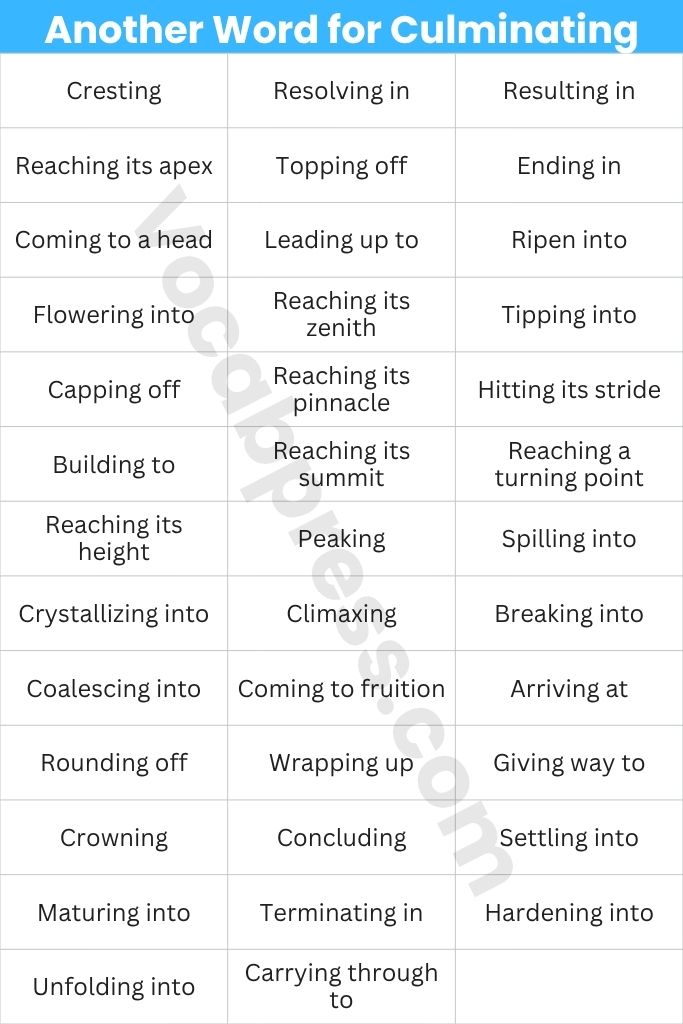
| Word / Phrase | Tone | Best Used When |
| Cresting | Vivid, literary | Tension or emotion hits its highest point |
| Reaching its apex | Formal, precise | Academic or analytical writing |
| Coming to a head | Conversational | Conflict or pressure can no longer be ignored |
| Flowering into | Warm, figurative | Something positive develops beautifully over time |
| Capping off | Casual, upbeat | A celebratory or satisfying final moment |
| Building to | Active, narrative | Gradual dramatic increase toward a moment |
| Reaching its height | Neutral to formal | Maximum intensity or achievement |
| Crystallizing into | Precise, thoughtful | Vague ideas becoming clear and solid |
| Coalescing into | Formal, analytical | Many elements joining into one result |
| Rounding off | Light, conversational | A clean and satisfying ending |
| Crowning | Dignified, celebratory | A career achievement or final honor |
| Maturing into | Gentle, developmental | Growth across a long period of time |
| Resolving in | Neutral, calm | Conflict or tension finding its outcome |
| Topping off | Informal | A finishing flourish or last touch |
| Leading up to | Sequential, narrative | Describing the path before a major event |
| Reaching its zenith | Elevated, formal | The absolute highest point of something |
| Reaching its pinnacle | Positive, formal | A peak in achievement or reputation |
| Reaching its summit | Slightly metaphorical | Effort-driven accomplishment at its peak |
| Peaking | Direct, neutral | A measurable or observable high point |
| Climaxing | Dramatic, narrative | A story or situation reaching its most intense moment |
| Coming to fruition | Hopeful, warm | Long-term plans finally succeeding |
| Wrapping up | Casual, everyday | Completing an activity or project |
| Concluding | Formal, general | A structured or organized ending |
| Terminating in | Technical, cold | Formal or legal contexts |
| Resulting in | Neutral, causal | Cause-and-effect outcomes, no buildup implied |
| Ending in | Plain, direct | Stating a final state without emotion |
| Ripen into | Natural, organic | Gradual development into something mature |
| Tipping into | Tense, suggestive | A critical threshold crossed |
| Hitting its stride | Performance-focused | Peak performance, not necessarily an ending |
| Reaching a turning point | Pivotal, analytical | A moment that changes direction |
| Spilling into | Fluid, transitional | One thing overflowing or moving into another |
| Breaking into | Sudden, energetic | A shift that happens with some force or surprise |
| Arriving at | Measured, deliberate | A logical destination after a process |
| Giving way to | Gradual, transitional | One phase ending as another begins |
| Settling into | Calm, resolved | Tension or movement finding its resting state |
| Hardening into | Firm, definitive | Something flexible becoming fixed or permanent |
| Unfolding into | Organic, open | A process revealing itself gradually toward a result |
| Carrying through to | Purposeful, sustained | Effort or intention following all the way to completion |
The Culminating Synonym Meaning Clusters That Actually Matter
A list of 38 words means nothing if you treat them as interchangeable. They’re not. They fall into four distinct clusters, and choosing the wrong cluster is where writers go wrong.
Cluster 1: Height and Peak
These words share the idea of something reaching its maximum point. The differences are subtle but real.
Cresting has movement in it. A wave crests. Emotion crests. There’s a sense that after this point, things will shift or descend. It works beautifully in narrative writing.
Reaching its apex is colder, more precise. It doesn’t suggest what comes after. Use it when you want the reader to focus on the highest point itself, not the change that follows.
Peaking is the most direct. No metaphor, no ceremony. It’s factual. Demand peaked. Interest peaked. Sales peaked. When you want clarity over texture, this is your word.
Reaching its zenith and reaching its pinnacle are nearly twins, but pinnacle leans toward personal or professional achievement while zenith carries a slightly more cosmic or absolute feeling. “The zenith of civilization” sounds right. “The pinnacle of her legal career” sounds right. Swap them and something feels slightly off.
Cluster 2: Completion and Closure
Not every use of “culminating” is about height. Sometimes the point is simply that something ended, finished, or found its final form.
Concluding is the safest formal option here. It signals a structured ending without any emotional coloring.
Resolving in adds the idea that something uncertain or tense found an answer. It’s completion with a sense of relief.
Wrapping up is fine for emails, meetings, and casual speech. In an essay or article, it can feel too light unless you’re writing in a conversational style deliberately.
Terminating in belongs in legal documents, contracts, and technical writing. It’s blunt and formal in a way that would feel jarring in ordinary prose.
Cluster 3: Transformation and Development
This is the cluster most synonym guides ignore entirely. Sometimes “culminating” describes a process of growth that turns into something new. A relationship develops. An idea evolves. A career transforms.
Flowering into carries warmth and forward movement. It works when the outcome is positive and the development felt natural, even beautiful.
Crystallizing into is more intellectual. Ideas that were scattered or unclear have now become solid and defined. It’s excellent for academic writing about how thinking develops.
Ripening into and maturing into both suggest time and patience were involved. Ripening has a slightly more organic, almost seasonal quality. Maturing implies deliberate growth and increasing sophistication.
Hardening into is different from all of these. It suggests something that was once flexible or uncertain has now become fixed. Opinions harden. Policies harden. It carries a slight edge.
Cluster 4: Buildup and Momentum
These words focus less on the destination and more on the movement toward it. They’re especially useful in storytelling and narrative writing.
Building to puts the energy in the journey. The story builds to something. The pressure builds to a confrontation. There’s momentum in the phrase itself.
Leading up to is more neutral and sequential. It describes the path without dramatizing it. Use it in reporting, explanations, and structured writing.
Coming to a head is the most human-feeling phrase in this whole list. It’s the one you’d say out loud. It carries urgency and inevitability. Things had been building, and now they simply could not wait any longer.
Tipping into is the most dangerous-sounding of this cluster. It suggests a threshold crossed, often with consequences. Situations tip into chaos. Frustration tips into anger. There’s a point of no return implied.
Read also: Another Word for Solidarity: 41 Alternatives That Actually Fit Your Writing
Another Word for Culminating in Sentence Rewrites: The Same Idea, Four Different Voices
Seeing the words in context is the fastest way to understand which one belongs in your writing.
Original: Years of research were culminating in a single breakthrough.
- Formal: Years of research coalesced into a single breakthrough.
- Casual: All that research finally came to something real, one major breakthrough.
- Creative: Every late night and failed experiment had been building to this, one moment that changed everything.
- Academic: The cumulative research trajectory crystallized into a definitive breakthrough finding.
Original: The tension in the final act culminates in a confrontation.
- Formal: The narrative tension resolves in a direct confrontation.
- Casual: Everything comes to a head in the final act.
- Creative: The story holds its breath, then breaks open in one violent confrontation.
- Academic: Dramatic tension reaches its apex and discharges in the climactic confrontation of the final act.
Original: Her career was culminating in this award.
- Formal: Her career reached its pinnacle with this award.
- Casual: This award was the cap on everything she had worked toward.
- Creative: Decades of work crested in a single evening, one award, one full-room applause.
- Academic: Her professional trajectory attained its highest point of recognition through this distinction.
Each rewrite changes not just the word but the entire texture of the sentence. That’s the real lesson here.
Formal Another Word for Culminating vs. Informal: Matching the Word to the Context
Academic essays and research writing: Coalescing into, crystallizing into, reaching its apex, reaching its zenith. These carry intellectual weight without sounding dramatic.
Professional emails and business reports: Capping off, wrapping up, reaching its conclusion, culminating in (kept deliberately, because in business writing it’s often the cleanest choice). Avoid anything poetic.
Storytelling and creative writing: Cresting, building to, coming to a head, flowering into, tipping into, spilling into. These carry feeling, not just information.
Words to avoid in formal contexts: Topping off, rounding off, wrapping up. They’re too light for serious writing and can make formal content feel informal at exactly the wrong moment.
Mistakes That Quietly Weaken Your Writing
Treating “resulting in” as a synonym. It isn’t. “Resulting in” is purely causal: one thing caused another. “Culminating in” implies a buildup over time. If there was no process before the outcome, “resulting in” is actually the more honest choice.
Stacking height synonyms. Apex, zenith, pinnacle, and summit all mean roughly the same thing. Using more than one in a single piece doesn’t add variety. It adds redundancy that careful readers notice.
Using “flowering into” for negative outcomes. The word carries warmth. “The misunderstanding flowered into a lawsuit” sounds wrong because the emotional temperature of the word clashes with the content. Match the feeling of your synonym to the feeling of your sentence.
Using “hitting its stride” as a closing word. This phrase means peak performance, not conclusion. Something hitting its stride is performing at its best, which might happen in the middle of a story, a season, or a career. It’s not an ending.
Using “climaxing” in professional or academic writing. It works cleanly in literary analysis. In business reports or formal essays, it can land awkwardly. “Reaching its apex” or “reaching its conclusion” does the same work without the risk.
Related Another Word for Culminating That Belong in the Same Conversation
These aren’t synonyms, but they often appear in the same writing where “culminating” shows up. Knowing the difference keeps your language precise.
Denouement: The resolution that follows the climax in a narrative. If “culminating” is the peak, denouement is what comes after. Useful in literary analysis, not in business writing.
Crescendo: Originally musical, now widely used for anything that builds in intensity before a peak. It describes the rise, while “culminating” describes the arrival. Use both only if they describe genuinely different moments.
Inflection point: A moment when direction changes, often used in business and economics. Not an ending. A shift. Useful when the story isn’t over but the course has changed.
Tipping point: Once crossed, things change permanently. It carries more weight than “culminating” and implies irreversibility. Use it when the stakes are high and the change is lasting.
Threshold: The edge just before something crosses into a new state. It often appears just before the culminating moment itself, not at it.
Read more:
32 Another Word for Emerging: The Complete Guide for Writers
Another Word for Grab: 40 Alternatives That Actually Fit Your Writing
FAQ’s for Another Word for Culminating
Can I keep using “culminating” in formal writing?
Yes, but use it once per piece. After that, reach for coalescing into, reaching its conclusion, or crystallizing into to vary the language without losing formality.
What’s the real difference between “coming to a head” and “reaching its peak”?
“Coming to a head” is almost always about tension or conflict that finally demands resolution. “Reaching its peak” works for anything from achievement to noise levels to emotional states. It’s neutral where “coming to a head” is urgent.
Is “cresting” too literary for general writing?
Only if the sentences around it are very plain. It will stick out in a report. In a narrative paragraph or a feature article, it fits naturally and adds life.
When should I just restructure the sentence instead of swapping words?
When no single synonym feels right. The casual and creative rewrites above did this deliberately. Sometimes “Everything built toward this one moment” is better than any single word replacement.
The Choice Is Always Yours
Here’s what the full list of 38 actually gives you: precision. Not variety for its own sake, but the ability to say exactly what kind of peak, ending, or transformation you mean.
Growth words like maturing into and flowering into do entirely different work than conclusion words like resolving in or concluding. Height words like apex and cresting feel different from pressure words like coming to a head or tipping into.
Pick the one that matches what actually happened in your content. That’s the decision no synonym list can make for you, but now at least you have the full picture to work from.

Marco Jr. is Author at fillmassage.com,
He explores the world of words and their meanings, helping readers understand language clearly. Passionate about explanations that guide and inform, he creates insightful content that educates, engages, and supports curious minds every day.