Writers reach for “care” the same way people reach for salt. Automatically. Without thinking. And just like over-salted food, overused words flatten everything around them.
The real problem is not the word itself. It is that “care” is doing five different jobs at once, and most of those jobs have a better, more precise word waiting. Finding that word changes how your sentence lands.
This article gives you 40+ alternatives, grouped by meaning, with honest guidance on when each one actually works.
What “Care” Really Covers
Before grabbing a synonym, you need to know which version of “care” you are replacing.
It can mean emotional concern. It can mean careful physical handling. It can mean looking after a person. It can mean medical treatment. It can even mean legal responsibility. Same word, five different directions.
That is why synonym lists alone fail. You need the right word for the right meaning.
The Complete Another Word for Care (40+ Words, Organized by Use)
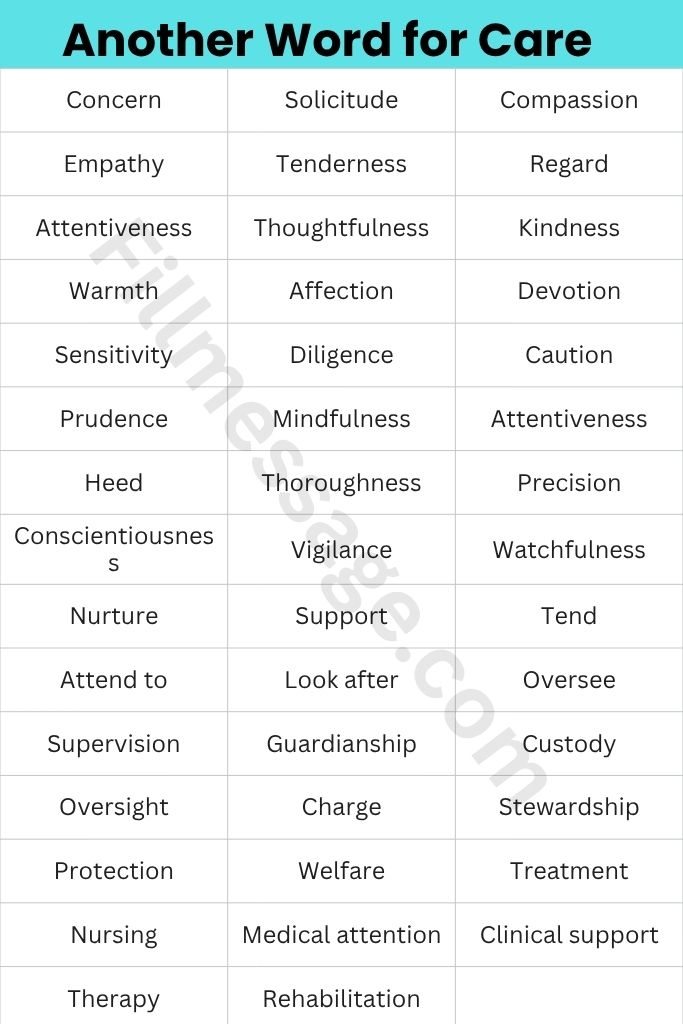
| Synonym | Tone | Best Used When |
| Concern | Warm, sincere | Expressing emotional worry for someone |
| Solicitude | Formal, tender | Professional or essay writing about attentiveness |
| Compassion | Deep, warm | Responding to suffering with genuine feeling |
| Empathy | Emotional, personal | Sharing another’s inner experience |
| Tenderness | Intimate, gentle | Writing about soft, loving attention |
| Regard | Respectful | Showing thoughtful consideration |
| Attentiveness | Positive, neutral | Describing focused, present awareness |
| Thoughtfulness | Warm, reflective | Considering someone’s needs before acting |
| Kindness | Simple, warm | Everyday emotional generosity |
| Warmth | Gentle | Describing an emotionally open presence |
| Affection | Personal | Feeling fondness toward someone |
| Devotion | Deep, loyal | Long-term commitment to a person or cause |
| Sensitivity | Aware, careful | Picking up on others’ emotional states |
| Diligence | Professional | Careful, sustained effort on a task |
| Caution | Practical, alert | Handling something with awareness of risk |
| Prudence | Formal, wise | Careful judgment in decisions |
| Mindfulness | Calm, deliberate | Aware, intentional attention to a task |
| Attentiveness | Neutral, positive | Focused care in action or listening |
| Heed | Slightly formal | Paying close attention to a warning or detail |
| Thoroughness | Professional | Completing something fully and carefully |
| Precision | Technical | Exact, accurate handling of something |
| Conscientiousness | Formal | Doing something carefully out of principle |
| Vigilance | Serious, alert | Active watching when something could go wrong |
| Watchfulness | Alert, neutral | Steady observation over time |
| Nurture | Warm, active | Long-term support for growth |
| Support | Broad, flexible | Practical or emotional help across most contexts |
| Tend | Action-focused | Actively looking after someone or something |
| Attend to | Slightly formal | Giving focused physical or professional care |
| Look after | Casual, warm | Everyday language for caring for someone |
| Oversee | Professional | Managing and monitoring responsibility |
| Supervision | Formal, neutral | Overseeing people, processes, or spaces |
| Guardianship | Legal, formal | Official responsibility for a person |
| Custody | Legal | Formal or legal care and control |
| Oversight | Professional | Monitoring a system or process |
| Charge | Formal | Being formally responsible for someone |
| Stewardship | Broad, responsible | Long-term care of something valuable |
| Protection | Defensive | Keeping someone or something from harm |
| Welfare | Broad | Overall wellbeing and condition of someone |
| Treatment | Medical, clinical | Healthcare provided to a patient |
| Nursing | Medical, hands-on | Direct physical care for the sick or elderly |
| Medical attention | Clinical | Formal care in a healthcare setting |
| Clinical support | Professional | Structured help in medical or therapeutic contexts |
| Therapy | Medical, therapeutic | Structured treatment for recovery |
| Rehabilitation | Medical | Recovery-focused support after illness or injury |
Care synonym Meaning Clusters: The Section That Actually Helps You Choose
Emotional Care synonym (Feeling-Based Words)
These words live in the heart space of care. Use them when the focus is on feeling, not action.
Concern is your most versatile starting point. It works in essays, emails, and conversation without sounding overdone. “She expressed deep concern for his recovery” reads cleanly in almost any register.
Compassion goes further. It includes the pull to help, not just the feeling of worry. A character who shows compassion does not just feel sad. They move toward the person who is hurting.
Empathy is even more specific. It means you understand the feeling from the inside. A nurse shows empathy when she recognizes the fear behind a patient’s silence, not just the words they say.
Solicitude sounds old-fashioned at first, but it has a precise tenderness to it that “concern” sometimes lacks. If you are writing something formal and want to show genuine emotional attentiveness, solicitude earns its place.
Tenderness, warmth, affection, and sensitivity sit on the softer end. These belong in personal writing, creative work, or any place where emotional intimacy is the point.
Another Word for Careful Attention to a Task
This is care as precision and focus, not emotion.
Diligence fits sustained, disciplined effort. If someone completes a complicated project carefully over several weeks, diligence is the word. Not caution, not mindfulness.
Caution carries risk awareness. You urge caution when something could go wrong. It is the right word for warnings, instructions, and safety contexts.
Prudence is caution elevated to wisdom. A prudent decision is not just careful. It is thoughtful about consequences. This word belongs in formal essays, legal writing, and professional communication.
Mindfulness has a deliberate, internal quality. It is about being present in what you are doing. This fits wellness writing, personal essays, and creative non-fiction well. It would sound odd in a technical manual.
Thoroughness, precision, and conscientiousness are the professional cluster. These work in workplace writing, performance reviews, and any context where careful execution of a task is the focus.
Looking After Someone (Action-Based Words)
This is care as responsibility in motion.
Nurture suggests ongoing, growth-oriented support. A teacher nurtures students. A founder nurtures a company culture. It extends well beyond parenting, though that is where most people put it.
Tend is more active and less emotionally loaded. You tend a garden. You tend to a wound. It focuses on the task of caring, not the feeling behind it.
Look after is the casual, everyday version. Use it in dialogue, personal writing, or any informal context. It sounds like something a real person would say.
Attend to lifts the register slightly. It is appropriate in professional communication, healthcare writing, and formal essays.
Support is the most flexible word on this list. It works in emotional, physical, professional, and practical contexts. The trade-off is that it is broad. When precision matters, choose something more specific.
Another Word for Medical and Clinical Care
In healthcare writing, “care” is often too vague to do real work.
Treatment refers to specific actions taken to address a medical condition. It is clinical, direct, and precise.
Nursing describes hands-on physical care delivered to patients. It is specific to the act of tending to bodily needs.
Clinical support and medical attention work well in professional reports, case studies, and healthcare documentation where formal language is expected.
Therapy and rehabilitation apply when the focus is recovery. Therapy addresses the ongoing process. Rehabilitation focuses on returning to prior function after illness or injury.
Another Word for Formal Responsibility and Oversight Care
Guardianship and custody carry legal weight. These are not interchangeable with “care” in casual writing. Reserve them for legal, official, or formal contexts only.
Oversight and supervision describe management of a process or group. They do not carry emotional warmth. They describe accountability.
Stewardship is care extended across time and scale. You exercise stewardship over an organization, a tradition, natural resources, or a community. It implies that you are protecting something on behalf of others, not just for yourself.
Welfare is a broader term describing the overall condition and wellbeing of a person or group. It often appears in policy writing, social work, and institutional contexts.
Another Word for Care In Sentence Rewrites: Watch the Words Work
Original: “She cared for her grandfather every day.”
- Formal: “She provided consistent, attentive support for her grandfather each day.”
- Casual: “She looked after her grandfather every single day without fail.”
- Creative: “She wrapped his days in quiet, patient nurture.”
- Clinical: “She assumed daily caregiving responsibilities for her elderly grandfather.”
Each version describes the same action. But each one creates a different emotional distance. The creative version pulls you in. The clinical version pushes you back. Neither is wrong. It depends on what you are writing.
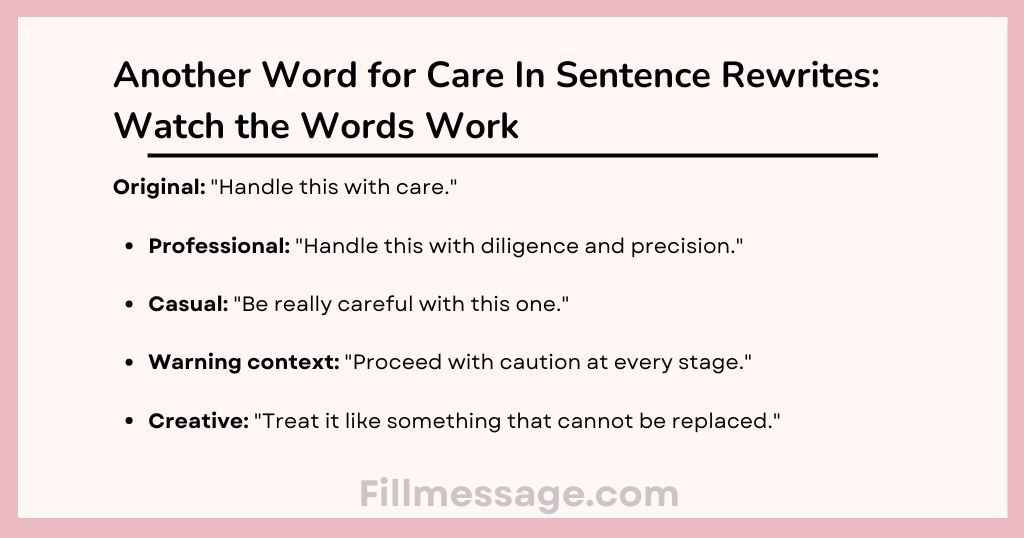
Original: “Handle this with care.”
- Professional: “Handle this with diligence and precision.”
- Casual: “Be really careful with this one.”
- Warning context: “Proceed with caution at every stage.”
- Creative: “Treat it like something that cannot be replaced.”
Notice the last one. Sometimes the best move is not picking a synonym at all. Describing the quality directly can be stronger than naming it.
Original: “The clinic provided excellent care.”
- Formal: “The clinic delivered outstanding medical treatment and clinical support.”
- Professional email: “The medical team offered thorough, attentive treatment throughout.”
- Academic: “The facility maintained high standards of patient supervision and therapeutic support.”
Care synonym Words That Look Interchangeable But Are Not
Concern vs. compassion. Concern is awareness of a problem. Compassion includes the urge to act. You can feel concern from across the room. Compassion usually moves your feet.
Vigilance vs. attentiveness. Vigilance carries urgency. Something might go wrong. Attentiveness is calmer. You are focused, but not on alert. Mixing these makes the emotional temperature of a sentence feel off.
Oversight vs. supervision. Oversight can mean watching carefully, but it also means accidentally missing something. If your sentence could be read either way, pick supervision instead.
Nurture vs. support. Nurture implies growth over time. Support implies help in the moment. A mentor nurtures. A colleague supports. Both are valuable, but they describe different relationships.
Empathy vs. sympathy. Sympathy means you feel for someone. Empathy means you feel with them, from inside their experience. In essays and professional writing, being specific about which you mean makes your point stronger.
Caution vs. prudence. Caution is a practical response to immediate risk. Prudence is a mindset. A cautious driver slows down at a sharp bend. A prudent driver plans a safer route before leaving.
Another Word for Care Formal vs. Everyday: Quick Reference
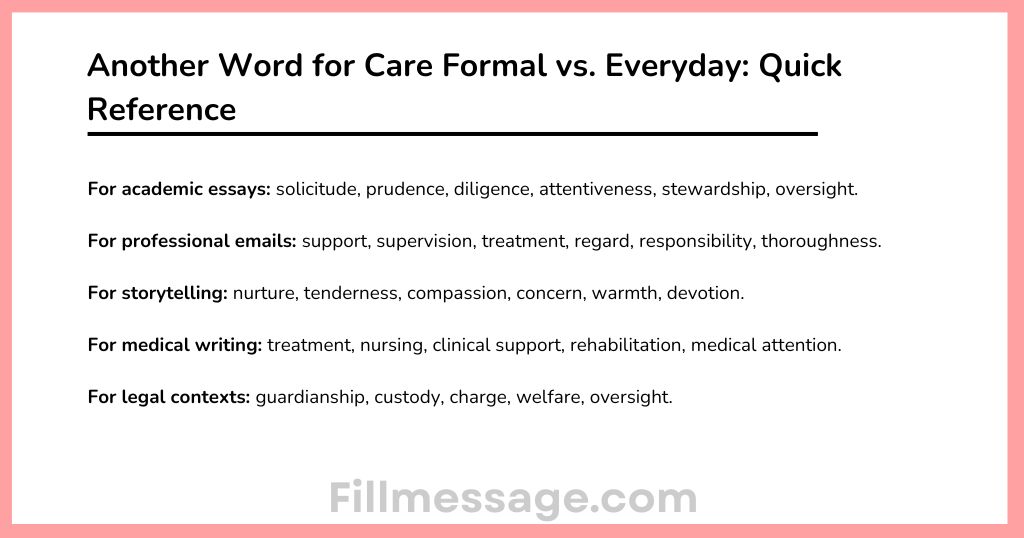
For academic essays: solicitude, prudence, diligence, attentiveness, stewardship, oversight.
For professional emails: support, supervision, treatment, regard, responsibility, thoroughness.
For storytelling: nurture, tenderness, compassion, concern, warmth, devotion.
For medical writing: treatment, nursing, clinical support, rehabilitation, medical attention.
For legal contexts: guardianship, custody, charge, welfare, oversight.
Words to keep out of formal writing unless you are very deliberate: tenderness, warmth, affection. These carry emotional intimacy that formal writing usually does not need.
Related Words That Sit Near “Care”
Duty is care made into obligation. You do not choose duty the way you choose concern. It is imposed, expected, or internalized as a value.
Responsibility adds accountability. You are answerable for the outcome. Care can be quiet and personal. Responsibility is visible and often social.
Commitment is care over time. You can feel compassion once. Commitment means you keep showing up.
Protection is a defensive subset of care. It focuses entirely on preventing harm, not on warmth or growth.
Welfare is the result of care given well. When care succeeds, welfare improves. Use it to describe condition and outcome, not the act of caring.
Read also:
Another Word for Having: 50+ Synonyms That Actually Fit Your Writing
32+ Another Word for Chaos: Pick the Right Word Every Time
FAQ’s about Another Word for Care
In a nursing essay, should I keep using “care” or replace it?
Replace it when you can. In clinical writing, “care” is too wide. “Patient support,” “nursing intervention,” “clinical treatment,” and “medical supervision” are all more precise. Rotate based on what the sentence is actually describing.
Is “solicitude” too old-fashioned for modern essays?
Not at all. It appears in published academic and literary writing regularly. It signals that you know the difference between surface concern and genuine attentiveness. Use it once or twice in an essay for effect. Do not overuse it.
Can “nurture” work in a business or professional context?
Yes, and it is underused there. You can nurture a team, a brand relationship, a mentorship, or a company culture. It brings warmth to professional writing without sounding unprofessional.
What is the single best alternative to “care” in a formal cover letter or email?
It depends on your sentence, but “attentiveness,” “diligence,” and “support” tend to carry well in professional writing. They are specific enough to mean something and neutral enough not to introduce unintended tone.
What to Take Away
You now have over 40 words that can replace “care,” and more importantly, you know which situation calls for which word. The table gives you options. The clusters show you why each one works. The rewrites let you see the difference in practice.
Pick by meaning first. Pick by tone second. And when in doubt, describe the quality directly rather than naming it. That approach will almost always produce stronger writing than any single synonym can.

Marco Jr. is Author at fillmassage.com,
He explores the world of words and their meanings, helping readers understand language clearly. Passionate about explanations that guide and inform, he creates insightful content that educates, engages, and supports curious minds every day.