Writers don’t always need a fancier word. Sometimes they just need the right one. “Weakest” works fine in many sentences, but when it starts repeating, or when the tone feels off, having real alternatives matters.
This isn’t a word dump. Every word here earns its place.
Why Word Choice Around “Weakest” Actually Matters
Think about these two sentences:
- “He was the weakest player on the team.”
- “He was the most exhausted player on the team.”
Both describe struggle. But the second one tells you why, and it carries more empathy. That shift happens because of one word swap. That’s the power this article is built around.
“Weakest” is a superlative. It compares. It ranks. But it doesn’t always explain. A good substitute can add texture, precision, or the right emotional weight without changing your core meaning.
What “Weakest” Really Means
It describes the lowest degree of strength, ability, or resilience among a group. Simple enough. But its emotional effect depends heavily on context. Calling a policy argument “the weakest” feels analytical. Calling a person “the weakest” can feel cold or dismissive. The word is neutral. Its impact is not.
All 24 Another Word for Weakest, Organized by Context
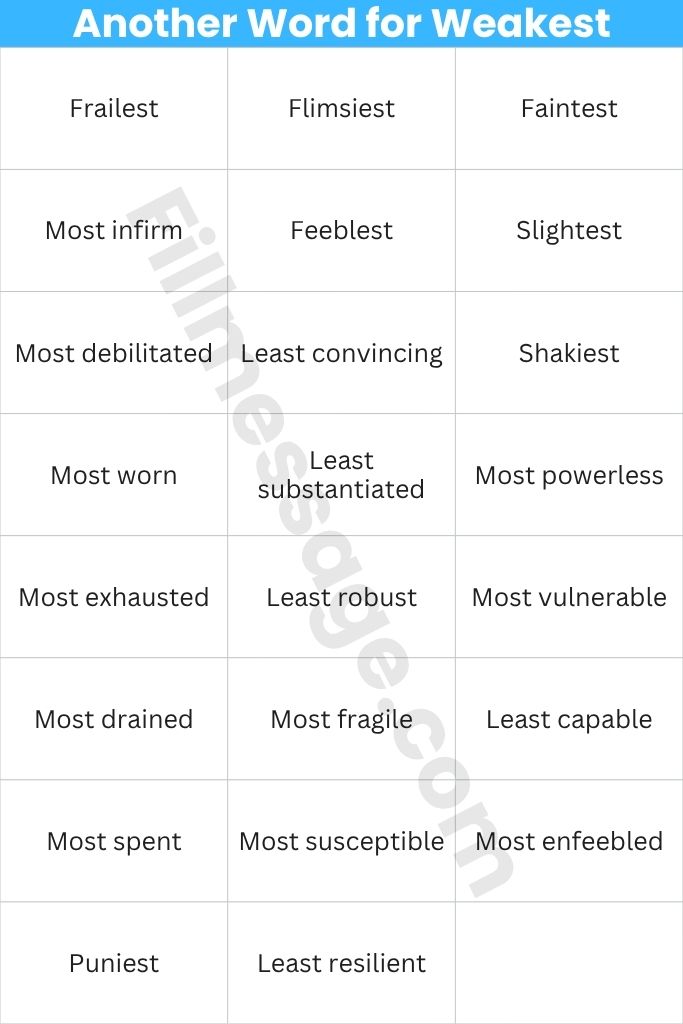
Rather than one flat list, these are grouped by what you’re actually describing. That way you can find your word faster.
Weakest Physical Body and Health Synonyms
| Word | Tone | Best For |
| Frailest | Gentle, clinical | People, bodies, health conditions |
| Most infirm | Formal, respectful | Age-related or medical weakness |
| Most debilitated | Clinical, serious | Weakness caused by illness or injury |
| Most worn | Conversational | Tired body, worn-down condition |
| Most exhausted | Everyday | Low stamina, physical depletion |
| Most drained | Honest, human | Energy loss, emotional fatigue |
Frailest carries compassion. Use it when you want readers to feel the vulnerability, not judge it. “She was the frailest of the three siblings, but not the quietest.”
Most infirm suits formal writing, especially around aging or medical contexts. It keeps a respectful distance.
Most debilitated implies something caused the weakness. It’s not a permanent state; it’s a result. That distinction matters in medical or analytical writing.
Most worn is softer and more conversational. It fits personal essays, character descriptions, or storytelling where clinical language would feel out of place.
Most exhausted needs no explaining. Everyone understands it. Use it when you want immediate clarity over stylistic texture.
Most drained works when the weakness is emotional as much as physical. It’s the honest choice for writing about burnout, grief, or prolonged stress.
Weakest Arguments, Ideas, and Reasoning Synonyms
| Word | Tone | Best For |
| Flimsiest | Mildly critical | Weak arguments, excuses, justifications |
| Feeblest | Tired, dismissive | Effort, logic, defense |
| Least convincing | Neutral, measured | Academic or professional critique |
| Least substantiated | Formal, analytical | Claims, evidence, research points |
Flimsiest is the sharpest of the four. It suggests the weakness is obvious, maybe even embarrassing. “That was the flimsiest case presented all day” carries a verdict without needing more words.
Feeblest is less aggressive but still critical. It implies a lack of force, like something that tried but didn’t arrive. “The feeblest attempt at an apology I’ve ever heard.”
Least convincing pulls back the emotion. It’s precise without being harsh, making it a good fit for academic feedback or professional writing.
Least substantiated is the most formal option here. Use it in research writing, reports, or anywhere the writing needs to stay measured and evidence-focused.
Weakest Structures, Systems, and Objects Synonyms
| Word | Tone | Best For |
| Flimsiest | Descriptive | Physical structures, materials |
| Least robust | Technical | Data, systems, frameworks |
| Most fragile | Careful, visual | Objects, relationships, ecosystems |
| Most susceptible | Analytical | Risk, exposure, vulnerability |
| Least resilient | Evaluative | Recovery capacity, systems, people |
Least robust fits technical writing cleanly. It doesn’t carry drama. It just identifies a gap. “The least robust section of the pipeline” says exactly what it needs to in a report.
Most fragile works well visually. Readers immediately picture something that could break. It suits creative writing, journalism, and any context where you want readers to feel concern.
Most susceptible focuses on exposure to harm rather than current weakness. A strong system can still be the most susceptible if it’s unprotected. That distinction matters.
Least resilient focuses on recovery, not just resistance. Something least resilient might hold up initially but won’t bounce back when pressure is applied. It’s a more specific and useful word in many analytical contexts.
Weakest Effort, Energy, and Output Synonyms
| Word | Tone | Best For |
| Most spent | Literary, heavy | Full depletion of effort or energy |
| Puniest | Informal, vivid | Small size or weak effort |
| Faintest | Soft, precise | Signals, sounds, hope, traces |
| Slightest | Precise | Degree, chance, small measures |
| Shakiest | Casual | Confidence, stability |
Most spent has a literary weight to it. It implies nothing is left. “By the final round, he was the most spent fighter in the ring.” It works in narrative and long-form writing where you want the reader to feel the depletion.
Puniest is informal and vivid. It works in creative writing or casual content where you want a word with personality. Keep it away from formal or professional contexts.
Faintest fits degree descriptions beautifully. “The faintest signal,” “the faintest hope,” “the faintest chance.” It’s precise and understated.
Slightest is similar to faintest but leans toward amount or degree. “The slightest advantage” or “the slightest resistance.” Calm and controlled.
Shakiest adds a sense of instability in motion. Not just weak, but unsteady. “The shakiest section of the plan” implies it could collapse under pressure.
Read also: 35 Another Word for Warm: The Right Word for Every Context
Weakest Power, Control, and Influence Synonyms
| Word | Tone | Best For |
| Most powerless | Emotional, political | Authority, control, agency |
| Most vulnerable | Careful, formal | Safety, exposure, human risk |
| Least capable | Neutral | Skill, performance, output |
| Most enfeebled | Elevated, literary | Influence, institutions, power |
Most powerless describes absence of control rather than lack of strength. There’s an emotional charge here. It fits writing about social issues, politics, or character dynamics in fiction.
Most vulnerable is one of the most commonly misused near-synonyms for weakest. Vulnerable isn’t about strength level. It’s about exposure to harm. Use it when that distinction supports your meaning.
Least capable is flat in the best way. No emotional coloring. It measures output and skill, which makes it reliable in performance reviews, reports, or any writing where you need objectivity.
Most enfeebled is literary and slightly formal. It works when describing institutions, powers, or figures whose strength has been reduced over time. “The most enfeebled branch of the government” has a historical or narrative ring to it.
Three Another Word for Weakest in Sentence Rewrites That Show the Difference
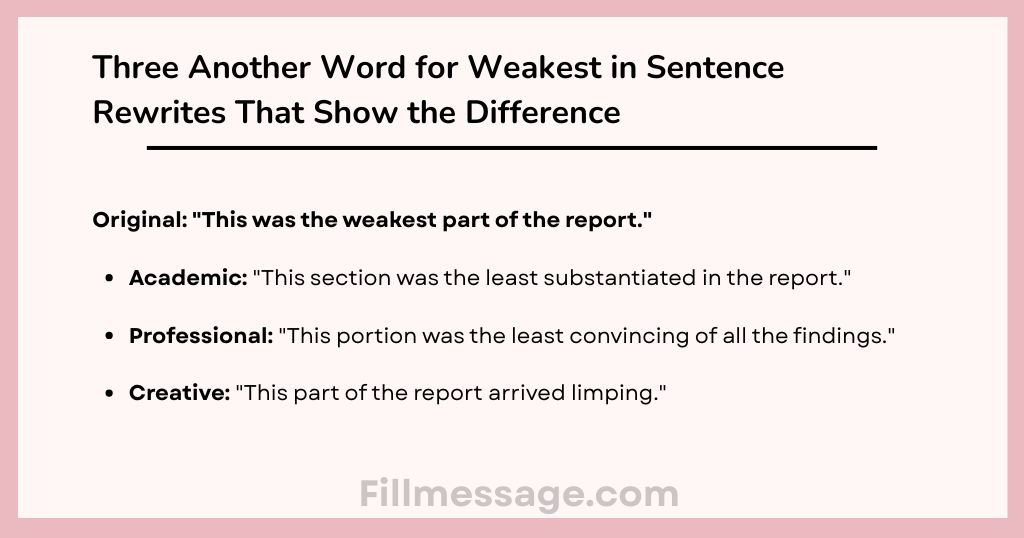
Original: “This was the weakest part of the report.”
- Academic: “This section was the least substantiated in the report.”
- Professional: “This portion was the least convincing of all the findings.”
- Creative: “This part of the report arrived limping.”
Original: “She was the weakest patient in the ward.”
- Clinical: “She was the most debilitated patient under observation.”
- Narrative: “Of everyone in the ward, she was the frailest, though not the most afraid.”
- Compassionate: “She was the most worn among them, carrying more than the others could see.”
Original: “The signal was weakest near the back wall.”
- Technical: “Signal integrity was least robust at the rear perimeter.”
- Conversational: “Reception was shakiest near the back wall.”
- Precise: “The faintest signal readings appeared consistently at the rear of the building.”
Mistakes Worth Avoiding
Fragile vs. Frail. These feel interchangeable but they’re not. Fragile suits things that break under pressure, like glass, ecosystems, or trust. Frail is almost always reserved for living things, especially people, and carries more warmth.
Powerless vs. Weakest. Powerless means an absence of control or authority. Weakest measures degree of strength. Swapping them changes meaning more than most writers realize.
Flimsiest in the wrong context. It works for arguments and physical structures. It sounds odd applied to a person’s health or emotional state. Read it back aloud before committing.
Overusing any single substitute. If you swap “weakest” for “feeblest” throughout an entire piece, the problem just shifts. Vary based on what’s actually being described.
Related Another Word for Weakest That Often Get Confused With Synonyms
These aren’t replacements for “weakest,” but they live nearby and often create confusion:
Brittle describes a specific failure mode, snapping rather than bending. It implies rigidity, not just weakness.
Faltering is about losing strength in the moment. It’s active, not a fixed state. A voice can be faltering. A step can be faltering. It works in motion.
Diminished implies something that was once stronger. It carries a before-and-after meaning that “weakest” doesn’t.
Subdued relates to energy or expression being reduced, not physical weakness. It often applies to mood, tone, or behavior.
Read more:
Another Word for Shaping: 49 Alternatives That Actually Fit Your Writing
Another Word for Self-Centered: 26 Synonyms That Actually Fit
FAQ’s
Can “feeblest” and “frailest” be swapped freely?
Not quite. Feeblest fits effort, force, and logic. Frailest fits bodies and health. They overlap in some sentences, but frailest carries more empathy. Feeblest carries more fatigue.
Is “most vulnerable” the same as “weakest”?
No. Weakest is about the degree of strength. Most vulnerable is about exposure to harm. A well-built system can be the most vulnerable if it’s the most targeted. Use them for different reasons.
Which alternatives work in academic writing?
Least resilient, least robust, most impaired, and least substantiated all carry the neutral, analytical tone that academic writing needs. Avoid puniest, shakiest, or most worn in that setting.
When should I just keep “weakest”?
When you need instant clarity in a comparison. In data tables, quick summaries, or anywhere the reader is scanning fast, “weakest” is precise and efficient. Variety for its own sake helps no one.
Choosing the Right Word
The table below gives you a fast decision guide:
| You’re describing… | Best choice |
| A person’s health | Frailest, most debilitated |
| An argument or excuse | Flimsiest, least convincing |
| A system or structure | Least robust, least resilient |
| Energy or stamina | Most drained, most spent |
| A signal or trace | Faintest |
| Authority or control | Most powerless |
| General performance | Least capable |
| Informal/creative use | Puniest, shakiest |
Word choice isn’t about finding something fancier. It’s about finding something truer to what you’re actually trying to say. Read your sentence. Think about who you’re describing and what you want the reader to feel. Then pick accordingly.
That’s the whole skill, really.

Marco Jr. is Author at fillmassage.com,
He explores the world of words and their meanings, helping readers understand language clearly. Passionate about explanations that guide and inform, he creates insightful content that educates, engages, and supports curious minds every day.