You have written the word “shaping” again. You can see it sitting there, repeated, a little flat. You know something else should go there, but nothing comes to mind that feels right.
The problem is not your vocabulary. It is that “shaping” does different jobs in different sentences. It can mean physical forming, slow influence, creative design, or deliberate control. Each job needs its own replacement. One synonym list does not cover all of that.
This guide does.
What “Shaping” Actually Does in a Sentence
Shaping means directing something toward a specific form or outcome through active effort. The process is still happening. It is not finished. That ongoing quality is what makes it different from words like “formed” or “built.”
It carries quiet authority. Whoever or whatever is shaping holds control over the direction of something. That is why the word lands in sentences about leaders, experiences, environments, and ideas as much as clay or dough.
Quick-Access Another Word for Shaping Table (All 49)
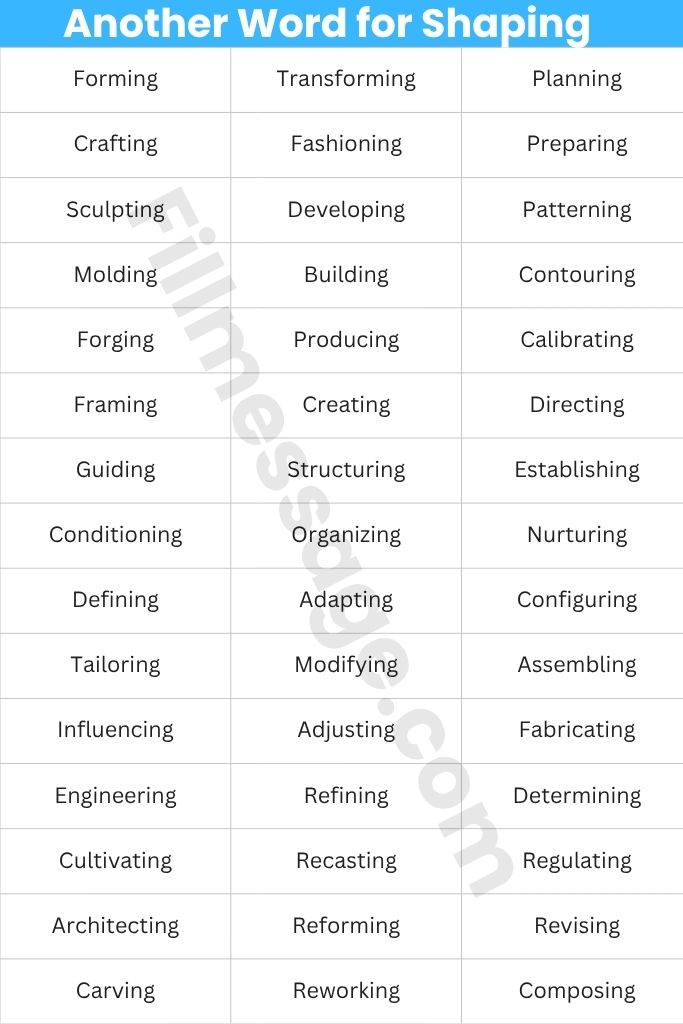
Organized by meaning cluster so you can find the right one fast, not just any one.
| Word | Tone | Best Used When |
| Forming | Neutral | Something is gradually taking shape |
| Crafting | Warm, skilled | Care and intention are central |
| Sculpting | Artistic | Precision and creativity both matter |
| Molding | Direct, hands-on | External pressure is applied to form something |
| Forging | Strong, effortful | Built under pressure or difficulty |
| Framing | Structural | Narratives, arguments, or presentations |
| Guiding | Soft, directional | Leading without force or control |
| Conditioning | Behavioral | Long-term influence through repetition |
| Defining | Precise | Setting boundaries or identity |
| Tailoring | Adaptive | Adjusting something to fit a specific need |
| Influencing | Subtle | Indirect impact over time |
| Engineering | Technical | Systematic planning and execution |
| Cultivating | Nurturing | Patient growth over a long period |
| Architecting | Formal, strategic | Large-scale structural design |
| Carving | Precise | Removing to reveal the final form |
| Designing | Creative | Visual or conceptual output |
| Constructing | Methodical | Building piece by piece |
| Transforming | Dramatic | A total or fundamental change |
| Fashioning | Deliberate | Creating with clear intent and style |
| Developing | Broad | Growth without a fixed endpoint |
| Building | Grounded | Assembling parts into something solid |
| Producing | Output-focused | End result matters most |
| Creating | Open | Bringing something new into existence |
| Structuring | Organized | Giving order or framework to something |
| Organizing | Practical | Arranging parts so they function well |
| Adapting | Flexible | Changing to suit new conditions |
| Modifying | Minor | Small adjustments to something existing |
| Adjusting | Light | Fine-tuning without major change |
| Refining | Polish-focused | Improving what already exists |
| Recasting | Reframing | Presenting something in a new light |
| Reforming | Corrective | Changing something that was flawed |
| Reworking | Revision | Going back to improve the whole |
| Remodeling | Structural change | Altering an existing structure significantly |
| Composing | Arrangement | Putting parts together with intention |
| Planning | Forward-looking | Thinking ahead to direct an outcome |
| Preparing | Process-focused | Getting something ready for a purpose |
| Patterning | Repetitive | Creating consistency through repetition |
| Contouring | Surface-specific | Defining edges, curves, or outlines |
| Calibrating | Precise, technical | Fine adjustments for accuracy |
| Directing | Authority-focused | The person in charge steers the outcome |
| Establishing | Foundational | Creating something meant to last |
| Nurturing | Caring | Tending with emotional investment |
| Configuring | Technical | Setting up systems or structures |
| Assembling | Part-to-whole | Bringing components together |
| Fabricating | Manufacturing | Constructing from raw materials |
| Determining | Decisive | Setting what the outcome will be |
| Regulating | Controlled | Keeping something within set limits |
| Revising | Editorial | Changing existing content or plans |
| Composing | Creative | Arranging elements into a unified whole |
Shaping synonym Meaning Clusters: Where Each Word Actually Belongs
A list of 49 words is only useful if you know which group fits your sentence. Here is how these words divide by real meaning.
Physical Formation
When something is literally being given a form, reach for sculpting, molding, carving, contouring, or fabricating.
The differences matter. Sculpting adds artistic intent. Molding suggests pressure applied from the outside. Carving implies material is removed to find the shape within. Contouring is about surface and edge definition. Fabricating is more industrial and applies to manufactured objects.
If you are writing about something made by hand or machine, these words are more vivid and accurate than “shaping” alone.
Slow, Ongoing Influence
Conditioning, cultivating, nurturing, guiding, and influencing all describe change that builds quietly over time. No single dramatic moment. Just sustained pressure or care that eventually changes the outcome.
The tone gap here is important. Cultivating and nurturing feel warm and supportive. Conditioning sounds clinical. Guiding keeps the subject’s agency intact. Influencing is the most indirect of the group. Pick based on how much control you want to imply.
Design and Strategic Planning
Engineering, architecting, designing, structuring, and planning work when someone is thinking ahead and building toward a specific vision. These lean formal and strategic.
“Shaping the company’s future” is fine. “Architecting the company’s future” implies someone has a blueprint. “Engineering a solution” suggests method and precision. Small word, big shift in meaning.
Adjustment and Refinement
Tailoring, adapting, refining, calibrating, modifying, and adjusting all apply when the thing already exists but needs to be fitted or improved.
Calibrating is the most precise. Refining suggests polish. Adapting implies external conditions caused the change. Tailoring is about personal fit. These are not interchangeable, and using the wrong one flattens what you are trying to say.
Construction and Assembly
Building, constructing, assembling, composing, and producing focus on putting parts together into a whole. The emphasis is on process and structure, not influence.
Assembling suggests the parts were already made. Constructing implies more method and layering. Composing is often used for creative work. Producing shifts attention to the output rather than the process.
Reframing and Revision
Recasting, reforming, reworking, remodeling, and revising all involve going back to something that already exists and changing it significantly.
Recasting is about how something is presented or understood, not its actual content. Reforming suggests something was broken or flawed. Reworking is general revision. Remodeling applies to structure. Revising is most common in writing and planning contexts.
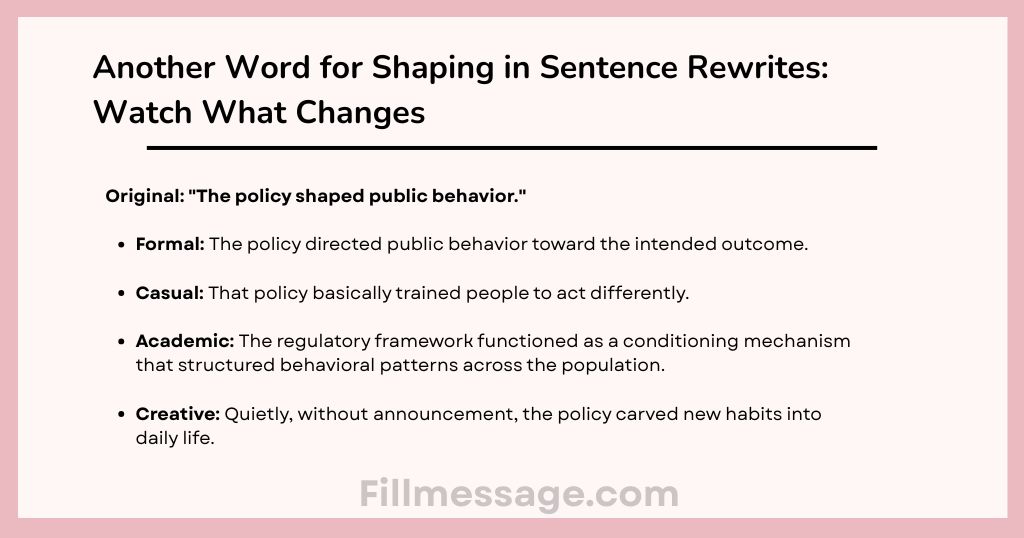
Another Word for Shaping in Sentence Rewrites: Watch What Changes
Original: “Her early years shaped who she became.”
- Formal: Her formative years played a decisive role in constructing her character and values.
- Casual: Those early years basically made her who she is today.
- Academic: Early developmental experiences functioned as conditioning forces in the formation of personal identity.
- Creative: Those years did not just touch her. They pressed into her like a seal into soft wax, and she hardened into someone new.
Original: “The policy shaped public behavior.”
- Formal: The policy directed public behavior toward the intended outcome.
- Casual: That policy basically trained people to act differently.
- Academic: The regulatory framework functioned as a conditioning mechanism that structured behavioral patterns across the population.
- Creative: Quietly, without announcement, the policy carved new habits into daily life.
Original: “He spent years shaping the organization.”
- Formal: Over many years, he systematically constructed the organization’s structure, values, and direction.
- Casual: He spent years building that organization into what it is now.
- Academic: Through sustained and deliberate effort, he engaged in the architecting of organizational culture and operational identity.
- Creative: Year after year, he worked the organization like a sculptor returning to the same stone, patient and certain of what it could become.
Each rewrite tells the same truth differently. The right version depends on your reader, your tone, and what you want them to feel.
Formal Another Word for Shaping vs. Informal: Where Each Word Belongs
Best for essays and reports: Forming, constructing, developing, engineering, establishing, structuring, determining. These hold weight without sounding dramatic.
Best for professional emails and workplace writing: Guiding, tailoring, building, refining, adapting. Active and clear without being stiff.
Best for storytelling and personal writing: Forging, sculpting, carving, cultivating, fashioning, nurturing. These carry texture. They make readers feel something rather than simply understand something.
Words to keep out of formal writing: Tweaking reads as too minor. Hacking together is too casual. Cooking up loses all seriousness. These shift tone sharply and can undermine credibility when professionalism matters.
Read also: 23 Another Word for Weight: Pick the Exact One You Need
Common Mistakes Writers Make
Molding vs. Guiding: Molding implies strong external control. It can suggest manipulation when you do not intend that. “She molded his thinking” sounds more forceful than “she guided his thinking.” Match the word to the actual level of influence.
Transforming when the change is small: Transforming means a complete, fundamental shift. Using it for minor changes overstates what happened and loses reader trust.
Framing vs. Shaping: Framing is about how something is presented and perceived. Shaping is about how something actually develops. You can frame a story without shaping the outcome. They are not the same.
Overusing Forming: It is safe, so writers default to it constantly. When it appears too many times in one section, your writing goes flat. Rotate.
Designing vs. Engineering: Designing leans creative and visual. Engineering implies systematic execution and technical planning. A designer imagines. An engineer builds to spec. The difference matters in professional and academic writing.
Conditioning used casually: In everyday conversation, conditioning often sounds behavioral or clinical. In personal or emotional writing, it can feel cold where you intended warmth. Consider cultivating or nurturing instead.
Related Another Word for Shaping That Are Close But Different
Developing is broader than shaping. It implies growth but does not suggest a specific direction or desired endpoint.
Configuring is almost always technical. It fits systems and settings but sounds awkward when applied to people or ideas.
Directing shifts the focus from the process to the person in charge. The authority becomes the subject, not the work being done.
Establishing is about permanence. Use it when the result is meant to be lasting and foundational, not temporary or in progress.
Composing focuses on arrangement. Parts are brought together thoughtfully. It is most natural in creative, musical, or written contexts.
Nurturing carries emotional investment that shaping does not. If care and patience are part of the story, nurturing earns its place.
Read more: Another Word for Against: 33 Alternatives That Actually Fit Your Writing
How to Choose Shaping Synonym Without Second-Guessing Yourself
Before swapping any word, ask three things quickly:
- Does this carry the same level of intensity as “shaping” in this sentence?
- Does it reflect the right relationship between the subject and what is being shaped?
- Does it match the tone of everything around it?
If all three answers are yes, use it. If one feels off, keep looking. The right synonym will not just fit the space. It will make the sentence sharper, more honest, and more specific than it was before.
That is the whole point of choosing carefully.

Marco Jr. is Author at fillmassage.com,
He explores the world of words and their meanings, helping readers understand language clearly. Passionate about explanations that guide and inform, he creates insightful content that educates, engages, and supports curious minds every day.