Most people grab “freedom” and move on. But freedom and liberation are not the same thing, and using them interchangeably is one of the quieter writing mistakes that weakens otherwise strong work.
Liberation carries movement. It means something held you, and now it does not. That tension matters. When you replace it carelessly, you flatten the sentence. When you replace it well, you add precision without losing power.
Here are 31 Another Word for Liberation alternatives, explained so you can actually use them.
What Makes This Word Hard to Replace
Liberation sits at a crossroads. It can be political, emotional, physical, or legal depending on the sentence around it. That is exactly why one substitute never works for every situation.
The word also implies a before and after. Someone or something was constrained. That changed. Any synonym you choose needs to carry at least a trace of that shift, or the sentence loses its meaning.
Another Word for Liberation: Quick Reference Table
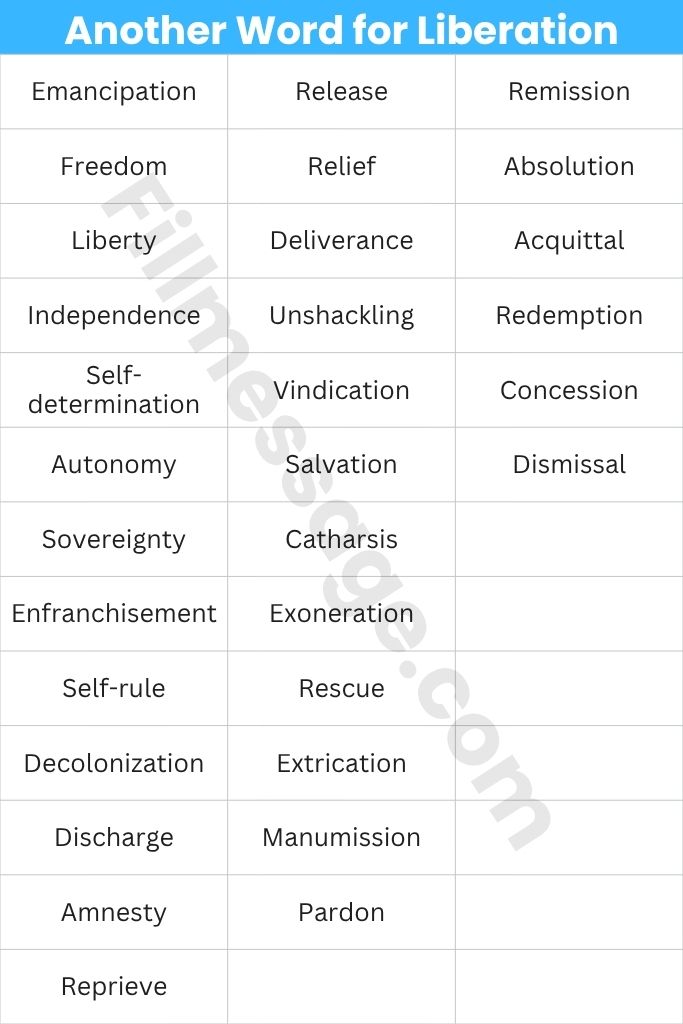
| Word | Tone | Best Context |
| Emancipation | Formal, serious | Political history, legal writing |
| Freedom | Neutral, broad | General essays, everyday use |
| Liberty | Civic, formal | Constitutional, philosophical writing |
| Independence | Factual, neutral | National history, institutions |
| Self-determination | Rights-focused | Geopolitical, human rights |
| Autonomy | Academic | Policy, psychology, institutions |
| Sovereignty | Political | International relations |
| Enfranchisement | Technical | Voting rights, civil history |
| Self-rule | Plain, direct | Accessible writing |
| Decolonization | Specific | Colonial history, political studies |
| Release | Calm, versatile | Personal writing, journalism |
| Relief | Gentle, soft | Emotional or personal situations |
| Deliverance | Dramatic | Storytelling, spiritual writing |
| Unshackling | Vivid, figurative | Creative or persuasive writing |
| Vindication | Moral weight | Clearing of blame or name |
| Salvation | Spiritual | Religious or moral contexts |
| Catharsis | Emotional | Personal narrative, psychology |
| Exoneration | Legal | Court cases, justice writing |
| Rescue | Action-focused | Emergency, dramatic narrative |
| Extrication | Technical | Physical entrapment scenarios |
| Discharge | Formal, neutral | Military, hospital, legal contexts |
| Manumission | Historical | Slavery history only |
| Amnesty | Political-legal | Political prisoners, pardons |
| Pardon | Formal legal | Individual legal cases |
| Reprieve | Tense, temporary | Legal or dramatic writing |
| Remission | Formal | Legal penalties, medical contexts |
| Absolution | Moral, spiritual | Religious or ethical writing |
| Acquittal | Legal, precise | Trial verdicts |
| Redemption | Moral, narrative | Storytelling, religious writing |
| Concession | Negotiated | Diplomacy, bargaining contexts |
| Dismissal | Narrow, legal | Charges dropped, judicial writing |
Group 1: Another Word for Political and Social Freedom Liberation
These ten alternatives belong when liberation describes a group, a nation, or a system. They carry civic or historical weight.
1. Emancipation
This is the closest match to liberation in a political sense. It describes a formal act of freeing people from legal or social subordination. It is the word historians reach for when a moment permanently changed who had rights and who did not. Use it in essays about civil rights movements, historical turning points, or policy analysis.
Example: “The emancipation of bonded workers reshaped the entire agricultural economy.”
2. Freedom
The most common swap, but also the most overused. Freedom is a state of being, not a transition. It does not carry the before-and-after tension that liberation does. Use it when you want a neutral, broadly understood word and do not need to emphasize what was overcome.
Example: “The constitution promised freedom to every citizen.”
3. Liberty
Liberty leans formal and civic. It appears in legal documents, philosophical arguments, and political speeches. It implies rights that are protected, not just a general absence of control. In casual or personal writing, it can sound stiff.
Example: “Civil liberty cannot exist where surveillance goes unchecked.”
4. Independence
Independence points to separation from external control. It works best for nations, regions, or institutions. It is factual and historical in tone. It does not carry the emotional weight of liberation but it does not need to.
Example: “The country marked fifty years of independence with public celebrations.”
5. Self-determination
This phrase appears in international law and human rights writing. It describes a people’s right to choose their own political future without outside interference. It is specific and carries significant legal authority. Do not use it in casual writing.
Example: “The treaty acknowledged the right of self-determination for all ethnic communities.”
6. Autonomy
Autonomy is about decision-making power. It applies to individuals, institutions, and regions. It fits academic writing well because it is precise without being dramatic. A region can have autonomy without full independence. A person can have autonomy within a relationship. That flexibility makes it useful.
Example: “Greater autonomy for local governments reduced bureaucratic delays.”
7. Sovereignty
Sovereignty is political authority at the highest level. A nation has sovereignty when no outside power can override its decisions. Use it in international relations, political science, or legal writing. It is too formal for most personal or narrative contexts.
Example: “The agreement recognized the full sovereignty of the newly formed state.”
8. Enfranchisement
This word is specific: it means gaining the legal right to vote or participate in civic life. When writing about voting rights, electoral history, or civil rights campaigns, enfranchisement is more precise than liberation. Outside that context, it sounds out of place.
Example: “The enfranchisement of working-class voters shifted the political balance significantly.”
9. Self-rule
Self-rule is the plain English version of autonomy and self-determination. It is easier to read and works well in journalism or any writing aimed at a general audience. It avoids jargon without losing meaning.
Example: “The community fought for self-rule after years of being governed from the capital.”
10. Decolonization
Decolonization is not a generic synonym. It describes a specific historical and political process: dismantling colonial structures and restoring power to formerly colonized peoples. If that is your subject, this word is more accurate than liberation. If it is not your subject, do not use it.
Example: “Decolonization in the mid-twentieth century created dozens of new nations.”
Group 2: Another Word for Personal and Emotional Release Liberation
These words fit when liberation describes an inner experience rather than a political event.
11. Release
Release is the most versatile word in this group. It works for emotional unburdening, physical freeing, and even legal discharge. It does not overstate and does not carry heavy drama. When you are unsure which word to use in a personal context, release is often the safest choice.
Example: “Telling the truth finally brought her a release she had not expected.”
12. Relief
Relief is softer and less charged than liberation. Use it when the main feeling is tension lifting rather than a dramatic transformation. A character who survives a difficult conversation does not feel liberation in that moment. They feel relief.
Example: “There was visible relief on his face when the results came back clear.”
13. Deliverance
Deliverance is dramatic. It suggests rescue from something serious, often with a spiritual or fateful quality. It does not belong in casual or light contexts. If someone found a better job, deliverance is too heavy. If someone survived something that nearly destroyed them, it fits.
Example: “She described her recovery as a kind of deliverance she could not fully explain.”
14. Unshackling
This word is figurative and vivid. It works in persuasive writing, op-eds, or creative work where you want the reader to feel the image. It implies visible, physical chains being broken, which makes it powerful in small doses. Do not overuse it.
Example: “The new policy represented an unshackling of small businesses from excessive regulation.”
15. Vindication
Vindication means being proven right or cleared of blame after unfair treatment. It carries moral weight. A person whose name was damaged and then restored does not feel liberation exactly. They feel vindication, and that distinction matters in storytelling and journalism.
Example: “Winning the appeal felt like vindication for everything he had endured.”
16. Salvation
Salvation comes from religious tradition but now appears across many writing contexts. It implies rescue from something catastrophic, moral, or existential. It carries more weight than rescue and more spiritual resonance than deliverance. Use it when the stakes feel absolute.
Example: “For many in the community, the new shelter was nothing short of salvation.”
17. Catharsis
Catharsis is not a direct synonym but describes the emotional release that often follows liberation. It is the feeling of something built up finally being let out. Writers and psychologists both use it. If your sentence is about emotional processing rather than an act of freeing, catharsis fits better than liberation.
Example: “The final scene of the play offered the audience a genuine catharsis.”
18. Exoneration
Exoneration means being officially cleared of guilt or wrongdoing. It is legal in tone but appears regularly in journalism. It implies a formal process concluded in someone’s favor. It is not emotional in the way liberation often is, but it does carry the sense that something unjust has been corrected.
Example: “New evidence led to the exoneration of a man who had spent twelve years in prison.”
Group 3: Synonym for Physical Freeing and Rescue Liberation
These words work when the liberation is literal and physical.
19. Rescue
Rescue is active and event-focused. Someone intervened. Something changed quickly. It is not metaphorical in most uses and works best when there is urgency in the scene.
Example: “The rescue operation lasted three days before all miners were brought to safety.”
20. Extrication
Extrication is technical. It describes physically removing someone from entrapment, usually in emergency contexts. Firefighters and paramedics use this word in reports. It does not carry emotional weight and should not be used metaphorically.
Example: “The team performed an extrication after the vehicle overturned on the highway.”
21. Discharge
In physical or institutional contexts, discharge means formally releasing someone from confinement, service, or treatment. It is neutral and procedural. A soldier receives a discharge. A patient is discharged from the hospital. It signals the end of an official process.
Example: “He received his discharge papers and walked out of the facility for the last time.”
22. Manumission
Manumission is a historical legal term for the formal freeing of an enslaved person. It belongs only in historical writing about slavery. Using it in any other context would feel strange and would likely confuse readers. When writing about that period of history, it is more precise than liberation.
Example: “The archive contained dozens of manumission documents dating back to the 1790s.”
Group 4: Synonym for Legal and Institutional Release Liberation
These words carry formal authority. They do not fit casual or creative writing.
23. Amnesty
Amnesty is an official, usually government-level pardon granted to a group of people, most often for political offenses. It is used in transitional justice writing and political journalism. It is not personal in the way a pardon is.
Example: “The outgoing government declared amnesty for political prisoners held during the conflict.”
24. Pardon
A pardon is granted to a specific individual. It removes legal penalties for a crime. Presidents, governors, and monarchs grant pardons. It is more personal and individual than amnesty.
Example: “The governor issued a pardon after reviewing the case for the third time.”
25. Reprieve
A reprieve delays a punishment but does not cancel it. This distinction is critical. If you use reprieve to mean full liberation, you have made a factual error. Use it when the freedom is temporary or uncertain.
Example: “The court granted a reprieve while the appeal was being reviewed.”
26. Remission
Remission means a reduction or cancellation of a penalty or debt. It is also a medical term describing a disease retreating. Context determines which meaning applies. In legal writing it refers to sentence reduction. In medical writing it refers to disease. Do not confuse the two.
Example: “Good behavior contributed to the remission of his remaining sentence.”
27. Absolution
Absolution clears someone of moral or religious guilt. It comes from Catholic tradition but is used more broadly now to describe any formal clearing of moral responsibility. It does not apply in legal contexts and should not be confused with exoneration.
Example: “She did not seek absolution from anyone; she had already made peace with her past.”
28. Acquittal
An acquittal is a specific legal verdict: not guilty. It ends a trial in the defendant’s favor. It is narrow and precise. Do not use it as a general synonym for liberation. It belongs only in writing about trials and verdicts.
Example: “The acquittal surprised many who had followed the case closely.”
29. Redemption
Redemption describes recovery from moral failure, guilt, or a serious low point. It appears in religious writing, but it is equally at home in fiction, journalism, and personal essays. It implies the person did something wrong and found a way back. That makes it different from liberation, which does not require fault.
Example: “His final act of generosity felt like redemption after years of selfish decisions.”
30. Concession
A concession is when one party gives up something during negotiation. It can include lifting restrictions or granting rights. It is not full liberation but a partial step toward it. Use it in diplomatic, political, or business writing.
Example: “The government’s concession on press freedom was seen as a first step, not a solution.”
31. Dismissal
Dismissal in a legal sense means charges were dropped or a case was thrown out. It is narrow, procedural, and does not carry emotional weight. Do not stretch it beyond legal writing.
Example: “The judge ordered the dismissal of all remaining charges against the defendant.”
Another Word for Liberation Three Rewrites, One Sentence
Original: “The people finally achieved liberation.”
Formal essay version: “After decades of organized resistance, the population secured full political emancipation and the right to self-determination.”
Journalistic version: “Years of pressure ended with a government announcement granting full autonomy to the region.”
Narrative version: “It was not until the last soldier left that the people allowed themselves to believe their long wait for deliverance was finally over.”
Each version says the same thing. Each one feels completely different. That is the work synonyms actually do.
Mistakes That Are Easy to Make
Treating reprieve as freedom. A reprieve pauses something. It does not end it. If your character gets a reprieve, they are not free yet.
Using deliverance in everyday moments. Save it for high-stakes situations. A promotion is not deliverance. Surviving a house fire might be.
Stacking synonyms in one paragraph. Using liberation, freedom, release, and emancipation in the same section does not show vocabulary range. It shows padding.
Confusing absolution with exoneration. Absolution is moral or spiritual. Exoneration is legal. They are not interchangeable.
Using enfranchisement outside voting contexts. It has one main job. Let it do that job.
Words That Live Near Liberation synonym
Oppression is what liberation answers. Knowing the opposite sharpens how you write about the idea itself.
Agency means having real power to act. It often appears alongside autonomy in academic and political writing.
Resistance is the process before liberation arrives. It describes the struggle, not the outcome.
Dignity sits at the heart of most liberation movements. Writers often underuse it when covering these topics.
Read more:
33 Another Word for Eye Opening: Pick the One That Actually Fits
30 Another Words for Handsomely: The Right Alternative for Every Context
FAQs about Another Word for Liberation
Is liberation always political?
No. It can describe a personal shift, an emotional release, or a physical escape. The word works across contexts. What changes is which synonym fits best in each one.
What is the antonym of liberation?
Captivity, subjugation, oppression, and enslavement are the clearest opposites. For physical contexts, confinement works. For political ones, suppression or tyranny.
Which word fits best in a formal essay?
Emancipation for historical contexts. Autonomy for institutional or policy writing. Self-determination for human rights and geopolitical topics. Pick based on what specifically is being argued, not just what sounds formal.
Can liberation sound too dramatic in personal writing?
Yes. In personal essays or casual writing, release or relief often reads more naturally. Liberation can sound like you are writing a political manifesto when you just mean someone finally moved on.
Choosing Well
The right word is not the longest or most impressive option. It is the one that fits the sentence so naturally the reader does not pause to notice it.
When you know whether the context is political, emotional, physical, or legal, and whether the tone should be formal or accessible, the right synonym from this list becomes obvious. Start there, not with the word itself.

Marco Jr. is Author at fillmassage.com,
He explores the world of words and their meanings, helping readers understand language clearly. Passionate about explanations that guide and inform, he creates insightful content that educates, engages, and supports curious minds every day.