You’ve typed “allocate” three times in one page and something feels off. The writing reads like a policy memo even when it shouldn’t. Or maybe you’re searching for a word that fits tasks instead of money, or time instead of resources.
That’s the real problem with “allocate.” It works everywhere, so writers lean on it too hard. The fix isn’t just swapping it out. It’s knowing which word to swap it with, and why.
What the Word Actually Does
To allocate is to give something a planned destination. Not randomly. Not generously. Deliberately. There’s intent in it, and usually a system behind it.
That’s what makes it tricky to replace. One synonym fits tasks. Another fits budgets. Another fits time. Use the wrong one and the sentence quietly breaks.
The Full Table: 41 Another Word for Allocate, Organized by Context
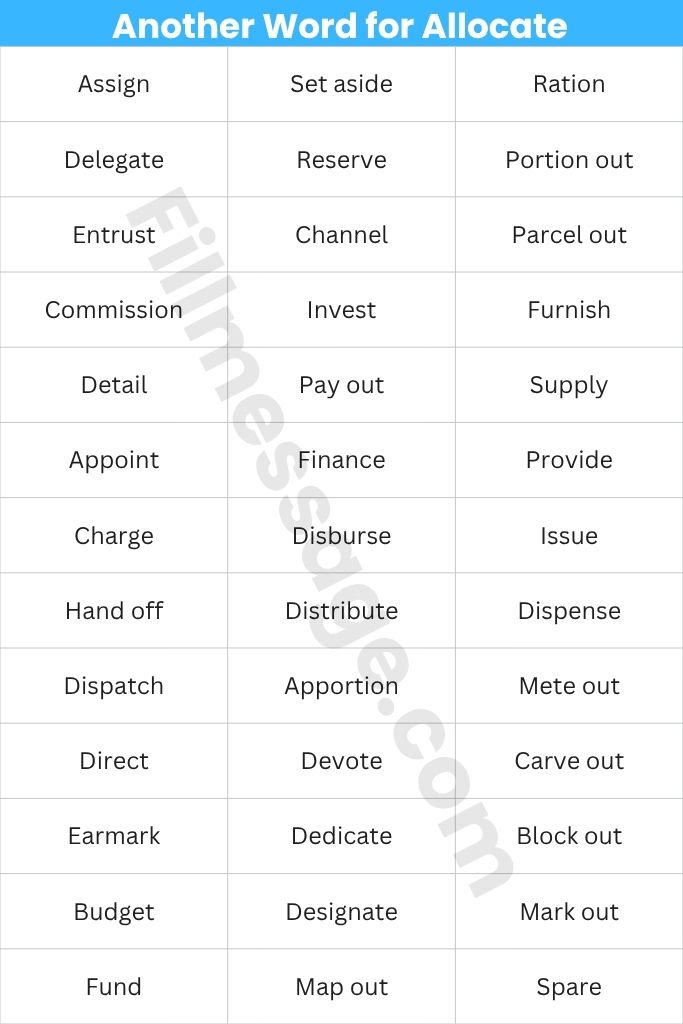
Each word is placed where it actually belongs, not just listed alphabetically.
Allocate Synonyms For Tasks and Responsibilities
| Word | Tone | What It Adds |
| Assign | Neutral-formal | Clean and direct; works in almost any context |
| Delegate | Professional | Implies passing authority, not just a task |
| Entrust | Warm, relational | Shows confidence in the person receiving the task |
| Commission | Official | Formally appointing someone to a specific job |
| Detail | Specialized | Used in military/legal contexts for task assignment |
| Appoint | Formal | Designating someone to a role or position |
| Charge | Firm | Giving someone responsibility with clear expectation |
| Hand off | Casual | Passing a task informally |
| Dispatch | Action-oriented | Sending someone to handle something specific |
| Direct | Clean, formal | Telling someone where to focus their effort |
Allocate Synonyms For Money and Budgets
| Word | Tone | What It Adds |
| Earmark | Formal-purposeful | Labels money for a specific use, nothing else |
| Budget | Practical | Planning how money will be used |
| Fund | Financial | Providing money to pay for something |
| Appropriate | Legislative | Officially setting aside money by law or policy |
| Commit | Decisive | Pledging money toward something firmly |
| Set aside | Calm, practical | Saving money for a planned purpose |
| Reserve | Neutral | Keeping money back for a defined reason |
| Channel | Directional | Moving money purposefully toward a goal |
| Invest | Strategic | Putting money in expecting a return or outcome |
| Pay out | Direct | Disbursing money that has already been decided |
| Finance | Formal | Covering the cost of something officially |
| Disburse | Technical | Releasing funds through a formal process |
Allocate Synonyms For Resources and Supplies
| Word | Tone | What It Adds |
| Distribute | Neutral | Spreading something across a group or area |
| Apportion | Formal | Dividing fairly based on a rule or share |
| Ration | Controlled | Distributing carefully when supply is limited |
| Portion out | Conversational | Dividing into parts informally |
| Parcel out | Informal | Breaking something into smaller pieces to share |
| Furnish | Formal | Providing what is needed to someone |
| Supply | Neutral | Making something available for use |
| Provide | General | Giving access to something needed |
| Issue | Official | Giving out something through a formal process |
| Dispense | Measured | Distributing in a controlled, often clinical way |
| Mete out | Literary | Giving in careful, deliberate amounts |
Allocate Synonyms For Time and Effort
| Word | Tone | What It Adds |
| Devote | Warm, committed | Personal dedication of time or energy |
| Dedicate | Intentional | Full commitment to a specific purpose |
| Carve out | Vivid, informal | Making space in a busy schedule |
| Set aside | Calm | Reserving time without urgency |
| Block out | Practical | Scheduling time specifically for something |
| Designate | Formal | Officially labeling a time or space for a purpose |
| Mark out | Quiet-formal | Identifying time or space for specific use |
| Map out | Planning-focused | Arranging time or effort in a structured way |
| Spare | Simple | Setting aside a small amount of time or energy |
How These Words Actually Differ
Seeing 41 words in a table is useful. Understanding where they break apart is what makes you a better writer.
Assign vs. Delegate
Both involve giving someone a task. But delegate means you’re also giving them the authority to handle it. If your manager assigns you a task, they may still control every decision. If they delegate it, the responsibility is genuinely yours. Writers often use these as equals. They’re not.
Earmark vs. Reserve
Reserve is general. Earmark is specific and protective. Reserved funds could technically be redirected. Earmarked funds are labeled and locked in. “The money is reserved for training” leaves a door open. “The money is earmarked for training” closes it.
Apportion vs. Distribute
Distribute is neutral spreading. Apportion implies a rule or principle behind the division. Grants are apportioned. Flyers are distributed. The difference is whether fairness or proportion is built into the act.
Devote vs. Dedicate
These are close. Devote tends to feel more personal, like a quiet ongoing commitment. Dedicate often implies a formal or public act of commitment. You devote your evenings to writing. You dedicate a book to your mother.
Ration vs. Dispense
Ration signals scarcity. Something is being rationed because there isn’t enough. Dispense is about controlled distribution regardless of scarcity. Medicine is dispensed. Food during a shortage is rationed.
Channel vs. Direct
Both suggest purposeful movement. Channel implies guiding something through a path toward a goal. Direct is more immediate, like pointing. You channel energy over time. You direct attention in a moment.
Another Word for Allocate in Three Sentences, Four Ways Each
Original: The organization will allocate funds to the community program.
- Formal: The organization has earmarked funds specifically for the community program.
- Casual: The organization is setting aside money to support the community program.
- Policy-style: Funds have been appropriated to sustain the community program through the fiscal year.
- Purposeful: The organization is channeling its financial resources directly into the community program.
Original: Please allocate this task to someone on the team.
- Direct: Please assign this task to a team member.
- Authority-based: Please delegate this to whoever can take ownership of it.
- Relational: Please entrust this to someone on the team who’s ready for it.
- Casual: Can you hand this off to someone on the team?
Original: We should allocate more time to planning.
- Practical: We should block out more time for planning before we move forward.
- Personal: We need to devote real time to planning, not just talk about it.
- Formal: Additional time should be designated for the planning phase of this project.
- Vivid: We need to carve out actual space for planning instead of rushing past it.
When the Original Word Is Still Best
Not every sentence needs a replacement. In formal policy writing, financial reporting, or academic papers, “allocate” is precise and appropriate. Replacing it for the sake of variety can actually reduce clarity.
If the word appears twice in one paragraph, change one instance. If it appears once in a page, leave it.
The goal is never to avoid the word entirely. It’s to use it intentionally.
Another Word for Allocate That Are Related but Mean Something Distinct
These are not synonyms for allocate, but they live in the same neighborhood and are worth knowing.
Administer means managing the process of distributing something, not deciding to distribute it. You administer a fund. You allocate from it.
Provision (as a verb) means to supply or equip in advance. More common in military or logistics writing.
Grant implies formal giving, often with power or authority behind it. A government grants funds. A manager doesn’t usually grant a task.
Pool is the opposite direction. Instead of dividing, you’re combining. Teams pool resources instead of allocating them individually.
Withhold is the clearest antonym. To withhold is to deliberately not allocate. Others include: retain, revoke, reclaim, and restrict.
Another Word for Allocate Formal vs. Casual: Quick Reference
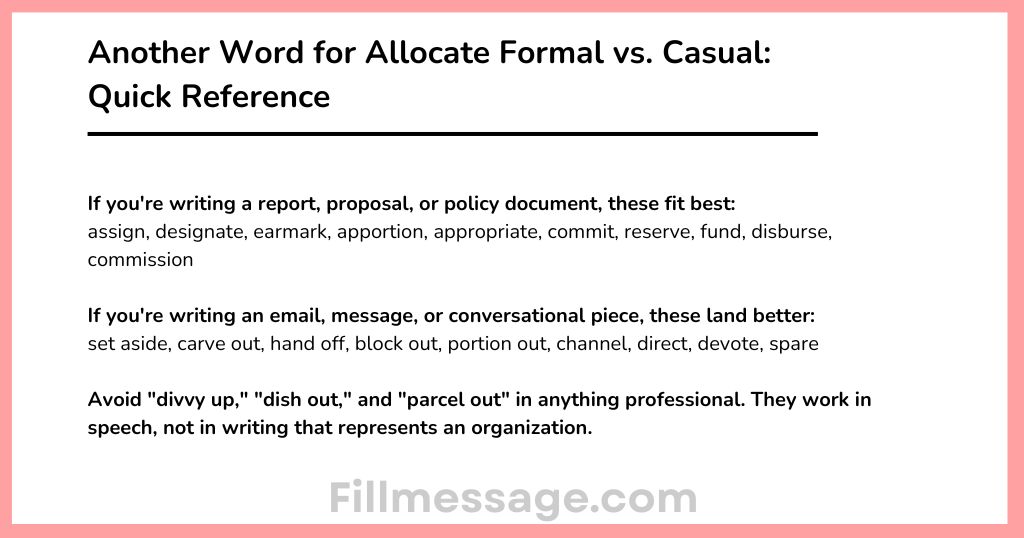
If you’re writing a report, proposal, or policy document, these fit best:
assign, designate, earmark, apportion, appropriate, commit, reserve, fund, disburse, commission
If you’re writing an email, message, or conversational piece, these land better:
set aside, carve out, hand off, block out, portion out, channel, direct, devote, spare
Avoid “divvy up,” “dish out,” and “parcel out” in anything professional. They work in speech, not in writing that represents an organization.
Common Mistakes Worth Avoiding
Using “distribute” when only one person or group receives something. Distribute suggests multiple recipients. If there’s one, use assign, direct, or designate.
Using “delegate” when you mean give. Delegation includes authority. If you’re just passing a job without giving the person power over it, “assign” or “hand off” is more accurate.
Using “devote” with money. It feels natural with time and effort but sounds off with financial resources. “She devoted the budget to marketing” doesn’t land the way “she channeled the budget toward marketing” does.
Using “appropriate” in casual writing. It belongs in legislative and policy contexts. Outside those, it reads as unnecessarily stiff.
Using “ration” when supply is not actually limited. Ration carries a scarcity signal. If there’s plenty of something, ration is the wrong word regardless of how carefully it’s being distributed.
Read also:
25 Another Word for Proofing: Pick the Right One Every Time
29 Another Word for Repercussions: The Right Word for Every Situation
Final Word
Pick based on three things: what’s being given, who’s receiving it, and how much weight you want the act to carry.
Tasks go to assign, delegate, or entrust. Money goes to earmark, budget, or channel. Time goes to devote, carve out, or block out. Fairness goes to apportion. Scarcity goes to ration.
Once you know those pairings, “allocate” stops feeling like the only option and starts feeling like one of many, each with its own specific job.

Marco Jr. is Author at fillmassage.com,
He explores the world of words and their meanings, helping readers understand language clearly. Passionate about explanations that guide and inform, he creates insightful content that educates, engages, and supports curious minds every day.