You’ve written “admire” three times in two paragraphs. You notice it. Your reader will too. But grabbing any random synonym from a list often makes things worse. “Venerate” where you needed “appreciate.” “Worship” in a professional email. These mismatches quietly damage your writing.
The goal here isn’t just giving you 47 words. It’s helping you understand which one belongs where.
What “Admire” Actually Means
Admire sits in interesting emotional territory. It’s warmer than respect, more grounded than worship, more deliberate than simply liking something. When you admire someone, you’re consciously recognizing their worth, whether that’s their character, their skill, or what they’ve achieved.
The feeling can be private and quiet, or open and expressive. That range is exactly why one synonym never covers everything.
All 47 Another Word for Admire, Organized by Meaning
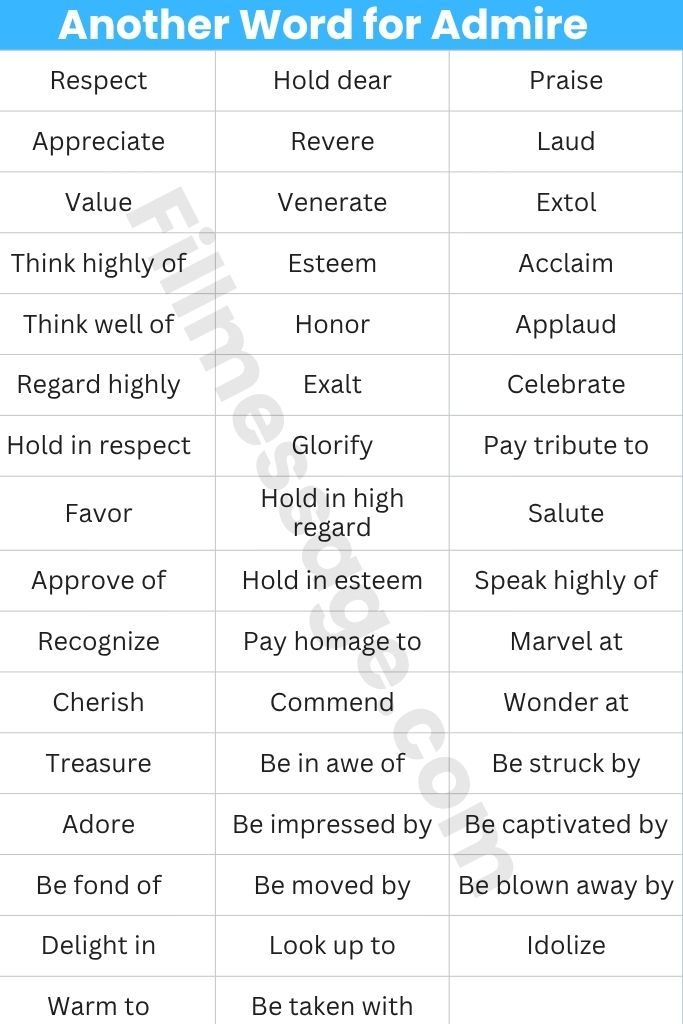
Group 1: Quiet, Steady Respect (Neutral Tone)
These work when admiration is calm, internal, and measured. No drama. No excess.
| Word/Phrase | Best Used When |
| Respect | Acknowledging character, skill, or position |
| Appreciate | Recognizing someone’s value without overstating it |
| Value | Treating someone’s qualities as genuinely important |
| Think highly of | Everyday writing, honest and simple |
| Think well of | Softer version of the above, conversational |
| Regard highly | Slightly more formal, works in both speech and prose |
| Hold in respect | Formal phrasing, suited to letters or tributes |
| Favor | Mild positive regard leaning toward preference |
| Approve of | You recognize merit and support it |
| Recognize | Neutral acknowledgment of someone’s worth or effort |
The key difference here: Respect acknowledges. Appreciate notices. Value assigns worth. They feel similar but land differently depending on your sentence.
Group 2: Warm and Personal (Affectionate Tone)
Use these in storytelling, personal essays, or any writing with emotional closeness.
| Word/Phrase | Best Used When |
| Cherish | Someone holds a meaningful place in your life |
| Treasure | You prize what someone gives or represents |
| Adore | Genuine warmth, close relationships, character writing |
| Be fond of | Gentle, familiar admiration mixed with affection |
| Delight in | Admiring what someone does rather than who they are |
| Warm to | The moment admiration begins to grow, useful in narrative |
| Be taken with | Early, instinctive attraction to someone’s quality |
| Hold dear | Personal, slightly old-fashioned but emotionally honest |
Watch out: Cherish and treasure both imply personal closeness. Don’t use either for a public figure you’ve never met. It reads as false.
Group 3: Deep, Elevated Admiration (Strong/Formal Tone)
These carry real weight. Each one says the feeling goes beyond ordinary admiration.
| Word/Phrase | Best Used When |
| Revere | Deep, serious admiration for wisdom, legacy, or character |
| Venerate | Near-sacred respect, historical figures or elders |
| Esteem | High regard with a formal, professional tone |
| Honor | Deliberate, conscious respect, often in tribute contexts |
| Exalt | Elevating someone in language or status, literary tone |
| Glorify | Raising someone’s image, sometimes beyond reality |
| Hold in high regard | Professional and academic writing |
| Hold in esteem | Slightly more formal version of the above |
| Pay homage to | A deliberate act of admiration, often for legacy |
Revere vs. Venerate: Both are strong, but venerate leans older, more ceremonial. You revere a great coach. You venerate a founding figure of a movement.
Group 4: Public Praise and Recognition (Official/Positive Tone)
These belong in speeches, award write-ups, recommendation letters, and formal recognition.
| Word/Phrase | Best Used When |
| Commend | Formally acknowledging someone’s effort or conduct |
| Praise | Expressing approval out loud or in writing |
| Laud | Written or spoken praise with genuine enthusiasm |
| Extol | Stronger than laud, used for significant achievements |
| Acclaim | Praise from many, often public and widespread |
| Applaud | Approving an action or decision, not just a person |
| Celebrate | Open, joyful recognition of someone’s worth |
| Pay tribute to | Formal recognition, often for milestone or legacy |
| Salute | Respectful acknowledgment, often for courage or service |
| Speak highly of | Recommending someone through genuine praise |
Laud vs. Extol: Laud praises. Extol almost argues a case for why someone deserves praise. Extol works harder.
Group 5: In-the-Moment Wonder (Reactive/Literary Tone)
These describe admiration as a reaction, something that hits you suddenly rather than builds over time.
| Word/Phrase | Best Used When |
| Marvel at | Sudden wonder and appreciation for something extraordinary |
| Wonder at | Softer than marvel, more introspective and quiet |
| Be in awe of | Admiration so strong it borders on speechlessness |
| Be impressed by | A direct, honest reaction to ability or quality |
| Be struck by | Something caught your attention and moved you |
| Be captivated by | Drawn in, almost involuntarily, by someone’s presence or work |
| Be moved by | Emotional response, strong in personal essays and memoirs |
| Be blown away by | Very casual, high-impact reaction, avoid in formal writing |
| Look up to | Seeing someone as a model worth following, informal but genuine |
| Idolize | Intense admiration, sometimes suggests uncritical devotion |
Be careful with idolize: It can read as a compliment in casual writing. In more serious contexts, it subtly implies the admiration has gone too far.
The Intensity Ladder
When you’re unsure how strong your word should feel, place it here:
Like → Be fond of → Appreciate → Respect → Admire → Esteem → Revere → Venerate → Worship
Moving right adds depth and formality. Moving left softens the feeling. Pick the point that matches what you actually mean, not what sounds most impressive.
Another Word for Admire in Sentence Rewrites: Seeing the Difference
Same feeling. Different words. Completely different effect on the reader.
Base sentence: She admired her professor.
- Formal: She held her professor in the highest esteem, crediting his guidance with shaping her academic path entirely.
- Casual: She really looked up to him and carried his advice with her long after graduation.
- Literary: Something in the way he spoke made her stop and listen, a quiet reverence she never quite named.
- Professional: She commended his mentorship openly, citing his influence in every acknowledgment she ever wrote.
Notice what changes. The formal version expands the feeling with context. The casual version grounds it in behavior. The literary version removes the label and just shows it. The professional version makes it an action.
Base sentence: He admired the painter’s skill.
- Neutral: He genuinely appreciated the precision and patience behind every piece she created.
- Elevated: Standing before her work, he felt something close to awe, the kind that makes you stop talking.
- Conversational: He was completely taken with how she worked. Couldn’t stop thinking about it.
Each version is honest. Each one tells a slightly different story about how strong the feeling is.
Formal Another Word for Admire vs. Informal: Where Each Word Belongs
For essays, academic writing, professional emails:
Esteem, commend, revere, laud, extol, hold in high regard, pay tribute to, honor, regard highly, salute
For fiction, creative nonfiction, personal essays:
Cherish, treasure, adore, marvel at, be captivated by, be moved by, be struck by, warm to, hold dear
For blogs, casual conversation, everyday writing:
Look up to, think highly of, be fond of, be taken with, be blown away by, appreciate, think well of
Words to handle with care in formal writing:
Idolize, worship, be blown away by, glorify. These can work in creative contexts but feel out of place in professional or academic tone.
Common Mistakes Writers Make
Using “appreciate” when the feeling is much stronger. If your character has spent years looking up to someone, “appreciate” is too thin. It sounds like gratitude for a small favor.
Confusing praise and admire. Admire is what you feel. Praise is what you do. You can admire someone silently for a decade. Praise requires you to actually say something.
Dropping “worship” into serious writing. In a novel, it can be powerful. In a tribute speech or a recommendation letter, it reads as exaggerated and undercuts your credibility.
Treating “look up to” as a universal replacement. It’s warm and natural in conversation. In formal or literary writing, it becomes repetitive fast and shrinks the emotional weight.
Using venerate for someone still alive and well-known. Venerate carries an almost ceremonial quality. It fits historical figures or deeply respected elders. Using it for a current pop star, for example, creates an unintentional tone clash.
Related Another Word for Admire That Belong Nearby
These aren’t synonyms but they connect directly to admiration and often appear alongside it.
- Admiration – The noun form. Use it when you want to name the feeling itself rather than describe it through a verb.
- Reverence – The emotional state behind revere and venerate. More about atmosphere than action.
- Awe – Raw wonder. Admiration can produce awe, but awe doesn’t always involve a person.
- Devotion – Admiration sustained over time and expressed through consistent action.
- Inspiration – What admiration sometimes creates. You admire someone and feel inspired. Different things.
- Envy – Admiration’s complicated neighbor. You can genuinely admire someone and feel envious at the same time. Worth acknowledging when writing complex characters.
Read more:
50 Another Word for Dedicated: Choose the Right One Every Time
35 Another Word for Warm: The Right Word for Every Context
Choosing the Right Word
Two questions will get you there almost every time.
First: How strong is the feeling? Match your word to the actual intensity, not the intensity you wish it had.
Second: What’s the context? Formal, personal, public, or reactive? Each group in this article maps to one of those situations.
The right synonym doesn’t just replace a word. It adds precision. And in writing, precision is what separates clear from forgettable.

Marco Jr. is Author at fillmassage.com,
He explores the world of words and their meanings, helping readers understand language clearly. Passionate about explanations that guide and inform, he creates insightful content that educates, engages, and supports curious minds every day.