You typed “against” and then typed it again. And again. By the third time, something felt off. Not wrong exactly, just… tired. Flat. Like the word stopped doing its job.
That is the problem with “against.” It works in too many situations, which means it stands out in none of them. Physical position, moral disagreement, legal conflict, emotional resistance, simple comparison — the word covers all of it without committing to any of it.
What you actually need is the right word for the right moment. Not a list you have to guess through. A guide you can actually use.
What This Word Really Does
“Against” is a preposition with a wide range. It can describe where something sits physically (“leaning against the fence”), how someone feels about an idea (“against the proposal”), or the force behind an action (“rowing against the current”).
The emotional weight shifts completely depending on context. Calm. Combative. Comparative. Literal. The word shape-shifts, and that is exactly why replacing it requires more than grabbing any synonym off a list.
All 33 Another Word for Against, Organized So You Can Actually Use Them
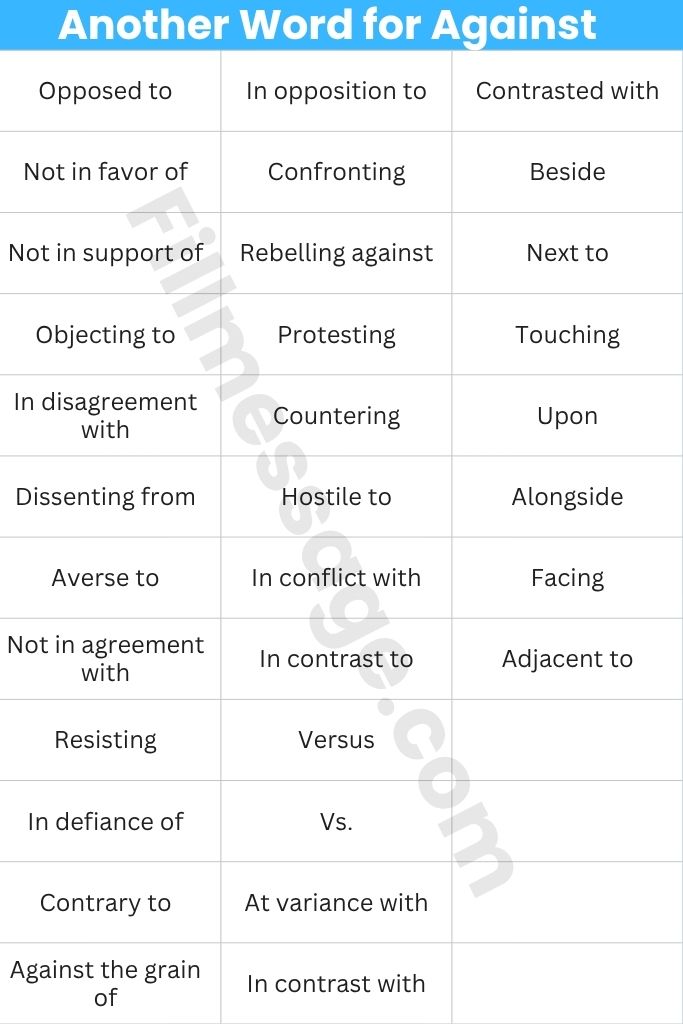
Rather than dumping 33 words in a row, here they are split by what kind of “against” you are working with.
When You Mean: Opinion or Stance
These work when someone holds a position that differs from another person, group, or idea.
| Word / Phrase | Tone | Use It When |
| Opposed to | Neutral, clean | Stating a clear position without drama |
| Not in favor of | Soft, diplomatic | You want to sound measured, not aggressive |
| Not in support of | Gentle, cautious | Mild pushback in professional settings |
| Objecting to | Formal | Legal, structured, or official contexts |
| In disagreement with | Neutral | Discussing differing views calmly |
| Dissenting from | Formal, serious | Academic papers, legal writing, official records |
| Averse to | Formal, personal | Someone feels reluctant, not just different |
| Not in agreement with | Neutral | Polite way to signal a gap in views |
Example shift:
Weak: “She was against the idea.”
Better: “She formally objected to the idea during the review.” Or casually: “She wasn’t in favor of it at all.”
When You Mean: Active Resistance or Conflict
These carry force. The opposition is not passive. Someone is pushing back, standing firm, or refusing to move.
| Word / Phrase | Tone | Use It When |
| Resisting | Active, ongoing | The pushback is sustained over time |
| In defiance of | Strong, moral | Standing against authority, rules, or pressure |
| In opposition to | Formal, firm | Official or structured conflict |
| Confronting | Direct, strong | Face-to-face resistance or challenge |
| Rebelling against | Emotional, intense | Deep, often long-term resistance to norms or power |
| Protesting | Public, vocal | Group or community-level opposition |
| Countering | Tactical, responsive | Responding to a specific argument or move |
| Hostile to | Negative, sharp | Actual animosity, not just disagreement |
| In conflict with | Neutral to strong | Friction between people, groups, or ideas |
| In defiance of | Moral weight | Going against rules or expectations deliberately |
Example shift:
Weak: “The workers were against management’s decision.”
Better: “The workers actively resisted management’s decision.” Or with more drama: “They protested every step management took.”
When You Mean: Contrast or Comparison
Sometimes “against” is not about conflict at all. It marks a difference or sets something apart visually or conceptually.
| Word / Phrase | Tone | Use It When |
| In contrast to | Neutral | Comparing two things that differ |
| Versus | Neutral, balanced | Competitions, comparisons, debates |
| Vs. | Informal shorthand | Headings, sports, quick comparisons |
| Contrary to | Formal, strong | Something directly contradicts a fact or expectation |
| At variance with | Formal | Data, findings, or ideas that don’t align |
| Against the grain of | Figurative | Going opposite to what is expected or normal |
| In contrast with | Neutral | Similar to “in contrast to,” works in most writing |
| Contrasted with | Neutral/Academic | Side-by-side comparisons in formal writing |
Example shift:
Weak: “Against the blue background, the red stood out.”
Better: “In contrast to the blue background, the red immediately drew attention.”
When You Mean: Physical Position
This is where most synonym lists fail writers. They suggest “opposing” for a spatial sentence and the result sounds unintentionally comic.
| Word / Phrase | Tone | Use It When |
| Beside | Neutral, spatial | Next to something, no conflict |
| Next to | Neutral, spatial | Physical closeness, literal use |
| Touching | Literal, close | Direct contact between surfaces |
| Upon | Formal, resting | Something resting on or leaning onto a surface |
| Alongside | Neutral | Running parallel, no opposition implied |
| Facing | Directional | Turned toward something or someone |
| Adjacent to | Formal, spatial | Formal writing about location or layout |
Example shift:
Weak: “He placed the ladder against the wall.”
Fine as is. But if you want variation: “He positioned the ladder alongside the wall” or “He leaned it directly upon the brickwork.”
The Tone Ladder: From Mild to Intense
If you are trying to calibrate how strongly a word reads, here is a rough scale from least to most forceful for opposition-based synonyms:
Not in favor of → At odds with → Opposed to → In opposition to → Resisting → Countering → Confronting → In defiance of → Rebelling against → Hostile to
Knowing where your word lands on this scale helps you match it to the moment. A diplomatic email needs something near the top. A character in a novel who has been pushed too far needs something near the bottom.
Mistakes That Quietly Hurt Your Writing
Mixing up “averse” and “adverse.” These are not interchangeable. Averse describes a personal feeling of reluctance. Adverse describes conditions or effects that cause harm. “Averse to risk” is correct. “Adverse to risk” is not.
Using “hostile to” for mild disagreement. If someone simply prefers a different approach, “hostile to” is too heavy. It suggests real animosity. Use it only when that tension actually exists.
Treating “versus” as aggressive. It is neutral. It marks two sides without implying that one is wrong. “Coffee versus tea” is preference, not warfare.
Dropping “in opposition to” into casual writing. It sounds stiff in informal contexts. “At odds with” or “not on board with” carries the same meaning without the weight.
Using “counter to” and “in contrast to” as if they are identical. Counter to implies contradiction or conflict. In contrast to simply marks a difference. One challenges. The other compares. They are not always swappable.
Using “contrary to” for personal disagreement. “Contrary to” works best when something contradicts a fact, expectation, or established idea. It is less suited to personal opinion.
Formal Another Word for Against vs. Casual: Quick Reference
For essays, reports, legal writing, professional emails: Opposed to, in opposition to, contrary to, objecting to, adverse to, dissenting from, at variance with
For blog posts, social media, casual conversation: At odds with, anti, not on board with, not a fan of, going against the grain
For storytelling and creative writing: Resisting, in defiance of, rebelling against, confronting, against the grain of
One rule worth remembering: anti is perfectly fine in casual or ideological contexts (“she was anti-establishment from day one”) but looks weak in formal writing. Do not use it in a professional report.
Related Another Word for Against That Often Come Up Here
These are not direct synonyms for “against,” but they belong in the same conversation and are worth knowing.
Dissent is principled disagreement, usually in a formal or public setting. It carries more gravity than simple opposition.
Friction describes ongoing tension without a dramatic blow-up. Useful when conflict is quiet and persistent.
Backlash is a strong public or community reaction against something. It implies scale and emotion.
Rebuttal is a direct response that pushes back against a specific argument. More focused than “against” in debate or discussion.
Veto means formally blocking something. Specific to decisions and authority.
Resistance is broader than any one synonym here. It covers passive reluctance all the way to active refusal.
Read also:
35 Another Word for Warm: The Right Word for Every Context
47 Another Word for Admire: The Complete Guide for Writers
FAQs on Against Synonym
Can “versus” replace “against” in emotional sentences?
No. “She fought versus the system” sounds broken. “Versus” needs two defined sides in a comparison or competition. It does not carry emotional force.
Is “contrary to” stronger than “opposed to”?
Yes, slightly. “Contrary to” suggests direct contradiction, often of a fact or established expectation. “Opposed to” is about stance or preference. “Contrary to evidence” works. “Opposed to evidence” sounds odd.
When is it better to just keep “against”?
When your writing is fast, casual, or spoken. “Against” is quick, clear, and universally understood. Replacing it with “in opposition to” in a short sentence just adds friction without adding meaning.
What is the safest, most neutral replacement for general use?
“Opposed to” for stance. “In contrast to” for comparison. Both work across most writing contexts without pushing the reader in any emotional direction.
How to Choose Quickly
Ask yourself one question before swapping: What kind of “against” is this?
- Physical placement? Use beside, next to, upon, or alongside.
- Mild disagreement? Use not in favor of or at odds with.
- Strong resistance? Use in defiance of or resisting.
- Formal stance? Use opposed to, contrary to, or objecting to.
- Comparison? Use in contrast to or versus.
- Emotional intensity? Use confronting, rebelling against, or hostile to.
The word “against” is not the problem. Reaching for a synonym when the original fits perfectly is. But when the word does need replacing, the answer is right here.

Marco Jr. is Author at fillmassage.com,
He explores the world of words and their meanings, helping readers understand language clearly. Passionate about explanations that guide and inform, he creates insightful content that educates, engages, and supports curious minds every day.