You typed solidarity and it felt right. Then you read it back and something felt slightly off. Too stiff maybe. Or too political for what you’re describing. Or just overused.
That feeling is worth listening to.
Solidarity is a strong word. It carries collective weight, shared commitment, and a sense of active standing-with. But not every moment of human connection needs all that. Sometimes the word you need is quieter. Sometimes it’s sharper. Sometimes it’s just more specific.
Here are 41 real alternatives, organized by what they actually mean, so you can pick the one that fits your sentence, not just your word count.
What Solidarity Actually Means
At its core, solidarity means people choosing to stand with others, especially during hardship or struggle. It’s collective. It implies action, not just feeling. It sits somewhere between private empathy and formal alliance, which is exactly why replacing it requires care.
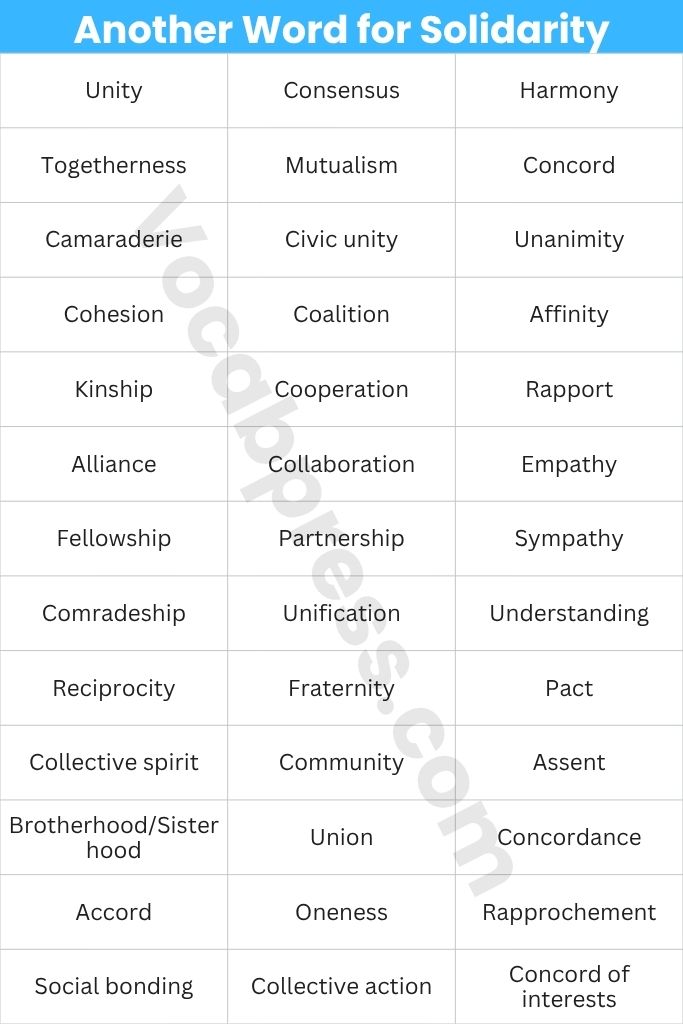
Quick-Access Another Word for Solidarity Table
| Word | Tone | Best Used When |
| Unity | Neutral, strong | Groups acting as one |
| Togetherness | Warm, personal | Community or family settings |
| Camaraderie | Relaxed, friendly | Teams, peer groups, workplaces |
| Cohesion | Analytical | Research, organizations |
| Kinship | Emotional, personal | Shared identity or experience |
| Alliance | Formal, strategic | Organizations, political partnerships |
| Fellowship | Warm, purposeful | Volunteer or faith-based groups |
| Comradeship | Intense, committed | Activism, historical writing |
| Reciprocity | Fair, balanced | When mutual exchange matters |
| Collective spirit | Uplifting | Campaigns, public movements |
| Brotherhood/Sisterhood | Moral, civic | Choose carefully for inclusivity |
| Accord | Diplomatic | Policy and international contexts |
| Consensus | Practical | Decision-making, governance |
| Mutualism | Technical | Sociology, organizational writing |
| Civic unity | Public, formal | Political or editorial commentary |
| Coalition | Temporary, issue-based | Multi-group causes |
| Cooperation | Action-focused | Teamwork and shared projects |
| Collaboration | Creative, joint | Professional or artistic contexts |
| Partnership | Shared responsibility | NGOs, business, joint ventures |
| Unification | Process-based | When unity is still forming |
| Harmony | Peaceful | Conflict-free relationship writing |
| Concord | Formal, literary | Essays, politics, organizations |
| Unanimity | Complete agreement | Voting, councils, decisions |
| Affinity | Natural connection | Personal, effortless bonds |
| Rapport | Interpersonal | One-on-one or small group trust |
| Empathy | Internal, feeling | When emotion leads action |
| Sympathy | Compassionate | Emotional identification |
| Understanding | Mutual comprehension | Education, diversity, conflict work |
| Fraternity | Civic, purposeful | Ethical or cross-cultural writing |
| Community | Collective identity | Shared place or way of life |
| Union | Joined formally | Labor, civic, or values-based writing |
| Oneness | Poetic, spiritual | Reflective or creative writing |
| Social bonding | Process-based | Psychology or sociology |
| Collective action | Visible, political | Movements, marches, organized effort |
| Pact | Committed, informal | Promise-based cooperation |
| Assent | Formal agreement | Legal, corporate contexts |
| Concordance | Scholarly | Academic writing, technical analysis |
| Rapprochement | Diplomatic | Healing after conflict |
| Concord of interests | Analytical | Coalition writing, policy analysis |
| Mutualism | Structural | Mutual-benefit organizations |
| Civic unity | Public-facing | Social commentary, editorial |
The Solidarity Synonym Meaning Clusters (This Is Where Most Writers Go Wrong)
Solidarity isn’t one thing. It holds at least four distinct ideas inside it, and your replacement word should match the one you actually mean.
Cluster 1: Emotional Another Word for Solidarity
People connect through shared pain, shared joy, or shared identity. No formal structure. No strategy. Just recognition.
Words that belong here: kinship, togetherness, affinity, empathy, sympathy, rapport, understanding, oneness
Kinship is the most powerful of these. It works when two people or groups recognize something of themselves in each other, even across very different lives. Affinity is lighter, more instinctive. Togetherness is the warmest, most conversational option. Oneness leans poetic and works beautifully in reflective or spiritual writing.
Empathy and sympathy both belong here but differ slightly. Empathy means you feel what someone else feels. Sympathy means you feel for them. Solidarity takes empathy one step further because it requires you to actually do something with that feeling.
Cluster 2: Action-Based Another Word for Solidarity
People aren’t just feeling with each other. They’re doing something together. Moving, building, fighting, creating.
Words that belong here: collective action, cooperation, collaboration, partnership, collective spirit, social bonding, pact
Collective action is the most political and public of these. Think marches, strikes, organized campaigns. Collaboration fits creative or professional projects. Partnership adds shared responsibility. A pact goes even further because it implies a promise, something more binding than simple agreement.
Social bonding is softer and more process-oriented. It describes how the connection forms over time, not just the connection itself.
Cluster 3: Structural Another Word for Solidarity
Formal, organized, institutional. Groups or nations committing to each other through structure, not just sentiment.
Words that belong here: alliance, coalition, accord, concord, concordance, consensus, unanimity, assent, union, unification, concord of interests, rapprochement
A coalition is often temporary and built around one specific issue. An alliance tends to be more lasting and strategic. Accord and concord both signal formal agreement; concord is more literary and suits essay writing. Concordance is the most academic of the group and usually appears in research or policy analysis.
Unanimity is worth using when you want to emphasize that everyone agreed, not just a majority. Rapprochement describes a specific kind of solidarity: two parties rebuilding trust after conflict. It carries history inside it.
Cluster 4: Communal Solidarity Synonym
The quiet, everyday kind. Not built by crisis, but by shared life. Belonging without announcement.
Words that belong here: community, fellowship, camaraderie, comradeship, brotherhood, sisterhood, fraternity, cohesion, harmony, civic unity, mutualism
Fellowship implies shared values and a gentle warmth. It works well in volunteer or faith-based contexts. Camaraderie is lighter and more conversational, perfect for teammates or coworkers. Comradeship carries more intensity, the bond between people who have struggled or fought side by side.
Cohesion is the most analytical option here. Social scientists use it to measure how tightly a group holds together. It’s solidarity observed from the outside rather than felt from within.
Solidarity Synonym in Five Rewrites That Show the Real Difference
Start with this sentence: “The workers showed solidarity during the strike.”
Formal/organizational tone:
The workers demonstrated cohesion and collective commitment throughout the labor action.
(Removes emotion, adds observable behavior. Better for reports or case studies.)
Casual/human tone:
The workers had each other’s backs the whole time. Nobody crossed the line alone.
(No single-word synonym, but the spirit is there. Works in narrative journalism.)
Academic/analytical tone:
Their collective action reflected deeply rooted mutualism within the labor community.
(Mutualism and collective action add theoretical weight. Fits research writing.)
Creative/narrative tone:
What kept them together wasn’t strategy. It was comradeship, the kind that forms under pressure and doesn’t dissolve when the pressure lifts.
(Comradeship adds emotional history. The sentence now has texture.)
Political/editorial tone:
Their civic unity sent a message that organized workers still hold real power.
(Civic unity lifts the moment into public significance.)
Read also: Another Word for Grab: 40 Alternatives That Actually Fit Your Writing
Another Word for Solidarity Formal vs. Casual: The Quick Breakdown
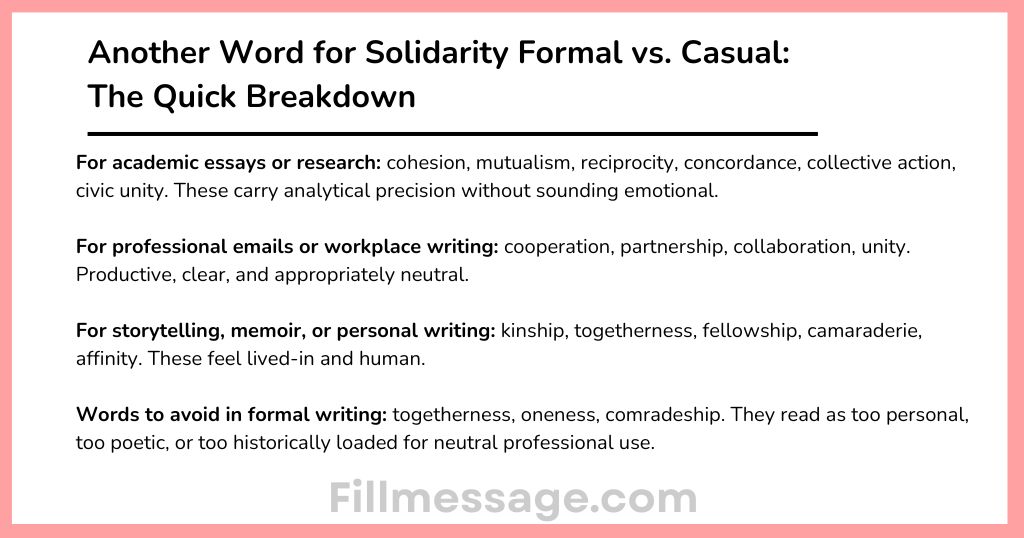
For academic essays or research: cohesion, mutualism, reciprocity, concordance, collective action, civic unity. These carry analytical precision without sounding emotional.
For professional emails or workplace writing: cooperation, partnership, collaboration, unity. Productive, clear, and appropriately neutral.
For storytelling, memoir, or personal writing: kinship, togetherness, fellowship, camaraderie, affinity. These feel lived-in and human.
Words to avoid in formal writing: togetherness, oneness, comradeship. They read as too personal, too poetic, or too historically loaded for neutral professional use.
Mistakes That Are Easy to Make
Swapping unity for solidarity in every sentence. Unity describes a condition. Solidarity describes a choice. A crowd becomes unified. Workers choose solidarity. The difference is agency, and in political or labor writing, that difference matters a lot.
Using camaraderie in serious political contexts. Camaraderie belongs in locker rooms and workplace profiles. It’s warm and slightly informal. For labor history, civil rights writing, or activism, reach for comradeship or collective spirit instead.
Treating rapport as a group word. Rapport is almost always one-to-one or small-group. It describes a smooth interpersonal dynamic. Solidarity is collective by nature. These two don’t swap cleanly.
Picking fellowship in corporate or secular settings. Fellowship carries a quiet religious or mission-driven feeling. In a business context, it can sound out of place. Partnership or collaboration usually serve better there.
Overusing alliance when you mean support. Alliance implies strategy and formal commitment. If a friend supports another friend through grief, that’s kinship or empathy, not an alliance. Precision here prevents your writing from sounding colder than you intended.
Confusing reciprocity with solidarity. Reciprocity means mutual exchange, both sides give and receive equally. Solidarity can be one-directional, standing with someone even when you get nothing back. They’re related but not the same.
Related Another Word for Solidarity Worth Understanding
Reciprocity sits close to solidarity but adds fairness as a requirement. Many argue that true solidarity is always reciprocal, that it loses meaning when it flows only from the powerful to the powerless without any reversal.
Empathy is where solidarity often begins. But empathy stays internal. Solidarity is empathy that requires something of you, a show of hands, a presence, a risk.
Cohesion is solidarity measured from the outside. Researchers use it to study how groups behave under pressure. It’s the data version of what solidarity feels like from the inside.
Collective action is what solidarity looks like in public. The march. The boycott. The walk-out. It’s solidarity made visible.
Mutualism brings an ecological lens. In sociology, it describes relationships where all parties benefit. It frames solidarity not as a moral act but as a structural one where everyone gains something.
Read also: 35 Another Word for Articulation: Precise Alternatives for Every Context
FAQ’s
Can unity replace solidarity in most sentences?
Often, but not always. Unity is passive. Solidarity is chosen. If the moment involves risk, sacrifice, or a deliberate stance, solidarity is the right word. Unity works when you just mean people are aligned.
Is togetherness too informal for serious writing?
For community journalism, local features, or personal essays, it’s fine. For policy writing or academic work, it reads too soft. Use cohesion or civic unity in those contexts.
What separates fellowship from comradeship?
Fellowship is about shared values and warmth. Comradeship is about shared struggle. One is about belonging to something good. The other is about surviving something hard together.
When does solidarity tip into something else?
When the exchange becomes one-way and permanent, solidarity starts to look like charity. When it becomes strategic and contractual, it becomes alliance. The word solidarity lives in the space between personal feeling and formal structure, which is why it’s hard to replace without thinking carefully.
The Practical Takeaway
Before you replace solidarity, ask one question: what is actually happening between these people?
Are they choosing to stand together despite cost? Solidarity still earns its place. Is the connection warm and everyday? Try fellowship or togetherness. Is it formal and organized? Alliance or coalition is cleaner. Is it personal and felt quietly? Kinship or affinity carries more truth.
The goal isn’t to avoid a word. The goal is to find the one that’s more precise. When you do that, the sentence doesn’t just say the right thing. It feels the right way.

Marco Jr. is Author at fillmassage.com,
He explores the world of words and their meanings, helping readers understand language clearly. Passionate about explanations that guide and inform, he creates insightful content that educates, engages, and supports curious minds every day.