You may not notice it, but Another Word for Grab is something many writers search for after using “grab” again and again in emails, stories, school work, or blog posts. The word is useful, but repeating it can make your writing feel flat.
This guide helps you choose the right replacement based on what you really mean. Whether someone is taking an object, catching attention, securing an opportunity, or making an arrest, you’ll find natural alternatives that fit the moment and make your writing clearer without sounding forced.
What “Grab” Is Really Doing in Your Sentence
Before picking a replacement, ask what grab is doing. Is it physical? Is it about capturing interest? Is it getting something before someone else does? Is it an arrest?
The answer changes everything. That is why this article groups the words by meaning, not just lists them alphabetically.
The Full Another Word for Grab Table: All 40 Words
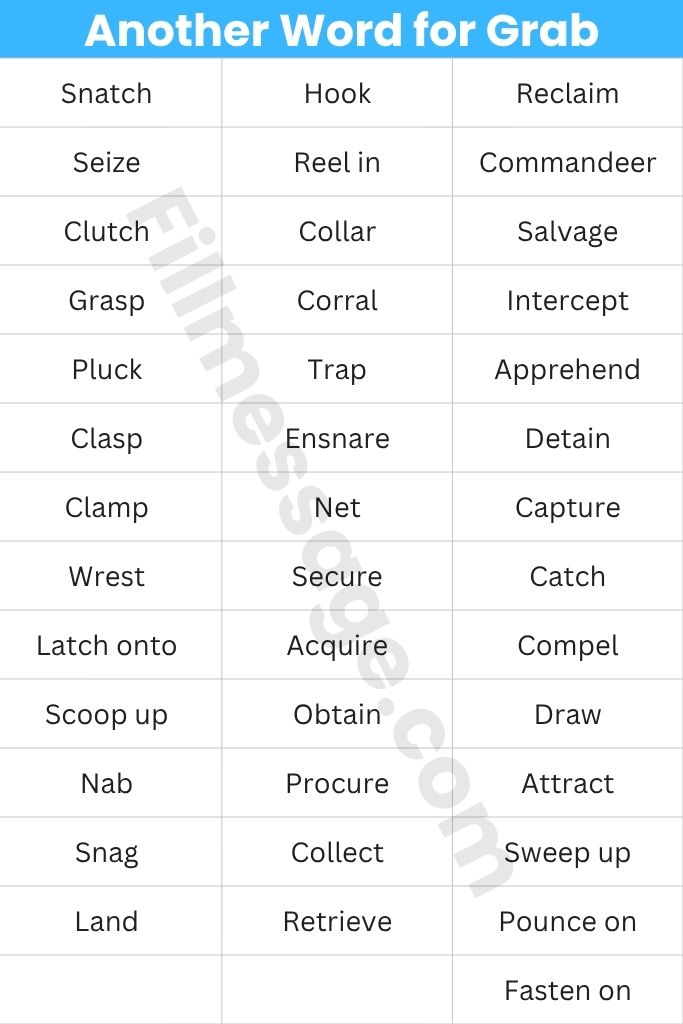
Mobile-friendly. Organized by cluster so you can scan and decide fast.
| Word | Tone | Use It When… |
| Snatch | Sharp, sudden | The action is quick and barely controlled |
| Seize | Forceful, commanding | Authority or urgency is in the scene |
| Clutch | Tense, emotional | Someone holds tight out of fear or desperation |
| Grasp | Controlled, deliberate | The grip is firm and intentional |
| Pluck | Light, precise | Taking something small with accuracy |
| Clasp | Warm, firm | Holding with both hands or with care |
| Clamp | Mechanical, rigid | The grip locks and does not move |
| Wrest | Strained, conflicted | Taking something against resistance |
| Latch onto | Persistent, urgent | Holding and refusing to release |
| Scoop up | Quick, sweeping | Lifting something in one broad motion |
| Nab | Playful, informal | Casual writing or light journalism |
| Snag | Opportunistic, casual | Getting something before others do |
| Land | Triumphant, informal | Achieving something after effort |
| Hook | Figurative, creative | Pulling someone’s interest or attention |
| Reel in | Gradual, strategic | Drawing someone closer over time |
| Collar | Vivid, narrative | Catching someone before they can leave |
| Corral | Wry, effortful | Gathering people or things with difficulty |
| Trap | Tactical, negative | Catching someone in a restricted space |
| Ensnare | Figurative, cunning | Pulling someone into a situation by design |
| Net | Efficient, confident | Getting something cleanly and completely |
| Secure | Formal, professional | Locking in something valuable or competitive |
| Acquire | Neutral, formal | Getting something through process or time |
| Obtain | Direct, official | Getting something with deliberate effort |
| Procure | Bureaucratic, deliberate | Formal sourcing or official contexts |
| Collect | Calm, unhurried | Gathering without urgency |
| Retrieve | Purposeful, controlled | Going back to get something placed or stored |
| Reclaim | Emotional, assertive | Taking back something that was yours |
| Commandeer | Bold, official | Taking something for urgent or official use |
| Salvage | Desperate, resourceful | Getting something before it is lost |
| Intercept | Tactical, precise | Stopping something before it reaches its target |
| Apprehend | Legal, formal | Detaining someone by authority |
| Detain | Official, measured | Holding someone without full arrest |
| Capture | Vivid, versatile | Catching something physical or abstract |
| Catch | Simple, natural | Stopping something mid-motion |
| Compel | Internal, emotional | Forcing attention or action from within |
| Draw | Gentle, inviting | Pulling someone in without force |
| Attract | Passive, magnetic | Something pulls people toward it naturally |
| Sweep up | Broad, swift | Taking multiple things in one motion |
| Pounce on | Eager, aggressive | Acting fast before an opportunity closes |
| Fasten on | Focused, deliberate | Fixing attention or grip tightly on one thing |
Grab Synonyms Meaning Clusters: The Words That Actually Differ
This is where most synonym lists fall short. They give you the words. They do not tell you how they feel differently from each other. That gap is what this section fills.
Physical Actions: Hand and Body
These words describe what happens when someone reaches out and takes something. The difference is in the how.
Grasp is clean and controlled. No panic. The person knows what they need and takes it with a steady hand.
Clutch carries weight. The grip is tight because the situation is intense. Think of someone clutching a railing on a shaky bridge. The emotion lives inside the word.
Clasp is warmer. It suggests both hands, or hands meeting. A mother clasps her child’s hand. It is physical but also caring.
Clamp is rigid and mechanical. Once clamped, nothing moves. Use this when the grip is locked, not just firm.
Pluck is the lightest of all. One finger and thumb, precise motion. You pluck a petal, a thread, a single item from a group. Almost musical.
Scoop up is broader. One sweeping movement that lifts everything in range. A parent scoops up a toddler. Someone scoops up the papers scattered on the floor.
Wrest is the hardest. There is always a struggle attached to it. You cannot wrest something that was handed over willingly. It implies pulling against resistance.
Sweep up is similar to scoop but more horizontal. Wide and fast. Think of a wave sweeping up shells or someone sweeping up their belongings before leaving.
Quick-Take Words: Speed and Opportunity
These words are about timing. The action happens fast, or the window is small.
Snatch is fast and slightly uncontrolled. It can feel reckless or urgent. Sometimes there is an edge of taking without full permission, even if none is intended.
Pounce on adds eagerness. The person was waiting. The moment arrived. They moved instantly. It is not random speed. It is prepared speed.
Snap up is similar but more common in commercial or competitive contexts. Shoppers snap up deals. Recruiters snap up top candidates before competitors do.
Nab keeps it light. Someone nabbed the last parking spot. It carries a slight grin. Never use it in formal writing.
Snag is close to nab but adds a hint of luck or clever timing. You snagged a table at a busy restaurant. You were in the right place.
Net is clean and complete. No mess. You netted a deal, a client, a result. The word suggests efficiency.
Land implies effort that paid off. You worked toward something and it came through. She landed the contract. He landed a role in the film.
Attention and Interest: The Figurative Side
This cluster is where “grab” causes the most writing problems. People write “grab attention” constantly, but there are far more precise options.
Hook is the strongest here. A hook catches and holds. It is not passive. When something hooks a reader, they cannot easily pull away. Use this in storytelling and marketing contexts.
Capture works across attention, emotion, mood, and even imagery. It is versatile without being vague. A photograph captures a moment. A performance captures the room.
Draw is softer. Something draws you in without force. You go willingly. It suggests invitation rather than pull.
Attract is the most passive of the group. The thing simply has a quality that brings people toward it. No action required from anyone. A display attracts shoppers.
Compel goes deeper. It is not about the eye catching something. It is about feeling that you must engage. A story can compel a reader to keep going even when it is late and they should sleep.
Reel in takes time. It is gradual. A skilled communicator reels in an audience across several minutes. A brand reels in a customer through repeated contact. The result feels earned, not forced.
Fasten on is specific and focused. Attention fastens on one thing and stays there. It works when something locks a person’s concentration completely.
Ensnare adds a layer of design. Someone or something was set up to pull people in. It can be neutral or slightly negative depending on tone.
Read also: Another Word for Allocate: 41 Better Synonyms
Getting or Obtaining: The Formal End
These words replace the casual “grab” when you are writing professionally or describing processes.
Secure signals that the thing was competitive or valuable and you made sure to get it. Securing a partnership means others might have taken it. Securing a venue for an event means you confirmed it and it is yours.
Acquire suggests accumulation or deliberate effort over time. Companies acquire assets. People acquire skills. It is never rushed.
Obtain is direct and official. It does not carry the sense of time or struggle. You simply obtained what was needed. Forms say “obtain approval.” Legal language uses it often.
Procure sounds more intentional and is often used in supply chain, government, or organizational contexts. Procuring materials or procuring services.
Retrieve means going back to get something. It was somewhere, you went and got it. A dog retrieves a ball. A person retrieves files from a system.
Reclaim carries personal history. Something was yours, it left, and now you are taking it back. It has emotional weight that the others do not.
Collect is unhurried and calm. Nobody collects something urgently. It suggests a planned, organized action.
Salvage is recovery under pressure. You grab what you can before something is lost entirely.
Commandeer is bold. Taking something for an urgent or official purpose, usually without complete permission. Soldiers commandeer vehicles. Directors commandeer spaces for filming.
Catching or Detaining: Authority and Conflict
Apprehend belongs to law enforcement. Do not use it casually. Police apprehend suspects. It implies legal authority and process.
Detain is slightly softer. It means holding someone without the full weight of arrest. Still official. Still formal.
Intercept is about motion. Something is on its way somewhere, and you stop it before it arrives. A pass is intercepted. A message is intercepted. The thing never reaches its destination.
Trap has a negative tone almost always. Something or someone is caught in a space they cannot escape. It can be literal or figurative.
Collar is vivid and informal. Used in storytelling or journalism. She collared him in the corridor before he could slip away. It has urgency and physical energy.
Corral is for groups. Wrangling people or things into one place with effort and mild chaos. It often carries a slightly humorous or exasperated tone.
Catch is the simplest of this group. Something was moving. You stopped it. No legal weight. No drama required.
Another Word for Grab in Sentence Rewrites: Four Scenarios
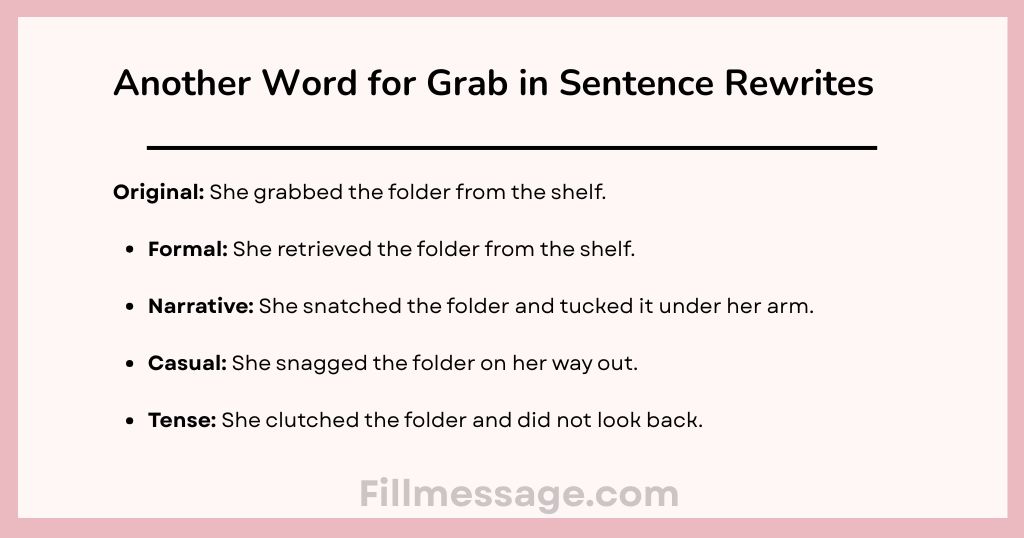
Original: She grabbed the folder from the shelf.
- Formal: She retrieved the folder from the shelf.
- Narrative: She snatched the folder and tucked it under her arm.
- Casual: She snagged the folder on her way out.
- Tense: She clutched the folder and did not look back.
Original: The ad grabbed everyone’s attention.
- Professional: The ad captured the audience’s attention immediately.
- Creative: The ad hooked viewers within the first three seconds.
- Gentle: The ad drew people in without trying too hard.
- Strong: The ad compelled the entire room to stop and look.
Original: He grabbed the opportunity.
- Professional: He secured the opportunity before it passed.
- Narrative: He pounced on it without hesitation.
- Casual: He snagged it at exactly the right moment.
- Formal: He seized the opportunity and moved forward.
Common Mistakes Writers Make
Using “seize” for ordinary actions. Seize carries force and authority. Using it for small everyday moments makes the writing feel overdramatic. Reserve it for situations that actually carry weight.
Confusing “capture” and “captivate.” Capture is an action you perform. Captivate is something that happens to a person because of an experience. A photo captures a moment. A story captivates a reader.
Using “apprehend” outside legal writing. It reads as strange in casual or creative contexts. Stick to law enforcement scenarios.
Treating “obtain” and “acquire” as the same. Obtain is a single transaction. Acquire usually involves time, accumulation, or process. You obtain a permit. You acquire expertise.
Overusing “snatch” when you mean “take quickly.” Snatch has a slightly rough edge. In some contexts it reads as reckless or even dishonest. Make sure the scene supports the energy of the word.
Related Another Word for Grab That Belong Nearby
These are not synonyms but live in the same space. Knowing them adds flexibility.
Retain means keeping something you already have. Opposite direction from grab.
Release is the word for letting go. Understanding the opposite sharpens how you use the taking words.
Demand overlaps with seize in intensity but works through speech rather than action.
Intercept sits between catching and obtaining. Worth knowing separately.
Accumulate is the slow version of acquire. Time is the main ingredient.
Read more:
32 Another Word for Emerging: The Complete Guide for Writers
Another Word for Heartwarming: 29 Alternatives That Actually Work
FAQs about Another Word for Grab
Is “snatch” always negative?
Not always, but it carries urgency and sometimes a hint of taking without permission. Context decides. A child snatching a toy reads as selfish. A goalkeeper snatching the ball reads as skilled.
Can I use “secure” in casual writing?
It can work if the thing being secured was actually competitive or valuable. Saying “I secured a coffee” reads stiff. Saying “we secured a table for eight on a Friday night” makes sense.
What is the difference between “hook” and “capture” for attention?
Hook is active and implies the reader is pulled in suddenly. Capture is slightly more neutral and works across more contexts. Use hook in writing about storytelling or marketing. Capture fits almost anywhere.
When does “wrest” work and when does it not?
Wrest only works when there is genuine resistance involved. If something was handed over or agreed upon, wrest does not fit. It needs tension, struggle, or conflict to justify its energy.
The Practical Takeaway
Match the word to the action, not just the general idea. Physical grip and emotional clinging need different words. Casual getting and formal acquisition need different words. Attention captured instantly and interest built slowly need different words.
Scan the table. Find your cluster. Pick the word that fits the actual moment in your sentence. That one swap will do more for your writing than a full paragraph rewrite.

Marco Jr. is Author at fillmassage.com,
He explores the world of words and their meanings, helping readers understand language clearly. Passionate about explanations that guide and inform, he creates insightful content that educates, engages, and supports curious minds every day.