There’s a quiet frustration that hits mid-draft. You’ve written “emerging” twice already, and now it’s sitting there a third time, doing the same vague job it always does. The sentence isn’t wrong. But it isn’t sharp either.
The issue with “emerging” is that it stretches across too many situations. A startup can be emerging. So can a threat, a talent, a movement, or a morning. These aren’t the same thing. And when you treat them all with one word, your writing flattens.
This guide gives you 32 Another Word for Emerging, sorted by meaning, tone, and situation. Not a word dump. A working resource.
What “Emerging” Really Means
“Emerging” describes something in the process of becoming visible, known, or prominent. It lives between “not here yet” and “fully arrived.”
The tone is mostly hopeful and neutral. But depending on what’s emerging, it can carry urgency, caution, or quiet tension. That emotional range is exactly why you need specific replacements, not just synonyms grabbed from a thesaurus.
The Complete List: 32 Another Word for Emerging
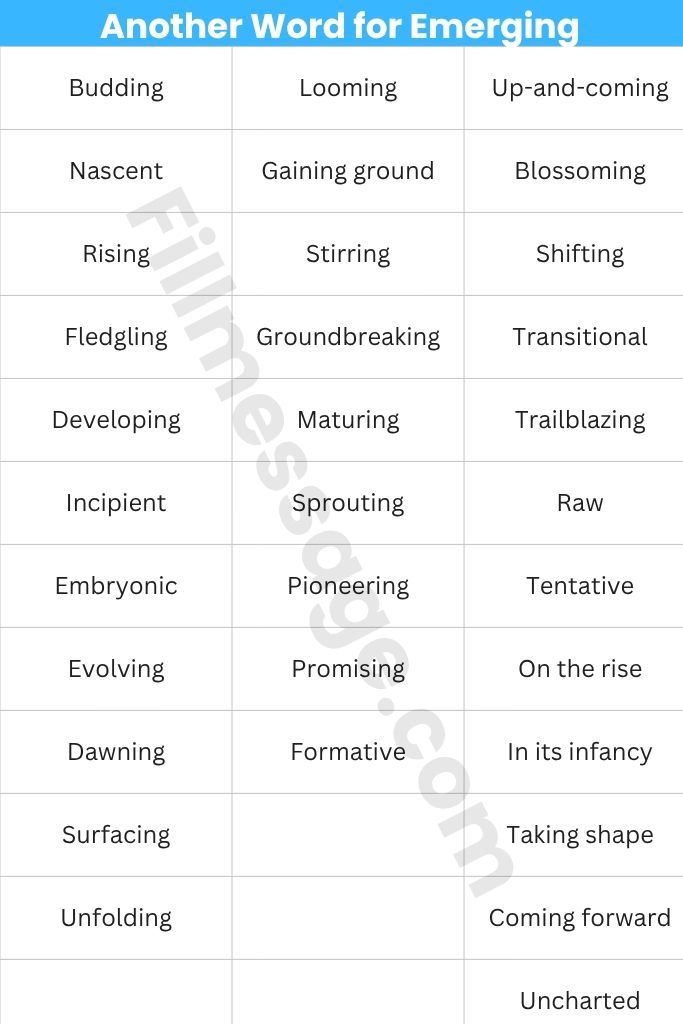
| Word/Phrase | Tone | Best Used When |
| Budding | Warm, hopeful | Early talent or creative potential is showing |
| Nascent | Formal, precise | Something is in its very first stage |
| Rising | Confident | A person or thing is gaining visibility and strength |
| Fledgling | Cautious | Something new but still finding stability |
| Developing | Neutral | Ongoing growth across general contexts |
| Incipient | Technical | Early clinical, structural, or scientific beginnings |
| Embryonic | Analytical | Extremely early; barely formed yet |
| Evolving | Dynamic | Something actively changing its form or direction |
| Dawning | Poetic | An era or idea is slowly beginning to take hold |
| Surfacing | Visual | Something rising from beneath or out of hiding |
| Unfolding | Narrative | A situation is developing gradually over time |
| Looming | Tense | Something approaching with weight or concern |
| Gaining ground | Informal, strong | Progress being made after effort or struggle |
| Stirring | Quiet, subtle | The earliest signs of something beginning |
| Groundbreaking | Bold, positive | First of its kind in a field or area |
| Maturing | Depth-focused | Something growing toward full development |
| Sprouting | Fresh, organic | New ideas or communities appearing quickly |
| Pioneering | Forward-moving | Leading into new territory before others do |
| Promising | Hopeful | Early stage with visible, believable potential |
| Formative | Reflective | Often used when looking back at a beginning period |
| Up-and-coming | Conversational | People or businesses gaining recognition |
| Blossoming | Warm, expansive | Talent or creativity opening up fully |
| Shifting | Directional | Change in tone, structure, or focus is happening |
| Transitional | Neutral to formal | Something moving between two distinct phases |
| Trailblazing | Energetic | Entering new space boldly before others follow |
| Raw | Honest, unpolished | Unrefined potential at its earliest, roughest stage |
| Tentative | Careful | Early and not yet confirmed or stable |
| On the rise | Conversational | Growing steadily in influence or popularity |
| In its infancy | Descriptive | Very early, still underdeveloped and fragile |
| Taking shape | Gradual, visual | Structure or form beginning to come together |
| Coming forward | Social, active | Stepping into visibility or public responsibility |
| Uncharted | Exploratory | Moving into space or areas no one has mapped yet |
Emerging Synonyms Four Meaning Clusters: The Real Breakdown
Grouping these by meaning matters more than listing them alphabetically. Here is how they actually divide.
Cluster 1: Extremely Early Stage
Nascent, embryonic, incipient, in its infancy, tentative, raw
These words describe something that has barely begun. There is almost nothing formed yet. Use these when earliness is the whole point.
“Nascent” fits essays and policy writing. “Embryonic” shows up in technology and science. “Incipient” belongs in medical or analytical writing. “Tentative” adds uncertainty. “Raw” adds honesty and roughness. “In its infancy” is more casual and descriptive.
If you use “emerging” here, you might imply more development than actually exists.
Cluster 2: Growing and Gaining Strength
Rising, gaining ground, blossoming, on the rise, maturing, promising, up-and-coming
These describe something past its first moment. It exists. It’s building. The movement is upward and visible.
“Rising” sounds confident. “Gaining ground” implies effort behind the growth. “Blossoming” fits creative or personal development. “Maturing” suggests depth arriving alongside growth. “Promising” adds hope but stays cautious. “Up-and-coming” is casual and works best in profiles or interviews.
Cluster 3: Gradually Coming Into View
Surfacing, dawning, stirring, taking shape, unfolding, sprouting
These describe a slow reveal. Something is appearing, but quietly. There is patience in each of these words.
“Surfacing” suggests something coming up from beneath. “Dawning” is best for eras and ideas. “Stirring” is the subtlest; it catches the very first movement before anything is visible yet. “Taking shape” works when something’s form is becoming clearer. “Unfolding” is ideal for narrative writing. “Sprouting” adds energy and organic freshness.
Cluster 4: Approaching or Shifting Direction
Looming, shifting, transitional, uncharted, pioneering, trailblazing, groundbreaking, coming forward
These words describe movement toward a new state. Some carry tension. Some carry boldness.
“Looming” carries weight and concern; don’t use it for positive things. “Shifting” stays clean and neutral. “Transitional” fits professional or policy contexts. “Uncharted” works when territory is genuinely unknown. “Pioneering” and “trailblazing” are close but “pioneering” focuses on the act of going first, while “trailblazing” focuses on the boldness of the path. “Groundbreaking” is strong; save it for genuine firsts. “Coming forward” is more social and human, often about people stepping into visibility or responsibility.
Another Word for Emerging in Sentence Rewrites: Watch the Shift
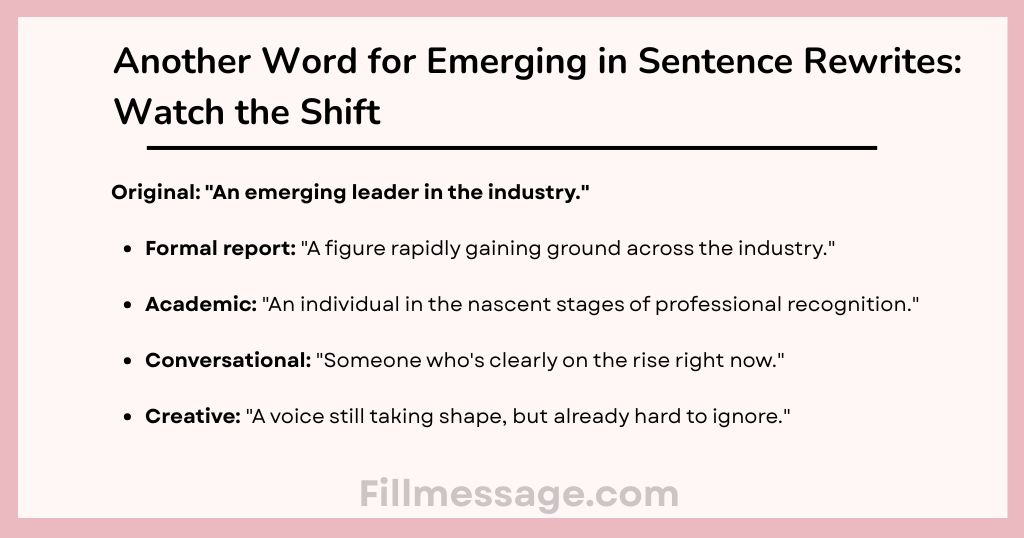
Same idea. Different words. Completely different feeling.
Original: “An emerging leader in the industry.”
- Formal report: “A figure rapidly gaining ground across the industry.”
- Academic: “An individual in the nascent stages of professional recognition.”
- Conversational: “Someone who’s clearly on the rise right now.”
- Creative: “A voice still taking shape, but already hard to ignore.”
Original: “The startup is emerging in the tech sector.”
- Business writing: “The startup is establishing a rising presence in the tech sector.”
- Casual: “They’re up-and-coming in tech, and people are starting to notice.”
- Narrative: “Something is unfolding inside this company, quietly and fast.”
Original: “An emerging threat to public health.”
- Clinical: “An incipient threat to public health systems.”
- Journalistic: “A threat now surfacing across public health.”
- Tense/urgent: “A looming public health threat that demands attention.”
What changes isn’t just the word. It’s the whole sentence’s energy.
Another Word for Emerging Formal vs. Informal: Where Each Word Actually Belongs
Picking the right context matters as much as picking the right synonym.
For formal writing, academic essays, and policy reports: Nascent, incipient, embryonic, formative, evolving, transitional, pioneering
For business writing and professional communication: Rising, developing, gaining ground, on the rise, maturing, groundbreaking
For storytelling, creative writing, and journalism: Dawning, stirring, taking shape, unfolding, blossoming, sprouting, uncharted
Words to keep out of formal writing: Up-and-coming, sprouting, raw, on the rise. These feel conversational. In a research paper or board report, they pull attention the wrong way.
Mistakes Writers Make With These Words
Using “nascent” loosely. It means something in its very first form. If something has been developing for two or three years, it is no longer nascent. The word loses meaning when stretched.
Treating “looming” as neutral. It is not. “Looming” carries tension and often threat. A “looming opportunity” sounds odd. A “looming deadline” sounds right. Check the emotional direction of your sentence before using it.
Mixing up “evolving” and “emerging.” Evolving means changing form. Emerging means coming into view. A product can evolve for years without emerging publicly. They describe different things.
Reaching for “developing” by habit. It is safe but flat. In many sentences, it communicates almost nothing specific. Ask whether “gaining ground,” “taking shape,” or “rising” would do the job better.
Confusing “promising” with the others. Promising describes what something could become. Emerging describes what is already becoming visible. A promising idea has not yet emerged. An emerging idea is already showing itself.
Overusing “groundbreaking.” It is a strong word. It belongs on genuine firsts. When used too often, it stops meaning anything.
Treating “pioneering” and “trailblazing” as identical. Pioneering focuses on being first. Trailblazing focuses on the courage and energy of the path. The difference is subtle but real in strong writing.
Another Word for Emerging Related Words That Are Not Synonyms
These words often appear near “emerging” but serve a different purpose.
Potential describes what something could become, not what it is doing right now. Emerging is active. Potential is still waiting.
Momentum captures the energy behind movement. It does not describe the thing itself, just the force carrying it forward.
Innovative is about originality, not developmental stage. Something can be innovative long after it has fully emerged.
Breakthrough describes a single moment of change. Emerging describes an ongoing process. One is an event. The other is a condition.
Read more:
25 Another Word for Proofing: Pick the Right One Every Time
29 Another Word for Repercussions: The Right Word for Every Situation
FAQs
Is “nascent” too stiff for general writing?
In most cases, yes. It reads naturally in academic or policy writing. In a blog post, newsletter, or casual article, “budding,” “early-stage,” or “just starting out” will feel more natural to your reader.
Can “rising” and “emerging” always swap?
Not reliably. “Rising” suggests visible upward movement with some traction already built. “Emerging” is earlier and more uncertain. A rising author has an audience growing. An emerging author is just becoming known.
When does “looming” stop working?
The moment your sentence has a positive or neutral subject. “Looming” introduces pressure. If pressure is not part of your meaning, the word fights against you.
Is “up-and-coming” ever appropriate in formal writing?
Rarely. It works in profiles, interviews, trend articles, and conversational content. In formal reports or academic papers, it reads as too casual and can undercut your credibility.
The Short Version Before You Go
“Emerging” is not a bad word. It becomes a problem when it covers too many different situations at once.
Ask yourself one question: emerging how? Is something brand new? Then try nascent, embryonic, or in its infancy. Is it growing in strength? Try rising, gaining ground, or blossoming. Is it quietly coming into view? Try surfacing, stirring, or taking shape. Is something approaching or shifting? Try transitional, looming, or unfolding.
That one question leads you to the right cluster. The right cluster gives you the right word. And the right word makes your sentence do exactly what you intended.

Marco Jr. is Author at fillmassage.com,
He explores the world of words and their meanings, helping readers understand language clearly. Passionate about explanations that guide and inform, he creates insightful content that educates, engages, and supports curious minds every day.