You finished a sentence. Read it back. “Repercussions” sits there, doing the job, but something feels slightly off. Maybe it sounds too heavy. Maybe too formal. Maybe you have already used it twice and your writing is starting to echo itself.
Word choice shapes how a reader feels before they even process the meaning. “Repercussions” is loaded with caution and weight. Sometimes that is exactly right. Other times, a lighter or more precise word does the job better.
Here are 29 Another Word for Repercussions, organized so you can actually use them.
What This Word Really Carries
Repercussions are not just results. They are the effects that follow something serious, usually something unwanted, and often with a delay. The original action is done, but the wave keeps spreading. That is the image behind this word.
Its tone is almost always cautionary or negative. That matters when you are looking for a substitute.
The Full Table: 29 Another Word for Repercussions at a Glance
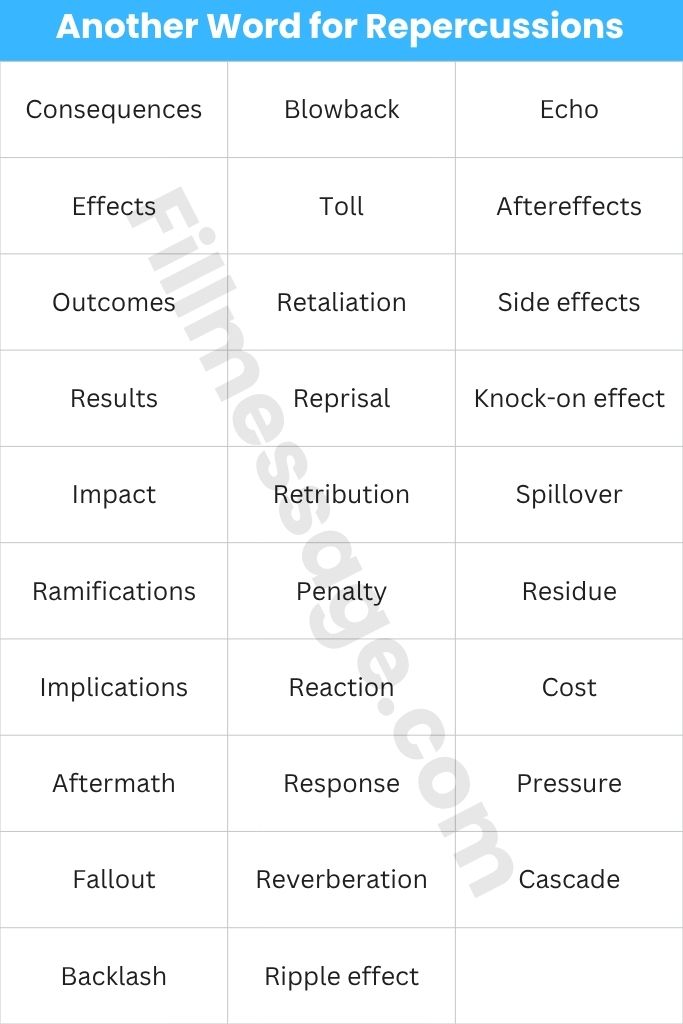
| Word | Tone | Best Used When |
| Consequences | Neutral | General all-purpose replacement |
| Effects | Neutral | Describing what followed an event |
| Outcomes | Neutral/Positive | Result could go either way |
| Results | Neutral | Plain, direct everyday writing |
| Impact | Neutral | Emphasizing scale or force |
| Ramifications | Formal | Legal, policy, analytical writing |
| Implications | Formal | What something means going forward |
| Aftermath | Negative | Damage has already happened |
| Fallout | Negative | Political or reputational damage |
| Backlash | Negative | Public reaction against something |
| Blowback | Informal/Negative | Sharper, edgier version of backlash |
| Toll | Negative | Damage that builds slowly over time |
| Retaliation | Strong negative | Deliberate, adversarial response |
| Reprisal | Strong negative | Organized act in response to harm |
| Retribution | Strong negative | Punishment with a moral undertone |
| Penalty | Formal/Negative | Official cost of a wrong action |
| Reaction | Neutral | How people or systems responded |
| Response | Neutral | Broader, often institutional reply |
| Reverberation | Figurative | Long-lasting, wave-like effects |
| Ripple effect | Figurative | Indirect, spreading consequences |
| Echo | Figurative | Delayed effect that returns or lingers |
| Aftereffects | Mild negative | Effects that linger after event ends |
| Side effects | Neutral | Unintended results alongside main one |
| Knock-on effect | Neutral | One thing triggering a chain of others |
| Spillover | Neutral | Effects spreading beyond original area |
| Residue | Mild negative | What remains after something passes |
| Cost | Neutral | What was lost or given up |
| Pressure | Neutral | Stress or force resulting from a situation |
| Cascade | Figurative | Multiplying effects that build forward |
Repercussions Synonym Meaning Clusters: Where Real Understanding Lives
A list alone is not enough. What separates a strong writer from an average one is knowing why one word fits and another does not. These clusters break down the differences clearly.
Neutral and Safe Another Word for Repercussions
Consequences, effects, results, outcomes, impact are your safest substitutes. They do not carry built-in drama. You can drop most of them into a sentence without shifting the emotional temperature.
One subtle difference worth noting: “outcomes” leans slightly positive, or at least open. “The outcomes surprised everyone” does not tell us if it was good or bad. “The consequences surprised everyone” hints that something went wrong. Same sentence structure, very different feeling.
“Impact” emphasizes force and scale. It works best when you want the reader to feel the size of something, not just that it happened.
When Damage Has Already Occurred
Aftermath, fallout, toll all belong after the fact. These are not words for predicting what might happen. They describe what is already being dealt with.
Aftermath signals that an event has closed but its effects remain. Fallout suggests ongoing, spreading damage, especially reputational or political. Toll is quieter but heavier. It implies something wore down over time rather than broke all at once. “The emotional toll” works in a way that “the emotional repercussions” does not quite land.
When People Push Back
Backlash, blowback, retaliation, reprisal, retribution all sit in this cluster, but they are not interchangeable.
Backlash is public resistance. Organized, visible, vocal. Blowback is its edgier sibling — sharper and more informal, often implying the initiator got hurt by what they started.
Retaliation and reprisal both describe deliberate action taken in response to harm. If someone chose to fight back, these words belong there. Retribution goes further still. It carries a moral or punishing weight. Use it carefully — it changes a sentence’s entire register.
Formal Writing Tools
Ramifications and implications are the go-to pair for professional, academic, and analytical writing.
Ramifications suggest branching: one decision spreads into multiple connected effects. “The ramifications of this ruling” fits a policy brief or legal document naturally.
Implications are slightly softer. They point toward meaning rather than just cause and effect. “The implications for public health are serious” is analytical without being alarmist. These two words are often treated as identical, but they are not. Ramifications are about what happens. Implications are about what it means.
Figurative and Creative Use
Reverberation, ripple effect, echo, cascade all work when you want the reader to feel the spreading or ongoing nature of something rather than just understand it intellectually.
Reverberation comes from sound — a wave that bounces back. Used figuratively, it suggests an effect that keeps returning. Echo is similar but more ghostlike, quieter. A ripple effect is immediately visual and conversational. Almost everyone understands it without effort.
Cascade is the most dramatic of these. It suggests effects that do not just spread but multiply as they move forward. Strong in science writing, economics, and crisis reporting.
Another Word for Repercussions in Sentence Rewrites: Watch the Tone Shift
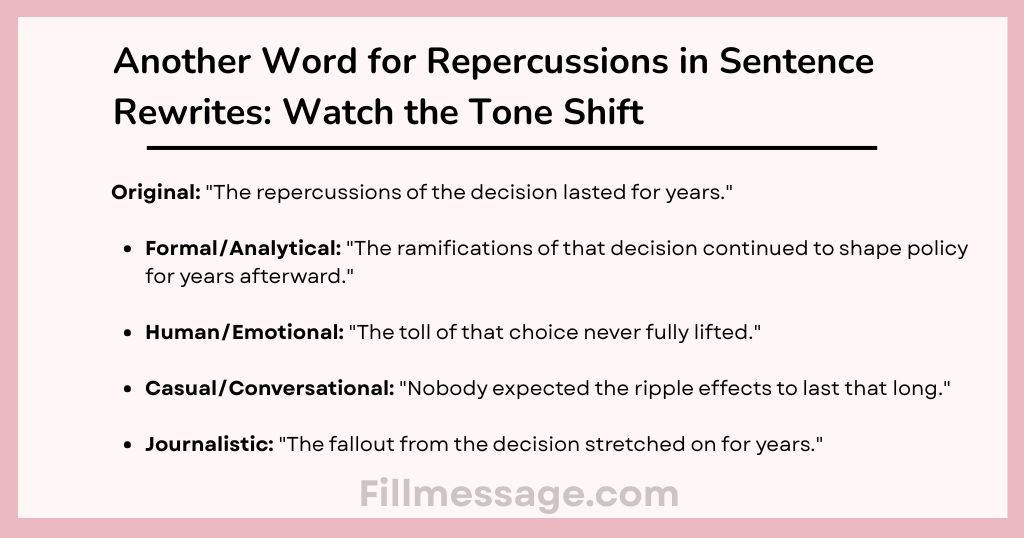
Original: “The repercussions of the decision lasted for years.”
- Formal/Analytical: “The ramifications of that decision continued to shape policy for years afterward.”
- Human/Emotional: “The toll of that choice never fully lifted.”
- Casual/Conversational: “Nobody expected the ripple effects to last that long.”
- Journalistic: “The fallout from the decision stretched on for years.”
Original: “There will be serious repercussions.”
- Professional email: “This carries significant implications that need to be addressed.”
- Warning/Legal tone: “The penalties for continuing this course of action are severe.”
- Narrative/Story: “What comes next will not be easy to walk back.”
- News/Commentary: “The backlash, if this moves forward, will be substantial.”
Original: “She did not consider the repercussions of her words.”
- Psychological/Reflective: “She did not consider the aftereffects her words would leave behind.”
- Formal: “She failed to account for the broader implications of her statement.”
- Simple/Direct: “She did not think about the impact her words would have.”
Each rewrite carries the same core meaning but changes what the reader feels. Tone is not decoration. It is part of the message.
Positive Repercussions: What to Use Instead
This is a gap most synonym articles skip entirely. “Repercussions” almost never describes something good. But sometimes you want to talk about positive ripple effects, beneficial outcomes, or constructive results.
In those cases, reach for:
- Benefits — straightforward and clear
- Gains — often used in business or measurable contexts
- Dividends — suggests a return on something invested
- Rewards — more personal, implies something earned
- Breakthroughs — when the positive effect is significant or unexpected
These are not synonyms for repercussions. They are the other side of the coin. When someone asks about “positive repercussions,” these are the words that actually serve the sentence.
Another Word for Repercussions Formal vs. Informal: Quick Practical Guidance
For academic papers or research writing, stick with ramifications, implications, consequences. They signal precision without emotional loading.
For professional emails and workplace communication, use consequences, effects, impact. They are clear, clean, and do not sound combative. Avoid “fallout” or “backlash” in client-facing messages unless the situation genuinely calls for that weight.
For storytelling, personal essays, or creative writing, use aftermath, toll, reverberations, ripple effects. These carry texture. They help the reader feel something, not just understand it.
Words to avoid in formal contexts: Blowback, backlash, retaliation. They carry an adversarial charge that can color an otherwise neutral professional document.
Mistakes That Quietly Hurt Your Writing
Using “repercussions” for positive outcomes. This is probably the most common misuse. If the result is good or even neutral, the word works against you. Choose outcomes, results, or effects instead.
Treating implications and ramifications as identical. They are close but not the same. Implications point to meaning. Ramifications point to spreading effects. Both work formally, but they answer slightly different questions.
Overloading one word. If “consequences” appears three times in one paragraph, your writing starts to feel stuck. Rotate through effects, outcomes, and impact to keep things moving.
Choosing aftermath before the event is over. Aftermath belongs after something has closed. If things are still unfolding, fallout fits better because it captures an ongoing situation, not a concluded one.
Using retaliation when you mean reaction. Reaction is neutral. Retaliation is deliberate and adversarial. These are not interchangeable. “Her reaction to the criticism” and “her retaliation after the criticism” describe completely different behaviors.
Another Word for Repercussions Related Words That Expand Your Range
Precedent — Not a synonym, but closely connected in legal and policy writing. A precedent shapes future consequences. Often appears right alongside ramifications.
Liability — Sits near penalty and consequence in formal contexts. It implies responsibility and exposure to risk.
Bearing — As in “this has a bearing on future decisions.” Understated and precise. Works well when you want to suggest influence without overstating it.
Weight — Figurative but powerful. “The weight of that decision” carries emotional gravity that clinical words like “results” cannot touch.
Read also:
41 Another Word for Presentation: The Only Guide You Actually Need
25 Another Word for Proofing: Pick the Right One Every Time
FAQ’s about Another Word for Repercussions
Can repercussions ever describe something good?
Technically yes, but in real-world writing, almost never. Readers are conditioned to read it as a warning. If your result is positive, choose a word that does not fight against that meaning.
What is the actual difference between fallout and aftermath?
Aftermath describes a state — what things look like after the dust settles. Fallout describes an active, ongoing process of damage spreading. Aftermath feels finished. Fallout feels like it is still happening.
Is “ramifications” just a formal version of “consequences”?
Close, but not quite. Ramifications suggest multiple branches spreading from one point. Consequences can be a single, direct result. Ramifications almost always implies complexity.
When should you just keep the original word?
When you specifically need to suggest a delayed, negative chain reaction. No other word on this list bundles those ideas quite as efficiently. If that is the precise meaning your sentence requires, keep it.
The Practical Takeaway
Here is the simplest decision guide:
Neutral, everyday writing: consequences or effects
Something damaging already happened: aftermath or toll
People reacted publicly: backlash or fallout
Formal or analytical writing: ramifications or implications
Creative or emotional writing: toll, reverberation, or ripple effect
Deliberate hostile response: retaliation or reprisal
Gradual, accumulating damage: toll or cascade
Positive angle: benefits, gains, or dividends
The word you choose does not just fill a slot. It sets the tone for everything around it. That is why this choice matters more than most writers realize.

Marco Jr. is Author at fillmassage.com,
He explores the world of words and their meanings, helping readers understand language clearly. Passionate about explanations that guide and inform, he creates insightful content that educates, engages, and supports curious minds every day.