You’ve written “get rid of” and something feels off. Maybe it’s too casual for the document you’re writing. Maybe you’ve used it twice already and it’s starting to look repetitive. Or maybe you just need something with more weight, more precision, more edge.
The problem isn’t the phrase itself. It’s using it when a better word exists.
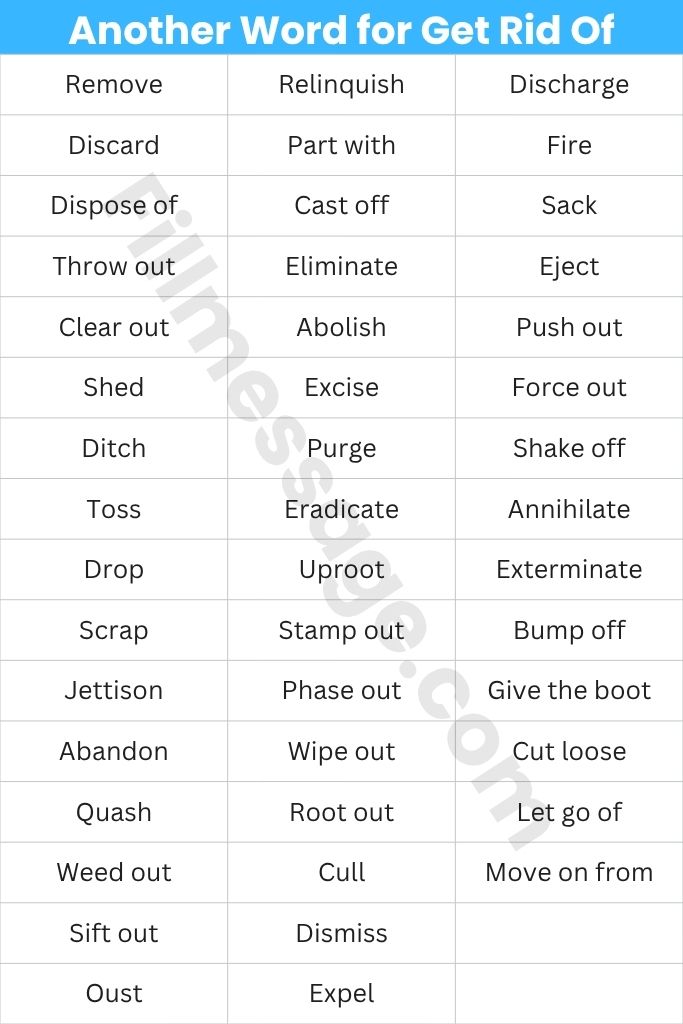
Here are 46 Another Word for Get Rid Of, each explained so you can actually use them correctly.
What “Get Rid Of” Really Means
It means to remove, release, or clear away something unwanted. It covers physical objects, people, habits, emotions, and systems. Tone-wise, it sits in casual-to-neutral territory. That’s useful in conversation but limiting in writing where precision matters.
Another Word for Get Rid Of Quick-Reference Table: All 46 at a Glance
| Word / Phrase | Tone | Best Used For |
| Remove | Neutral | Objects, policies, people |
| Discard | Neutral | Unwanted items |
| Dispose of | Formal-neutral | Safe or deliberate disposal |
| Throw out | Casual | Everyday clutter |
| Clear out | Casual | Spaces, stockpiles |
| Shed | Soft/figurative | Habits, weight, feelings |
| Ditch | Informal | Plans, ideas, objects |
| Toss | Very informal | Quick or careless disposal |
| Drop | Informal | Ideas, topics, people |
| Scrap | Informal | Projects, drafts, prototypes |
| Jettison | Formal | Unnecessary weight or features |
| Abandon | Neutral | Plans, places, commitments |
| Relinquish | Formal | Rights, control, possession |
| Part with | Emotional | Things you’re attached to |
| Cast off | Literary | Burdens, old identity |
| Eliminate | Formal/technical | Errors, options, variables |
| Abolish | Formal | Laws, rules, systems |
| Excise | Precise/formal | Text, passages, content |
| Purge | Strong/formal | Records, files, groups |
| Eradicate | Very strong | Root-level problems, disease |
| Uproot | Figurative | Deep habits, traditions |
| Stamp out | Strong | Behaviors, fires, practices |
| Phase out | Gradual/neutral | Products, systems, policies |
| Wipe out | Strong/informal | Entire amounts or groups |
| Quash | Formal | Rumors, rebellions, emotions |
| Root out | Investigative | Corruption, hidden problems |
| Weed out | Selective | Weak candidates, bad elements |
| Cull | Technical/selective | Data sets, lists, animals |
| Sift out | Careful/neutral | Errors, inconsistencies |
| Dismiss | Formal/neutral | Employees, ideas, claims |
| Oust | Strong/formal | Leaders, officials |
| Expel | Formal | Members, students |
| Discharge | Formal | Employees, patients, obligations |
| Fire | Informal | Employees |
| Sack | Informal (British) | Employees |
| Eject | Physical/formal | People removed from a space |
| Push out | Informal | People from roles or groups |
| Force out | Direct | People from positions of power |
| Shake off | Figurative/soft | Moods, habits, followers |
| Annihilate | Very strong | Use figuratively with caution |
| Exterminate | Harsh/literal | Pests, insects only |
| Bump off | Slang | Avoid in serious writing |
| Give the boot | Slang | Informal dismissal |
| Cut loose | Casual/idiomatic | Ending ties with someone |
| Let go of | Soft/emotional | Attachments, people, feelings |
| Move on from | Reflective/soft | Past events, relationships |
The Four Meaning Clusters of Get Rid Of synonym
Not all removal is the same action. A document gets excised. A law gets abolished. A feeling gets shaken off. Using the wrong word from the wrong group is where good writing quietly breaks down.
Cluster 1: Removing Physical Things
These work for objects, spaces, possessions, and tangible items.
Remove, discard, dispose of are the reliable core here. “Remove” is the most neutral of the three. It doesn’t judge the object, it just takes it away. “Discard” adds a slight sense of rejection, the item simply isn’t worth keeping. “Dispose of” implies a process, something that needs proper handling rather than just tossing aside.
Throw out, clear out, toss are casual. They fit conversations, blog posts, personal writing, and dialogue. You’d write “dispose of hazardous materials” in a safety manual, but you’d tell a friend to “throw out the old leftovers.”
Shed deserves special mention. It carries almost no force. It’s natural, gradual, quiet. Trees shed leaves. People shed old versions of themselves. When you write “she shed those expectations,” it feels different from “she dropped them.” It suggests the thing fell away on its own, not through effort.
Ditch, scrap, drop are useful when the removal involves a decision, especially a sudden one. Ditching a plan feels impulsive. Scrapping a project sounds more deliberate. Dropping a topic mid-conversation can be abrupt or casual depending on how you frame it.
Jettison sounds formal but is vivid. Originally about throwing cargo off a ship to stay afloat, now it’s used for anything being cut to reduce weight or complexity. “They jettisoned three features before launch” sounds controlled and intentional.
Relinquish is about giving up something you had a right to or a grip on. It’s formal and slightly solemn. “Part with” is its emotional cousin. When someone says they hated to part with something, you understand there was real attachment involved.
Cast off leans literary. It works in personal essays, memoir, or reflective writing. “Casting off old beliefs” reads like someone consciously stepping away from who they used to be.
Abandon implies leaving something behind, often mid-process. A plan gets abandoned. A building gets abandoned. It carries a slight sense of incompletion.
Cluster 2: Removing Something Abstract
Problems, policies, habits, errors, and systems call for this group.
Eliminate is the workhorse of formal writing. Clinical, clean, and precise. It removes something completely without making it dramatic. “Eliminate the error” is stronger than “get rid of the error” and takes the same amount of effort to write.
Abolish belongs with systems and structures. Laws get abolished. Policies get abolished. Using it for smaller things makes it feel overblown. It implies collective or official action.
Excise is a surgical word. It comes from cutting, literally. In writing, it means to cut out a specific piece of text, a paragraph, a clause, a scene. Editors excise. It’s precise and carries almost no emotion.
Purge is stronger and carries more drama. Purging a database sounds technical. Purging a group of people sounds alarming. The word has a complicated history in political contexts, so use it carefully and make sure the reader’s first interpretation is the one you intend.
Eradicate is the strongest in this cluster. It implies total, permanent removal with nothing left behind. It works for disease, deep-rooted injustice, or systemic problems. Using it for something minor makes the writing feel overheated.
Uproot is figurative but vivid. It works for anything that has taken hold over time, traditions, habits, mindsets. “Uprooting generational patterns” says something that “eliminating them” doesn’t quite capture.
Stamp out has energy. It suggests active, forceful effort. A campaign stamps out misinformation. A movement stamps out discrimination. It’s informal enough for op-eds and strong enough for persuasive writing.
Phase out is the gentlest word in this cluster. It implies a gradual process, a deliberate transition over time. Products get phased out. Outdated systems get phased out. When the removal isn’t sudden, this is the word.
Quash is formal and sharp. Rumors get quashed. Rebellions get quashed. It implies that someone in power acted to suppress something quickly.
Root out, weed out, cull, sift out are all selective removal words. You’re not removing everything, just specific parts.
- Root out is investigative. Something was hidden, and now it’s being found and removed.
- Weed out is evaluative. You’re comparing and removing the weaker elements.
- Cull is technical, most common in data, biology, or large-scale sorting contexts.
- Sift out is careful and methodical. It focuses on the process of separating rather than the act of removing.
Wipe out is informal but strong. It suggests total removal, often sudden. “The storm wiped out the harvest” works. “Please wipe out the redundant entries” works in casual workplace communication.
Cluster 3: Removing a Person from a Role or Space
This cluster needs the most tone awareness. The same act, someone leaving a position, can sound clinical, dramatic, or cruel depending on your word choice.
Dismiss is the standard formal choice. It’s measured and official. Employees get dismissed. Claims get dismissed. It doesn’t carry heat.
Oust implies struggle. When someone gets ousted, there was resistance. It’s a word that belongs in news writing, political reporting, and organizational narratives. It tells the reader this wasn’t easy or clean.
Expel is institutional. Schools expel students. Organizations expel members. It comes with the sense of formal process and broken rules.
Discharge is more neutral than it sounds. It’s used in military, medical, and employment contexts. A patient gets discharged from a hospital. A soldier gets discharged from service. It can be positive or negative depending on context.
Fire is blunt and common. Everyone understands it. It’s informal, so it doesn’t belong in official documentation, but it’s perfectly clear in most writing.
Sack is the British English version of fire. It’s informal, sometimes humorous in British contexts, and broadly understood internationally.
Eject is physical. Security ejects someone from a venue. A pilot ejects from a cockpit. It’s about forceful physical removal.
Push out, force out are both informal and suggest that the person didn’t leave willingly. “Force out” is more direct about the power involved.
Cluster 4: Emotional and Figurative Removal
These words handle feelings, relationships, and personal weight. They’re softer, more human, and often more honest in personal writing.
Shake off suggests something that was following you or clinging to you, and now you’re free. Shaking off a bad mood. Shaking off an obsession. It implies motion and release.
Annihilate is extreme and almost always figurative when it appears in everyday writing. “She annihilated her self-doubt before walking on stage.” It’s dramatic on purpose, and that’s fine when the moment earns it.
Exterminate is harsh and literal. Reserve it for actual pests. Using it figuratively for anything involving people reads as cold or threatening.
Bump off is slang and implies something dark. It belongs in crime fiction, humorous contexts, or nowhere at all in formal writing.
Give the boot is cheerful slang for dismissal. It can soften a difficult topic in casual writing or make a workplace story feel more human.
Cut loose is warm and idiomatic. It works for relationships, partnerships, and situations where you’re finally freeing yourself or someone else from something that wasn’t working. It doesn’t sound harsh.
Let go of is the most emotionally open phrase in this entire list. It works for people, relationships, past experiences, and beliefs. When you write “she finally let go of the resentment she’d been carrying,” it says something no clinical synonym could match.
Move on from is reflective. It belongs in personal writing, recovery narratives, and any context where the focus is on what comes next rather than the act of removal itself.
Another Word for Get Rid Of Sentence Rewrites: Seeing the Difference in Action
Original: We need to get rid of this old system.
- Formal report: The legacy system will be phased out over the next two quarters.
- Direct email: We’re scrapping the old system and starting fresh.
- Academic paper: The existing framework must be eliminated to reduce operational redundancy.
- Internal memo: It’s time to cut loose from this setup and move to something that actually works.
Original: She wanted to get rid of her anxiety before the speech.
- Gentle/personal: She worked on letting go of the anxiety that had followed her for weeks.
- Casual: She shook off the nerves and stepped up to the mic.
- Formal: She employed structured techniques to eliminate performance anxiety prior to the address.
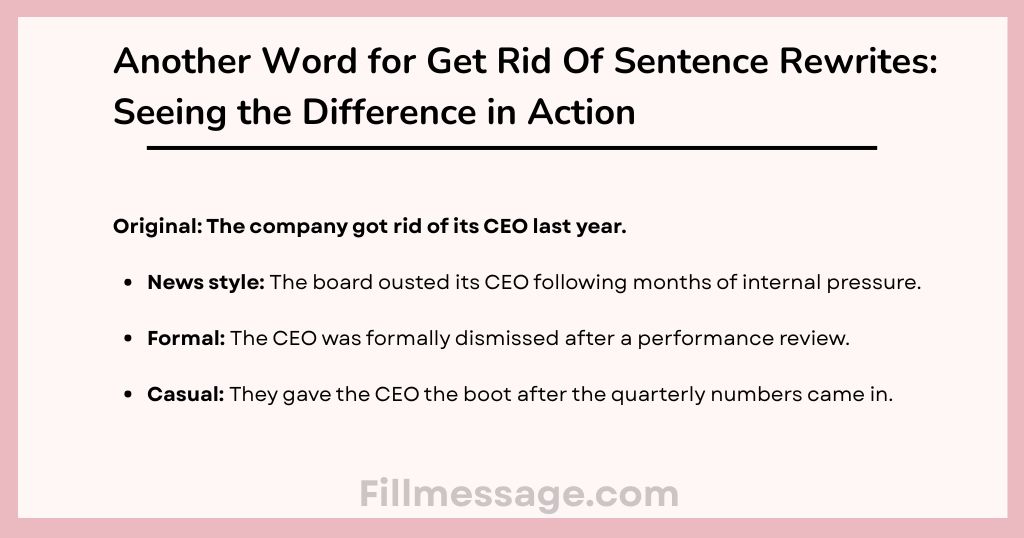
Original: The company got rid of its CEO last year.
- News style: The board ousted its CEO following months of internal pressure.
- Formal: The CEO was formally dismissed after a performance review.
- Casual: They gave the CEO the boot after the quarterly numbers came in.
Each rewrite changes not just the style but what the reader understands about the situation, who had power, how it happened, and how the writer feels about it.
Another Word for Get Rid Of Formal vs. Casual: Which Group to Reach For
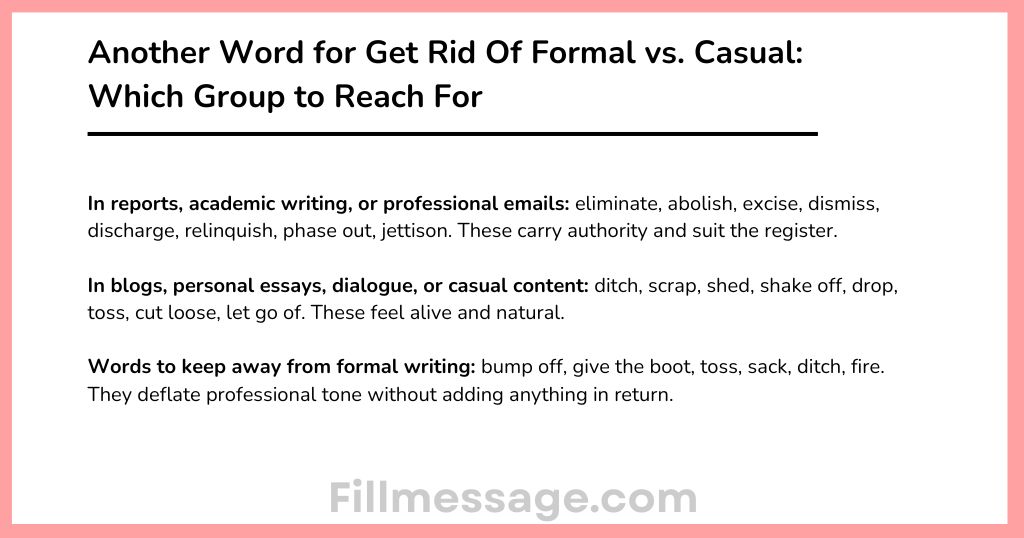
In reports, academic writing, or professional emails: eliminate, abolish, excise, dismiss, discharge, relinquish, phase out, jettison. These carry authority and suit the register.
In blogs, personal essays, dialogue, or casual content: ditch, scrap, shed, shake off, drop, toss, cut loose, let go of. These feel alive and natural.
Words to keep away from formal writing: bump off, give the boot, toss, sack, ditch, fire. They deflate professional tone without adding anything in return.
Mistakes Worth Avoiding about Get Rid Of synonym
Using “eliminate” when you mean “reduce.” Eliminate means total removal. If something is being reduced or scaled back, that’s a different word entirely.
Reaching for “eradicate” in small situations. Eradicating your email backlog sounds unintentionally dramatic. Save eradicate for things that genuinely need total, permanent removal.
Mixing register without noticing. If your document says “the policy was abolished” in one paragraph and “we ditched the old rule” in the next, readers feel the inconsistency even if they can’t explain it.
Assuming “dispose of” and “discard” are identical. Dispose of suggests a deliberate process with some responsibility attached. Discard is simpler and more indifferent. They’re close but not interchangeable in every sentence.
Using “purge” near anything involving people without thinking twice. It has a dark political history. In technical writing about data, it’s fine. In writing about organizations or communities, it can land wrong.
Synonym for Get Rid Of Related Words That Deepen Your Vocabulary
Renounce goes further than removal. It’s a public declaration that you’re giving something up, a belief, a title, a citizenship. Removing something privately is not the same as renouncing it.
Surrender implies handing something to another party. It’s removal plus transfer. What you give up goes somewhere.
Declutter is soft and specific. It belongs in writing about simplification, whether physical spaces or mental habits. It’s about reducing excess, not forceful removal.
Neutralize appears in strategic and technical writing. The threat isn’t destroyed but made harmless. That distinction matters in certain contexts.
Detach focuses on separation without destruction. You detach a component. You detach emotionally from an outcome. Nothing is gone, just no longer connected.
Read more:
31 Another Word for Liberation: The Complete Guide for Writers
30 Another Words for Handsomely: The Right Alternative for Every Context
FAQs
What’s a professional way to say “get rid of” in a formal email?
Depends on what you’re removing. For policies: “discontinue” or “revoke.” For people: “dismiss” or “discharge.” For problems: “eliminate” or “resolve.” Match the word to what’s actually being removed.
What slang works for “get rid of” without sounding harsh?
“Ditch” and “cut loose” are the safest bets. They’re casual and clear without implying cruelty. “Drop” works too when context makes the meaning obvious.
How do you say “get rid of a problem” more powerfully?
Try “stamp out,” “root out,” or “eradicate” depending on how deep the problem runs. “Stamp out” works for visible, active problems. “Root out” works for hidden or systemic ones. “Eradicate” works when you want to signal that it’s gone for good.
Is there a softer way to say “get rid of” someone in a relationship context?
Yes. “Let go of,” “move on from,” and “release” all work without sounding clinical or cold. They center the emotional reality of the situation, which is usually what the writing needs.
Making the Right Call
Every word in this list removes something. But each one does it differently. “Phase out” takes time. “Excise” is surgical. “Oust” involves resistance. “Let go of” involves the heart.
The next time “get rid of” appears in your draft, ask one question: what actually happened here? Was it sudden or gradual? Formal or personal? Chosen or forced? The answer points you to the right word. Pick that one, and the sentence improves immediately.

Marco Jr. is Author at fillmassage.com,
He explores the world of words and their meanings, helping readers understand language clearly. Passionate about explanations that guide and inform, he creates insightful content that educates, engages, and supports curious minds every day.