Sometimes, “another world” is the only phrase that comes to mind when something feels unusual, magical, or far away from normal life. But the right words can create a much stronger image and emotion.
This guide to Words for Another World helps writers, students, and creators choose alternatives based on meaning, tone, and situation. Whether you are describing a fantasy place, an afterlife idea, or a powerful feeling, you will find words that fit naturally.
What the Phrase Actually Holds
“Another world” sounds simple. It isn’t. It can describe the place a soul goes after death. It can describe a realm a hero enters in a fantasy novel. It can describe how a garden felt at dusk, or how a piece of music made you forget where you were sitting.
The phrase stretches across all of those uses because it’s emotionally flexible. That flexibility is also what makes it vague. A stronger word picks one of those meanings and commits to it.
Quick-Access Words for Another World Table (26+ Words)
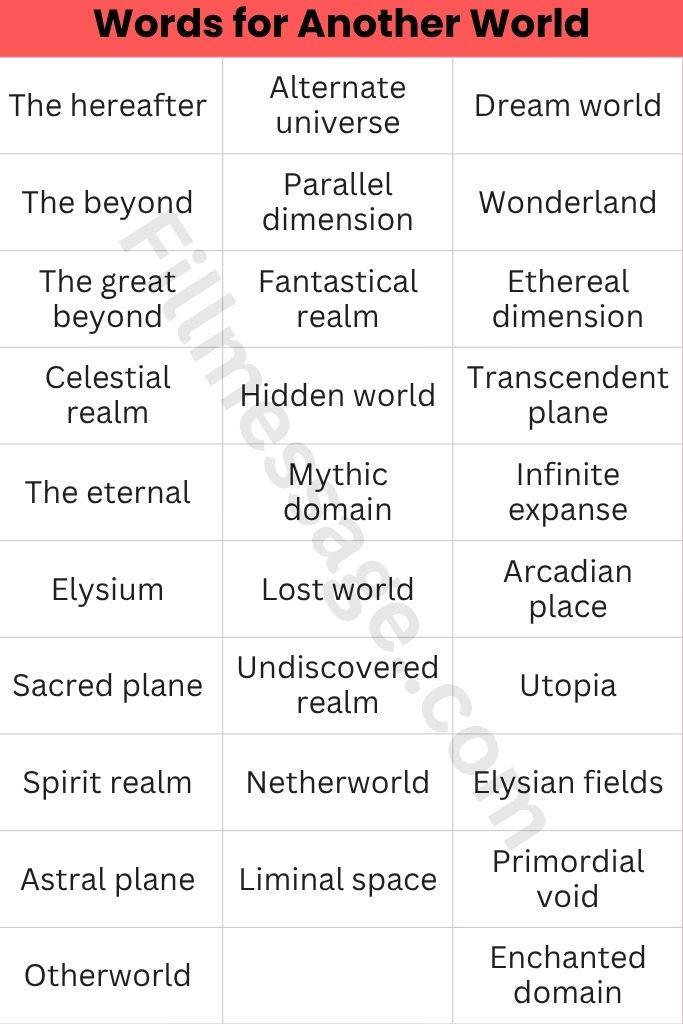
| Word / Phrase | Tone | Best Used When |
| The hereafter | Solemn, spiritual | Writing about death or what follows it |
| The beyond | Open, mysterious | Poetry, eulogies, quiet spiritual prose |
| The great beyond | Warm, informal | Casual tributes, conversational writing |
| Celestial realm | Elevated, poetic | Divine or heavenly settings |
| The eternal | Grave, timeless | Memorials, religious writing |
| Elysium | Classical, beautiful | Peaceful afterlife, literary contexts |
| Sacred plane | Reverent, devotional | Spiritual essays, faith-based writing |
| Spirit realm | Folkloric, mythic | Cultural writing, mythology, fantasy |
| Astral plane | Esoteric, mystical | Spiritual or new-age contexts |
| Otherworld | Ancient, literary | Celtic myth, folk-rooted fantasy |
| Alternate universe | Neutral, modern | Sci-fi, speculative fiction, casual speech |
| Parallel dimension | Technical, speculative | Physics-adjacent fiction, hard sci-fi |
| Fantastical realm | Rich, cinematic | High fantasy, worldbuilding |
| Hidden world | Curious, secretive | Adventure fiction, discovery narratives |
| Mythic domain | Grand, epic | Legend-based storytelling |
| Lost world | Nostalgic, adventurous | Historical fiction, exploration themes |
| Undiscovered realm | Hopeful, exploratory | Coming-of-age, adventure writing |
| Netherworld | Dark, mythological | Gothic fiction, underworld imagery |
| Liminal space | Unsettling, psychological | Surreal fiction, eerie atmosphere |
| Dream world | Soft, imaginative | Poetry, gentle creative fiction |
| Wonderland | Playful, whimsical | Children’s content, lighthearted prose |
| Ethereal dimension | Airy, delicate | Atmospheric poetry, subtle description |
| Transcendent plane | Abstract, philosophical | Spiritual essays, academic writing |
| Infinite expanse | Vast, open | Space writing, existential themes |
| Arcadian place | Peaceful, pastoral | Idyllic landscape writing, literary fiction |
| Utopia | Idealistic, formal | Social commentary, essays, fiction |
| Elysian fields | Classical, serene | Literary tributes, poetic afterlife imagery |
| Primordial void | Dark, cosmic | Creation myths, existential writing |
| Enchanted domain | Warm, storybook | Middle-grade fiction, fairy tale writing |
Words for Another World Meaning Clusters: The Differences That Actually Matter
Spiritual and Afterlife Words
The hereafter, the beyond, the great beyond, celestial realm, the eternal, Elysium, sacred plane, Elysian fields, astral plane.
These words belong near grief, faith, and mortality. They aren’t interchangeable in tone, though. “The great beyond” sounds gentle, even comforting. “The eternal” sounds final and vast. “Elysium” and “Elysian fields” are classical and beautiful but assume a reader who recognizes the Greek reference. Use them in literary writing, not in a sympathy card.
“Astral plane” carries a very specific flavor. It fits new-age or esoteric writing but can read as odd in mainstream spiritual contexts. Know your audience before reaching for it.
Fantasy and Fictional Realms
Otherworld, alternate universe, parallel dimension, fantastical realm, hidden world, mythic domain, lost world, undiscovered realm, netherworld, enchanted domain.
These words exist to build settings. “Otherworld” feels rooted in Celtic and folk tradition. “Alternate universe” is modern, almost casual, comfortable in both sci-fi dialogue and everyday speech. “Parallel dimension” sounds more precise, more science-adjacent.
“Netherworld” is consistently dark. It doesn’t describe a beautiful place. It describes a realm below, associated with shadow and myth. “Enchanted domain” leans warm and storybook. If you’re writing for younger readers or a gentler tone, it fits. “Fantastical realm” is broad enough to apply across most fantasy subgenres without committing to a specific tradition.
Feeling and Experience Words
Liminal space, dream world, wonderland, ethereal dimension, transcendent plane, infinite expanse, primordial void.
This group describes sensation more than location. A character doesn’t travel to a liminal space in the traditional sense. They experience it. It’s the feeling of being between things, not fully anywhere.
“Wonderland” carries lightness. “Transcendent plane” sounds philosophical. “Primordial void” is heavy and cosmic, useful when writing about emptiness, creation, or the absence of everything. These words work when the point is how something felt, not where it literally was.
Words for Another World Sentence Rewrites: Four Originals, Four Perspectives Each
Original: “The old temple felt like another world.”
- Formal: The temple existed at a remove from contemporary life, its atmosphere shaped entirely by another era.
- Creative: Inside, the air itself had a different weight, as though the building remembered things the rest of the city had forgotten.
- Casual: Walking in there honestly felt like stepping into a completely different time altogether.
- Poetic: The temple kept its own hours. The dust spoke. The silence was not empty.
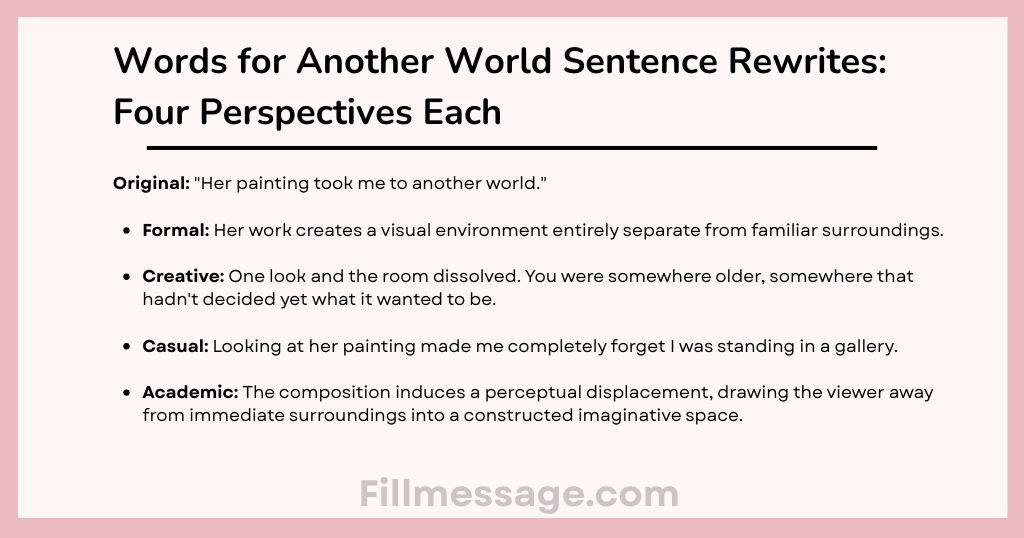
Original: “Her painting took me to another world.”
- Formal: Her work creates a visual environment entirely separate from familiar surroundings.
- Creative: One look and the room dissolved. You were somewhere older, somewhere that hadn’t decided yet what it wanted to be.
- Casual: Looking at her painting made me completely forget I was standing in a gallery.
- Academic: The composition induces a perceptual displacement, drawing the viewer away from immediate surroundings into a constructed imaginative space.
Original: “The city felt like another world at night.”
- Formal: After dark, the city took on a character entirely distinct from its daytime self.
- Creative: Night didn’t change the city. It revealed it, stripped back to something stranger and quieter.
- Casual: At night, the same streets felt like a completely different place.
- Poetic: The city after midnight belonged to no map. It invented itself street by street.
Notice what shifts each time. The formal version removes drama and adds distance. The creative version shows rather than tells. The casual version keeps the feeling but drops the weight. The poetic version abandons the comparison entirely and builds its own image. None of these is better in isolation. All of them are better than “another world” in the right context.
Words for Another World Formal vs. Informal: Which Word Goes Where
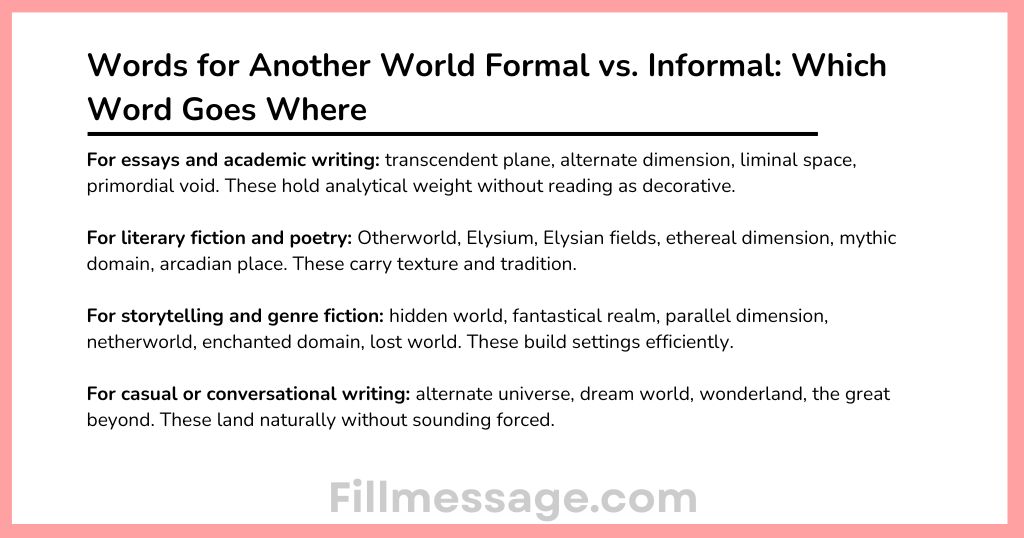
For essays and academic writing: transcendent plane, alternate dimension, liminal space, primordial void. These hold analytical weight without reading as decorative.
For literary fiction and poetry: Otherworld, Elysium, Elysian fields, ethereal dimension, mythic domain, arcadian place. These carry texture and tradition.
For storytelling and genre fiction: hidden world, fantastical realm, parallel dimension, netherworld, enchanted domain, lost world. These build settings efficiently.
For casual or conversational writing: alternate universe, dream world, wonderland, the great beyond. These land naturally without sounding forced.
Words to avoid in formal writing: “Wonderland” reads too childlike. “The great beyond” is too colloquial. “Enchanted domain” belongs in fiction, not in an essay.
Common Mistakes Worth Avoiding
Mixing up “surreal” and “otherworldly.” They feel similar but aren’t the same. Surreal describes reality that has been distorted or bent. Otherworldly describes something that seems to genuinely belong somewhere else entirely. A melting watch is surreal. A voice that sounds like it has no human source is otherworldly.
Overworking “ethereal.” It’s been used so often in creative writing that it’s started losing its texture. When every beautiful thing is ethereal, the word stops doing work. Reserve it for moments that genuinely feel weightless or barely present.
Confusing “utopia” with “paradise.” Utopia describes a perfect society built by human design and intention. Paradise describes a perfect place, usually one that exists naturally or divinely. A utopia can fail. In most traditions, paradise cannot. They aren’t synonyms.
Misusing “liminal space.” This phrase carries a very specific emotional signature now. It describes places that feel between states: empty, transitional, slightly wrong. Using it to describe a beautiful mountain meadow will read as a mistake to most informed readers.
Placing “netherworld” in hopeful writing. It doesn’t belong there. Its associations are consistently shadowed. If you’re describing something peaceful or transcendent, choose differently.
Related Words That Add Depth
Transcendence names the experience rather than the destination. If your sentence is about what a person felt rather than where they went, transcendence works where “another world” would just describe a location.
Elysian functions as an adjective. “An elysian quiet filled the room.” It’s classical without being inaccessible, and it adds beauty without naming a specific mythological place.
Arcadian describes a purer, simpler version of this world rather than a completely separate one. Writers who want peace without full escape often reach for this. It has a pastoral, pre-modern warmth to it.
Void is the functional opposite. Not “another world” but the complete absence of one. When writing needs contrast, when a character needs something to push against or escape from, void holds that emptiness with precision.
Mundane works as a contrast word in a different way. Where void is cosmic emptiness, mundane is ordinary earthly life. Pairing transcendent language with “mundane” creates effective tension in both fiction and essay writing.
Read more:
46+ Another Word for Division: Right Word, Right Place
26+ Another Term for Life Changing: Find the Right Word for Every Moment
FAQs about Words for Another World
Q: Is “otherworldly” only for fantasy writing?
No. It works in music reviews, travel writing, nature writing, and descriptions of people. “Her voice was otherworldly” is natural in any genre. It simply means something that feels too striking or unusual to belong to ordinary experience.
Q: What’s the cleanest word for “another world” in a eulogy?
“The beyond” or “the hereafter” work most broadly because they aren’t tied to a single tradition. “The great beyond” is warmer and more conversational. “Celestial realm” is more formal and poetic. Choose based on the tone of the service, not the length of the word.
Q: Can “alternate universe” be used seriously, or does it sound too casual?
It depends entirely on context. In sci-fi writing, it’s completely serious and established. In casual conversation, it’s idiomatic and comfortable. In a literary essay, it might feel slightly light. “Parallel dimension” reads as more deliberate in formal contexts.
Q: What’s the difference between “my world” synonyms and “another world” synonyms?
“My world” synonyms (my sphere, my domain, my reality) are personal and inward-facing. They claim a private space. “Another world” synonyms are outward-facing. They point to something that exists beyond the speaker. The emotional direction is completely different.
Choosing the Right Word
Here’s the short version: decide what kind of “another world” you mean before you go looking for the word.
If you mean the afterlife, reach toward the hereafter, the beyond, or Elysium. If you mean a fictional setting, choose between otherworld, alternate universe, or fantastical realm based on how ancient or modern the story feels. If you mean a feeling or experience, try liminal space, transcendent plane, or dream world depending on how light or heavy the moment is.
The word you want already exists. You just need to know which direction you’re facing first.

Marco Jr. is Author at fillmassage.com,
He explores the world of words and their meanings, helping readers understand language clearly. Passionate about explanations that guide and inform, he creates insightful content that educates, engages, and supports curious minds every day.