There’s a moment every writer knows. You’ve typed “agenda” three times in two paragraphs, and something feels off. Not wrong exactly, just flat. Repetitive. Like you’re circling the same word because no better one came to mind fast enough.
The real problem isn’t repetition though. It’s using a word that carries the wrong weight for your context. “Agenda” in a corporate email lands differently than “agenda” in a political article or a casual team chat. The word works, but it doesn’t always fit.
This guide helps you find the word that actually fits, not just a synonym that technically means the same thing.
What “Agenda” Actually Covers
At its core, an agenda is a list of things to be done or discussed. But that definition is too simple to be useful. In practice, “agenda” carries layers.
It can mean a meeting outline. A personal set of goals. A hidden motive. A public policy position. Depending on which layer you’re working with, a completely different word might serve you better.
That’s the gap most synonym lists miss. They list words without explaining which kind of agenda they replace.
Quick-Reference Another Word for Agenda Table
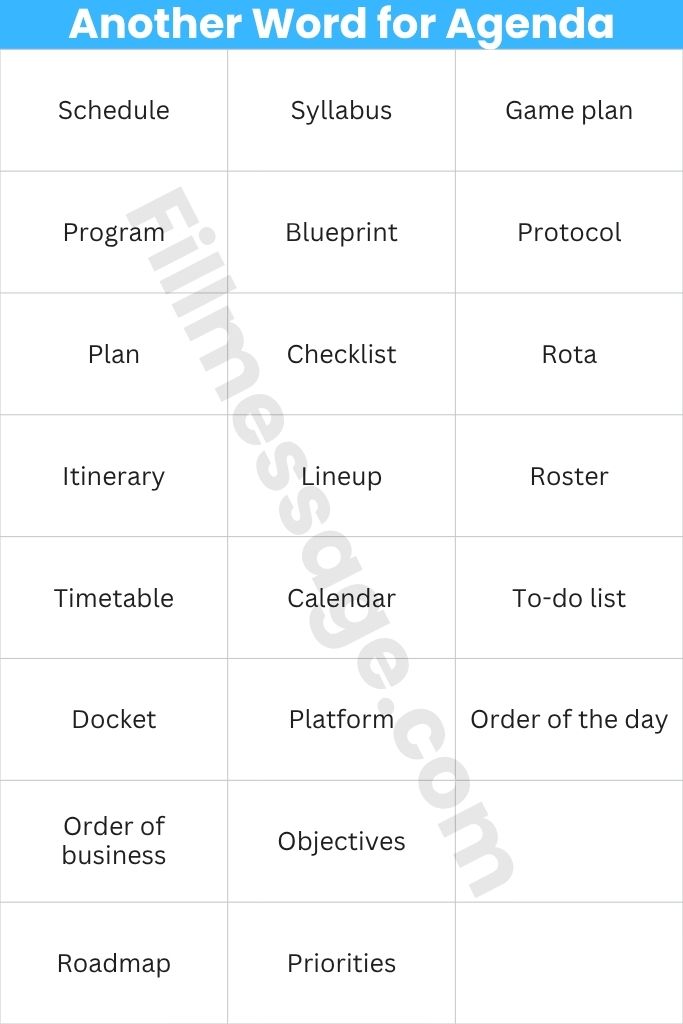
| Word | Tone | Best Used When |
| Schedule | Neutral, practical | Timing matters most |
| Program | Formal, structured | Events, courses, ceremonies |
| Plan | Flexible, general | Strategy or project work |
| Itinerary | Specific, travel-linked | Trips, visits, delegations |
| Timetable | Rigid, recurring | Classes, transport, shifts |
| Docket | Legal, official | Courts, formal boards |
| Order of business | Parliamentary | Board meetings, assemblies |
| Roadmap | Strategic, phased | Product or organizational plans |
| Syllabus | Educational | Courses, training programs |
| Blueprint | Detailed, execution-ready | Complex project planning |
| Checklist | Task-oriented | Operations, compliance work |
| Lineup | Light, sequential | Events, releases, speakers |
| Calendar | Visual, time-based | Publishing, appointments |
| Platform | Political, public | Policy goals, advocacy |
| Objectives | Goal-focused | Business, research targets |
| Priorities | Ranked, decision-driving | Leadership, quarterly planning |
| Game plan | Informal, energetic | Sales, startups, team talks |
| Protocol | Procedural, formal | Diplomacy, labs, ceremonies |
| Rota | Rotating, UK-common | Healthcare, schools, shifts |
| Roster | People-assigned | Teams, staffing, volunteers |
| To-do list | Personal, casual | Daily tasks, agile standups |
| Order of the day | Old-formal | Clubs, societies, assemblies |
Agenda Synonym Words Grouped by What Kind of Agenda You Mean
When the Agenda Is About Time and Sequence
Schedule is probably the most natural swap in everyday writing. It puts timing at the center. If the point of your agenda is when things happen, “schedule” carries that without extra explanation.
Timetable works similarly but implies repetition. A timetable for weekly team syncs. A timetable for semester classes. It feels fixed, structured, institutional.
Calendar is the visual version. It maps time across days or weeks. Editorial calendars. Event calendars. Any time your agenda spans a longer stretch and you want readers to picture it spread across time, “calendar” fits.
Itinerary belongs specifically to movement. If your agenda involves going somewhere, seeing things, arriving and departing, use this. It’s the right word for travel, visits, field trips, and delegation schedules.
When the Agenda Is About Goals and Direction
Roadmap is the modern favorite in business and product writing. It shows direction across phases. It doesn’t just list what you’ll do; it implies a journey from where you are now to where you’re going.
Blueprint is more precise. It’s a plan with specific components, owners, and steps. If the agenda you’re describing is a detailed execution document, not just a direction, “blueprint” conveys that level of preparation.
Objectives works when you want to strip out process entirely and focus only on what success looks like. No steps, no order of events. Just the outcomes being aimed at.
Priorities does something slightly different. It tells you not just what you’re working toward, but what matters most when trade-offs arise. Useful in leadership communication, quarterly planning, and strategic framing.
When the Agenda Belongs to a Meeting or Formal Setting
Order of business is the most structurally precise option here. It signals that items will be taken up in a deliberate sequence, usually governed by rules or procedure. Formal boards use it. Parliamentary bodies use it.
Docket lives in legal and official contexts. Court dockets. Municipal dockets. It implies a formal register of items awaiting review, not just a list but a queue with weight behind it.
Program fits conferences, ceremonies, and structured events. A program tells you what’s happening and in what order, but it has more ceremony than a plain schedule. It implies something worth attending.
Protocol handles situations where the agenda is really a set of procedural rules. Diplomatic protocol. Lab protocol. Safety protocol. When the order of doing things has official significance, this word carries that.
When the Agenda Is Personal or Informal
Game plan is casual, energetic, and a little competitive. It works in sales conversations, startup pitches, and any writing where you want to sound strategic but approachable.
To-do list is the most honest informal option. No pretense. No ceremony. It says: here are the things that need doing, in roughly this order.
Lineup is interesting because it can swing casual or semi-formal. A product release lineup. A speaker lineup. It’s sequential but light, without the weight of “schedule” or “program.”
Checklist differs from all others in one key way: it implies verification. You don’t just follow a checklist, you tick things off. When completion and confirmation matter, this is the better word.
When the Agenda Is About People or Shifts
Roster and rota are both about assigning people to responsibilities. A roster lists who does what. A rota rotates that responsibility over time. In UK and Commonwealth English, “rota” is the everyday word. In American English, “roster” is more common.
Neither replaces “agenda” in a meeting context. But if your agenda is essentially who’s working when, one of these fits better.
When the Agenda Carries a Political or Public Meaning
Platform is the political word. It describes a set of publicly stated goals, values, and commitments. A party platform. A candidate’s platform. An organizational platform. It’s not just what you plan to discuss; it’s what you stand for.
Syllabus shifts this into education. A syllabus is an agenda for learning, structured across a course or program. It sets expectations for what will be covered, by when, and in what depth.
Another Word for Agenda in Sentence Rewrites: See the Difference in Action
Here’s where word choice actually reveals its power. Same idea, different words, completely different feel.
Original: “Let’s review the agenda before the meeting starts.”
- Formal: “Please familiarize yourself with the order of business prior to the session.”
- Casual: “Quick look at the game plan before we kick things off.”
- Academic: “Participants should review the program objectives in advance of the scheduled proceedings.”
- Creative: “Before the clock hits nine, let’s map out exactly where we’re headed.”
Notice how “order of business” signals structure and formality. “Game plan” creates momentum and informality. The academic version distances itself with passive construction. The creative one skips the label entirely and describes the action instead.
Original: “She had her own agenda at the meeting.”
- Neutral: “She arrived with her own priorities clearly in mind.”
- Critical: “Her personal objectives had little to do with the group’s goals.”
- Diplomatic: “She brought a separate set of concerns to the table.”
The word “agenda” in this sentence implies something hidden or self-serving. None of the rewrites fully capture that shadow meaning, which is actually a good reminder: sometimes “agenda” is the only word that implies hidden motive. Don’t replace it when that’s the meaning you need.
Common Mistakes Writers Make
Swapping “schedule” for “agenda” in formal meetings. They’re close but not identical. A schedule tells you when. An agenda or order of business tells you what and in what order. Both can coexist in the same document.
Using “roadmap” for short-term plans. Roadmaps imply phases, milestones, and a longer view. Using it for a week’s work makes the word feel inflated.
Calling something a “blueprint” when it’s still rough. A blueprint suggests completeness and detail. If the plan is still forming, “draft plan” or “outline” is more honest.
Treating “platform” as interchangeable with “agenda” in business contexts. Platform carries political and public weight. In a business meeting, nobody has a platform. They have an agenda, a plan, or a set of objectives.
Using “checklist” when you mean “agenda.” An agenda opens discussion. A checklist closes tasks. If people are meant to talk, don’t call it a checklist.
Related Another Word for Agenda Worth Knowing
Outline sits between agenda and blueprint. It shows structure without prescribing detail. Good for early-stage planning.
Framework is broader than a plan. It provides the rules and boundaries within which a plan is built. Common in policy, design, and research.
Mandate carries authority. When someone has a mandate, they don’t just have an agenda; they have permission to act on it. Useful in political and organizational writing.
Directive is agenda plus authority plus urgency. It’s not a list of things to discuss but a list of things to execute.
These four words often appear near “agenda” in writing but each one shifts the power dynamic in a specific direction.
Read also:
26 Another Word for Risk: Choose the Right One Every Time
30 Another Word for Fire: The Right Word for Every Flame
The Takeaway
“Agenda” is a reliable word, but it’s not always the sharpest one. When timing matters, reach for “schedule” or “timetable.” When direction matters, “roadmap” or “blueprint” does more work. When the setting is formal, “order of business” or “docket” signals that you understand the context. And when the agenda implies motive rather than structure, keep the original word. Nothing else does that job quite as cleanly.
The goal isn’t to avoid “agenda.” It’s to reach for the word that actually matches what you’re describing.

Marco Jr. is Author at fillmassage.com,
He explores the world of words and their meanings, helping readers understand language clearly. Passionate about explanations that guide and inform, he creates insightful content that educates, engages, and supports curious minds every day.