You wrote “fire” again. And it worked. But did it do what you actually needed?
There is a big difference between the fire crackling at a campsite and the fire swallowing an entire neighborhood. The same word covers both. But should it? When your word choice is too broad, your reader does not feel what you want them to feel. They just read past it.
This article is for writers, students, and anyone who has ever paused mid-sentence thinking: there has to be a better word here.
What “Fire” Actually Carries
Fire is not just a noun. It is an event, an emotion, a dismissal, and an action all at once. That is exactly why replacing it gets complicated. Before picking a synonym, you need to know which version of fire you are talking about.
The word carries heat, urgency, and danger by default. But its emotional weight changes completely based on context. A bonfire at a celebration feels nothing like a warehouse in flames. Your synonym choice should make that gap obvious, not blur it.
Quick Another Word for Fire Table: 30 Alternatives by Context
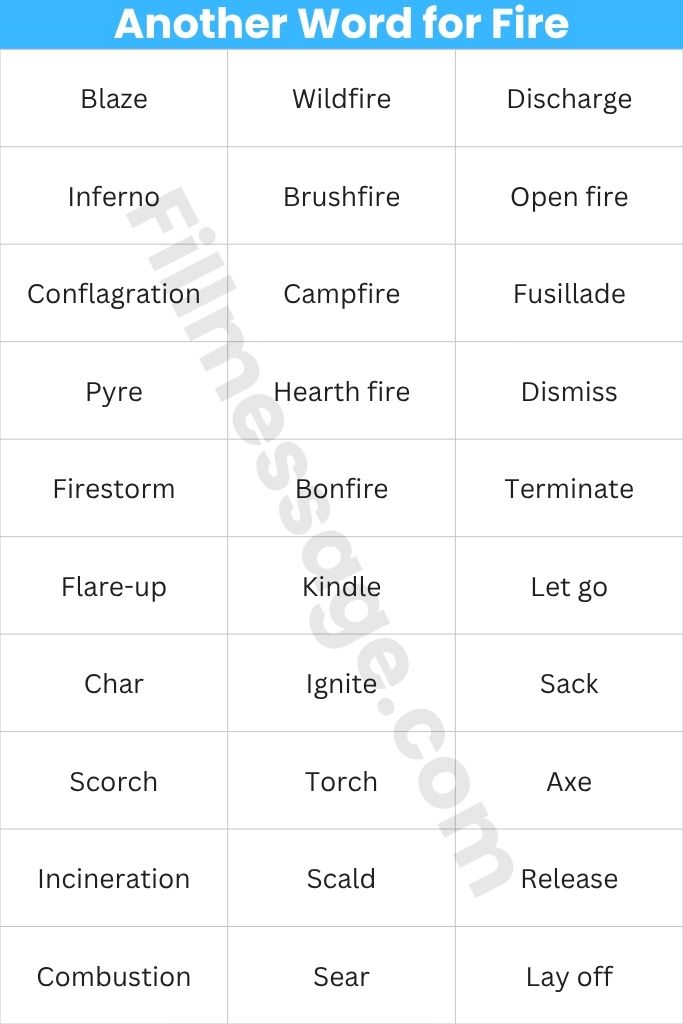
| Word | Context | Tone |
| Blaze | Strong visible fire | Dramatic |
| Inferno | Enormous, uncontrollable fire | Intense |
| Conflagration | Large destructive fire | Formal |
| Pyre | Ceremonial burning | Solemn |
| Firestorm | Wind-driven fire or public backlash | Forceful |
| Flare-up | Sudden, brief burst of fire | Quick/urgent |
| Char | Burning that leaves marks | Quiet/dark |
| Scorch | Surface-level burning | Mild |
| Incineration | Complete burning, nothing left | Clinical |
| Combustion | Technical burning process | Scientific |
| Wildfire | Fast-spreading natural fire | Alarming |
| Brushfire | Small fire in dry vegetation | Regional/news |
| Campfire | Small, controlled outdoor fire | Warm/casual |
| Hearth fire | Indoor fire, home setting | Cozy |
| Bonfire | Large outdoor social fire | Festive |
| Kindle | To start a small fire (verb) | Gentle |
| Ignite | To set something burning (verb) | Sharp |
| Torch | To burn deliberately (verb) | Aggressive |
| Scald | Burning through liquid heat | Sharp |
| Sear | Fast, intense surface burn | Culinary/literary |
| Discharge | To fire a weapon | Military/formal |
| Open fire | To begin shooting | Military |
| Fusillade | Rapid burst of gunfire | Literary/formal |
| Dismiss | End employment formally | HR/formal |
| Terminate | End a contract | Legal/cold |
| Let go | Release from a job | Polite/neutral |
| Sack | Fire someone informally | Casual/British |
| Axe | Cut a role or person | Journalistic |
| Release | Remove from a team professionally | PR-friendly |
| Lay off | Remove due to budget or structure | Economic |
Fire Synonym Breaking It Down: Fire Has Four Different Lives
1. Fire as a Physical Event
This is the most common use. But even here, the right word changes everything.
Blaze suggests something dramatic and visible. You can see it from far away. It draws attention. Use it when size and spectacle matter.
Inferno goes further. It suggests total chaos, extreme heat, and very little hope of control. Firefighters do not walk into a blaze and call it an inferno lightly. The word feels final.
Conflagration is the formal version. You will see it in news writing and official reports. It signals something massive and destructive without using dramatic flair.
Flare-up is completely different. It is short, sudden, and often unexpected. A flare-up can be put out. An inferno cannot.
Combustion strips emotion away entirely. It is the scientific term. Use it when you want clinical precision, not drama.
2. Fire as a Verb: Starting or Setting a Fire
This is where tone shifts fast.
Kindle is soft. It suggests care, a small beginning, and even warmth. You kindle a fire in a fireplace. The word carries patience.
Ignite is faster and sharper. It often implies a trigger point, a moment when something suddenly starts. Writers use it figuratively too: “the speech ignited outrage.”
Torch is deliberate and often negative. Someone torches a building on purpose. The word holds intent and sometimes accusation.
Incinerate leaves nothing behind. It is total destruction through burning. The word is cold and final, which makes it powerful in both literal and figurative writing.
3. Fire as a Weapon or Attack
When fire means shooting or attacking, the vocabulary shifts into military and action territory.
Open fire is the moment shooting begins. It is a turning point in any scene. Direct, physical, and serious.
Discharge sounds official. It is the technical way to describe firing a weapon. You will see it in legal statements and formal reports.
Fusillade describes rapid, continuous gunfire. It is more literary and less common in everyday use, but powerful when you need that specific image of shots firing in quick succession.
4. Fire as a Job Ending
This is one of the strangest uses of the word because it has nothing to do with heat. But language works that way.
The difference between these words matters more than people think.
Terminated is cold and legal. It often follows misconduct or a formal process. It does not soften the blow.
Let go is the gentlest version. It often implies it was not personal or performance-related. Companies use it when they want to seem humane.
Sacked is casual and mostly British. It sounds blunt and informal.
Axed is journalistic. You will read it in headlines where space is tight and the action is direct.
Released is often used for athletes and public figures. It protects reputation on both sides.
How the Same Sentence Changes With Different Words
Original: The fire spread quickly.
- Formal: The conflagration advanced rapidly across the district.
- Casual: The blaze tore through the block before anyone could stop it.
- Tense/cinematic: The inferno moved like it had somewhere to be.
- News-style: A brushfire consumed over 200 acres within the first hour.
Each version creates a different picture. The facts are almost the same. The feeling is completely different.
Original: He was fired yesterday.
- Formal: He was dismissed from his position effective immediately.
- Casual: He got sacked and cleared out his desk by noon.
- PR tone: He was released from his role following a mutual decision.
- Direct/harsh: His contract was terminated without notice.
Notice how the same event becomes more or less serious, more or less personal, depending on the word. Writers who understand this have real control over their reader.
Mistakes That Catch Writers Off Guard
Using “inferno” for small fires. If a candle tips over and starts a small fire in a kitchen, calling it an inferno is exaggeration. Your credibility drops when the scale does not match.
Using “kindle” in a violent context. Kindle is gentle. Writing “they kindled the enemy camp” sounds odd. The word brings warmth, not destruction.
Mixing “lay off” and “fired.” These are not the same. Laid-off employees lose jobs because of company decisions, budget cuts, or restructuring. Fired employees lose jobs because of their own actions or performance. Confusing them can cause real harm in professional writing.
Using “conflagration” in casual writing. It is accurate, but it pulls the reader out of the moment if the rest of your writing is conversational. Match the word to the register of your piece.
Calling every shooting scene a “fusillade.” This word has a very specific feel. Overusing it makes it lose its weight. Save it for moments that earn it.
Related Another Word for Fire Worth Knowing
Ember – What remains after fire. Quiet, fading heat. Useful in emotional metaphors about things dying slowly.
Char – The damage fire leaves behind. Darker and more visual than “burn.”
Smolder – Fire without flame. Something burning slowly, underground or beneath the surface. A perfect word for tension that has not exploded yet.
Flicker – The movement of a small, uncertain fire. Also useful for things that are fragile or fading.
Scorch – Surface damage from heat. Not total destruction. Often used to describe near-misses or partial damage.
Read more:
24 Another Word for Poverty: Choose Right One for What You’re Saying
26 Another Word for Risk: Choose the Right One Every Time
Choosing the Right Word
Here is the real takeaway: the best synonym is the one that matches your scale, your tone, and your scene all at once.
If you are writing about something massive and catastrophic, reach for inferno or conflagration. If something is fast and wild, wildfire or blaze fits. If you need warmth and intimacy, campfire or hearth fire does more work than “fire” ever could.
For job loss, think about whether the situation was personal or structural. That one detail should guide your word choice every time.
Your reader does not know what word you considered and rejected. They only feel the one you chose.

Marco Jr. is Author at fillmassage.com,
He explores the world of words and their meanings, helping readers understand language clearly. Passionate about explanations that guide and inform, he creates insightful content that educates, engages, and supports curious minds every day.