You already know what balance means. But when you type it for the third time in two paragraphs, something feels off. The writing gets flat. The word stops doing its job.
That is not a vocabulary problem. It is a precision problem.
“Balance” carries too many meanings at once. It can describe a bank account, a gymnastics pose, a fair judgment, or a calm mind. When readers see it, they have to figure out which version you mean. A more specific word does that work for them, and your writing becomes sharper without any extra effort.
This guide helps you pick the right replacement, not just hand you a list.
What “Balance” Actually Covers
At its core, balance means two things are equal or stable enough that neither one collapses. It suggests things are held in check, distributed fairly, or maintained without tipping over.
But the emotional weight shifts depending on context. In finance, balance feels clinical. In relationships, it feels hopeful. In physical spaces, it feels visual. That shift matters when you are choosing a replacement word.
Quick-Access Another Word for Balance Table
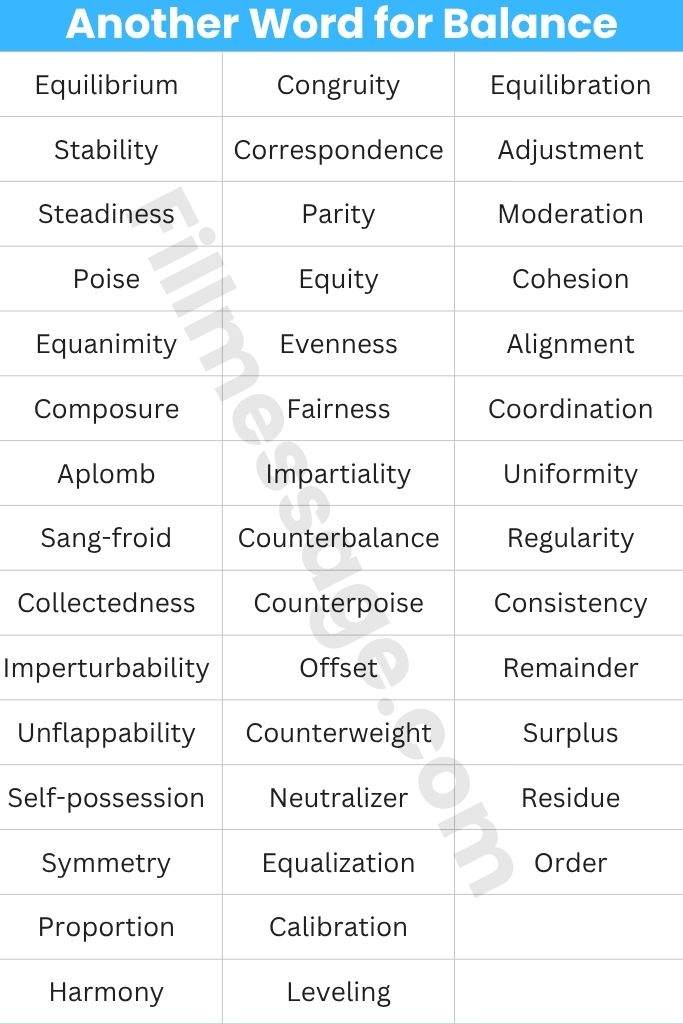
| Word | Best Tone | Use It When… |
| Equilibrium | Neutral/Scientific | Writing about systems, science, or mental states |
| Steadiness | Warm/Practical | Describing reliable behavior or physical control |
| Poise | Polished/Formal | Talking about grace under pressure |
| Equanimity | Calm/Reflective | Describing emotional control in hard moments |
| Symmetry | Visual/Design | Working in art, layout, or architecture |
| Harmony | Warm/Creative | Writing about relationships or music |
| Stability | Grounded/Serious | Finance, structure, or long-term situations |
| Parity | Fair/Policy | Equality in rights, pay, or opportunity |
| Composure | Emotional/Social | Staying calm when things go wrong |
| Counterbalance | Mechanical/Strategic | One thing offsetting another |
| Proportion | Design/Analytical | How parts relate to the whole |
| Calibration | Technical/Precise | Fine-tuning systems or responses |
| Alignment | Strategic/Structural | Goals, posture, or values matching up |
| Evenness | Simple/Direct | Fair distribution or smooth consistency |
| Aplomb | Confident/Stylish | Handling pressure with visible ease |
Balance Synonym Meaning Clusters: Grouped by What You Actually Mean
The biggest mistake writers make is grabbing any synonym and hoping it fits. These clusters help you match the right word to the right idea.
When You Mean Emotional Calm
Some people use balance when they mean someone is not panicking. That is a different idea. Try:
Equanimity – This is deeper than calm. It describes someone who faces difficulty without becoming reactive. A grief counselor writes with equanimity. A war reporter reports with equanimity.
Composure – More surface-level than equanimity. It is about visible control. Someone regains composure after bad news.
Aplomb – This has flair. It suggests someone handled something tricky and looked confident doing it. It works best when there is a slight sense of admiration in your sentence.
Sang-froid – Borrowed from French, this describes a cool, almost detached calm under extreme pressure. Use it sparingly. It adds tone but can feel out of place in casual writing.
When You Mean Fairness or Equal Treatment
Parity – Best for formal or policy writing. Gender parity, pay parity, trade parity. It implies measurement.
Equity – This word has moral weight. It goes beyond equality to suggest fairness based on need, not just identical treatment. Use it in social or ethical contexts.
Impartiality – Good for legal or judging contexts. It describes absence of bias more than the presence of fairness.
Evenness – Simpler and softer. It describes fair distribution without the formal edge of parity or equity.
When You Mean Physical or Structural Stability
Steadiness – Works for physical things (a steady hand, a steady platform) and people behaving reliably.
Stability – Broader than steadiness. You can describe a building, a relationship, or a country as stable.
Equilibrium – This one leans scientific but crosses over into emotional writing too. A person finds equilibrium after a period of chaos.
Counterbalance – Specifically useful when one force offsets another. A heavy counterbalance keeps the crane from tipping.
When You Mean Visual or Proportional Harmony
Symmetry – Two sides matching. Best in design, architecture, or face descriptions.
Proportion – How parts relate to each other. Not about matching, but about fitting correctly.
Harmony – Softer and more feeling-based. Design harmony suggests things that look good together, not necessarily identical.
Alignment – More strategic. Used in design when things are deliberately positioned, or in business when goals match.
Another Word for Balance in Sentence Rewrites: See the Difference Yourself
Weak sentence: “She tried to balance her emotions during the meeting.”
- Formal: She maintained composure throughout the session.
- Casual: She kept it together when things got tense.
- Creative: She held herself very still inside while the room fell apart around her.
- Academic: She demonstrated emotional regulation in a high-stress environment.
Each version says something slightly different. Composure focuses on visible control. “Kept it together” is relatable. The creative version shows rather than tells. The academic version names a skill.
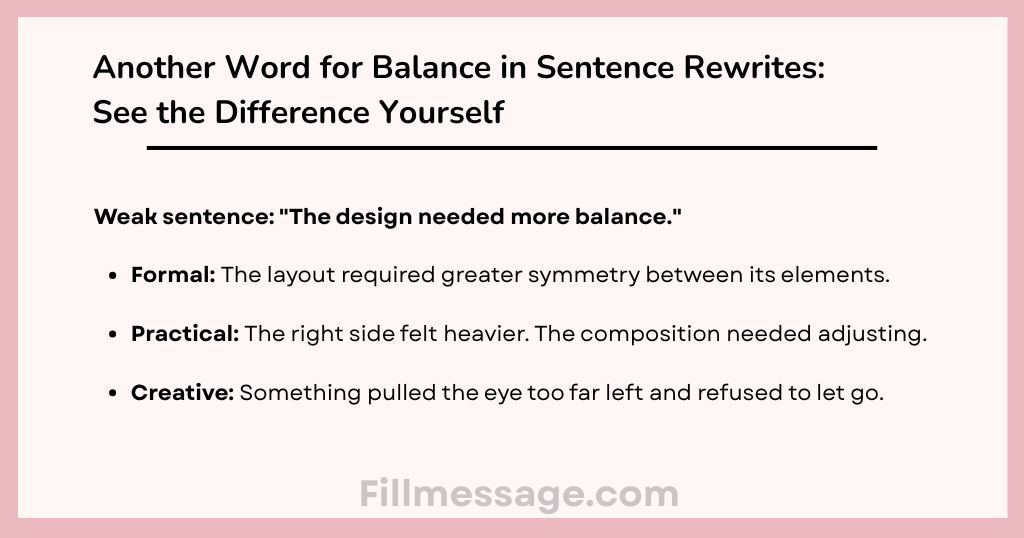
Weak sentence: “The design needed more balance.”
- Formal: The layout required greater symmetry between its elements.
- Practical: The right side felt heavier. The composition needed adjusting.
- Creative: Something pulled the eye too far left and refused to let go.
Weak sentence: “We need balance in the budget.”
- Formal: The budget requires equalization across departments.
- Direct: Spending and income need to match.
- Policy-style: Fiscal parity between divisions is essential for sustainable operations.
Notice how each swap carries a slightly different expectation. Equalization sounds like action. Parity sounds like a goal. Matching sounds like a basic requirement.
Formal Another Word for Balance vs. Casual: Where Each Word Belongs
Use in professional emails or essays:
- Equilibrium, parity, equanimity, stability, impartiality, composure
Use in storytelling or personal writing:
- Steadiness, harmony, poise, aplomb, evenness, sang-froid
Use in technical or design work:
- Calibration, alignment, symmetry, proportion, counterbalance
Words to avoid in formal writing:
- “Hang” (as in “hang in balance”), “on an even keel” (clichéd), and “juggling” as a synonym for balance. These work in casual speech but weaken professional writing.
Common Mistakes Worth Knowing
Equilibrium is not always interchangeable with stability. Stability describes a state that holds. Equilibrium describes a point where opposing forces cancel out. A building can be stable but not in equilibrium. A chemical reaction reaches equilibrium but might not feel stable at all.
Harmony does not mean balance. Harmony means things work together pleasingly. Balance means things are equal or stable. A room can have color harmony without any visual balance.
Poise is not just physical. Many writers use it only for posture or movement, but it works just as well for social grace. “She answered with poise” is perfectly natural.
Do not use equanimity casually. It is a strong word. Saying someone “handled the snack choice with equanimity” sounds off. Save it for real difficulty.
Symmetry without proportion can still feel wrong. Two sides can match and still look awkward if the proportions are off. These are related but not the same.
Related Another Word for Balance That Expand Your Range
Moderation – Balance between excess and restraint. Often used in health, lifestyle, or ethics contexts.
Cohesion – Things sticking together well. Related to balance but focused on unity, not equality.
Resilience – Not a synonym for balance, but often confused with it. Resilience is the ability to return to balance after disruption.
Groundedness – Describes a person who is emotionally balanced in a consistent, long-term way. More personal than stability.
Temperance – An older word for moderation and self-control. Works in formal or historical writing.
Integration – When different parts are combined smoothly. Suggests balance through fitting together rather than equaling out.
Read also:
29 Another Word for Primary: Real Alternatives That Actually Work
Another Word for Discovered: 20+ Better Choices for Every Context
Choosing the Right Word
Here is the short version of everything above:
If you mean someone stayed calm under pressure, use composure or equanimity. If you mean two things are equally matched, use parity or equilibrium. If you mean something looks visually right, use symmetry or proportion. If you mean things are working together well, use harmony. If you mean someone carried themselves with visible confidence, use poise or aplomb.
“Balance” is not a bad word. It just works harder when something more specific takes its place.

Marco Jr. is Author at fillmassage.com,
He explores the world of words and their meanings, helping readers understand language clearly. Passionate about explanations that guide and inform, he creates insightful content that educates, engages, and supports curious minds every day.