You finish a sentence and something feels off. “The scientist discovered a new species.” It works. But does it work well? Or does it just… sit there?
“Discovered” is one of those words writers lean on too heavily. It covers so much ground that it starts losing its edges. A child finding a candy bar in a coat pocket is not the same as a geologist uncovering a mineral vein after three years of fieldwork. But if you use “discovered” for both, the writing flattens.
The real issue is not the word itself. It is that writers forget they have choices. And the right choice changes how a reader feels about the moment.
This article gives you those choices, with enough context to use them well.
What “Discovered” Actually Means at Its Core
At its simplest, “discovered” means to find or become aware of something that was previously unknown, hidden, or unnoticed. But the word carries a quiet assumption: that whatever was found had value or significance.
That emotional weight is why swapping it out carelessly can misfire. Some replacements feel too light. Others too dramatic. The difference matters.
Quick Another Word for Discovered Reference Table
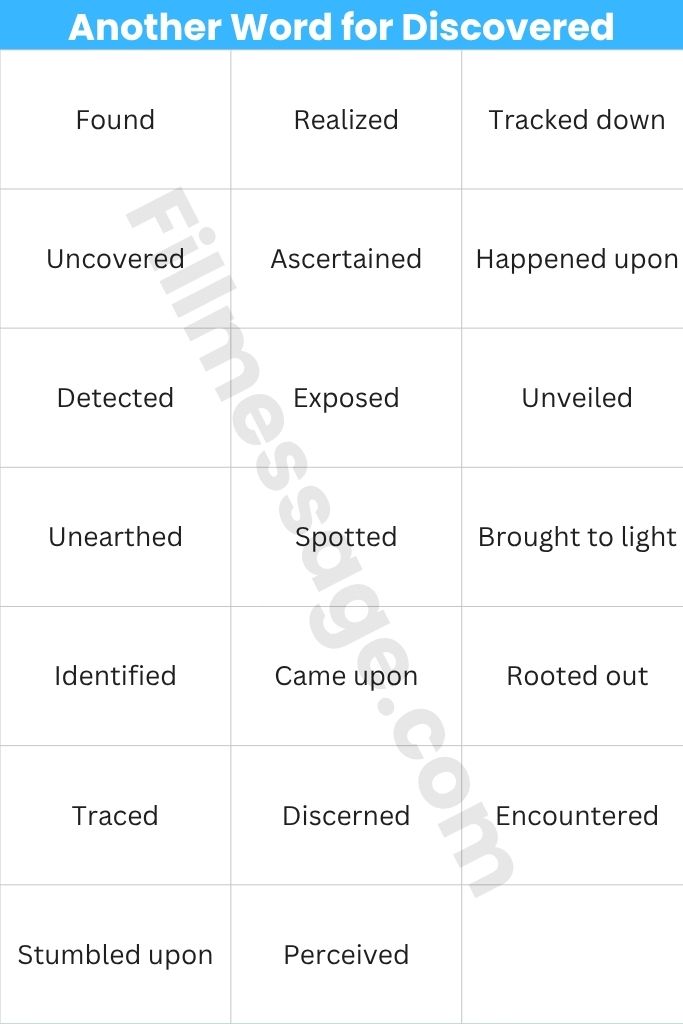
| Word | Tone | Best Used When |
| Found | Neutral, everyday | Something was simply located |
| Uncovered | Investigative | A hidden truth or problem is revealed |
| Detected | Technical, precise | Equipment or testing finds something |
| Unearthed | Dramatic, vivid | Something buried or forgotten comes to light |
| Identified | Specific, careful | Something is recognized and named |
| Traced | Methodical | A path or origin is followed back |
| Stumbled upon | Casual, accidental | Found by complete chance |
| Realized | Internal, mental | A truth became clear in the mind |
| Ascertained | Formal, official | Verified after deliberate checking |
| Exposed | Strong, revealing | Wrongdoing or a secret is brought forward |
| Spotted | Quick, visual | Noticed fast, often in passing |
| Came upon | Literary, soft | Encountered unexpectedly while moving |
| Discerned | Subtle, thoughtful | Something hard to see or understand becomes clear |
| Perceived | Sensory or intellectual | Awareness through feeling or thinking |
| Tracked down | Persistent, active | Found after serious effort |
| Happened upon | Old-fashioned, charming | Came across by luck or chance |
| Unveiled | Ceremonial, public | A reveal that carries announcement energy |
| Brought to light | Figurative, expressive | Made a hidden fact visible |
| Rooted out | Aggressive, purposeful | Found something harmful and removed it |
| Encountered | Neutral, physical | Met or came across, often unexpectedly |
Discovered Synonym Meaning Clusters: Groups That Think Differently
Not all synonyms for “discovered” share the same logic. Grouping them by meaning helps you pick the one that fits your actual moment.
Accidental Discovery
These words signal that no one was looking. The find was a surprise.
- Stumbled upon
- Happened upon
- Came upon
- Came across
- Encountered
Use these when the discovery is unplanned. A hiker coming across an abandoned cabin. A reader finding a handwritten note tucked in a used book.
Active, Deliberate Finding
These carry intention. Someone was searching.
- Tracked down
- Traced
- Searched out
- Rooted out
- Located
These words respect effort. They tell the reader that work went into the finding.
Revelation and Exposure
These are about bringing something into the open, often something that was kept hidden.
- Uncovered
- Exposed
- Unmasked
- Brought to light
- Disclosed
- Divulged
There is often a moral charge here. These words suggest that someone did not want this thing to be found. Great for investigative writing, journalism, or dramatic fiction.
Sensory and Perceptual Awareness
These describe a more quiet, internal moment of noticing.
- Perceived
- Discerned
- Noticed
- Observed
- Spotted
Perfect when the discovery is less about facts and more about experience. A character noticing a shift in someone’s tone. A reader perceiving an unusual texture in a fabric.
Scientific and Technical Discovery
These words belong in reports, research, and professional writing.
- Detected
- Identified
- Determined
- Ascertained
- Verified
They communicate precision. They suggest the discovery came through method, not luck.
Mental Discovery: Realizing a Truth
Sometimes the thing “discovered” was never physically hidden. It was a truth that finally clicked.
- Realized
- Learned
- Found out
- Recognized
- Understood
These are internal discoveries. The world did not reveal something new. The writer’s mind did.
Another Word for Discovered in Sentence Rewrites: Same Idea, Different Feel
Take one idea and watch how the word choice rewires the tone entirely.
Base sentence: She discovered the mistake in the final report.
- Formal: She identified a significant error in the concluding section of the report.
- Casual: She caught a mistake in the report right at the end.
- Academic: The error was detected during the final review phase of the documentation process.
- Creative: She stumbled upon the mistake like a stone in a smooth path, unexpected and hard to ignore.
Each version points to the same event. But the word choice shapes how serious, how accidental, how human the moment feels.
Base sentence: The team discovered an old document in the archives.
- Formal: The team located a historical document within the archival collection.
- Casual: The team came across an old document buried in the archives.
- Investigative: The team unearthed a document that had gone untouched for decades.
- Narrative: While sorting through the archives, the team happened upon a document no one had seen in years.
Base sentence: He discovered that his business partner had been lying.
- Neutral: He found out that his business partner had not been truthful.
- Strong: The investigation exposed his partner’s deception.
- Quiet/Internal: He slowly realized that none of what his partner had said was true.
- Dramatic: The truth was finally unmasked, and it pointed directly at the person he trusted most.
Formal Another Word for Discovered vs. Informal: Choosing by Context
If you are writing an academic essay or a business report, lean on:
- Ascertained
- Identified
- Determined
- Detected
- Verified
These carry authority. They suggest method and evidence.
If you are writing fiction, personal essays, or anything conversational:
- Came across
- Stumbled upon
- Found out
- Realized
- Spotted
These breathe easier. They do not demand formality. They let the moment feel human.
Words to avoid in formal writing:
- Stumbled upon (too accidental-sounding for academic context)
- Found out (too casual)
- Happened upon (literary but can sound quaint in professional use)
Common Mistakes Writers Make
Using “uncovered” when nothing was hidden. If a researcher simply ran a test and got a result, “uncovered” overstates it. Save it for findings with a dramatic edge.
Treating “detected” and “spotted” as interchangeable. “Detected” implies tools, testing, or method. “Spotted” implies a quick visual recognition. Using “detected” for casual observation makes writing feel stiff.
Reaching for “exposed” when the finding is neutral. “Exposed” carries a negative connotation. It usually implies that something shameful or wrong was brought to light. Using it for a neutral scientific finding creates unintended drama.
Overusing “realized” for external discoveries. “Realized” is internal. If something happened in the world, a character did not just “realize” it. They found out, were told, or came across it.
Confusing “disclosed” with “revealed.” “Disclosed” is typically institutional. A company discloses information. A person reveals something. Using “disclosed” in a personal narrative can sound cold and distant.
Related Another Word for Discovered Worth Knowing
These sit near “discovered” but work differently. Each has its own lane.
Noticed is smaller and softer than discovered. It is awareness without significance necessarily attached. You notice a smell. You discover a pattern.
Learned is about information received, often from another person or source. Discovery is usually personal or direct. Learning can be secondhand.
Revealed often has a passive quality. Something was revealed to someone. Discovery tends to be active. The discoverer did the work.
Encountered suggests a meeting or crossing of paths. It does not always mean something was unknown before. Two researchers might encounter the same obstacle without either one “discovering” it.
Recognized means something was already known in some form. You recognize a face because you have seen it before. Discovery implies the thing was genuinely new or unknown to you.
Read also:
30 Another Word for Speculation: Synonyms, Meanings, and Usage Guide
29 Another Word for Primary: Real Alternatives That Actually Work
The Practical Takeaway
The word “discovered” is not broken. It just cannot do every job alone.
Before you type it, ask: was this accidental or intentional? Was it hidden or just unnoticed? Is the tone formal or personal? Is this an internal realization or a physical finding?
Your answers point to the right word. Use this article as a working reference, not a checklist. The goal is not to sound sophisticated. It is to say exactly what you mean, in the way that fits the moment best.

Marco Jr. is Author at fillmassage.com,
He explores the world of words and their meanings, helping readers understand language clearly. Passionate about explanations that guide and inform, he creates insightful content that educates, engages, and supports curious minds every day.