You’ve typed “primary” again. Third time in two paragraphs. It’s not wrong, but it’s starting to feel lazy. The word works fine in a medical form or legal document. But in an essay, a pitch, or even a work email, repeating it dulls your writing fast.
The real problem isn’t the word itself. It’s that “primary” carries a neutral, slightly clinical tone. Sometimes that’s perfect. Other times, you need something warmer, stronger, or more precise. Swapping it blindly won’t help. Choosing the right replacement will.
This guide breaks down 29 solid alternatives, explains how they differ, and shows you when to actually use them.
What “Primary” Really Means
“Primary” points to what comes first or matters most. It signals rank, sequence, or importance. The tone is formal and direct. It doesn’t carry strong emotion. It’s the baseline word before you decide how much weight you want to add.
Quick Another Word for Primary Reference
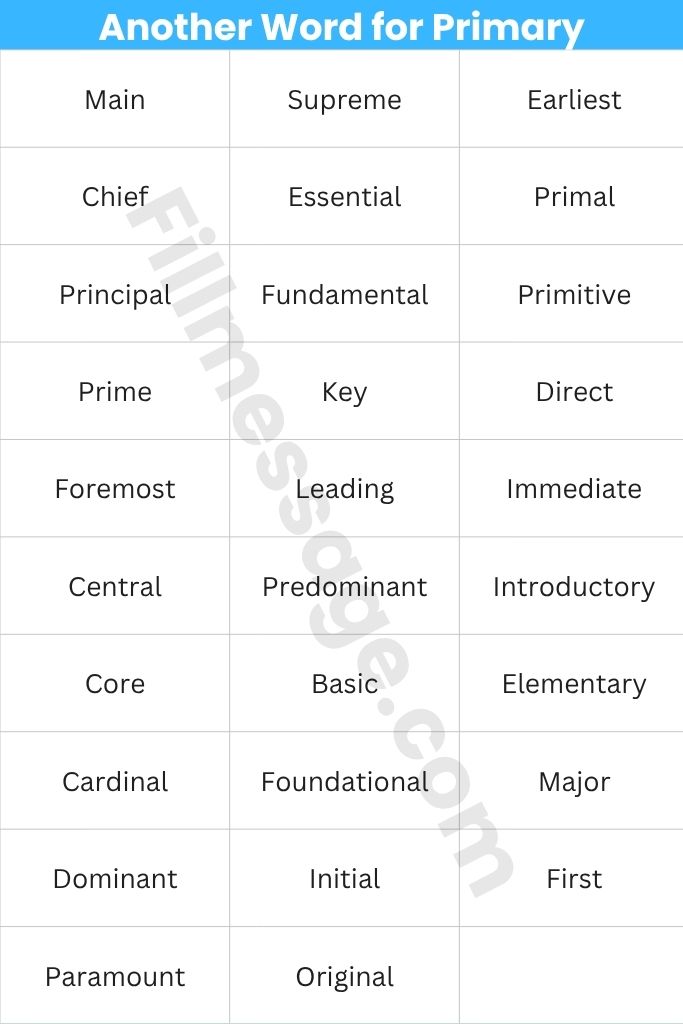
| Word | Tone | Best Used When |
| Main | Neutral | Everyday writing, emails |
| Chief | Formal | Leadership, responsibilities |
| Principal | Semi-formal | Objectives, education |
| Prime | Strong | Priorities, concerns |
| Foremost | Elevated | Importance, values |
| Central | Neutral | Issues, themes |
| Core | Direct | Problems, concepts |
| Cardinal | Formal | Rules, principles |
| Dominant | Strong | Themes, patterns |
| Paramount | Very strong | Safety, urgency |
| Supreme | Authoritative | Law, power |
| Essential | Practical | Needs, requirements |
| Fundamental | Academic | Skills, knowledge |
| Key | Casual-professional | Factors, decisions |
| Leading | Positive | Companies, figures |
| Predominant | Descriptive | Trends, features |
| Basic | Simple | Beginner, foundational |
| Foundational | Educational | Learning, structure |
| Initial | Sequential | Steps, reactions |
| Original | Historical | Plans, versions |
| Earliest | Chronological | Records, origins |
| Primal | Emotional/deep | Instincts, feelings |
| Primitive | Early-stage | Technology, systems |
| Direct | Causal | Sources, causes |
| Immediate | Urgency | Causes, needs |
| Introductory | Educational | Guides, lessons |
| Elementary | Simple | Concepts, levels |
| Major | Scale-based | Problems, changes |
| First | Sequential | Steps, priorities |
The 29 Another Word for Primary, Grouped by Meaning
When You Mean “Most Important”
1. Main
The everyday go-to. Fits almost anywhere. Clean and simple.
The main issue here is poor communication.
2. Chief
Adds a layer of authority. Works well when rank or responsibility is involved.
Her chief duty is keeping the project on schedule.
3. Principal
Slightly more formal than “main.” Common in education and business writing.
The principal goal of the program is skill development.
4. Prime
Suggests highest quality or top priority. Has a sharper edge than “main.”
Speed is our prime concern right now.
5. Foremost
Stronger than “leading.” Implies something stands above everything else.
Trust remains foremost in any lasting partnership.
6. Paramount
Reserve this for genuine urgency or high stakes.
Patient safety is of paramount importance.
7. Supreme
Works when authority or final power is the point. Common in legal and governance writing.
The committee holds supreme decision-making power.
8. Dominant
Best when something controls or overshadows everything around it.
Cost reduction was the dominant driver behind the merger.
9. Cardinal
Suggests a principle so important it cannot be broken.
Transparency is a cardinal rule in public service.
10. Central
Quiet but effective. Implies something sits at the heart of a topic.
Community feedback is central to this review.
When You Mean “Core or Foundational”
11. Core
Direct and modern. Especially useful in business and tech contexts.
The core challenge is scaling without losing quality.
12. Essential
Implies something cannot be left out. Practical tone.
Clear writing is essential in any professional field.
13. Fundamental
Suggests something that everything else is built on.
Reading comprehension is a fundamental academic skill.
14. Basic
Simple and unpretentious. Avoid it when you want to sound authoritative.
The training covers basic workplace safety protocols.
15. Foundational
Similar to “fundamental” but slightly more educational in feel.
These sessions offer foundational knowledge for new hires.
16. Elementary
Points to the most introductory level of understanding.
The course starts with elementary design concepts.
When You Mean “First or Earliest”
17. Initial
Refers to something at the start of a process.
The initial results were more promising than expected.
18. Original
Points to the first version or the source.
The original proposal only covered two phases.
19. Earliest
Specifically about time. Useful in historical or research writing.
The earliest known records date back to the 12th century.
20. First
Simple sequence word. Works in almost any context.
Your first step is to identify the actual problem.
21. Introductory
Positioned at the beginning of something by design.
This is an introductory overview of the entire system.
When You Mean “Leading or Most Influential”
22. Leading
Positive tone. Suggests being ahead of others in a field.
She is a leading expert in behavioral research.
23. Predominant
Means something appears or influences more than others.
Anxiety was the predominant theme across the responses.
24. Key
Casual but effective. Very common in professional writing.
This is a key factor in building audience trust.
25. Major
Highlights scale or significance. Slightly more casual than “paramount.”
The update fixed a major security vulnerability.
When You Mean “Deeply Rooted or Instinctive”
26. Primal
Refers to something deeply embedded in human nature or early existence.
The instinct to protect one’s family is primal.
27. Primitive
Suggests an early, undeveloped stage. Use carefully since it can sound dismissive.
The system relied on a primitive data-sharing method.
28. Direct
Points to something coming straight from a source, without steps in between.
The team received direct input from the client.
29. Immediate
Signals something happening right now or without delay.
The immediate effect of the change was noticeable.
Primary Synonym Meaning Clusters: Where the Real Differences Live
Some of these words look interchangeable. They are not.
Prime vs. Paramount “Prime” means highest on your list. “Paramount” means nothing else compares. Use “prime” for priorities. Use “paramount” only when stakes are genuinely critical.
Core vs. Central “Core” suggests the innermost part of something. “Central” describes position or focus. A “core belief” lives deep in someone. A “central theme” sits at the middle of a discussion.
Basic vs. Fundamental “Basic” can sound slightly dismissive in certain contexts. “Fundamental” sounds like a building block worth respecting. In formal writing, “fundamental” carries more weight.
Initial vs. Original “Initial” is about sequence. “Original” is about origin. The “initial draft” is the first you wrote this session. The “original plan” is what existed before changes were made.
Dominant vs. Predominant “Dominant” implies control or power. “Predominant” implies frequency or visibility. A dominant force controls others. A predominant color simply appears most often.
Another Word for Primary in Sentence Rewrites: Same Idea, Different Effect
Original sentence: “The primary goal is to improve sales.”
- Formal: “The principal objective is to drive sustainable revenue growth.”
- Casual: “The main thing we’re chasing right now is better sales numbers.”
- Academic: “The foremost aim of this initiative is to enhance commercial performance.”
- Creative: “Everything points toward one target: growth that actually sticks.”
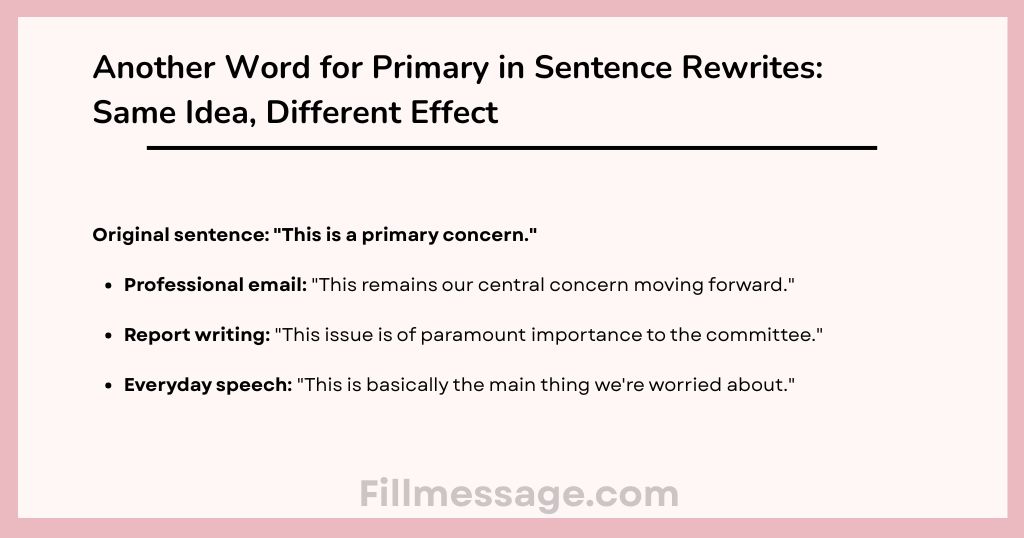
Original sentence: “This is a primary concern.”
- Professional email: “This remains our central concern moving forward.”
- Report writing: “This issue is of paramount importance to the committee.”
- Everyday speech: “This is basically the main thing we’re worried about.”
Notice how swapping the word shifts the entire weight of the sentence. “Paramount concern” sounds urgent. “Main concern” sounds measured. Neither is wrong. The choice depends on what feeling you want to create.
Formal Another Word for Primary vs. Informal: Which Word Fits Where
Best for academic essays: Fundamental, principal, foremost, paramount, central
Best for business emails: Key, main, core, leading, chief
Best for storytelling: Primal, original, dominant, central
Avoid in formal writing: Basic, elementary, primitive. These can sound reductive or dismissive in a professional context.
Common Mistakes Writers Make
Using “paramount” too casually. It signals extreme importance. If you use it for something minor, it loses all power.
Treating “fundamental” and “basic” as identical. “Basic” can accidentally signal that something is too simple or obvious. “Fundamental” treats the same idea with more respect.
Overusing “key.” It’s a strong professional word but gets worn out fast. If every point is key, none of them are.
Confusing “prime” with “primary.” They’re close but not identical. “Prime” implies peak quality or highest priority. “Primary” is more about order or rank.
Using “primal” in a business context. It works beautifully in psychology or storytelling. In a quarterly report, it just sounds odd.
Related Another Word for Primary Worth Knowing
Predominating – Ongoing control or influence. Useful when something is still actively dominating.
Pivotal – A moment or factor that changes direction. Stronger than “key” for turning points.
Overarching – Covers everything beneath it. Good for goals or themes that span a whole project.
Critical – Implies urgency and necessity together. Stronger than “essential” in most contexts.
Defining – Suggests this thing shapes the identity of something. Powerful in storytelling and brand writing.
Read also:
Another Word for Would: 34 Alternatives That Actually Work
30 Another Word for Speculation: Synonyms, Meanings, and Usage Guide
Final Thought
The word you choose shapes how your reader feels before they even process the meaning. “Primary” is reliable. But “paramount” demands attention. “Core” implies depth. “Main” stays out of the way. None of these words are better in isolation. The right one depends entirely on what you are trying to communicate and how much weight you want behind it.
Pick the word that matches the moment, not just the dictionary definition.

Marco Jr. is Author at fillmassage.com,
He explores the world of words and their meanings, helping readers understand language clearly. Passionate about explanations that guide and inform, he creates insightful content that educates, engages, and supports curious minds every day.