You’ve typed “presentation” four times in one document and it’s starting to feel like a crutch. Or maybe you’re writing a food blog and “presentation” sounds too stiff. Or your teacher said vary your vocabulary and now you’re staring at a blank thesaurus tab wondering which word actually fits.
Here’s the thing: “presentation” means several different things depending on context. A wrong swap doesn’t just change the word. It changes the entire feeling of your sentence. This guide gives you 41 Another Word for Presentation, sorted by meaning, with clear guidance on when each one works and when it doesn’t.
What Makes This Word Tricky to Replace
“Presentation” covers at least four distinct situations:
- A spoken talk in front of an audience
- A set of visual slides or a digital file
- The way something looks when displayed (food, products, design)
- The formal act of submitting or offering something in writing
No single synonym covers all four. That’s why random swaps often feel wrong even when the replacement word seems close enough.
All 41 Another Word for Presentation, Organized by Meaning
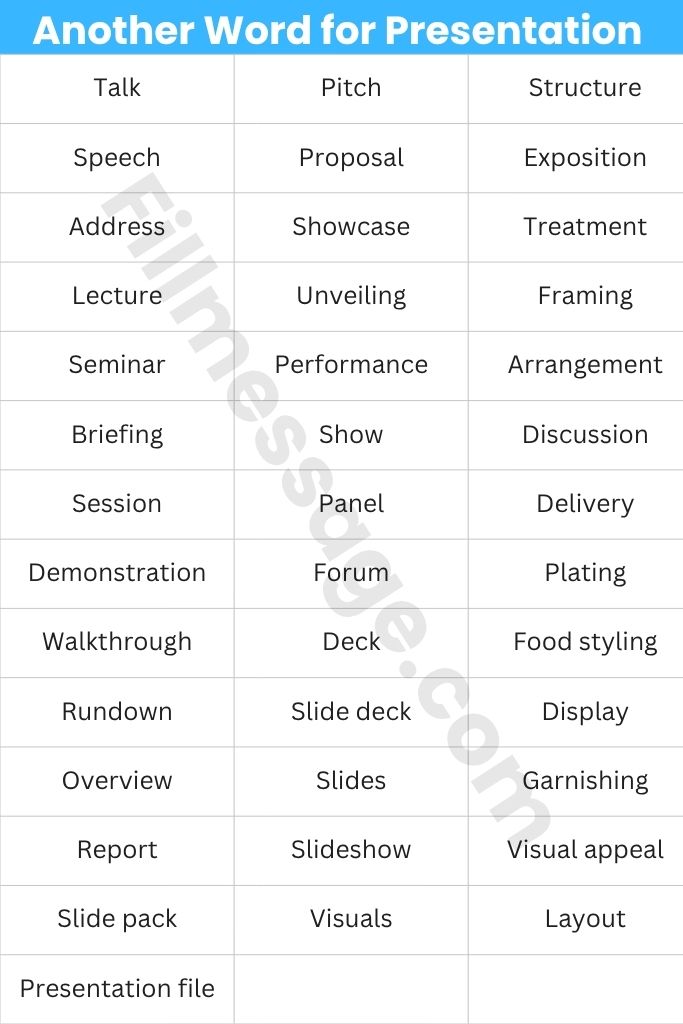
Group 1: Spoken Talks and Verbal Delivery Presentation Synonyms (School, Work, Events)
These replace “presentation” when someone is speaking in front of others. The differences are mostly about formality and setting.
| Word | Tone | Best For |
| Talk | Casual | Class, informal office settings |
| Speech | Formal | Ceremonies, graded school talks |
| Address | Very formal | Conferences, civic events |
| Lecture | Instructional | University, professional training |
| Seminar | Participatory | Academic, group discussion |
| Briefing | Business | Corporate updates, executive summaries |
| Session | Neutral | Workshops, training programs |
| Demonstration | Practical | Sales, classroom, product training |
| Walkthrough | Technical | Step-by-step product or process explanation |
| Rundown | Informal | Quick verbal summary in a meeting |
| Overview | Neutral | Project updates, team meetings |
| Report | Neutral | School, office, structured verbal summary |
| Pitch | Persuasive | Sales, startups, funding requests |
| Proposal | Formal | Business plans, academic funding |
| Showcase | Positive | Portfolio reviews, product reveals |
| Unveiling | Dramatic | Product launches, major announcements |
| Performance | Creative | Theatre, arts, public speaking events |
| Show | Informal/creative | Public events, informal demonstrations |
| Panel | Collaborative | Conferences with multiple speakers |
| Forum | Open discussion | Community or professional group meetings |
Quick note on tone differences within this group:
“Talk” keeps things light. “Address” adds gravity. “Lecture” implies the audience is there to learn, not just listen. “Pitch” signals you want something. These aren’t interchangeable just because they all involve speaking.
Group 2: Slides, Decks, and Visual Files Presentation Synonyms
These replace “presentation” when you’re referring to the actual file, the slides, or the visual display used during a talk.
| Word | Tone | Best For |
| Deck | Casual/professional | Startup, business, creative agency |
| Slide deck | Standard professional | Most corporate environments |
| Slides | Neutral | School, work, universal |
| Slideshow | Viewing experience | Describing what an audience watches |
| Slide pack | Formal/corporate | Consulting, large organizations |
| Visuals | Broad | Marketing, design, teaching |
| Presentation file | Neutral/technical | Sending a file, naming documents |
“Deck” is now standard in most business conversations. “Slideshow” describes the experience of viewing rather than the file itself. “Slide pack” is more common when the slides are handed off as a formal document rather than projected live.
Group 3: Written Presentation of Ideas (Essays, Reports, Academic Writing)
When you’re writing an essay and mean the way ideas are organized or delivered on the page, these are your options.
| Word | Tone | Best For |
| Structure | Neutral | Overall arrangement of written content |
| Exposition | Academic | Clear explanation of facts or background |
| Treatment | Analytical | How a topic is handled in a piece of writing |
| Framing | Intellectual | How an argument is positioned for the reader |
| Arrangement | Neutral | Order and layout of ideas |
| Discussion | Conversational | When writing explores rather than declares |
| Delivery | Stylistic | The manner in which ideas reach the reader |
“Treatment” and “framing” are often overlooked here. They’re more precise than “structure” when you want to describe not just the order of ideas, but the angle or perspective the writer brings to them.
Group 4: Food, Product, and Visual Display Presentation Synonyms
In culinary, hospitality, and visual design contexts, “presentation” refers to how something looks when shown to others.
| Word | Tone | Best For |
| Plating | Professional | How food is arranged on a dish |
| Food styling | Media/photography | Visual prep for cameras and content |
| Display | Broad | Products, buffets, retail setups |
| Arrangement | Neutral | Food spreads, floral, visual design |
| Garnishing | Culinary detail | Finishing touches on a dish |
| Visual appeal | Descriptive | Overall attractiveness of any display |
| Layout | Design/food | How elements are placed within a space |
“Plating” is the most professionally accepted term in kitchen settings. “Food styling” belongs in the world of content creation and photography. “Display” works well across buffets, retail windows, and trade shows.
Another Word for Presentation in Sentence Rewrites: Same Idea, Different Effect
Seeing the swaps in action is more useful than any definition.
Original: “My presentation tomorrow is about climate change.”
- Casual school setting: “I’ve got a talk on climate change tomorrow.”
- Academic: “I’m delivering a seminar paper on climate change tomorrow.”
- Business conference: “I’m presenting a briefing on climate policy tomorrow.”
- Creative event: “I’m unveiling my climate change project tomorrow.”
Each version signals something different about the speaker, the audience, and the stakes. The word you choose sets the expectation before anyone hears a single sentence of the content.
Original: “The presentation of food at this restaurant impressed everyone.”
- Professional review: “The plating here shows genuine craft and attention.”
- Casual food blog: “The way they arrange every dish is almost too pretty to eat.”
- Culinary training context: “Food styling at this level takes years to develop.”
Original: “She gave a great presentation at the conference.”
- Formal recap: “She delivered a compelling briefing that shifted the room’s thinking.”
- Admiring tone: “Her session was one of the most memorable of the entire day.”
- Informal message to a colleague: “Her talk absolutely landed.”
Where Writers Go Wrong about Presentation Synonyms
Calling every talk a lecture. A lecture implies a longer format with instructional intent. Using it for a ten-minute class talk sounds stiff and slightly condescending.
Using “pitch” when you just mean “talk.” A pitch wants something. If you’re only sharing information, not requesting approval, funding, or a sale, pitch is the wrong word.
Writing “deck” in formal documents. In consulting, startups, and creative agencies, deck is completely acceptable. In legal, government, or academic writing, it reads as too informal.
Replacing “presentation” with “show.” Show works in creative and public event contexts. It weakens formal writing significantly.
Assuming “proposal” and “pitch” are the same. A pitch is verbal and persuasive, usually short. A proposal is document-based, detailed, and formal. Confusing them signals imprecision.
Using “performance” for routine business talks. It implies theatrical quality. A Monday status update is not a performance. An artist’s stage debut is.
Another Word for Presentation Formal vs. Informal at a Glance
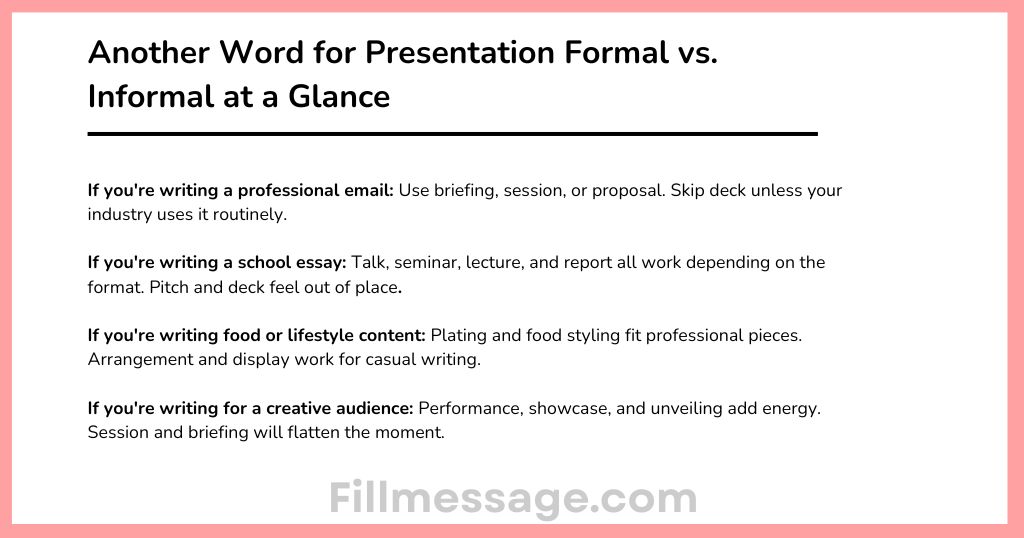
If you’re writing a professional email: Use briefing, session, or proposal. Skip deck unless your industry uses it routinely.
If you’re writing a school essay: Talk, seminar, lecture, and report all work depending on the format. Pitch and deck feel out of place.
If you’re writing food or lifestyle content: Plating and food styling fit professional pieces. Arrangement and display work for casual writing.
If you’re writing for a creative audience: Performance, showcase, and unveiling add energy. Session and briefing will flatten the moment.
Presentation Synonyms Related Words That Often Get Confused With Synonyms
Pitch vs. presentation: A pitch is always trying to persuade. A presentation can be purely informational.
Portfolio vs. showcase: The portfolio is the collection of work. The showcase is the act of displaying it. They’re connected but not the same word.
Synopsis vs. overview: Both are condensed summaries. A synopsis usually refers to narrative or written content. An overview suits broader topics and reports.
Narrative vs. presentation: The narrative is the story thread running through a presentation. Strong presentations have narratives inside them. They’re not the same thing.
Read more:
46 Another Word for Get Rid Of That Make You Sound Smarter
22 Another Word for Fast Paced: Pick the Right One Every Time
FAQs about Another Word for Presentation
Is “talk” too casual for professional settings?
It depends on the culture. In creative agencies, media companies, and startups, “talk” feels efficient and natural. In law firms or government settings, “briefing” fits better. Read the room before you write.
Can “pitch” and “presentation” be used interchangeably?
Only when persuasion is the actual goal. If you’re asking for funding, approval, or a sale, pitch works. If you’re sharing quarterly results, it doesn’t. The word changes reader expectation immediately.
What’s the difference between a seminar and a briefing?
A briefing is tight, focused, and usually short, designed for decision-makers. A seminar runs longer, invites discussion, and is built around learning. Both are formal, but they serve different purposes.
When does “showcase” work better than “presentation”?
When pride of display is part of the point. Student portfolios, product launches, creative reviews: showcase fits naturally. A budget update is not a showcase.
The Practical Takeaway
You don’t need 41 words rattling around in your head every time you write. You need a simple filter: Who is speaking? Who is listening? What is actually being shared? Is it a talk, a file, a food dish, or a written argument?
Answer those four questions and the right word from this list becomes obvious. The goal isn’t to avoid “presentation.” It’s to use the word that fits with enough precision that your reader instantly understands the context without you having to explain it.

Marco Jr. is Author at fillmassage.com,
He explores the world of words and their meanings, helping readers understand language clearly. Passionate about explanations that guide and inform, he creates insightful content that educates, engages, and supports curious minds every day.