You’ve written “risk” twice in the same sentence and something feels off. Not wrong, just flat. Vague. Like the word is doing the bare minimum.
That’s the honest problem with “risk.” It works everywhere, which means it says nothing specific anywhere. A surgeon’s “risk” is different from a startup founder’s “risk,” which is different again from a novelist’s “risk.” Same word, completely different worlds.
This guide gives you 36+ Another Word for Risk, grouped by meaning, with clear examples, tone guidance, and practical rewrite demonstrations.
What “Risk” Really Carries
At its core, risk means the possibility of something going wrong before it happens. It sits between uncertainty and consequence. The word is emotionally neutral but leans slightly negative. It gives no signal about severity, likelihood, or source of harm. That’s its weakness as a word, and that’s exactly why replacing it well matters.
The Full Another Word for Risk Table: 36+ Alternatives at a Glance
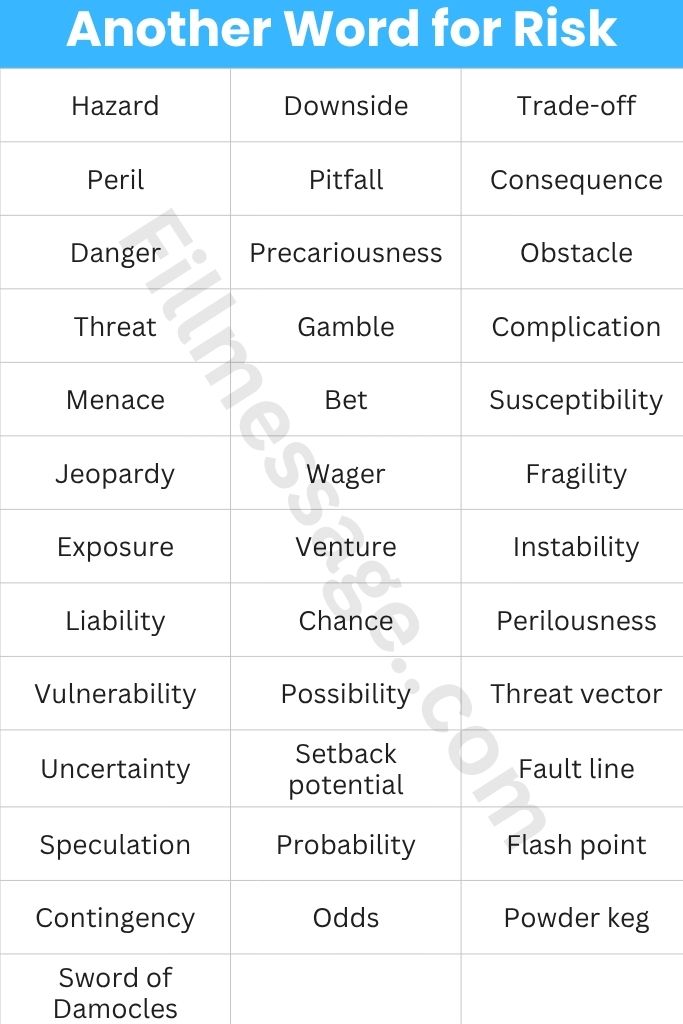
| Word | Tone | Best Used When |
| Hazard | Neutral/Technical | Describing a source of harm in safety or engineering contexts |
| Peril | Dramatic | Writing narratives or urgent, high-stakes warnings |
| Danger | Direct/Urgent | Harm is close, real, and immediate |
| Threat | Serious | Something external is actively causing concern |
| Menace | Vivid/Hostile | Persistent or recurring source of harm |
| Jeopardy | Formal | Legal, administrative, or high-consequence settings |
| Exposure | Clinical | Finance, insurance, public health, corporate reports |
| Liability | Legal | Responsibility if something goes wrong |
| Vulnerability | Careful | Tech, health, social science contexts |
| Uncertainty | Neutral | Academic essays, policy analysis, research |
| Speculation | Intellectual | Unproven theories, editorial analysis, forecasting |
| Contingency | Strategic | Planning documents, project management |
| Downside | Conversational | Casual reports, emails, everyday decisions |
| Pitfall | Practical | Guides, how-to content, instructional writing |
| Precariousness | Descriptive | Unstable social, structural, or economic situations |
| Gamble | Informal | Voluntary decisions with uncertain outcomes |
| Bet | Casual | Dialogue, personal storytelling, informal writing |
| Wager | Deliberate/Formal | Calculated, intentional risk-taking |
| Venture | Hopeful | Business endeavors carrying financial uncertainty |
| Chance | Probabilistic | Mild or neutral likelihood without alarm |
| Possibility | Open | When outcome is unknown but not necessarily bad |
| Setback potential | Practical | When failure means delay, not disaster |
| Probability | Analytical | Quantified or measurable likelihood |
| Odds | Statistical | Numerical or comparative framing of likelihood |
| Trade-off | Comparative | Known costs vs. known gains |
| Consequence | Outcome-focused | Referring to what follows a risky action |
| Obstacle | Structural | A defined barrier, not an uncertain outcome |
| Complication | Process-based | Something that makes success harder |
| Susceptibility | Medical/Social | Openness to harm due to existing weakness |
| Fragility | Structural | Tendency to break under pressure or stress |
| Instability | Systemic | Conditions that could shift or collapse unpredictably |
| Perilousness | Elevated Formal | Quality of being deeply dangerous; used sparingly |
| Threat vector | Technical | Cybersecurity, risk analysis, IT security writing |
| Fault line | Figurative | Hidden structural weakness about to surface |
| Flash point | Urgent/Figurative | A moment or issue where danger could ignite suddenly |
| Powder keg | Vivid | Volatile situation ready to escalate |
| Sword of Damocles | Literary | A looming threat that hangs over without action |
Another Word for Risk Meaning Clusters: The Groups That Actually Matter
Most synonym lists stop at the word itself. That’s not enough. You need to understand why one word fits and another doesn’t. Here’s where the real differences live.
Another Word for Physical and Immediate Risk
Danger, Peril, Hazard, Menace
These four feel similar on the surface but point in different directions.
Danger is the most direct. It signals that harm is present and close. “The unstable scaffolding poses real danger to everyone on site.” You feel urgency with this word.
Hazard shifts focus from the experience to the source. It’s what causes the problem, not the problem itself. Safety manuals, engineering reports, and regulatory documents rely on it. “Loose wiring is a fire hazard that requires immediate inspection.”
Peril is cinematic. It suggests serious, often unavoidable danger. Works well in narratives, historical writing, and journalism covering crises. In a quarterly earnings report, it would feel out of place.
Menace carries a hostile or persistent edge. The harm isn’t just present, it keeps coming back. “Traffic congestion has become a daily menace for residents in the city’s outer boroughs.”
Another Word for Financial and Strategic Risk
Exposure, Liability, Downside, Contingency, Venture
Exposure is the language of finance and insurance. It quantifies how open an entity is to potential loss without dramatizing it. “The bank’s exposure to commercial real estate loans has more than doubled.” Precise, measured, professional.
Liability narrows further. It’s specifically about legal or financial responsibility when things go wrong. Not every risk becomes a liability. But when it does, the word should shift. “The product recall significantly increased the company’s legal liability.”
Downside is the everyday version of exposure. It implies a comparison, that there’s an upside somewhere and you’re naming what sits on the other side. “The downside of a remote-first policy is harder team cohesion.” Conversational and clear.
Contingency reframes risk entirely. Instead of warning about it, you’re acknowledging that a plan exists for it. “The project budget includes a contingency for unexpected material costs.” This word signals maturity and foresight.
Venture focuses on the endeavor itself, usually with a hopeful edge. “The international venture carries real currency risk but opens a market three times our current size.” The risk is acknowledged but not centered.
Another Word for Uncertain and Probabilistic Risk
Uncertainty, Speculation, Chance, Odds, Probability, Possibility
These words live in the space between “definitely fine” and “definitely bad.” They don’t predict harm. They measure the unknown.
Uncertainty is the academic workhorse. It’s honest and precise without being dramatic. “The policy’s long-term effects remain a subject of genuine uncertainty.” Strong in research, analysis, and formal writing.
Speculation adds an intellectual layer. It implies someone made a reasoned guess without enough evidence. “Current revenue projections are largely speculation until confirmed by third-quarter results.”
Chance is the most neutral of this group. It doesn’t lean negative. “There’s a reasonable chance the vote will be postponed.” You’re talking about odds, not threats.
Odds frames things numerically or comparatively. “The odds of a successful outcome improve significantly with early intervention.” It feels analytical and grounded.
Probability is even more precise. It belongs in research, data analysis, and technical writing. “The probability of system failure rises by 18% during peak usage.”
Possibility is the lightest word in this cluster. It opens a door without predicting what’s behind it. “There’s a possibility the timeline shifts if approvals are delayed.”
Another Word for Hidden and Gradual Risk
Pitfall, Vulnerability, Precariousness, Fault Line, Susceptibility, Fragility
These words describe risks that don’t announce themselves. They build quietly or hide in plain sight.
Pitfall warns about traps that are easy to miss. It’s perfect for instructional content. “A common pitfall in onboarding new staff is skipping the documentation review phase.”
Vulnerability describes a specific weak point that could be exploited or made worse. Used heavily in tech, healthcare, and social research. “The app’s vulnerability to data interception was identified in the security audit.”
Precariousness captures instability at a systemic or structural level. “The precariousness of informal housing in flood zones has grown harder to ignore.” It carries real weight when the situation is genuinely fragile.
Fault line is figurative but powerful. It describes a hidden crack in a system or relationship that hasn’t broken yet but might. “The merger exposed a deep fault line between the two leadership teams.”
Susceptibility points to an existing condition that makes harm more likely. “Children with lower immunity show higher susceptibility to seasonal infections.” Used often in medical and social science writing.
Fragility describes a tendency to break under pressure. It’s structural rather than personal. “The supply chain’s fragility became obvious when the first port closure triggered a global shortage.”
Another Word for Chosen and Voluntary Risk
Gamble, Bet, Wager, Speculation, Venture
When someone chooses to accept a risk, the word should carry that sense of agency and intention.
Gamble is the most widely used. It implies a voluntary action with an uncertain outcome, and it doesn’t try to hide the stakes. “Skipping the user testing phase was an expensive gamble.”
Bet is casual. It works in dialogue, personal essays, and informal writing. “Promoting someone without management experience was a bet that eventually paid off.”
Wager is more considered and slightly older in feel. It suggests someone thought it through before accepting the risk. “The board’s market entry strategy was essentially a calculated wager on shifting consumer preferences.”
Speculation here refers to the action, not just the idea. “Investing heavily in the sector without data amounted to speculation more than strategy.”
Another Word for Figurative and Literary Risk
Powder Keg, Flash Point, Sword of Damocles, Perilousness
These live in creative writing, commentary, and editorial pieces. They’re vivid but require the right context.
Powder keg describes a situation that could explode at any moment. “The ongoing wage dispute turned the factory floor into a powder keg.” Strong imagery, limited to informal or creative use.
Flash point is the moment risk becomes action. “The leaked memo became the flash point that ended the partnership.” It works in journalism and narrative writing.
Sword of Damocles refers to a looming threat that hangs over without resolving. A literary reference with specific effect. “The pending lawsuit hung like a sword of Damocles over the company’s expansion plans.”
Perilousness is the quality of being deeply dangerous. Rarely used but precise when the weight needs to feel heavy. “The perilousness of the route was understated in the original planning documents.”
Read also: 26+ Another Word for Meticulous: Real Alternatives That Actually Fit
Another Word for Risk in Sentence Rewrites: Before and After
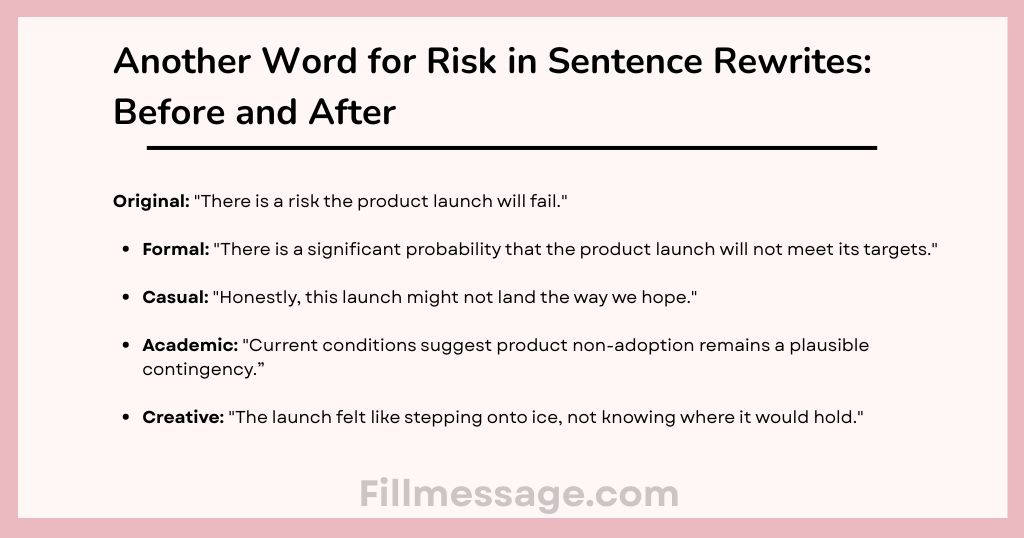
These three examples show how word choice changes what the reader understands.
Original: “There is a risk the product launch will fail.”
- Formal: “There is a significant probability that the product launch will not meet its targets.”
- Casual: “Honestly, this launch might not land the way we hope.”
- Academic: “Current conditions suggest product non-adoption remains a plausible contingency.”
- Creative: “The launch felt like stepping onto ice, not knowing where it would hold.”
Original: “The investment carries risk.”
- Professional: “The investment carries considerable exposure to sector volatility.”
- Conversational: “The downside here is real and worth discussing before committing.”
- Analytical: “The probability of capital loss is non-trivial given current market conditions.”
Original: “Ignoring this issue is a risk.”
- Instructional: “Ignoring this issue is a pitfall that could delay your timeline significantly.”
- Legal/Formal: “Failing to address this creates measurable liability for the organization.”
- Vivid: “Leaving this unresolved is a powder keg waiting for a spark.”
Each rewrite doesn’t just change the word. It changes what the reader learns from the sentence.
Another Word for Risk Formal vs. Informal: Which Words Go Where
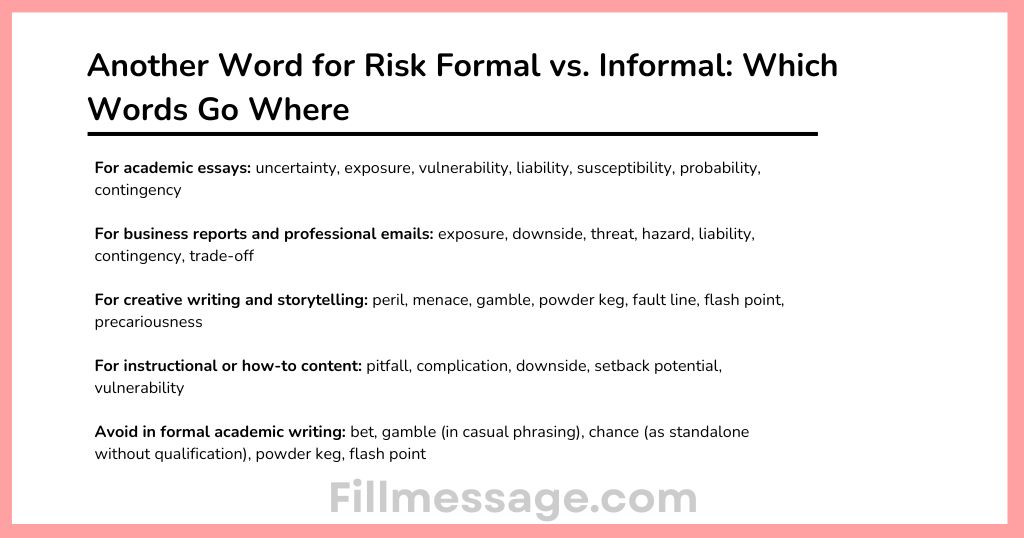
For academic essays: uncertainty, exposure, vulnerability, liability, susceptibility, probability, contingency
For business reports and professional emails: exposure, downside, threat, hazard, liability, contingency, trade-off
For creative writing and storytelling: peril, menace, gamble, powder keg, fault line, flash point, precariousness
For instructional or how-to content: pitfall, complication, downside, setback potential, vulnerability
Avoid in formal academic writing: bet, gamble (in casual phrasing), chance (as standalone without qualification), powder keg, flash point
The register mismatch is the most common mistake. Writing “it was a gamble” in a legal brief or research paper immediately undercuts credibility. The idea may be sound, but the word signals carelessness.
Mistakes Worth Avoiding about Risk synonyms
Hazard vs. danger: Hazard is the source. Danger is the experience. Icy roads are a hazard. Sliding off the road is the danger. These move in opposite directions.
Threat vs. uncertainty: A threat implies an agent, something or someone actively causing it. Uncertainty is a condition with no specific actor. “Economic uncertainty” is not a threat. A hostile trade policy is.
Contingency vs. risk: These are often confused. A contingency is a response to risk, not risk itself. “We have a contingency in place” means a plan exists. It does not mean the risk is gone.
Downside vs. consequence: Downside implies comparison to an upside. Consequence is simply what follows. If there’s nothing positive to compare against, “consequence” is the cleaner word.
Overusing vulnerability: The word has become trendy across business, wellness, and tech writing. When everything becomes a vulnerability, the word loses meaning. Reserve it for situations where a genuine, specific weak point has been identified.
Using peril in everyday contexts: Peril signals extreme, often life-threatening situations. Using it in a marketing strategy document or a budget discussion is a tone error that pulls readers out of the moment.
Synonyms for Risk Related Words That Often Get Mixed In
Setback: What risk sometimes produces. A setback is a known, temporary reversal. It’s retrospective. Risk is prospective.
Consequence: The outcome after something goes wrong. Risk exists before the event. Consequence lives after it.
Obstacle: A defined block that’s already present. Risk is uncertain; an obstacle is concrete and known.
Trade-off: A deliberate exchange of known quantities. When the costs and gains are already understood, you’re dealing with a trade-off, not a risk.
Instability: A systemic condition rather than a single event. It describes an environment where risk is constant and structural rather than occasional.
Read also:
41 Another Word for Deeper: The Right Word for Every Context
27 Another Word for Campaign: Right Word, Right Context
FAQ’s
What is the best academic synonym for risk in an essay?
Uncertainty is the strongest choice for most academic writing because it’s precise, probabilistic, and emotionally neutral. In social science, vulnerability fits well. In economics or public health, exposure is widely accepted and respected.
Can I use “downside” in a professional email?
Yes, and it often works better than “risk” in that context. “The main downside of this timeline is reduced testing capacity” is direct, professional, and immediately understood. It’s one of the rare conversational words that crosses into workplace writing without friction.
What is the antonym of risk?
Security and safety are the most natural opposites. Certainty works when the risk in question is probabilistic. Stability works in financial or structural contexts. None are perfect antonyms because risk is layered, and language rarely offers clean mirrors.
Is “hazard” stronger or weaker than “danger”?
Neither is stronger. They describe different things. Hazard identifies the source or condition. Danger describes the state of being threatened by it. A wet floor is a hazard. The danger is slipping and falling. In formal or technical writing, hazard is more precise. In urgent or emotional writing, danger hits harder.
The Real Takeaway
The goal of replacing “risk” is not to sound more sophisticated. It’s to be more accurate. When you write “financial exposure” instead of “financial risk,” the reader understands the domain, the direction, and the degree all at once. That’s three jobs one word is doing instead of one.
Match the word to the actual situation. Is the risk physical? Use danger or hazard. Is it financial? Use exposure or liability. Is it hidden? Use pitfall or fault line. Is it chosen? Use gamble or venture. Is it systemic? Use instability or precariousness.
The right word doesn’t just replace “risk.” It explains something “risk” never quite could.

Marco Jr. is Author at fillmassage.com,
He explores the world of words and their meanings, helping readers understand language clearly. Passionate about explanations that guide and inform, he creates insightful content that educates, engages, and supports curious minds every day.