Looking for useful Things That Start With E? This guide brings together common words people actually use in daily life. You’ll find foods, animals, household objects, school supplies, body parts, and many more examples. Whether you are teaching children, building vocabulary, or planning a classroom activity, this list makes it easy to explore the letter E in a practical and memorable way.
The letter E appears everywhere in English, from simple words like egg and ear to advanced terms like ecosystem and electricity. That makes it one of the most valuable letters to learn early and revisit often.
What Are Some Things That Start With E?
- Egg
- Elephant
- Envelope
- Eraser
- Eagle
- Engine
- Earth
- Elbow
- Eggplant
- Eyebrow
These ten words alone span food, animals, body parts, school tools, and nature — showing just how wide the letter E reaches across everyday vocabulary.
Food Things That Start With E
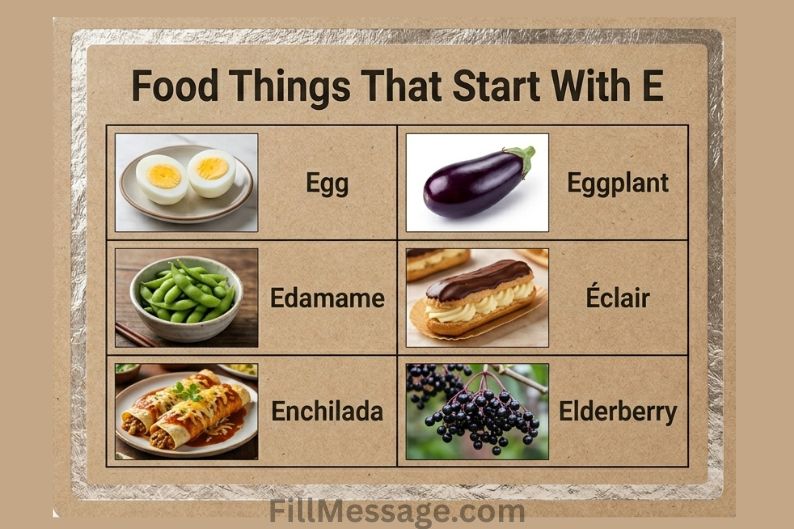
Food words stick in memory fast. Connecting a letter to something on the dinner table makes it concrete in a way flashcards rarely do.
Egg — Boiled, fried, scrambled, or poached — eggs appear in nearly every cuisine on the planet.
Eggplant — A deep purple vegetable used in dishes like baba ganoush and ratatouille. Called “aubergine” in British English.
Edamame — Young soybeans, steamed and lightly salted. Originally Japanese, now found in grocery stores worldwide.
Éclair — A French pastry filled with cream and topped with chocolate icing.
Enchilada — A rolled tortilla filled with meat or cheese, covered in chili sauce. A staple of Mexican cooking.
Elderberry — A small dark berry used in syrups, jams, and herbal teas.
Espresso — Concentrated coffee made by forcing hot water through finely ground beans.
Eel — Grilled eel, called unagi, is a prized dish in Japanese cuisine with a rich, slightly sweet flavor.
Empanada — A dough pocket stuffed with meat, cheese, or vegetables, then baked or fried. Common across Latin America and Spain.
Endive — A slightly bitter leafy vegetable used in salads and appetizers.
Escargot — Cooked land snails, considered a delicacy in French cuisine.
Escarole — A mildly bitter leafy green frequently used in Italian wedding soup.
English muffin — A round, flat bread made for toasting. A breakfast staple in the US and UK.
Evaporated milk — Canned, concentrated milk with most of its water removed. Used widely in baking and custards.
Eggnog — A creamy spiced drink made with eggs and milk, traditionally served during winter holidays.
Edam — A semi-hard Dutch cheese with a mild, slightly salty flavor, recognizable by its red wax coating.
Egg roll — A crispy fried roll filled with vegetables and sometimes meat, common in Chinese-American cuisine.
Elote — Mexican street corn, grilled and coated with mayo, cheese, chili, and lime.
Elephant garlic — A large, mild variety of garlic with a gentler flavor than regular garlic cloves.
Animals That Start With E
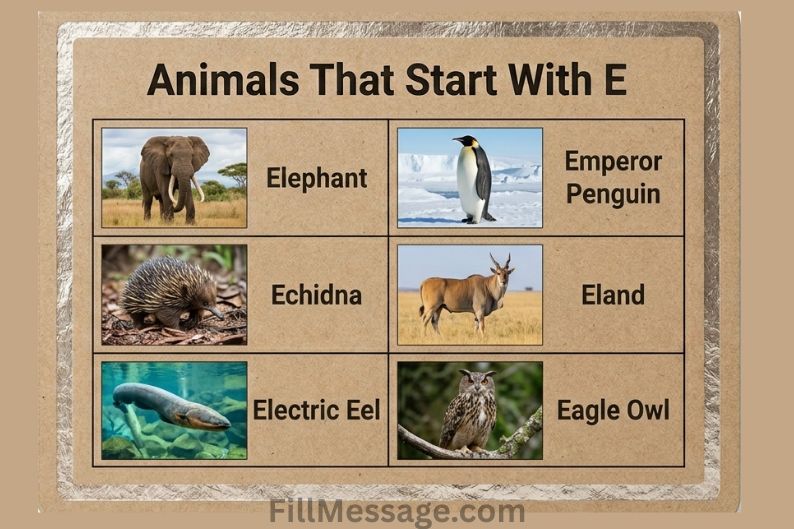
Elephant — The largest land animal on Earth. African elephants have larger ears than Asian ones, and both species are known for strong social bonds.
Eagle — A large bird of prey with exceptional eyesight. The bald eagle can spot prey from over a mile away.
Eel — A snake-like fish found in saltwater and freshwater. The electric eel generates pulses strong enough to stun prey.
Echidna — A spiny, egg-laying mammal from Australia. One of only five mammals in the world that lay eggs.
Elk — A large deer species found across North America and parts of Asia. Males grow a fresh set of antlers every year.
Emperor Penguin — The tallest and heaviest penguin species, living exclusively in Antarctica. Males balance eggs on their feet through brutal polar winters.
Emu — A tall, flightless bird native to Australia. The second-largest bird in the world after the ostrich.
Egret — A graceful white wading bird that stands completely still in shallow water, waiting to strike at fish.
Earthworm — Lives in soil and plays an essential role in aerating the ground and decomposing organic matter.
Ermine — A small weasel whose coat turns entirely white in winter. That white fur historically appeared on royal robes.
Eland — The world’s largest antelope, native to African grasslands. Despite its size, it can jump over 8 feet from a standstill.
Elephant seal — A massive marine mammal. Males have an inflatable nose and can weigh up to 5,000 pounds.
European bison — The heaviest land animal in Europe, once nearly extinct, now carefully protected.
Estuarine crocodile — Also called the saltwater crocodile. The largest living reptile on Earth.
Electric ray — A flat ocean fish that generates electric charges to stun prey — different from an eel but equally effective.
Earwig — A small insect with distinctive pincers at its tail end. Despite the name, it does not crawl into ears.
Emerald tree boa — A bright green snake that coils on branches in South American rainforests.
Eurasian otter — A semi-aquatic mammal found along rivers and coastlines across Europe and Asia.
Household Items That Start With E
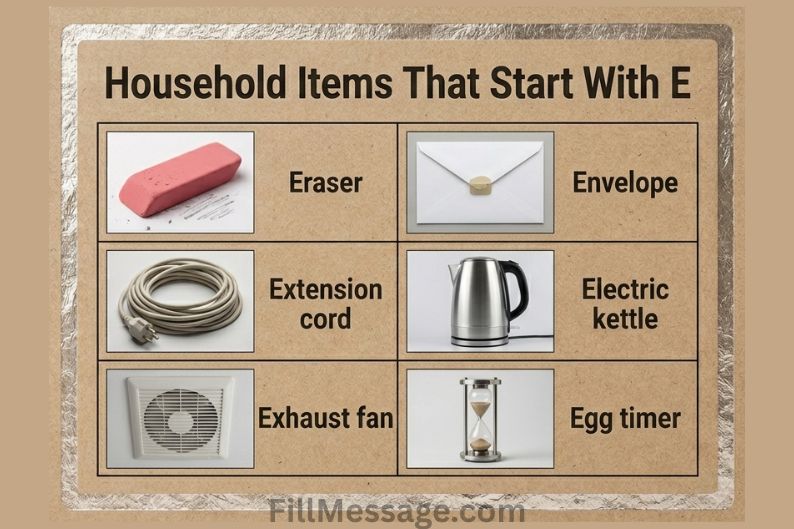
Most of these are sitting in your home right now — which makes this section perfect for scavenger hunts and ESL home vocabulary lessons.
Eraser — The rubber tool that corrects pencil mistakes. Found in every pencil case and junk drawer.
Envelope — The paper sleeve used to send letters and cards.
Extension cord — A flexible cable that brings a power outlet closer to where it’s needed.
Electric kettle — Heats water faster than a stovetop. Standard in most European and Asian kitchens.
Exhaust fan — Installed in kitchens and bathrooms to remove steam, odors, and excess heat.
Egg timer — A small timer used to track cooking time. Traditionally shaped like an egg.
Electrical outlet — The wall socket where devices are plugged in.
Exercise mat — A padded mat used for yoga, stretching, or floor workouts.
End table — A small table beside a sofa or armchair, usually holding a lamp or remote control.
Electric blanket — A blanket with embedded heating wires for cold nights.
Eyedropper — A small tube used to measure and dispense liquid in drops. Found in medicine cabinets and science kits.
Eyelets — The small metal rings in shoes that laces thread through. Most people use the word without knowing it.
Embroidery hoop — A circular frame that holds fabric taut for hand-stitching.
Electric razor — A battery or cord-powered shaving device.
Electric toothbrush — A powered toothbrush with a rotating or vibrating head.
Espresso machine — A countertop appliance that brews espresso by forcing pressurized water through coffee grounds.
School Objects That Start With E
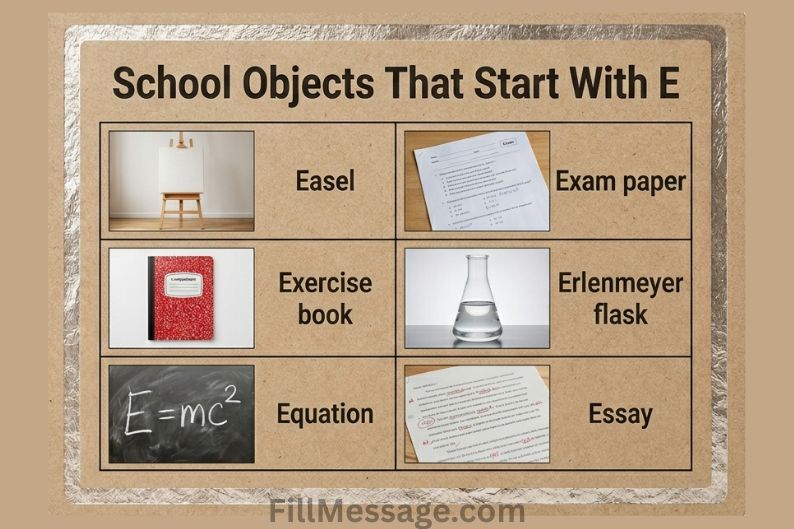
Encyclopedia — A reference book covering a vast range of topics. Physical encyclopedias lined school libraries for decades before the internet arrived.
Easel — A standing frame used to hold a canvas or display board in art classrooms and presentations.
Exam paper — The printed test sheet students complete during assessments.
Exercise book — A lined notebook for written schoolwork. Called a composition notebook in American English.
Erlenmeyer flask — The classic conical glass flask from science class. Named after German chemist Emil Erlenmeyer.
Equation — A mathematical statement showing two expressions are equal. The foundation of algebra.
Essay — A structured piece of writing that argues or explores a point. One of the most assigned tasks from middle school through university.
Expo marker — The dry-erase marker used on whiteboards in classrooms worldwide.
Nature Things That Start With E
Ecosystem — A community of living organisms interacting with their environment. Forests, coral reefs, and deserts are all distinct ecosystems.
Eclipse — When one celestial body passes into another’s shadow. A solar eclipse is one of the most dramatic natural events visible from Earth.
Estuary — Where a river meets the sea. Among the most biologically productive environments on the planet.
Erosion — The gradual wearing away of rock and soil by wind, water, or ice. Visible on cliffs and canyon walls.
Equator — The imaginary line circling Earth’s middle. Countries along it stay warm year-round.
Elevation — The height of a point above sea level. Critical for mountaineers, pilots, and weather forecasters.
Elm — A tall deciduous tree with serrated leaves. Dutch elm disease devastated elm populations across Europe and North America during the 20th century.
Evergreen — Any tree or shrub that keeps its leaves through all four seasons. Pines and spruces are the most familiar.
Evening primrose — A wildflower that opens at dusk and attracts moths for pollination instead of bees.
Equinox — The two points each year when day and night are exactly equal in length — one in spring, one in autumn.
Eruption — The release of lava, ash, and gases from a volcano. One of the most powerful geological events on Earth.
El Niño — A climate pattern involving warming of Pacific Ocean surface temperatures that disrupts weather worldwide.
Clothing and Accessories Things That Start With E
Earrings — Jewelry worn on the earlobes or along the ear cartilage. One of the oldest forms of personal adornment.
Earmuffs — Padded coverings worn over the ears in cold weather or loud environments.
Espadrilles — Casual flat shoes with a woven rope sole, originally from the Basque region of Spain and France.
Evening gown — A formal dress worn to galas, award ceremonies, or formal dinners.
Elastic — Stretchy material sewn into waistbands, cuffs, and sock tops to keep clothing in place.
Epaulettes — Decorative shoulder pieces on military uniforms. Originally designed to deflect sword blows.
Eyelet dress — A dress made from fabric with small decorative punched holes, popular in spring and summer.
Eton collar — A wide, stiff white collar originally worn by students at Eton College in England.
Ensemble — A complete outfit where all pieces are coordinated and worn together.
Musical Instrument Things That Start With E
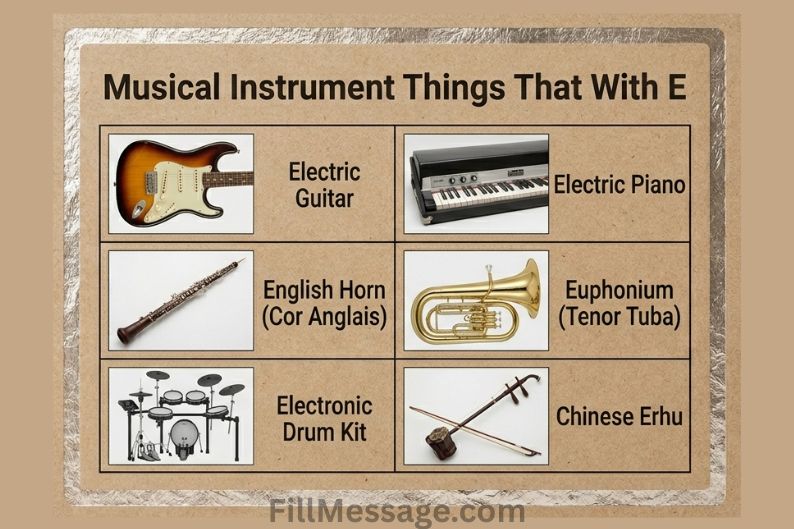
Electric guitar — The amplified string instrument that defined rock, blues, and pop music from the 1950s onward.
Electric piano — A keyboard that produces sound electronically. The Fender Rhodes is the most iconic example.
English horn — A woodwind instrument similar to an oboe but larger and lower in pitch. Despite the name, it originated in Poland.
Euphonium — A brass instrument resembling a small tuba with a warm, rich tone. A staple of brass and military bands.
Electronic drum kit — A digital drum set where each pad triggers a sampled sound. Far quieter than acoustic drums.
Erhu — A two-stringed Chinese instrument played with a bow. Expressive and slightly haunting, capable of mimicking the human voice.
Ektara — A single-stringed folk instrument from South Asia, traditionally played by wandering musicians.
Body Part Things That Start With E
Eye — The organ responsible for vision. Human eyes can distinguish approximately 10 million colors.
Ear — The organ for hearing and balance. The inner ear contains fluid-filled canals that tell the brain which way is up.
Elbow — The joint connecting the upper and lower arm. The “funny bone” sensation comes from the ulnar nerve running through it.
Eardrum — The thin membrane inside the ear that vibrates in response to sound waves.
Esophagus — The muscular tube carrying food from the throat to the stomach. About 8 inches long in adults.
Eyebrow — The strip of hair above each eye. Studies show people struggle to recognize faces without eyebrows.
Eyelid — The thin fold of skin that covers and protects the eye. Humans blink roughly 15–20 times per minute without thinking.
Eyelash — Short curved hairs along the eyelid edge that keep dust and debris away from the eye.
Science and Technology Things That Start With E
Electricity — The flow of electric charge through a conductor. Powers nearly every device in modern life.
Electron — A subatomic particle with a negative charge. The movement of electrons is what electricity actually is.
Element — A pure substance made of only one type of atom. The periodic table organizes all 118 known elements.
Enzyme — A biological molecule that speeds up chemical reactions in living organisms. Digestive enzymes break food down in the stomach.
Evolution — The process by which species change over generations through natural selection.
Ethernet — A system for connecting devices in a local network using cables. Still faster than wireless for most purposes.
Encryption — Converting data into coded form to prevent unauthorized access. Every secure website uses it.
Embryo — An organism in its earliest development stage, before organs are fully formed.
Epicenter — The point on Earth’s surface directly above the origin of an earthquake.
Epidermis — The outermost layer of skin. The body’s first line of defense against the environment.
Exoskeleton — A hard external shell that supports and protects an animal’s body. Insects, crabs, and lobsters all have one.
Equilibrium — A state of balance between opposing forces. Used in physics, chemistry, and biology.
Abstract and Conceptual Things That Start With E
Emotion — A mental state arising in response to experience. Joy, fear, anger, and sadness are the four most universally recognized.
Empathy — The ability to understand and share another person’s feelings.
Effort — The energy and determination put into a task.
Ethics — The branch of philosophy dealing with right and wrong. Also refers to a person’s own moral code.
Equality — The state of being equal in rights, status, or opportunity.
Experience — Knowledge gained through doing rather than being taught.
Expression — Communicating thoughts or feelings through words, art, music, or body language.
Endurance — The ability to sustain prolonged physical or mental effort.
Enthusiasm — Intense enjoyment or eagerness toward something.
Etiquette — The accepted rules of polite behavior in a society or group.
Exuberance — Lively energy and cheerful excitement.
Envy — Discomfort caused by wanting what someone else has.
Cool and Unique Things That Start With E
Echo — Sound that bounces off a surface and returns to the listener.
Enigma — A mystery that resists easy explanation. The Enigma machine was a World War II cipher device — cracking it helped end the war.
Epoch — A defined period of time in geology or history. Scientists use epochs to organize Earth’s 4.5-billion-year timeline.
Elixir — A liquid believed to have special or magical properties. Appears in ancient alchemy, medieval medicine, and modern fantasy.
Eureka — The exclamation attributed to Archimedes upon discovering water displacement. Still used today for any sudden realization.
Emblem — A symbol representing a group, nation, or idea. Country flags and school crests are both emblems.
Epitaph — The inscription on a gravestone. Shakespeare’s own warns against moving his bones.
Effigy — A constructed figure representing a person. Guy Fawkes Night bonfires burn effigies each November in the UK.
Outdoor and Travel Things That Start With E
Entrance — The way into any building, park, or public space.
Escalator — Moving stairs found in airports, malls, and metro stations. Invented in 1891.
Expedition — An organized journey with a specific goal. Shackleton’s Antarctic expedition remains one of history’s most dramatic survival stories.
Embankment — A raised ridge of earth or stone built alongside rivers or roads to prevent flooding.
Esplanade — A long, flat stretch of ground beside the sea or river, designed for walking.
Excursion — A short trip made for pleasure or learning. School field trips are excursions.
Express train — A train that skips smaller stations to move passengers faster between major destinations.
Exhibit — A display of objects or artwork in a museum or gallery.
Escarpment — A steep slope or cliff formed by erosion or geological faulting.
Edifice — A large, imposing building. Often used to describe historic or significant structures.
Things That Start With E for Preschool
At the preschool level, recognition matters more than spelling. These words work because children already know what they are — the letter just gives the familiar thing a name.
| Word | Why It Works |
| Egg | Seen at breakfast every morning |
| Eye | Children can point to their own |
| Ear | Physical and immediate |
| Elephant | Classic alphabet book staple |
| Earth | They live on it |
| Eight | Already learning to count |
| Engine | Trains and cars make it exciting |
| Exit | On every door — real-world reading |
Fun Activities Using E Words
Home scavenger hunt — Give children a list of E words and challenge them to find or photograph as many as possible around the house. Most kids are surprised how quickly the list fills up.
Word scramble — Scramble letters from E words and let children unscramble them. GLAEE (eagle), RASREE (eraser), PNEHLAET (elephant). Works well for ages 6 and up.
Alphabet book project — Each child draws one E word per page and writes one sentence about it. Simple for kindergartners, scalable for older students.
“I Spy” with E words — Works in the car, classroom, or on a nature walk. Forces children to actively scan their environment rather than passively sit.
Flashcard match game — Write the word on one card, draw or print the image on another. Match them up. Effective for ESL learners building visual-to-word connections.
E-word story challenge — Write or tell a short story using at least five E words. “The eagle spotted an earthworm near the elm tree” is a complete sentence and a vocabulary win simultaneously.
Bring real objects — An actual egg, an eraser, and an envelope on the table make a stronger impression than any worksheet. Let children hold them, label them, and connect the physical object to the letter.
The Full Extended List — Additional Things That Start With E
These words are not covered in any section above. This list exists purely to extend the count with fresh vocabulary.
Plants: Echinacea, Elderflower, Eucalyptus, Eelgrass, Epiphyte, Euphorbia
Geography: Easter Island, Edinburgh, Egypt, Ellis Island, Estonia, Euphrates River, English Channel
Materials: Ebony, Enamel, Epoxy, Emulsion, Ethanol
Additional animals: Elephant bird (extinct), Eurasian lynx, Earwig (if not listed above)
Architecture: Eave, Entryway
Weather: Evaporation, Exosphere
Games and activities: E-sports, Escape room
Additional abstract: Empowerment, Enlightenment, Elegance
Educational Value of E Words
The letter E carries unusual weight in English phonics. One of the first rules children learn is the “magic E” — adding a silent E changes a word’s vowel sound entirely. “Cap” becomes “cape.” “Hop” becomes “hope.” “Bit” becomes “bite.” This single rule unlocks the pronunciation of hundreds of words.
For ESL learners, short E words like “egg,” “elk,” and “elm” follow consistent patterns that build early confidence. Longer ones like “electricity” and “ecosystem” appear frequently in academic reading, making them high-value targets for intermediate learners.
Read more:
280+ Things That Start With D — Words, Objects, Animals, Foods & More
250+ Things That Start With C — For Kids, Learners & Word Explorers
FAQ’s on Things That Start With E
What are the easiest E words for young children to learn first?
The best starting words are familiar objects children can see or touch. Egg, eye, ear, elephant, and eraser are especially effective because kids already know what they are. When a word connects to something real, it becomes much easier to remember and use.
Why is the letter E important in English?
E is the most frequently used letter in English. It appears in many common words and plays a key role in phonics, especially in the silent E pattern that changes vowel sounds, such as cap to cape and hop to hope.
What are some interesting animals that start with E?
Popular examples include elephant, eagle, echidna, elk, emu, and emperor penguin. These animals come from different parts of the world and give learners a fun way to expand vocabulary while exploring nature.
How can teachers use E words in the classroom?
Teachers can turn E words into scavenger hunts, matching games, writing prompts, and phonics lessons. Grouping words by category, such as foods or animals, helps students learn faster and retain more vocabulary.
What are some advanced E words for older students?
Older learners may benefit from words like ecosystem, encryption, equilibrium, evolution, and empathy. These terms appear often in science, technology, and academic reading.
The letter E stretches across nearly every corner of daily life — from food on the table and animals in the wild, to tools in the classroom and ideas that shape how we think. These words cover far more ground than most people expect from a single letter. And there are always more to find — language never really runs out.

Marco Jr. is Author at fillmassage.com,
He explores the world of words and their meanings, helping readers understand language clearly. Passionate about explanations that guide and inform, he creates insightful content that educates, engages, and supports curious minds every day.