You’ve probably seen it in a comment section, heard it in an anime clip, or had someone drop it in a group chat. Ara ara. Two words, repeated. And depending on where you saw it, it might have felt flirty, motherly, sarcastic, or completely random.
That’s the thing about this phrase — it doesn’t have one clean meaning. It has a real meaning, a TV meaning, and a meme meaning. All three are floating around the internet at the same time, which is exactly why people keep searching for it.
The Actual Japanese Meaning First
“Ara” (あら) in Japanese is a reaction word. Simple as that. It’s the equivalent of “oh” or “oh my” in English — a soft sound you make when something catches you off guard, worries you slightly, or just surprises you a little.
Say it twice and the feeling gets heavier. More expressive. Ara ara becomes closer to “oh dear” or “well, well” — the kind of thing someone says when they’re mildly affected by a situation but not shocked by it.
In actual Japan, this phrase belongs mostly to older women. Mothers. Aunts. Teachers. The woman next door watching a child do something clumsy. It’s gentle, slightly theatrical, and very feminine in tone. A man saying it in casual conversation would sound genuinely unusual.
That’s the original. Soft. Warm. Completely ordinary.
Why Ara Ara Sounds Different in Anime
Anime didn’t change the words. It changed the energy behind them.
A specific female character type in anime — calm, mature, slightly mysterious, always a step ahead — started using “ara ara” as almost a personality badge. These characters speak slowly, smile knowingly, and react to chaos around them with quiet amusement rather than panic.
The phrase picked up that energy. Suddenly it wasn’t just “oh my” — it was “oh my, aren’t you interesting.” Playful. A little superior. Warm but with an edge.
That shift is what made the phrase stick in fan culture. It became attached to a feeling rather than a literal translation.
Ara Ara The Meme Version Is a Costume
Here’s where it fully separates from real Japanese.
Online — on TikTok, Reddit, Discord, anime Twitter — “ara ara” became a roleplay signal. Drop it in a comment with a tilde at the end and you’re immediately playing a character. The teasing older woman. The one who calls you “good boy” and acts gently amused by everything you do.
“Ara ara, you really thought that plan would work~”
That tilde matters more than people realize. Without it, the phrase reads as genuine mild surprise. With it, you’re firmly in fan culture territory. The meaning hasn’t changed exactly — but the attitude has been turned up to a very specific setting.
None of this is how people in Japan actually text each other. This version lives almost entirely inside fandom.
What Ara Ara Means When Someone Sends It to You
Context does all the work here.
If it comes with a “~” or “uwu” energy, or if the person is clearly into anime, they’re playing a character. It’s affectionate and teasing — not serious, not literal.
If someone uses it in a straightforward sentence without any theatrical flair, they might genuinely just mean “oh wow” or “oh no.” Especially if they’re actually Japanese or learning the language seriously.
The phrase itself isn’t flirty by default. Fandom turned it that way. Knowing the difference stops you from misreading someone’s tone completely.
Read also: Chicos Meaning — More Than Just a Spanish Word
Ara Ara The Korean and Turkish Question
People frequently search “ara ara meaning in Korean” and “ara ara meaning in Turkish” — usually because the phrase travels fast and sounds like it could belong to other languages too.
It doesn’t carry the same meaning in either one.
In Korean, “ara” is a name or shows up in specific verb forms. In Turkish, “ara” means gap, break, or call. Neither connects to the Japanese expression. The similar sounds are just coincidence — the phrase belongs to Japanese and stayed there until anime carried it globally.
Ara Ara vs. Other Japanese Reaction Words
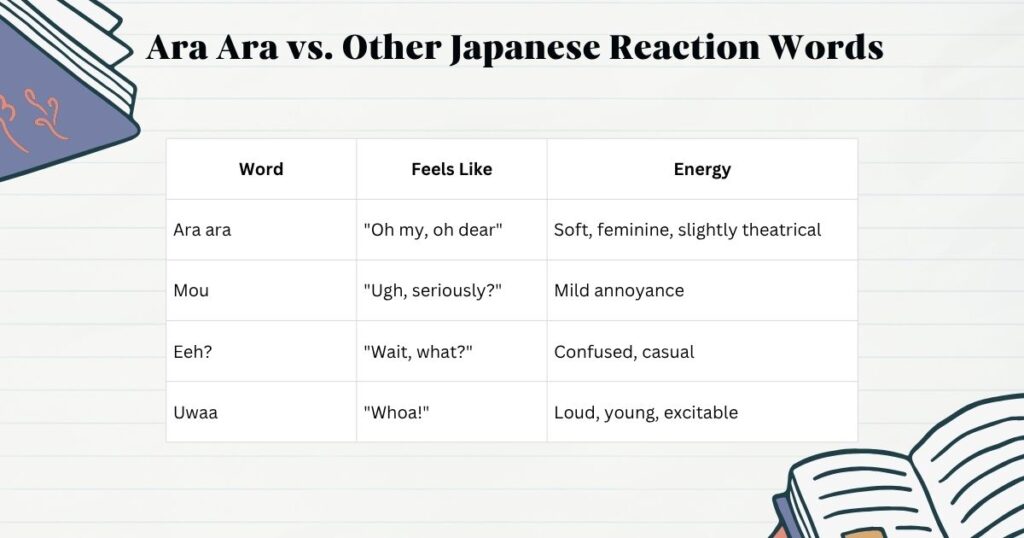
| Word | Feels Like | Energy |
| Ara ara | “Oh my, oh dear” | Soft, feminine, slightly theatrical |
| Mou | “Ugh, seriously?” | Mild annoyance |
| Eeh? | “Wait, what?” | Confused, casual |
| Uwaa | “Whoa!” | Loud, young, excitable |
Ara ara sits in its own lane — unhurried, gently expressive, and almost never aggressive.
Read also: Conned Meaning — What It Actually Means When Someone Says It
A Note on “Ara Ara Sayonara”
Some people search this combination after seeing it in a subtitle or clip. These aren’t a fixed pair with a special meaning. “Sayonara” just means goodbye. If a character says both in one scene, they’re simply leaving while speaking in their usual tone. No secret connection between the two.
FAQs
If a girl sends me “ara ara,” what does she mean?
Most likely she’s being playful — teasing you in an affectionate, anime-influenced way. It’s not a confession or a threat. It’s closer to “oh you~” said with a smirk. Read the rest of her tone to be sure.
Is it weird to use “ara ara” if you’re not Japanese?
Not in fan spaces. It’s used freely in anime communities worldwide. Just know you’re using the meme version, not dropping real Japanese into conversation — those are two different things.
Does “ara ara” mean something bad or offensive?
No. In Japanese it’s genuinely polite and soft. Online it can be teasing, but it’s not rude or vulgar in any version of its use.
Why do people say “ara ara” in a low, slow voice in videos?
That’s the anime character impression. The slow delivery is part of the character type — calm, unbothered, slightly superior. The voice is doing as much work as the words.

Marco Jr. is Author at fillmassage.com,
He explores the world of words and their meanings, helping readers understand language clearly. Passionate about explanations that guide and inform, he creates insightful content that educates, engages, and supports curious minds every day.