You typed “unlike” three times in two paragraphs. You noticed. Your reader will too.
The word isn’t wrong. It just gets tired fast. And when it repeats, it signals something to the reader: the writer ran out of options. That’s the last impression you want to leave.
This guide gives you 31+ real alternatives, sorted by how they actually work in writing. Not alphabetical filler. Practical, tone-aware choices you can use today.
What “Unlike” Really Signals
“Unlike” draws a line between two things. It says: these don’t match. Simple job, done simply.
The problem is that “different” can mean a hundred things. A slight variation. A total mismatch. A logical contradiction. A cultural gap. “Unlike” treats all of them the same way, which is why it often undersells the contrast you actually mean.
The right substitute makes that contrast precise. It tells the reader how different, not just that different.
The Full Another Word for Unlike Table
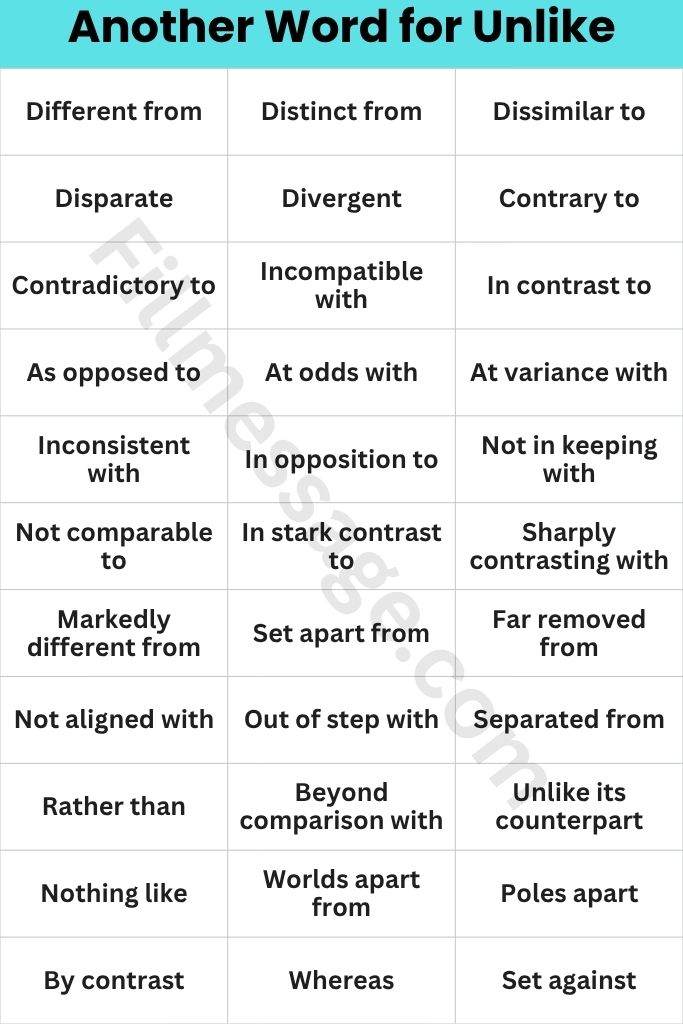
| Word / Phrase | Tone | Best Used When |
| Different from | Neutral | Basic contrast, any context |
| Distinct from | Neutral-formal | Clear, specific separation |
| Dissimilar to | Formal | Noticeable, describable difference |
| Disparate | Academic | Things too different to fairly compare |
| Divergent | Formal | Ideas or paths moving in opposite directions |
| Contrary to | Formal | One thing works against another |
| Contradictory to | Strong-formal | One thing logically cancels the other |
| Incompatible with | Technical | Two things that cannot coexist or function together |
| In contrast to | Essay-formal | Topic sentences, analytical comparisons |
| As opposed to | Semi-formal | Comparing choices, preferences, positions |
| At odds with | Conversational-formal | Conflicting perspectives or results |
| At variance with | Academic | Evidence or findings that conflict |
| Inconsistent with | Technical-formal | Data, behavior, or rules that don’t align |
| In opposition to | Formal | Strong logical or ideological contrast |
| Not in keeping with | Formal | Something that breaks an established standard |
| Not comparable to | Analytical | Resisting a false or misleading comparison |
| In stark contrast to | Emphatic | High-impact contrast in essays or opinion pieces |
| Sharply contrasting with | Rhetorical | Deliberate side-by-side opposition |
| Markedly different from | Emphasis | When the gap needs stressing |
| Set apart from | Neutral-descriptive | Emphasizing separation or individuality |
| Far removed from | Descriptive | A wide, significant gap |
| Not aligned with | Professional | Goals, values, or strategies that don’t match |
| Out of step with | Casual-descriptive | Something misaligned with a group or trend |
| Separated from | Descriptive | Conceptual or physical distance |
| Rather than | Transitional | Choosing one thing over another |
| Beyond comparison with | Rhetorical | Extreme or unique differences |
| Unlike its counterpart | Essay phrasing | Clean variation when comparing paired subjects |
| Nothing like | Conversational | Informal writing, everyday speech |
| Worlds apart from | Idiomatic | Strong vivid contrast in casual or creative writing |
| Poles apart | Idiomatic | Extreme informal contrast, two total opposites |
| By contrast | Transitional | Shifting between sentences or paragraphs |
| Whereas | Structural | Two contrasting ideas in one sentence |
| Set against | Rhetorical | Deliberate opposition in argument or narrative |
Another Word for Unlike Meaning Clusters
Sorting by tone helps you find words quickly. But understanding what kind of difference each word describes is what makes your writing actually sharper.
Cluster 1: Mild, Clean Contrast
These do the job without drama. Safe in most settings.
“Different from,” “distinct from,” “set apart from,” “separated from.” These work when the gap between two things is real but not extreme. A product comparison, a factual observation, a casual distinction. No heat, just clarity.
Cluster 2: Structural or Fundamental Difference
When things don’t just differ but belong to entirely separate categories.
“Disparate” is the clearest example. It quietly signals that comparing these two things directly might itself be misleading. “Divergent” works when two things started from the same point and moved in different directions over time. These are the words for research writing and analytical essays, where precision is everything.
Cluster 3: Active Conflict and Opposition
This cluster isn’t about difference. It’s about tension.
“Contrary to,” “contradictory to,” “incompatible with,” “in opposition to,” “at odds with.” These words imply that the gap isn’t passive. One side pushes against the other. Use these when the contrast carries weight, not just when two things happen to differ.
“Contrary to expectations, the data showed improvement” works because “contrary” signals a genuine clash with what was predicted. “Different from expectations” would flatten that tension.
Cluster 4: Emphasis and Rhetorical Impact
When you want the reader to feel the gap, not just note it.
“In stark contrast to,” “worlds apart from,” “poles apart,” “markedly different from,” “beyond comparison with.” These are tools for opinion writing, persuasive essays, and creative nonfiction. They amplify. Used well, they land. Used too often, they exhaust.
One per piece is usually the right limit.
Cluster 5: Transitional Phrases That Show Contrast
These don’t replace “unlike” in a preposition slot. They handle contrast between clauses or sentences.
“By contrast,” “whereas,” “rather than,” “as opposed to.” These keep your writing moving. When you’ve used “in contrast to” once already, “by contrast” carries the next transition without repeating the pattern.
Another Word for Unlike in Sentence Rewrites: Same Idea, Different Impact
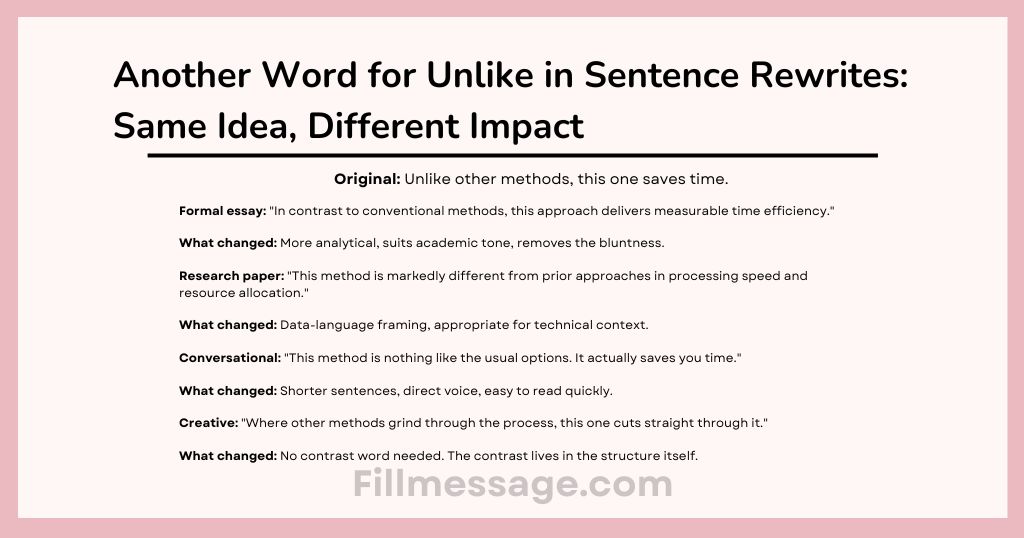
This is where word choice becomes visible. Take one sentence and watch how the alternative reshapes it.
Original: Unlike other methods, this one saves time.
Formal essay: “In contrast to conventional methods, this approach delivers measurable time efficiency.”
What changed: More analytical, suits academic tone, removes the bluntness.
Research paper: “This method is markedly different from prior approaches in processing speed and resource allocation.”
What changed: Data-language framing, appropriate for technical context.
Conversational: “This method is nothing like the usual options. It actually saves you time.”
What changed: Shorter sentences, direct voice, easy to read quickly.
Creative: “Where other methods grind through the process, this one cuts straight through it.”
What changed: No contrast word needed. The contrast lives in the structure itself.
Original: Unlike her colleagues, she stayed calm.
Professional report: “Her response was notably distinct from that of her colleagues under the same conditions.”
Storytelling: “Her colleagues lost their footing. She didn’t move an inch.”
Academic: “Her behavioral response was inconsistent with the patterns observed across the broader peer group.”
Three completely different reading experiences. Same fact. The word did that.
Another Word for Unlike Formal vs. Informal: A Practical Split
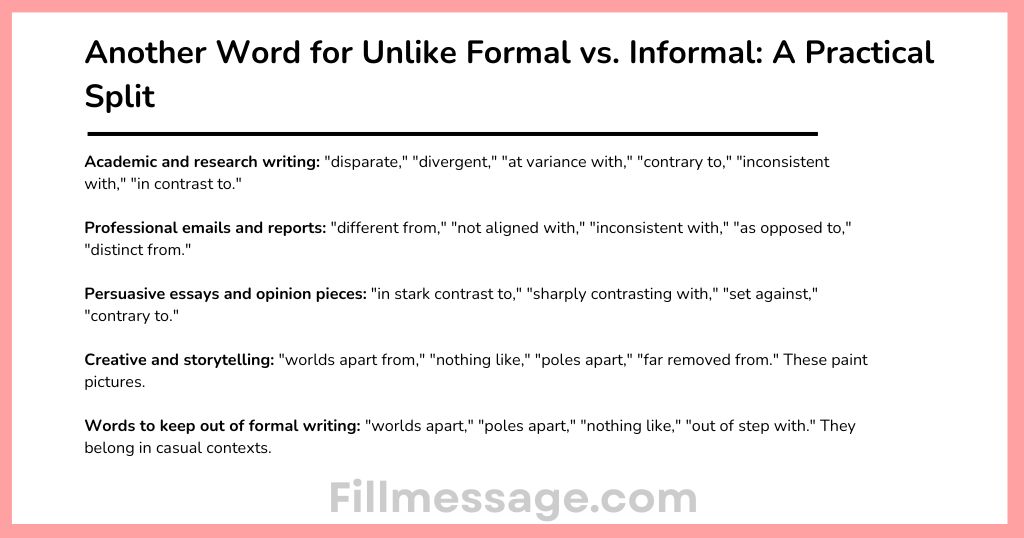
Writers mix these up more than any other vocabulary error. A word that works beautifully in a blog post can undercut a research paper’s credibility, and vice versa.
Academic and research writing: “disparate,” “divergent,” “at variance with,” “contrary to,” “inconsistent with,” “in contrast to.” These carry analytical weight. They suit thesis comparisons, literature reviews, and data discussions.
Professional emails and reports: “different from,” “not aligned with,” “inconsistent with,” “as opposed to,” “distinct from.” Clean, clear, never feel forced.
Persuasive essays and opinion pieces: “in stark contrast to,” “sharply contrasting with,” “set against,” “contrary to.” Strong enough to make a point land.
Creative and storytelling: “worlds apart from,” “nothing like,” “poles apart,” “far removed from.” These paint pictures. They don’t just describe a gap; they make you feel its size.
Words to keep out of formal writing: “worlds apart,” “poles apart,” “nothing like,” “out of step with.” They belong in casual contexts. In an essay or report, they read as out of place and slightly careless.
Common Mistakes With Another Word for Unlike
Using “contrary to” when you mean “different from.”
“Contrary to” implies active opposition. If two reports simply have different findings, they’re “different.” If one directly contradicts the other’s conclusion, then “contrary to” fits. Mixing these up makes mild differences sound like arguments.
Treating “disparate” as a fancy “different.”
“Disparate” means the things are so unlike that comparison itself becomes problematic. Using it for minor differences overstates your case. Reserve it for genuinely incomparable subjects.
Confusing “incompatible” with “contradictory.”
Incompatible things can’t function or exist together practically. Contradictory things conflict logically. A vegetarian and a steakhouse menu are incompatible. Two scientific claims that both can’t be true are contradictory.
Stacking contrast markers in one paragraph.
“Unlike… in contrast to… as opposed to…” three times in five sentences exhausts the reader. Vary your contrast signals. Not every sentence needs a marker. Sometimes the contrast is clear from the content alone.
Forcing idiomatic phrases into formal writing.
“Poles apart” in a university essay reads as a tonal mismatch. It’s not grammatically wrong. It just signals that the writer wasn’t reading the room.
Unlike synonym Related Words That Work Alongside These
These aren’t synonyms for “unlike,” but they live in the same neighborhood. Good contrast writing uses them together.
Whereas – Builds contrast inside a single sentence. Clean and slightly formal. Works in essays and reports without sounding stiff.
Conversely – Signals a reversal. “The first group improved. Conversely, the second group declined.” Strong in analytical writing.
Nevertheless – Moves past a contrast rather than introducing one. Acknowledges the difference, then keeps going.
Diverge – The verb form. Useful when describing how two things moved apart over time rather than just stating they’re different now.
Differentiate – The action of separating or distinguishing. Helpful when you want to describe the act of noticing contrast, not just the contrast itself.
Read more:
50+ Another Word for Instrumental: Find the Right Word Every Time
29+ Another Word for Downplay: The Right Word for Every Situation
FAQ’s about Another Word for Unlike
Is “different from” always the safest substitute?
For most situations, yes. It’s neutral, widely accepted, and works across formal and informal writing. The one gap is structural: “unlike X, Y does…” doesn’t swap cleanly to “different from X, Y does…” In those cases, “in contrast to X, Y does…” is your best direct replacement.
Can “as opposed to” appear in academic essays?
It’s acceptable, but it carries a slightly conversational edge. In strong formal writing, “in contrast to” or “contrary to” usually fits better. Save “as opposed to” for when you want a slightly lighter tone within an otherwise formal piece.
What separates “distinct” from “disparate”?
“Distinct” means clearly identifiable and separate. “Disparate” means so fundamentally different that direct comparison is itself questionable. Two writing styles can be distinct. Two research populations drawn from completely different demographic realities are disparate.
When does “unlike” actually stay the best choice?
When you need the preposition structure to flow naturally and you haven’t used it recently in the same piece. “Unlike its predecessor, this model…” is clean and efficient. The issue is overuse, not the word itself.
Choosing Quickly: A Decision Rule
Ask yourself two things before picking a word:
First, how strong is the contrast? Mild differences take neutral words. Fundamental clashes take stronger ones. Active opposition takes the conflict cluster.
Second, who is reading this? Academic readers expect precision. General readers expect clarity. Creative readers respond to texture and feeling.
Match strength to the gap. Match register to the audience. Everything else follows.
That’s the whole skill, really. The list gives you the options. The two questions tell you which one to use.

Marco Jr. is Author at fillmassage.com,
He explores the world of words and their meanings, helping readers understand language clearly. Passionate about explanations that guide and inform, he creates insightful content that educates, engages, and supports curious minds every day.