You typed “dialogue” three times in one paragraph. You noticed. That small discomfort is actually good instinct.
But the real issue isn’t repetition. It’s not knowing which word actually fits when you swap it out. Drop the wrong synonym into a sentence and the tone shifts in ways readers feel instantly, even if they can’t explain why.
This guide fixes that. Not just more words, but the right word for your exact situation.
What Dialogue Really Means
Dialogue is a two-way exchange of words between people. It implies both speaking and listening, even imperfectly. It carries a sense of purpose beneath the surface.
That baseline matters when you replace it. Some synonyms keep that energy. Others quietly change it.
35+ Another Word for Dialogue at a Glance
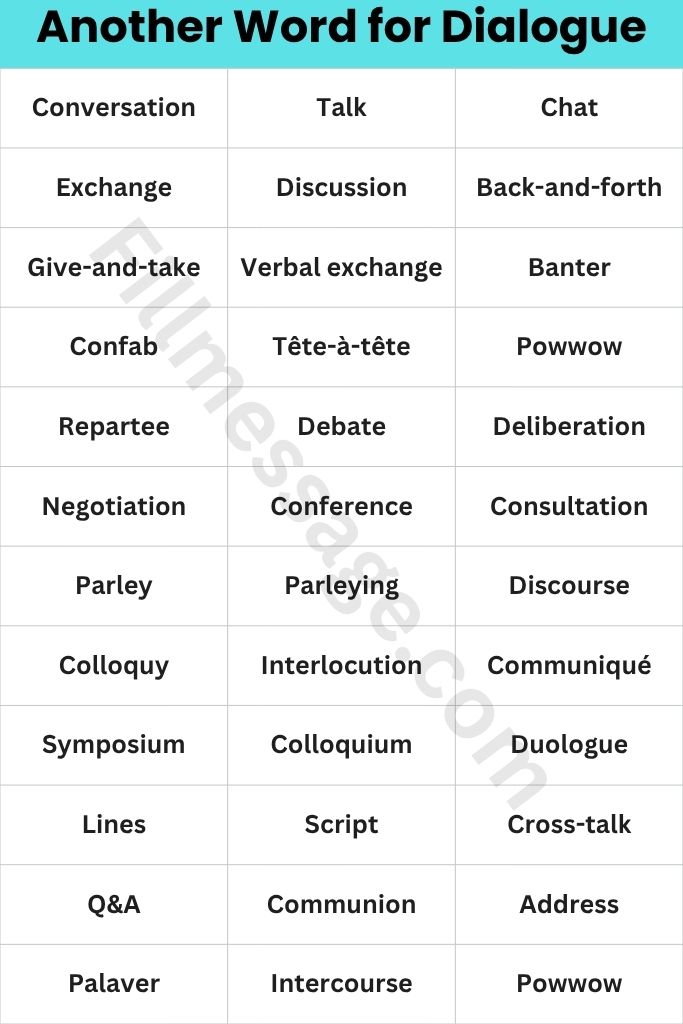
| Word | Tone | Best Used When |
| Conversation | Warm, natural | Characters or people talk freely |
| Talk | Easy, short | Casual scenes or quick headlines |
| Chat | Light, informal | Friendly or digital exchanges |
| Exchange | Clean, neutral | Reporting facts without emotional color |
| Discussion | Mild-formal | Ideas explored together openly |
| Back-and-forth | Descriptive | Equal trading of words or opinions |
| Give-and-take | Balanced | Both sides contributing equally |
| Verbal exchange | Neutral, clear | Any spoken back-and-forth |
| Banter | Playful, quick | Light teasing between characters |
| Confab | Quiet, informal | Side conversation, brief huddle |
| Tête-à-tête | Private, close | One-on-one intimate talk |
| Powwow | Casual, group | Informal team-style discussion |
| Repartee | Witty, sharp | Clever quick-fire responses |
| Debate | Charged, opposing | Two sides arguing different views |
| Deliberation | Heavy, careful | Weighing a decision before acting |
| Negotiation | Strategic | Parties working toward agreement |
| Conference | Structured | Formal meeting or official setting |
| Consultation | Advisory | Expert guiding a client or patient |
| Parley | Historical, diplomatic | Rivals meeting under truce to talk |
| Parleying | Active, ongoing | Currently in the act of negotiating |
| Discourse | Elevated, broad | Essays, lectures, formal writing |
| Colloquy | Formal, literary | Philosophical or scholarly exchange |
| Interlocution | Technical, precise | Legal or linguistic formal exchange |
| Communiqué | Official, written | Formal statement between parties |
| Symposium | Academic, group | Structured intellectual gathering |
| Colloquium | Academic event | Formal hosted discussion of ideas |
| Duologue | Theatrical | Two-person scripted scene |
| Lines | Script-specific | What a character speaks on stage |
| Script | Written format | Full written conversation in media |
| Cross-talk | Chaotic, overlapping | Multiple voices at once, no order |
| Q&A | Interactive | Audience-speaker question format |
| Communion | Intimate, emotional | Deep personal or spiritual sharing |
| Address | One-directional | Formal speech or official statement |
| Palaver | Negative, weary | Long, pointless, unresolved talk |
| Intercourse | Archaic, formal | Old formal sense of social exchange |
| Powwow | Informal, group | Casual team gathering to talk things out |
Dialogue Synonym Meaning Clusters: Where the Real Differences Live
Dumping words in a single list misses the point. “Dialogue” actually breaks into five distinct zones, and knowing which zone you’re writing in changes your word choice completely.
Everyday and Casual Another Word for Dialogue
Conversation, chat, talk, confab, banter, back-and-forth, give-and-take
These feel lived-in. They belong in informal scenes, blog posts, personal essays, and any moment where people are just being people. The differences are subtle but worth knowing.
A “chat” is usually brief. A “conversation” can stretch for hours. “Banter” crackles with humor, almost always between people comfortable with each other. “Confab” has a slightly hushed quality, like two people talking low in a corridor. “Give-and-take” suggests neither person is dominating the exchange.
Decision-Making and Stakes Another Word for Dialogue
Negotiation, deliberation, conference, parley, consultation
These words carry weight. Something is being decided or resolved. Use them when characters or real people have something at stake.
“Negotiation” puts two parties with different needs in the same room. “Deliberation” is slower, more internal, a group thinking aloud before choosing. “Parley” has a historical feel, rivals meeting under temporary truce. “Consultation” places one person in the role of expert, the other as someone seeking guidance.
Literary and Performed Another Word for Dialogue
Duologue, repartee, lines, script, cross-talk
Writers working in fiction or drama need words that describe structure, not just speech. “Duologue” is a two-person scripted scene, precise and theatrical. “Repartee” is the quick, intelligent back-and-forth that makes readers pause and smile. “Lines” refers to what characters actually say. “Cross-talk” describes the overlapping chaos when no one waits their turn.
Formal and Academic Another Word for Dialogue
Discourse, colloquy, interlocution, deliberation, colloquium, symposium
These don’t belong in casual writing. Inside an essay, policy document, or philosophical text, they work with precision. “Discourse” is the most flexible of this group. It describes a single exchange, a pattern of communication, or the entire framework of how a subject gets discussed in society. “Interlocution” is more specific, formal back-and-forth where roles are defined. “Colloquy” fits well when two thinkers are exploring an idea together in writing or structured speech.
Negative or Charged Another Word for Dialogue
Palaver, cross-talk, debate
These carry judgment. “Palaver” implies nothing useful came out of the exchange. “Cross-talk” suggests disorder. “Debate” isn’t inherently negative, but it signals opposition. Two people exploring ideas together isn’t a debate. Two people defending opposing positions is.
Use these words deliberately. Accidentally choosing “palaver” when you mean a productive discussion quietly insults the conversation you’re describing.
Another Word for Dialogue: In Four Sentences, Four Different Readings
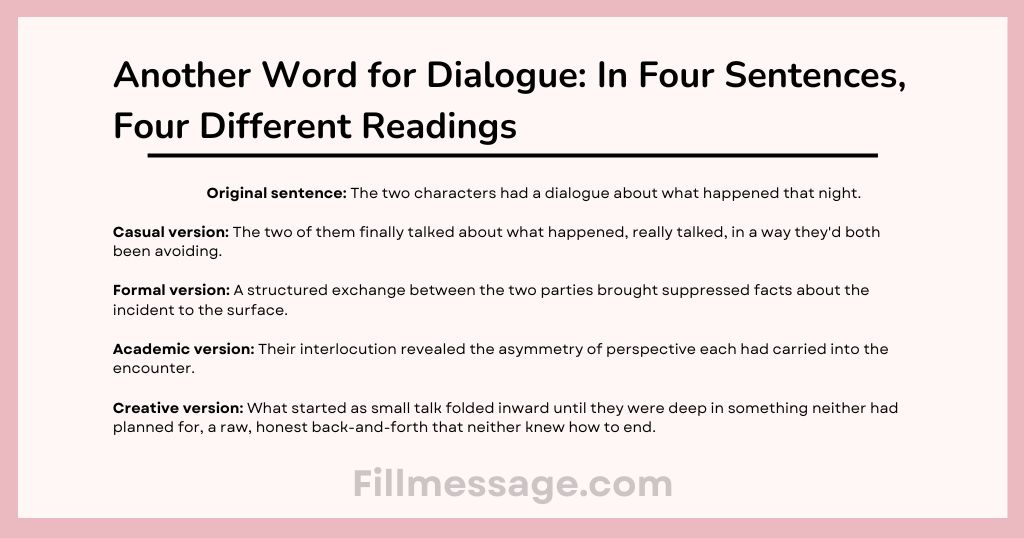
Same event. Different word. Watch what shifts.
Original sentence: The two characters had a dialogue about what happened that night.
Casual version: The two of them finally talked about what happened, really talked, in a way they’d both been avoiding.
Formal version: A structured exchange between the two parties brought suppressed facts about the incident to the surface.
Academic version: Their interlocution revealed the asymmetry of perspective each had carried into the encounter.
Creative version: What started as small talk folded inward until they were deep in something neither had planned for, a raw, honest back-and-forth that neither knew how to end.
Each version reports the same scene. The word choice tells the reader how to feel about it before they’ve finished the sentence.
Dialogue Synonyms for Scripts and Film Writing
Screenwriters and playwrights work in a more specific vocabulary when describing or labeling exchanges rather than writing them.
Duologue is your cleanest term for a two-person scripted scene.
Lines refers to the specific words each character delivers.
Script covers the full written structure.
Cross-talk is a direction as much as a description, overlapping speech that requires specific notation in a screenplay.
If you’re writing a film review or analysis rather than the script itself, “verbal exchange” and “back-and-forth” both work smoothly. “The film’s sharpest verbal exchanges happen in the second act” reads naturally. Reaching for “interlocution” in a review sounds strained.
Another Word for Dialogue Formal vs. Informal: The Mistake Most Writers Make
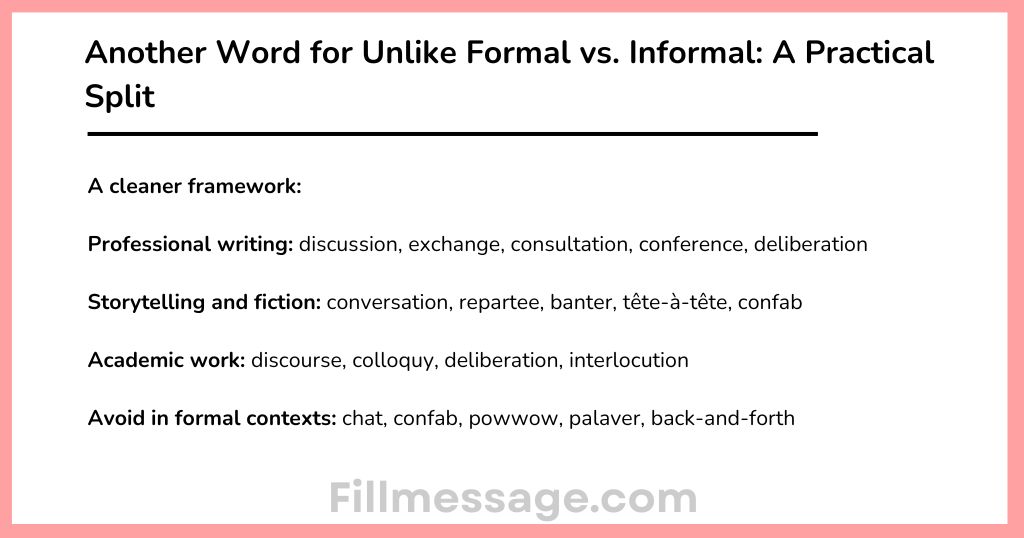
The error isn’t usually choosing a wrong word. It’s mixing registers without noticing.
A professional proposal that uses “chat” in a subheading feels slightly off. A personal essay that uses “discourse” throughout feels stiff and distant. Readers sense the friction even when they don’t identify it.
A cleaner framework:
Professional writing: discussion, exchange, consultation, conference, deliberation
Storytelling and fiction: conversation, repartee, banter, tête-à-tête, confab
Academic work: discourse, colloquy, deliberation, interlocution
Avoid in formal contexts: chat, confab, powwow, palaver, back-and-forth
Context still wins every time. But when uncertain, simpler and more neutral is almost always the safer choice.
Where Writers Go Wrong: The Real Mistakes with Another Word for Dialogue
Using “repartee” for serious exchanges. Repartee is witty by definition. It cannot describe a tense argument without creating unintended irony.
Stretching “discourse” too thin. One conversation between two people is rarely a “discourse” in the precise sense. Discourse often describes broader communication patterns around a topic, how society collectively speaks about something. Using it for a single scene overstates it.
Treating “debate” and “discussion” as the same. A discussion has no required opposition. A debate does. Two people casually exploring a book together are having a discussion. Two people defending opposing interpretations are debating.
Overworking “exchange.” It’s clean and useful, but repeated too often it drains warmth from emotional scenes. Use it to report. Use other words to feel.
Choosing impressive over clear. “Interlocution” is a real word with a real use. But if your audience is general, it creates friction. Precision serves the reader, not the writer’s vocabulary.
Dialogue Synonym Related Words That Belong Nearby
These aren’t synonyms but they live in the same neighborhood. Knowing how they differ keeps your writing precise.
Monologue – One person speaking without response. The structural opposite of dialogue. Useful when contrasting scene types.
Soliloquy – A character speaking to themselves or the audience, not to another character. Stage and literary use only.
Subtext – What characters mean beneath the words they say. When writing about dialogue craft, this word matters enormously.
Rhetoric – The art of persuasive speech. Relevant when discussing how someone’s words are shaped to influence, not just to communicate.
Narration – The voice that tells the story rather than speaking within it. Related to dialogue structurally, but a different layer entirely.
Read also –
31+ Another Word for Unlike: The Writer’s Complete Guide
29+ Another Word for Downplay: The Right Word for Every Situation
FAQ’s about Dialogue Synonyms
What’s the safest neutral replacement for “dialogue” in formal writing?
“Discussion” or “exchange” almost always work. Neither carries strong connotation and both read cleanly in professional and academic contexts without stiffness.
Is “discourse” just a fancier version of “dialogue”?
Not exactly. Dialogue is a specific back-and-forth between individuals. Discourse can mean that, but it also describes the larger patterns of communication surrounding a topic across time and culture. In academic writing, using them interchangeably is imprecise.
Which word fits best in a theater or film review?
“Exchange” for general scene references. “Duologue” when describing a specific two-character scene with structural intention. “Repartee” only if the writing genuinely crackles with wit. Avoid “interlocution” in reviews entirely.
Does “conversation” always work as a replacement?
In casual contexts, almost always yes. But “dialogue” sometimes implies more purpose than “conversation” carries. If two people are genuinely trying to work something out, “conversation” softens that intent slightly. Worth noticing whether that matters for your sentence.
The Practical Takeaway
You don’t need all 36 words. You need the right small shortlist for how you write.
For most everyday writing: conversation, exchange, and discussion will take you through ninety percent of situations cleanly.
For fiction and scripts: repartee, banter, duologue, and back-and-forth do targeted, precise work that generic words can’t.
For formal and academic work: discourse, deliberation, and consultation carry weight without tipping into pretension.
And when the exchange has been a complete waste of everyone’s time? That’s exactly what palaver was made for.
Choose for meaning first. Sound second. That order holds every time.

Marco Jr. is Author at fillmassage.com,
He explores the world of words and their meanings, helping readers understand language clearly. Passionate about explanations that guide and inform, he creates insightful content that educates, engages, and supports curious minds every day.