Here’s something most writers don’t think about until it’s too late. You finish a powerful scene, read it back, and the word “destiny” appears four times in six sentences. Suddenly it feels overwritten. Theatrical. The weight you wanted is now working against you.
The fix isn’t just swapping in any synonym. It’s knowing which word carries the right meaning for that specific moment. “Fate” feels different from “calling.” “Doom” lands differently than “purpose.” This guide gives you 36+ real alternatives, sorted by tone, with enough context to choose confidently.
What Makes “Destiny” Hard to Replace
Destiny sits at the intersection of hope and inevitability. It suggests a future that already exists somewhere, waiting. That emotional mix is what makes it powerful in storytelling and what makes lazy replacements feel flat.
Its tone is serious. Slightly elevated. Not something you’d drop into casual conversation without effect. Any synonym you choose either matches that gravity, softens it, or darkens it. Knowing which direction you’re moving is the whole skill.
36+ Another Word for Destiny by Tone and Use
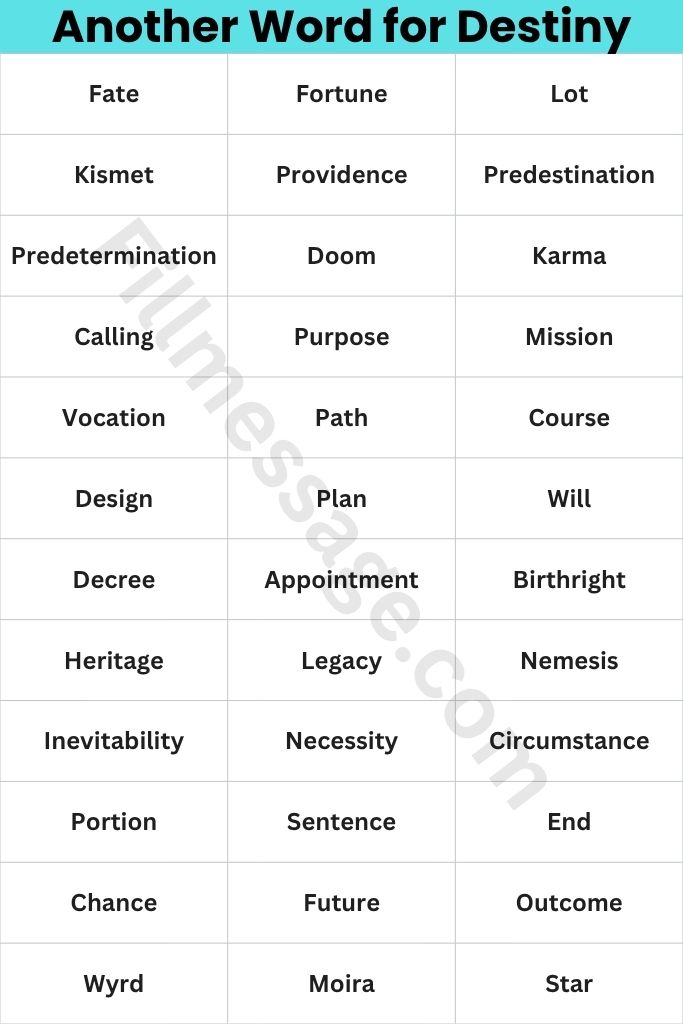
| Word | Tone | Best Used When |
| Fate | Neutral, universal | General writing, most flexible replacement |
| Fortune | Lightly optimistic | Destiny tied to luck or life outcomes |
| Lot | Resigned, quiet | Someone accepts what life handed them |
| Kismet | Warm, romantic | Poetic or spiritual moments, especially love |
| Providence | Reverent | Religious or philosophical contexts |
| Predestination | Heavy, doctrinal | Theological writing or belief debates |
| Predetermination | Cold, academic | Philosophy, logic, formal argument |
| Doom | Dark, terminal | Tragic or hopeless outcomes only |
| Karma | Moral, cyclical | Spiritual cause-and-effect writing |
| Calling | Personal, directional | Someone drawn toward a specific life path |
| Purpose | Motivational, clear | Modern writing about meaning and direction |
| Mission | Active, goal-oriented | Character on a defined life task |
| Vocation | Serious, earned | Life work, spiritual or professional calling |
| Path | Open, flexible | Life journey without a fixed endpoint |
| Course | Neutral, forward | Events moving in a natural direction |
| Design | Intentional | A plan arranged by a higher intelligence |
| Plan | Practical or divine | When destiny feels organized or guided |
| Will | Commanding | Divine will or higher-power narrative |
| Decree | Authoritative, formal | Divine or royal command writing |
| Appointment | Formal, solemn | A fated meeting or moment |
| Birthright | Ownership-toned | Destiny linked to origin or lineage |
| Heritage | Cultural, inherited | Fate passed through blood or tradition |
| Legacy | Forward-looking | What someone leaves behind by design |
| Nemesis | Confrontational | A destined reckoning or opponent |
| Inevitability | Philosophical | Something that cannot be stopped |
| Necessity | Logical, cold | Must-happen outcome, no alternatives |
| Circumstance | Detached | Describing external conditions neutrally |
| Portion | Humble, old-fashioned | Assigned share of suffering or blessing |
| Sentence | Grim, legal | Fate that feels like punishment |
| End | Blunt, final | An ultimate conclusion or terminus |
| Chance | Loose, uncertain | When destiny feels random rather than fixed |
| Future | Plain, colorless | When you want zero emotional weight |
| Outcome | Practical | Final result of choices or events |
| Wyrd | Archaic, poetic | Old English, Norse, or fantasy writing |
| Moira | Mythological | Greek classical themes or tragedy |
| Star | Astrological, lyrical | “Born under a lucky star” type writing |
| Trajectory | Modern, neutral | Life arc without spiritual connotation |
| Reckoning | Building tension | Something long coming, finally arriving |
That’s 38 usable alternatives. Each one earns its spot for a specific reason.
Destiny Synonym Meaning Clusters: The Differences That Actually Matter
Listing synonyms is easy. Understanding why one fits and another doesn’t, that’s the part most articles skip.
Destiny Synonyms That Mean “It Was Always Going to Happen”
Fate, predestination, necessity, and inevitability all sit in this group. The outcome feels locked. The person had little say.
Fate works almost anywhere. Predestination sounds theological, almost churchy. Necessity reads like a philosophy textbook. Inevitability suits analytical writing where emotion is kept at a distance.
Destiny Synonyms That Mean “A Direction Someone Is Meant to Move Toward”
Calling, vocation, purpose, and mission shift the feel entirely. The person isn’t trapped. They’re drawn. These words suggest agency and movement rather than submission to a fixed end.
This cluster suits biographies, spiritual memoirs, character arcs in fiction, and any writing where a person discovers rather than simply receives their destiny.
DestinySynonyms That Mean “What Life Assigned You”
Lot, portion, and circumstance carry quiet resignation. No cosmic drama. No grand design. Just the reality a person was handed and chose to accept or endure.
“He made peace with his lot” sounds grounded, almost rural in its simplicity. “He accepted his circumstance” sounds more detached, slightly clinical. Both avoid the theatrical pull of destiny while keeping the same core meaning.
Synonyms for Romantic or Spiritual Writing
Kismet, providence, design, and will work when belief or feeling is part of the point. These words ask the reader to trust that something larger is operating.
Kismet has warmth and intimacy. Providence carries reverence. Design implies intelligence behind events. Will suggests authority. Pick based on whether the tone is tender, faithful, structural, or commanding.
Destiny Synonyms for Dark or Tragic Writing
Doom, nemesis, sentence, and reckoning belong here. They don’t just replace destiny. They recolor the entire scene.
A character meeting their doom isn’t finding purpose. They’re walking into ruin. Use these deliberately, because they change the emotional contract with your reader.
Another Word for Destiny in Sentence Rewrites: The Same Idea, Four Different Feels
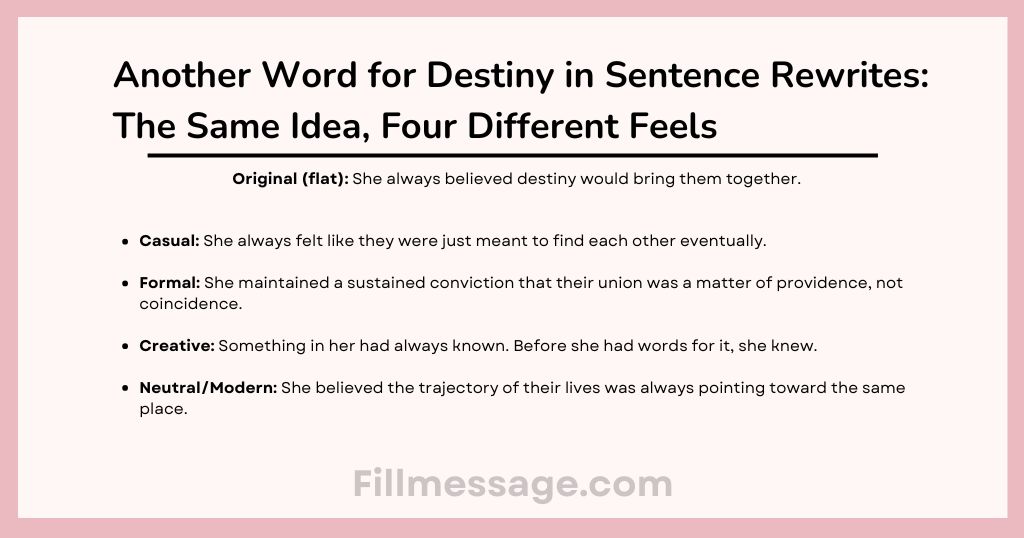
Original (flat): She always believed destiny would bring them together.
- Casual: She always felt like they were just meant to find each other eventually.
- Formal: She maintained a sustained conviction that their union was a matter of providence, not coincidence.
- Creative: Something in her had always known. Before she had words for it, she knew.
- Neutral/Modern: She believed the trajectory of their lives was always pointing toward the same place.
Each version carries the same idea. But the emotional register shifts completely depending on which word anchors the sentence.
Original (overused): He followed his destiny without question.
- Purposeful tone: He followed his calling without needing it explained or justified.
- Resigned tone: He accepted his lot and moved through life without much argument.
- Dark tone: He walked toward his doom with the quiet calm of someone who had stopped fighting it.
- Academic tone: He acted in accordance with what he understood to be a predetermined course.
Original (vague): Their meeting felt like destiny.
- Romantic: It felt like kismet, the kind of meeting you can’t plan and can’t quite explain.
- Grounded: It seemed less like coincidence and more like the natural end of two parallel paths finally crossing.
- Mythological: There was something Moira-like about it, as if the threads had been woven long before either of them arrived.
Another Word for Destiny Formal vs. Informal: Quick Reference
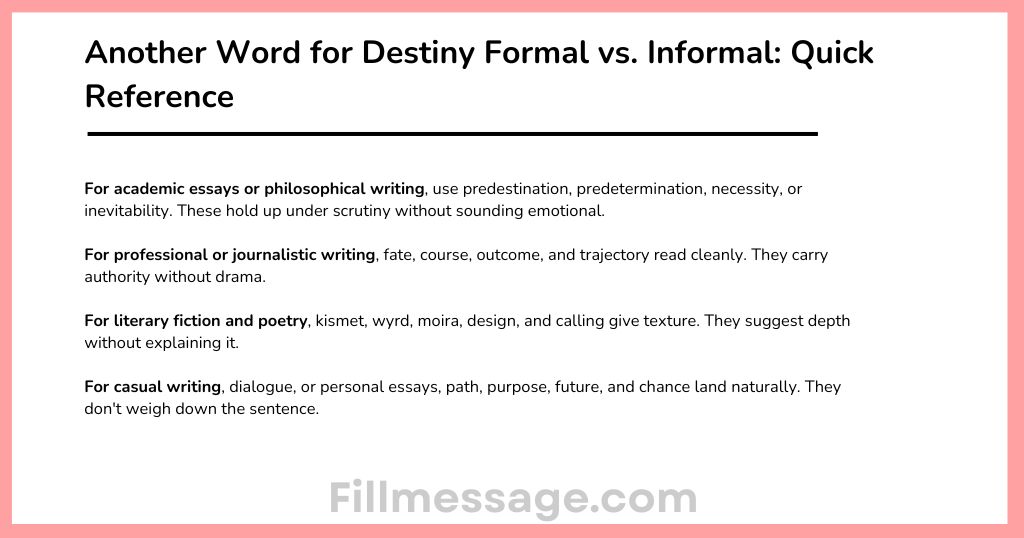
For academic essays or philosophical writing, use predestination, predetermination, necessity, or inevitability. These hold up under scrutiny without sounding emotional.
For professional or journalistic writing, fate, course, outcome, and trajectory read cleanly. They carry authority without drama.
For literary fiction and poetry, kismet, wyrd, moira, design, and calling give texture. They suggest depth without explaining it.
For casual writing, dialogue, or personal essays, path, purpose, future, and chance land naturally. They don’t weigh down the sentence.
Words to keep out of formal writing: kismet, doom, wyrd, star. They read as stylized or emotionally charged in contexts that call for restraint.
Destiny Synonym Mistakes That Are Easy to Make With These Words
Treating fate and destiny as exact copies. In practice they’re close, but fate leans toward an unavoidable end, something that catches you. Destiny leans toward direction and purpose, something that calls to you. The gap is small in casual writing and significant in careful writing.
Dropping karma into sentences where it doesn’t belong. Karma carries a specific meaning rooted in moral cause and effect across time. It’s not a general synonym for destiny. Using it loosely can feel imprecise or dismissive of its actual meaning.
Using doom for anything less than genuine tragedy. A hard situation is not doom. A failed relationship is not doom. Reserve the word for writing where the outcome is genuinely final and dark. Otherwise it reads as overdramatic.
Confusing purpose with destiny. Purpose is something a person builds and chooses. Destiny is something waiting for them. One is active. The other is received. These feel similar but point in opposite directions, and mixing them up weakens both.
Overusing rare synonyms. Words like kismet, wyrd, and moira are powerful exactly because they’re uncommon. Using any of them more than once in a single piece dulls the effect. One well-placed appearance does more than three scattered ones.
Destiny Synonym Related Words Worth Keeping Nearby
Predilection – A natural lean toward something. Softer than destiny. Useful when you want to suggest a person was always heading somewhere without claiming it was fixed.
Inclination – Similar to predilection but even lighter. Good for writing where destiny feels like a nudge rather than a command.
Trajectory – The arc of where something is heading. Modern, secular, and works well in writing that avoids spiritual language entirely.
Reckoning – A confrontation with what has been building. Related to destiny in the sense of something long unavoidable finally arriving.
Birthright – Destiny tied to where a person came from. Useful when the fated quality is inherited rather than discovered.
Destiny in Other Languages (Useful Context for Writers)
Writers working in fiction or lyrical prose sometimes draw from other language traditions for specific shades of meaning.
Kismet comes from Arabic and Turkish roots. It carries a gentle, almost resigned acceptance of what was always going to happen. That’s partly why it works better in romantic writing than in tragic writing.
Moira is Greek. In classical mythology, the Moirai were the Fates who assigned each person their portion of life at birth. Using Moira in writing pulls in that whole tradition without needing to explain it, if your reader knows the reference.
Wyrd is Old English. It means fate woven into the nature of existence, not just an outcome but a living force. Fantasy writers and poets working in archaic registers find it particularly useful.
Destino is the direct Spanish and Italian cognate, and it carries similar weight in both languages, often appearing in passionate or dramatic writing with natural ease.
These aren’t just trivia. Each word brings cultural history with it, and that history can deepen a scene when used with intention.
Read more –
35+ Another Word for Dialogue: Right Word for Every Scene and Setting
33+ Another Word for Myself: Every Alternative You Actually Need
FAQ’s about Destiny Synonyms
Is fate exactly the same as destiny?
Close but not identical. Fate implies an unavoidable endpoint. Destiny often implies a purpose-driven direction. In casual use the difference barely matters. In precise writing, fate is what finds you and destiny is what calls you.
What’s a four-letter synonym for destiny?
Fate is the strongest option and the closest in meaning. Doom is also four letters but carries a completely negative charge. Neither is interchangeable with the other despite sharing the letter count.
What’s a slang alternative for destiny?
No single slang word has taken the spot cleanly. Phrases carry more weight in informal speech: “written in the stars,” “meant to be,” “in the cards.” These function as casual equivalents without sounding out of place in everyday conversation.
What are real antonyms for destiny?
Chance, coincidence, randomness, and free will work as direct opposites. They all push against the idea of a fixed or guided outcome and suggest that events could have gone differently.
The Short Version Before You Go
If you need one swap that works almost everywhere, use fate.
If your writing is purposeful and forward-moving, calling or purpose will feel more alive.
If the tone is spiritual or romantic, kismet or providence carry the right warmth.
If the outcome is genuinely dark and final, doom earns its place.
Everything else on this list fills a gap between those anchors. The point isn’t collecting 38 synonyms. It’s walking into your next sentence knowing exactly which word does the job you need done.

Marco Jr. is Author at fillmassage.com,
He explores the world of words and their meanings, helping readers understand language clearly. Passionate about explanations that guide and inform, he creates insightful content that educates, engages, and supports curious minds every day.