You’ve typed “myself” twice in the same sentence and something feels off. Or you’re writing a bio, a reflection, an email, and the word just sits there, flat and overworked. The problem isn’t the word itself. It’s that “myself” does three different jobs in English, and most people reach for it without thinking about which job they need covered.
That’s what this guide fixes. Not just a list, but the reasoning behind each choice, so you pick the right one every time.
What “Myself” Is Actually Doing in Your Sentence
Before you replace it, know what it’s doing. “Myself” functions in three distinct ways:
Reflexive: The action loops back to the speaker. I pushed myself harder.
Emphatic: You’re stressing personal involvement. I built this myself.
Informal stand-in: People often use it instead of “me” or “I,” though this is grammatically shaky. Please reach out to myself. (Incorrect. Use “me.”)
Each function needs a different kind of replacement. One word won’t cover all three.
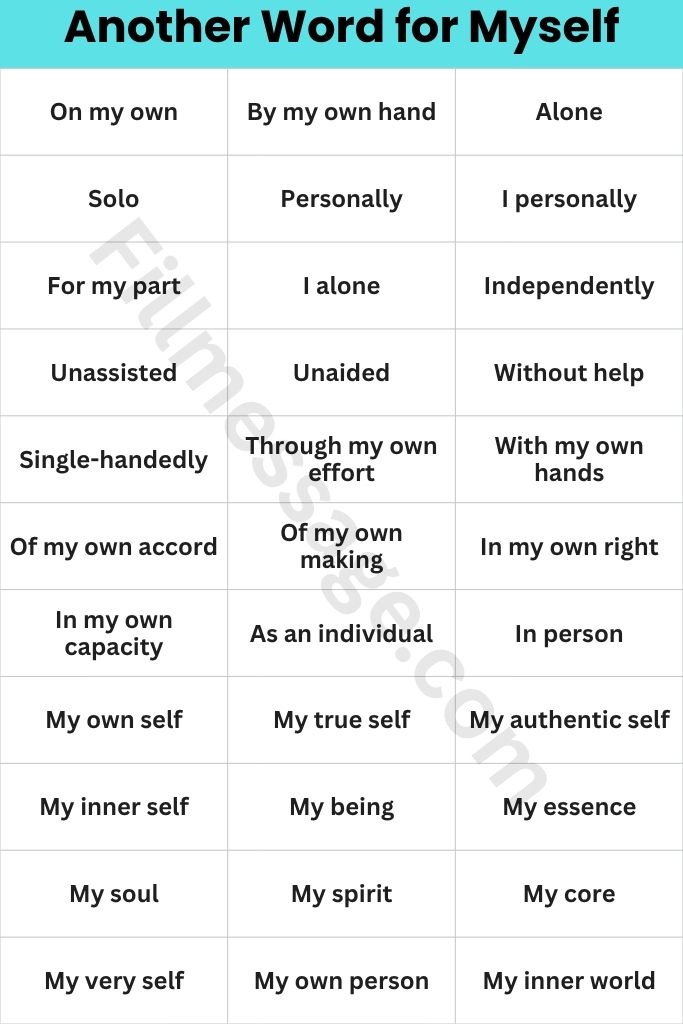
33+ Another Word for Myself by Use
| Word / Phrase | Tone | Best For |
| On my own | Natural, warm | Independence, everyday writing |
| By my own hand | Literary | Creative, craft-focused writing |
| Alone | Plain, direct | Simple solo action |
| Solo | Casual, modern | Captions, informal content |
| Personally | Warm emphasis | Sharing opinions or direct views |
| I personally | Conversational | Informal opinions, speech |
| For my part | Thoughtful | Essays, measured opinions |
| I alone | Assertive | Sole responsibility or ownership |
| Independently | Neutral | Academic, professional |
| Unassisted | Formal | Reports, official writing |
| Unaided | Formal | Academic papers |
| Without help | Plain | Everyday direct phrasing |
| Single-handedly | Confident | Achievements, accomplishments |
| Through my own effort | Purposeful | Goal writing, storytelling |
| With my own hands | Vivid | Physical work, craft |
| Of my own accord | Formal | Voluntary action |
| Of my own making | Creative | Decisions, art, consequences |
| In my own right | Assertive | Establishing credentials |
| In my own capacity | Professional | Formal letters, legal writing |
| As an individual | Neutral | Academic or professional context |
| In person | Clear | Physical presence |
| My own self | Reflective | Self-discovery writing |
| My true self | Expressive | Personal growth, bios |
| My authentic self | Modern | Wellness, branding, personal bios |
| My inner self | Poetic | Journaling, emotional writing |
| My being | Philosophical | Essays, deep reflection |
| My essence | Aesthetic | Identity-focused writing |
| My soul | Emotional | Poetry, heartfelt captions |
| My spirit | Uplifting | Motivational, poetic tone |
| My core | Grounded | Values-based, earnest writing |
| My very self | Emphatic | Literary, dramatic emphasis |
| My own person | Assertive | Identity and independence |
| My inner world | Introspective | Psychological, meditative writing |
| My authentic voice | Modern | Writing, branding, creative bios |
That’s 34 options. Now let’s make them useful.
Myself Synonym Meaning Clusters: The Right Group for Your Sentence
Cluster 1: Doing Something Without Help
These replace “myself” when the point is that you did something independently, without assistance from others.
- On my own fits almost any sentence naturally.
- Single-handedly adds confidence and a slight dramatic edge.
- Unassisted / unaided belong in formal or academic writing.
- Solo is punchy and casual, fits social content well.
- Without help is the most blunt, direct option.
Quick swap: I finished the project myself. → I finished the project on my own. (or single-handedly if you want more impact)
Cluster 2: Emphasizing Your Personal Involvement
Here you’re not saying you worked alone. You’re saying: I, specifically, was involved in this.
- Personally is the cleanest, most versatile choice.
- For my part signals a measured, thoughtful opinion.
- I alone is stronger. Use it when you want to make clear that no one else shares the responsibility or credit.
Quick swap: I myself reviewed the document. → I personally reviewed the document. Or if tone allows: I alone reviewed it.
Cluster 3: Identity, Reflection, and Inner Life
This is where the interesting options live. If you’re writing anything emotional, personal, or reflective, the grammar-first alternatives feel thin. These carry weight.
- My true self implies growth and authenticity.
- My authentic self is widely used in wellness, branding, and personal essays.
- My inner self suits journaling and introspective writing.
- My being / my essence lean philosophical, best in essays or poetry.
- My soul / my spirit carry emotional or spiritual charge.
- My core is grounded and sincere without sounding dramatic.
- My inner world works well when writing about thought, feeling, or mental life.
None of these are grammar substitutes. They’re tone upgrades for when the sentence is about who you are, not just what you did.
Another Word for Myself in Sentence Rewrites: Watch the Tone Shift
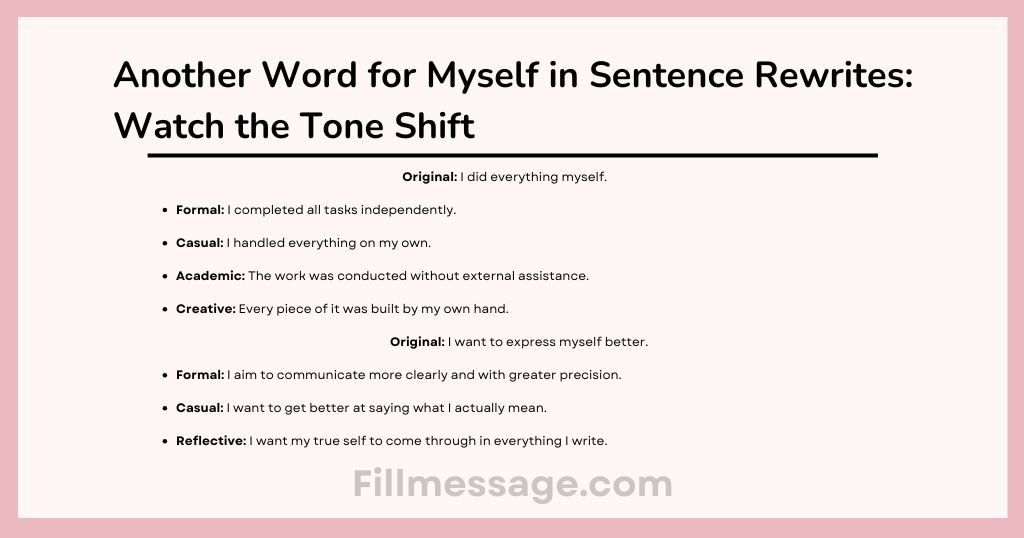
Original: I did everything myself.
- Formal: I completed all tasks independently.
- Casual: I handled everything on my own.
- Academic: The work was conducted without external assistance.
- Creative: Every piece of it was built by my own hand.
Original: I want to express myself better.
- Formal: I aim to communicate more clearly and with greater precision.
- Casual: I want to get better at saying what I actually mean.
- Reflective: I want my true self to come through in everything I write.
Original: I myself am not sure about this decision.
- Neutral: Personally, I’m not sure about this decision.
- Casual: Honestly, I can’t say I’m sure.
- Literary: Even looking inward, I find no certainty here.
The pattern is consistent: removing “myself” and rebuilding the sentence usually makes it tighter, not weaker.
Another Word for Myself Formal vs. Casual: Which Option Belongs Where
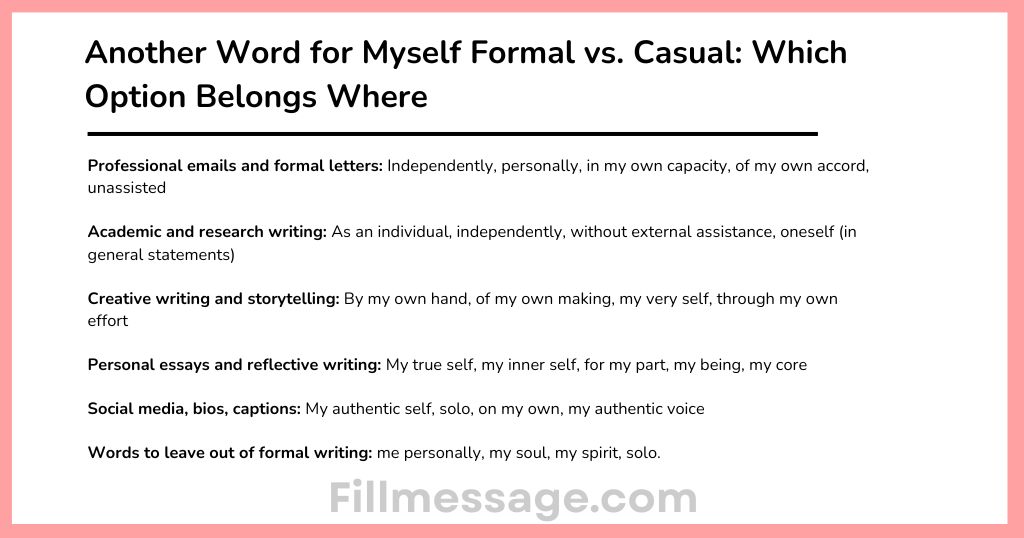
Professional emails and formal letters: Independently, personally, in my own capacity, of my own accord, unassisted
Academic and research writing: As an individual, independently, without external assistance, oneself (in general statements)
Creative writing and storytelling: By my own hand, of my own making, my very self, through my own effort
Personal essays and reflective writing: My true self, my inner self, for my part, my being, my core
Social media, bios, captions: My authentic self, solo, on my own, my authentic voice
Words to leave out of formal writing: me personally, my soul, my spirit, solo. These are fine in creative contexts but land awkwardly in business or academic settings.
Myself Synonym Mistakes That Quietly Weaken Your Writing
Using “myself” instead of “me.” “Please contact myself with questions” is extremely common and consistently wrong. Use “contact me.” Straightforward is stronger here, not weaker.
Forcing “oneself” into personal sentences. Oneself belongs in general, instructional statements: “One must challenge oneself.” It breaks immediately in personal moments: “I made dinner for oneself” is a grammar error. Keep oneself impersonal and general.
Dropping emotional alternatives into practical sentences. My being, my essence, my soul are powerful in the right place. In a work report or a simple how-to, they sound misplaced. The sentence has to earn that kind of language.
Doubling up emphasis. I myself personally is something people write. It’s triple redundancy. One emphasis word per sentence is always enough.
“Myself” Across Languages: For Bilingual and ESL Writers
Some writers search for this because they’re translating or writing across languages and want the right emotional equivalent, not just a literal swap.
In Spanish, yo mismo/a handles both reflexive and emphatic uses, mirroring English closely.
In French, moi-même carries the same dual function.
In German, ich selbst is used for emphasis, while mich covers reflexive use.
In Japanese, 自分 (jibun) means “one’s self” and works in everyday and literary writing.
In Hindi, खुद (khud) is casual and common; स्वयं (swayam) is more formal and literary.
This matters for bilingual writers who want the tone to feel right in both languages, not just technically correct in one.
Myself Synonym Related Words in the Same Space
These aren’t direct replacements for “myself,” but they appear in the same kind of writing and are worth distinguishing.
Self – Broader, functions as a noun. A strong sense of self. Self-awareness. Self-doubt.
Identity – About who someone is over time, not in one moment. More permanent and layered than “myself.”
Ego – Carries a psychological or philosophical tone. Can sound clinical depending on the context.
I – The right choice when “myself” is being incorrectly used as a subject. Myself went to the meeting is wrong. I went to the meeting is correct.
Me – The correct object form when there’s no reflexive or emphatic need. She told me is always cleaner than she told myself.
Being – Philosophical in weight. Works in deeper writing when the subject is existence, thought, or identity rather than action.
Read more –
35+ Another Word for Dialogue: Right Word for Every Scene and Setting
33+ Another Word for Myself: Every Alternative You Actually Need
FAQ’s about Another Word for Myself
Is it wrong to write “please contact myself”?
Yes, in standard grammar it is. “Myself” needs an earlier mention of “I” in the sentence to work correctly. When there’s no earlier “I,” use “me.” Please contact me is correct, clear, and sounds more confident, not less.
What’s the most poetic way to say “myself”?
It depends on what you’re trying to feel. For depth and philosophy: my being or my essence. For warmth and emotion: my soul or my spirit. For modern authenticity: my true self or my authentic self. The best poetic alternatives grow from the tone of the whole sentence, not just the word slot.
Can I use “oneself” instead of “myself”?
Only in general statements. “One should trust oneself” works. “I cooked dinner for oneself” doesn’t. If the sentence is personal and specific, oneself is the wrong move. Stick to myself, on my own, or restructure the sentence.
What works best for a personal essay or bio?
Vary your choices throughout. Use on my own for action, for my part for opinions, and my authentic self or my true self for identity statements. Locking onto one replacement across a whole essay creates the same repetition problem you started with.
The Bottom Line
The word you need depends on what “myself” is doing in your sentence. Ask that question first.
If it signals independence: reach for on my own, single-handedly, independently.
If it adds emphasis: try personally, for my part, I alone.
If it’s about identity or feeling: choose from the inner-self cluster based on how deep the tone needs to go.
And if “myself” is being used in place of “me” or “I” where it doesn’t belong, the best replacement isn’t a synonym. It’s the correct pronoun.
Stronger writing isn’t about finding fancier words. It’s about using the right one with intention.

Marco Jr. is Author at fillmassage.com,
He explores the world of words and their meanings, helping readers understand language clearly. Passionate about explanations that guide and inform, he creates insightful content that educates, engages, and supports curious minds every day.