You write the sentence. It says what happened, but not how it felt. “He downplayed the issue.” Technically correct. Completely forgettable.
The problem is not the word itself. The problem is that “downplay” hides everything interesting: the intention behind it, the damage it caused, the tone of the moment. One better word unlocks all of that.
This guide gives you 29+ real alternatives, grouped by meaning, with examples that show exactly when and why each one works.
What “Downplay” Really Means
To downplay something is to make it appear smaller, less serious, or less important than it actually is. Simple enough.
But here is what the definition misses: downplaying can be kind, cruel, strategic, cowardly, or humble, depending entirely on context. That is why the synonym matters more than most writers realize. The word you choose reveals the motive.
Quick-Access Another Word for Downplay
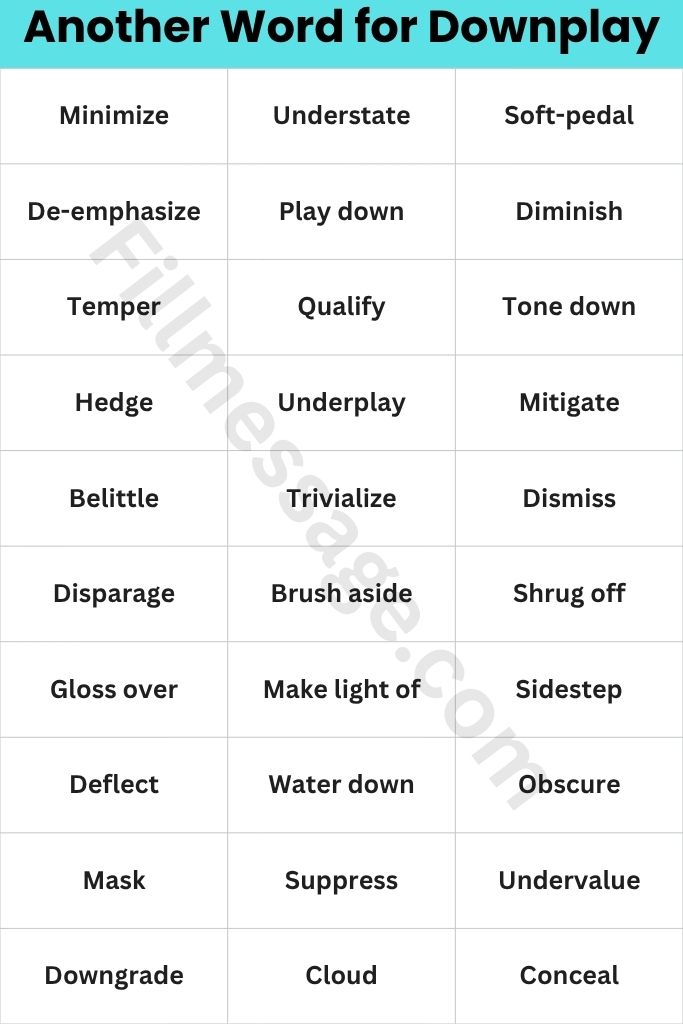
| Word | Tone | Best Used When |
| Minimize | Neutral | General writing, professional contexts |
| Understate | Subtle, formal | Essays, academic analysis |
| Soft-pedal | Tactful, gentle | Journalism, sensitive communication |
| De-emphasize | Precise, neutral | Reports, technical writing |
| Play down | Casual | Spoken or informal writing |
| Diminish | Formal | Reducing perceived value professionally |
| Temper | Careful | Softening a strong claim |
| Qualify | Cautious | Adding limits to a statement |
| Tone down | Mild | Reducing intensity in messaging |
| Hedge | Evasive | Weakening a claim with qualifiers |
| Underplay | Neutral | Holding back emphasis deliberately |
| Mitigate | Formal | Reducing the severity of an issue |
| Belittle | Harsh, negative | Attacking someone’s feelings or worth |
| Trivialize | Harsh | Treating a serious matter as nothing |
| Dismiss | Blunt, cold | Total rejection of importance |
| Disparage | Critical | Speaking negatively about something |
| Brush aside | Informal | Ignoring concerns quickly |
| Shrug off | Casual | Treating something as no big deal |
| Gloss over | Avoidant | Skipping past uncomfortable details |
| Make light of | Semi-formal | Using humor to reduce seriousness |
| Sidestep | Evasive | Avoiding a topic without denying it |
| Deflect | Strategic | Redirecting attention from something |
| Water down | Informal | Weakening the impact of something |
| Obscure | Deliberate | Hiding the true weight of something |
| Mask | Figurative | Covering the real nature of something |
| Suppress | Strong | Actively keeping something unseen |
| Undervalue | Negative | Treating something as worth less than it is |
| Downgrade | Neutral | Reducing status or importance formally |
| Cloud | Figurative | Blurring clarity around an issue |
| Conceal | Deliberate | Hiding something on purpose |
Gentle and Neutral Another Word for Downplay
Not every act of downplaying is dishonest or unkind. A doctor softens a diagnosis. A speaker qualifies a bold claim. A writer chooses restraint over drama. These words fit those moments.
Understate is the most elegant option here. It suggests deliberate, measured handling. “The review understated the film’s emotional impact” sounds sharp and intentional in academic or critical writing.
Soft-pedal implies awareness and care. The person knows the full weight of something and is choosing how much of it to show. “The spokesperson soft-pedaled the recall announcement to avoid public panic.” There is strategy in it, but not necessarily dishonesty.
Temper and qualify both suggest that someone is managing the strength of a claim. “She tempered her criticism before presenting it to the board” sounds professional and self-aware. These work especially well in formal writing where bluntness would be inappropriate.
Mitigate has a slightly legal or official feel. “The statement mitigated the severity of the findings.” Use it when the downplaying has institutional weight behind it.
Hedge is worth separating from the others. To hedge is to protect yourself by weakening your own words. “He hedged his prediction with so many qualifiers that nobody knew what he actually thought.” There is a slight cowardice implied that the others do not carry.
When Downplay Synonym Causes Real Harm
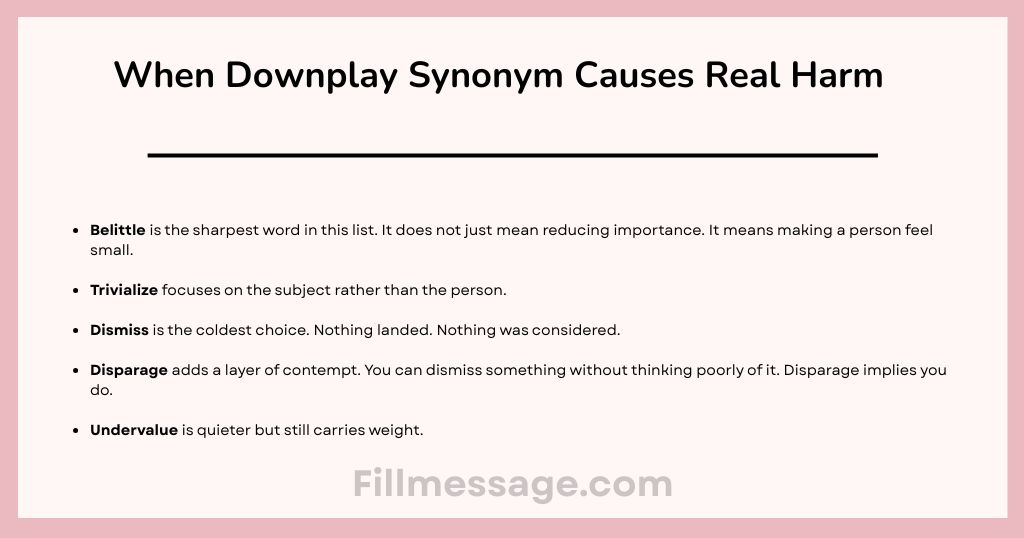
This cluster matters most for writers trying to name what actually happened in a painful situation. “Downplay” is too mild for moments that genuinely hurt someone.
Belittle is the sharpest word in this list. It does not just mean reducing importance. It means making a person feel small. “She belittled every concern he raised until he stopped raising them.” Readers feel the damage in that sentence. Use it when the emotional harm is part of the story.
Trivialize focuses on the subject rather than the person. “The article trivialized years of scientific research.” It calls out the dismissal of something serious, without necessarily implying personal cruelty.
Dismiss is the coldest choice. Nothing landed. Nothing was considered. “The principal dismissed the students’ complaints without a single follow-up question.” It describes total rejection, not partial reduction.
Disparage adds a layer of contempt. You can dismiss something without thinking poorly of it. Disparage implies you do. “He disparaged the proposal in front of the entire team, which ended the discussion before it began.”
Undervalue is quieter but still carries weight. “The committee undervalued her contributions for years before she was finally recognized.” It does not imply cruelty exactly, but it does imply injustice.
Evasion and Strategic Downplay Synonym Avoidance
Sometimes downplaying is really about what someone refuses to face directly. These words name that particular behavior.
Gloss over is one of the most useful in this cluster. “The annual report glossed over three consecutive quarters of losses.” The information was technically present, but given no room to breathe. Readers understand the maneuvering immediately.
Sidestep suggests movement. The person saw the issue coming and moved around it. “She sidestepped every question about the delayed timeline with confident non-answers.”
Deflect is more active. Someone is redirecting attention, not just avoiding. “He deflected criticism by immediately bringing up a competitor’s worse record.” There is effort and intention in it.
Obscure and cloud both involve deliberate blurring of clarity. “The lengthy contract language obscured the hidden fees.” “His vague explanation only clouded the issue further.” Use these when the purpose seems to be confusion, not just caution.
Suppress is the strongest here. It implies active effort to keep something out of view. “The internal investigation was suppressed before the results could be released.”
Downplaying Yourself
This is a separate situation entirely, and writers often reach for the wrong word here. When someone makes themselves seem less capable or accomplished than they are, the tone can be warm, sad, or strategic depending on context.
Understate still works here. “He understated his role in building the company from nothing.” It can read as humility or self-protection.
Underplay is slightly different. “She underplayed her qualifications in the interview, worried about seeming arrogant.” There is a deliberate holding back of full truth.
Minimize in reflexive use carries a quiet sadness. “She minimized everything she had built, as if it cost nothing to create.”
For personality description, self-deprecating is the most specific option. “His self-deprecating humor made him easy to like, even if it masked how seriously he took his work.” It is the word that fits when downplaying yourself is a habit or a social style, not just a single choice.
Another Word for Downplay in Sentence Rewrites: Same Idea, Different Word
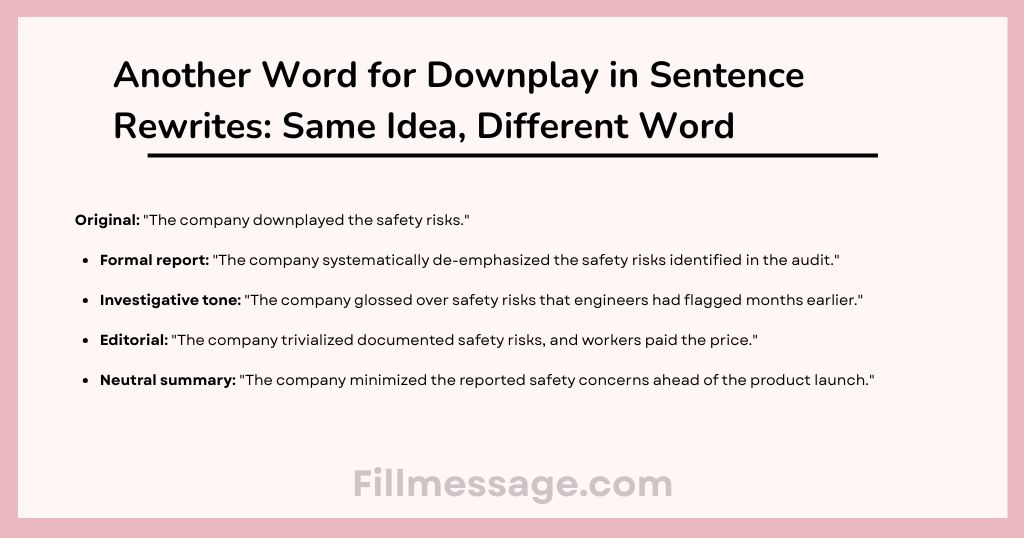
Original: “The company downplayed the safety risks.”
- Formal report: “The company systematically de-emphasized the safety risks identified in the audit.”
- Investigative tone: “The company glossed over safety risks that engineers had flagged months earlier.”
- Editorial: “The company trivialized documented safety risks, and workers paid the price.”
- Neutral summary: “The company minimized the reported safety concerns ahead of the product launch.”
Each sentence describes the same event. Each one tells a different story about blame, intention, and consequence.
Original: “She downplayed her achievements during the interview.”
- Warm, narrative: “She soft-pedaled everything she had accomplished, as if success were something to apologize for.”
- Analytical: “She consistently understated her achievements, which likely cost her the offer.”
- Conversational: “She kept brushing aside her own wins even when the interviewer pushed back.”
The word you choose is not decoration. It is information.
Another Word for Downplay Formal vs. Informal: A Practical Split
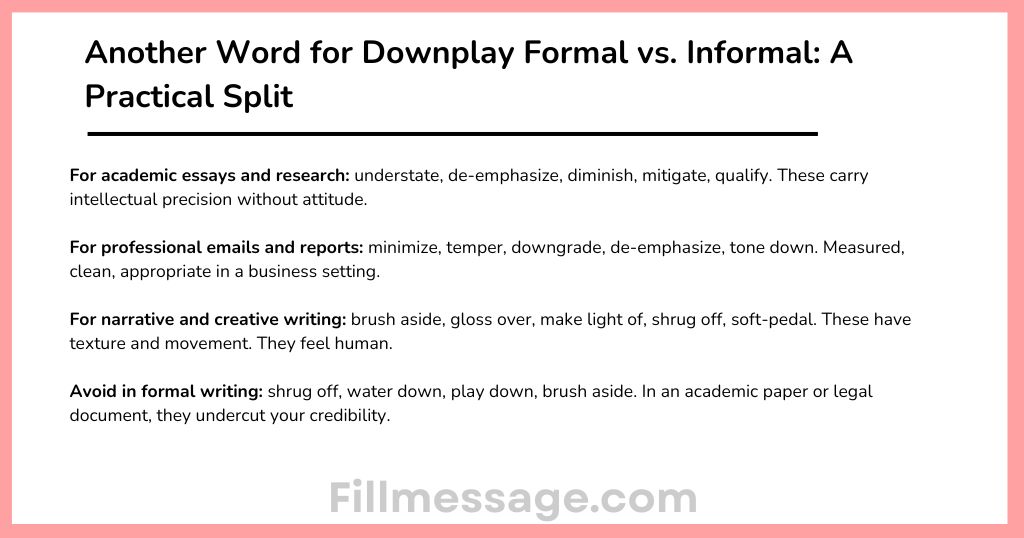
For academic essays and research: understate, de-emphasize, diminish, mitigate, qualify. These carry intellectual precision without attitude.
For professional emails and reports: minimize, temper, downgrade, de-emphasize, tone down. Measured, clean, appropriate in a business setting.
For narrative and creative writing: brush aside, gloss over, make light of, shrug off, soft-pedal. These have texture and movement. They feel human.
Avoid in formal writing: shrug off, water down, play down, brush aside. In an academic paper or legal document, they undercut your credibility.
Common Mistakes With Another Word for Downplay
Reaching for “belittle” when you mean something neutral. Belittle carries contempt. If a spokesperson is handling a story carefully, “soft-pedal” or “minimize” is more accurate. Belittle implies cruelty, not caution.
Treating “dismiss” and “understate” as the same thing. Understating something means acknowledging it quietly. Dismissing it means rejecting it entirely. These describe opposite levels of engagement.
Using “diminish” for self-description. “He diminished his talent” sounds like something the world did to him. “He understated his talent” keeps the choice with him. One implies victimhood, the other implies modesty.
Confusing “hedge” with “qualify.” Qualifying adds useful limits to a claim. Hedging protects the speaker at the expense of clarity. Both soften a statement, but qualify is intellectual precision while hedge is often avoidance.
Downplay Synonym Related Words Worth Knowing
Sanitize goes further than downplay. To sanitize a report is to remove anything uncomfortable from it, not just reduce it. The implication of manipulation is stronger.
Undermine attacks from below. You downplay something by reducing its surface appearance. You undermine it by weakening its foundation. The damage is deeper and less visible.
Concede is almost the opposite move. When you concede a point, you are acknowledging its importance, not reducing it. Knowing this distinction helps in argument-based writing.
Soften is broader than most words on this list. You can soften a message, a tone, a verdict, or a policy. It does not always imply that the truth is being hidden, just that the delivery is being handled carefully.
Read also:
63+ Another Word for Cash: Real Alternatives for Every Tone and Context
50+ Another Word for Instrumental: Find the Right Word Every Time
FAQ’s about Another Word for Downplay
Is “understate” formal enough for academic essays?
Yes, it is one of the best options. It suggests a deliberate rhetorical or authorial choice, which is exactly the kind of thing academic writing analyzes. “The author understates the economic consequences, leaving readers to draw their own conclusions.”
What is the difference between “trivialize” and “minimize”?
Minimize reduces the size of something. Trivialize suggests it never deserved to be taken seriously in the first place. Minimizing a risk says it is smaller than reported. Trivializing it says the concern was foolish to begin with. That is a sharper accusation.
Is there a positive word for downplaying yourself?
Self-deprecating fits when it is habitual and socially warm. Understate works when it is situational and deliberate. Neither carries a negative charge when used in the right setting.
When does “soft-pedal” work better than “downplay”?
When there is clear intention and care behind the choice. Soft-pedaling suggests someone is managing a response thoughtfully. Downplaying can imply deception. The difference matters in journalism and PR writing especially.
The Bottom Line
Pick the word that names the real action, not just the surface one.
Careful and tactful? Use soft-pedal, understate, or temper.
Dismissive and unkind? Use belittle, trivialize, or dismiss.
Avoiding something uncomfortable? Use gloss over, sidestep, or deflect.
Calculated and deliberate? Use suppress, obscure, or minimize.
About yourself? Use understate, underplay, or self-deprecating.
“Downplay” tells readers that something was made smaller. The right synonym tells them why, and that is the difference between writing that informs and writing that actually lands.

Marco Jr. is Author at fillmassage.com,
He explores the world of words and their meanings, helping readers understand language clearly. Passionate about explanations that guide and inform, he creates insightful content that educates, engages, and supports curious minds every day.