The letter C is one of the most common and useful letters in English. It begins everyday words like cat, car, cake, and cup, making it an excellent starting point for children, students, and anyone building vocabulary. This guide to Things That Start With C brings together familiar objects, animals, foods, and interesting discoveries in one organized place.
Whether you are teaching the alphabet, creating classroom activities, or improving English skills, these C words are easy to explore and remember. Each section groups related words so readers can quickly find practical examples and learn them in a natural way.
What Are Some Things That Start With C?
A fast snapshot before the full breakdown:
Cactus — Balloon — wait, wrong letter. Here we go: Cactus, Ceiling fan, Centipede, Chimney, Citrus, Clamp, Cobweb, Cockpit, Conveyor belt, Crossbow, Crown, Crutch, Cylinder, Czar
These aren’t the first C words most people think of, which is deliberate — the familiar ones (cat, car, clock) get their own sections with full descriptions below.
Food things That Start With C
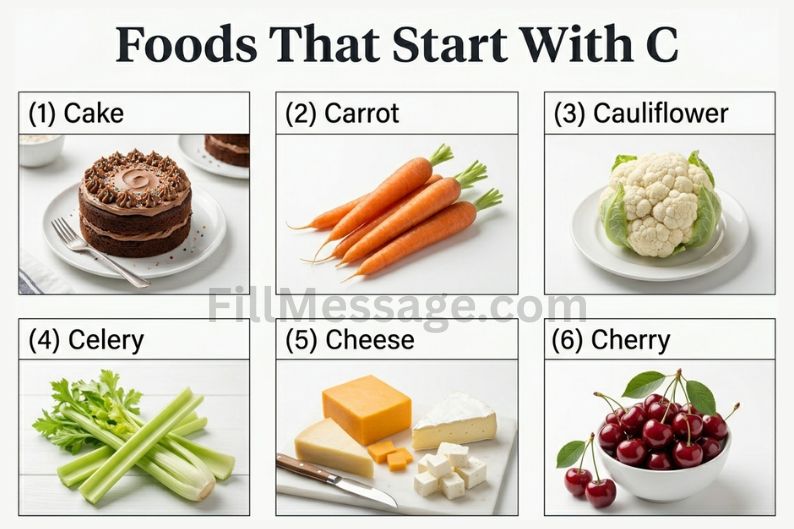
Cake — A baked dessert built from flour, eggs, sugar, and butter. Decorated with frosting for birthdays, layered with fruit for afternoon tea, or eaten plain from a tin on a Tuesday.
Carrot — An orange root vegetable eaten raw as a snack, roasted with other vegetables, or blended into soups. One of the first vegetables children learn to recognize by color.
Cauliflower — A white vegetable from the brassica family. Roasted until caramelized, mashed as a potato substitute, or eaten raw with dip.
Celery — A pale green vegetable with a distinctive crunch and mild flavor. Often paired with peanut butter or used as a base for stocks and stews.
Cheese — A dairy product with hundreds of varieties globally — cheddar, mozzarella, brie, feta, parmesan, halloumi. Each has a different texture, flavor, and use.
Cherry — A small stone fruit that comes in sweet and sour varieties. Used in pies, jams, chocolate desserts, and eaten fresh by the handful.
Chocolate — Derived from cacao beans and consumed in more forms than almost any other ingredient — bars, drinks, sauces, cakes, truffles, and ice cream.
Cinnamon — A spice ground from the inner bark of cinnamon trees. Adds warmth to baked goods, oatmeal, rice dishes, and hot drinks.
Clementine — A seedless, easy-peel citrus fruit slightly sweeter than a standard orange. A reliable lunchbox staple.
Coconut — A tropical drupe whose flesh, milk, water, and oil each serve different culinary purposes. Central to cuisines across South and Southeast Asia.
Cod — A mild, white-fleshed saltwater fish. The default fish in British fish-and-chips and common in baked and poached seafood dishes.
Coleslaw — A cold salad of shredded cabbage with either a creamy mayo dressing or a sharp vinegar one. A standard side dish at barbecues worldwide.
Corn — A grain eaten on the cob, popped, creamed, ground into flour, or fermented. One of the world’s most widely grown food crops.
Cranberry — A tart red berry used in juices, dried snack mixes, chutneys, and the sauce that appears on Thanksgiving tables across North America.
Crepe — A paper-thin French pancake cooked on a flat griddle. Filled with Nutella, fruit, or savory fillings like ham and cheese.
Croissant — A laminated pastry with many buttery, flaky layers. The result of a labor-intensive folding technique developed in French bakeries.
Cucumber — A mild, water-rich vegetable sliced into salads, pressed into drinks, or served whole with hummus.
Curry — Not one dish but an entire family of spiced preparations found across South Asian, Southeast Asian, and Caribbean cooking. The spice blend changes by region.
Cabbage — A dense, leafy vegetable used in stir-fries, soups, fermented dishes like kimchi and sauerkraut, and raw salads.
Cashew — A kidney-shaped nut with a creamy texture. Eaten roasted, blended into dairy-free milks, or used whole in savory cooking.
Clam — A bivalve shellfish used in chowders, pasta dishes, and steamed preparations.
Animals That Start With C
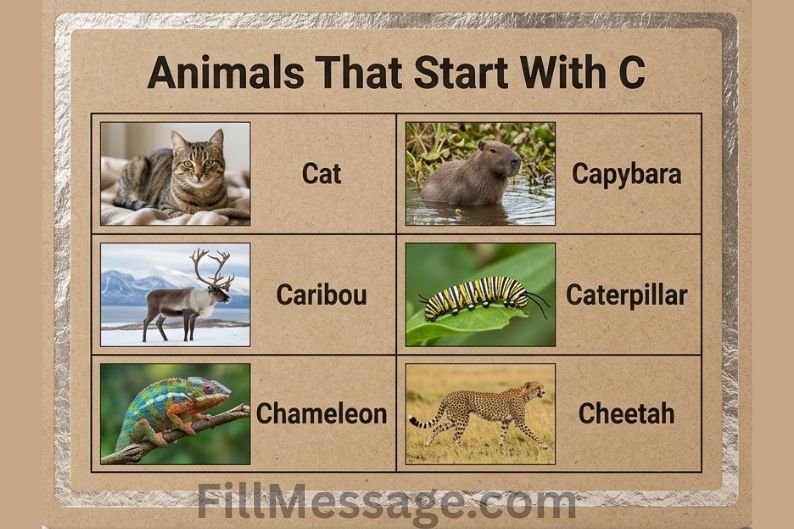
Cat — Among the most popular pets worldwide. Independent by nature, though often deeply attached to their households.
Capybara — The world’s largest rodent. Native to South America, it lives near water in large social groups and is famously unbothered by other animals.
Caribou — A large deer species from Arctic and subarctic regions. Known as reindeer in Europe and Asia, where they’ve been domesticated for transport and dairy.
Caterpillar — The larval stage of butterflies and moths. Spends its early life eating leaves before sealing itself inside a chrysalis to transform.
Chameleon — A reptile with independently moving eyes and the ability to shift skin color for communication and camouflage.
Cheetah — The fastest land animal alive, capable of reaching 70 mph in short bursts. Built for acceleration rather than endurance.
Chimpanzee — Humans’ closest living relatives among the great apes. Uses tools, solves problems, and communicates through complex vocalizations and gestures.
Chinchilla — A small South American rodent with extraordinarily dense, soft fur. Kept as a pet and historically hunted to near-extinction for its coat.
Cobra — A venomous snake recognized by the wide hood it spreads when threatened. Found across Africa and Asia in several species.
Cockroach — One of the most resilient insects on earth. Fossil evidence shows cockroaches have existed for over 300 million years.
Condor — A massive vulture with a wingspan up to 10 feet. Among the longest-lived birds, sometimes reaching 70 years in captivity.
Corgi — A herding dog breed originating in Wales, recognized by its short legs, long body, and alert expression.
Cormorant — A diving seabird that plunges underwater to catch fish. Unlike ducks, its feathers aren’t waterproof, so it spreads its wings to dry after diving.
Cougar — A large solitary wild cat native to the Americas. Also called mountain lion, puma, or panther depending on the region.
Cow — A large domesticated mammal raised for milk, meat, and historically for draft work. Central to agricultural economies for thousands of years.
Coyote — A medium-sized wild canine native to North America. Highly adaptable — found in deserts, forests, prairies, and increasingly in urban areas.
Crab — A crustacean with a broad shell, two claws, and sideways locomotion. Found in both saltwater and freshwater habitats worldwide.
Crane — A tall wading bird with long legs, a long neck, and elaborate courtship dances. Several species migrate thousands of miles each year.
Cricket — A small jumping insect. Males produce their familiar chirping by rubbing their wings together — a behavior called stridulation.
Crocodile — A large semi-aquatic reptile with an elongated snout. Among the closest living relatives of dinosaurs and birds.
Crow — A highly intelligent corvid. Known to use tools, recognize individual human faces, and even hold grudges.
Household Things That Start With C
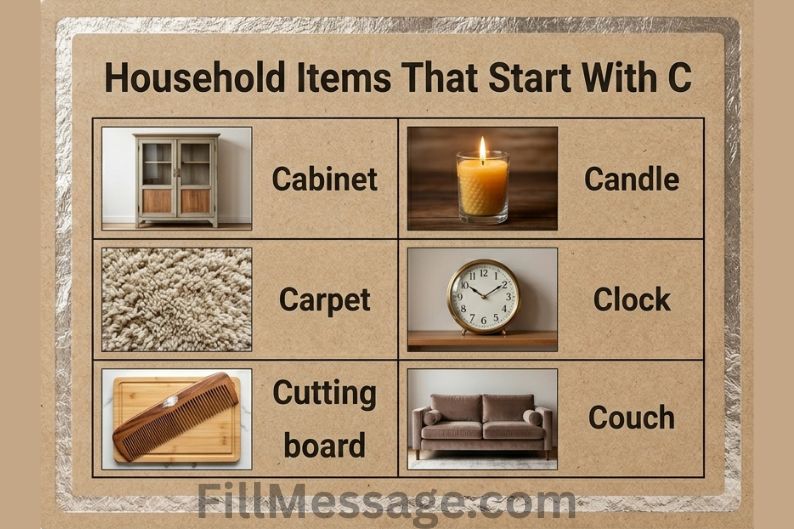
Cabinet — A storage unit with hinged or sliding doors. Found in kitchens, bathrooms, laundry rooms, and offices.
Candle — A cylinder of wax with an embedded wick. Burns to produce light and, in scented varieties, fragrance.
Carpet — Soft woven floor covering installed in bedrooms, living rooms, and hallways for comfort and insulation.
Clock — A timekeeping device. Analog clocks show time through moving hands; digital ones display numbers. Found on walls, shelves, and almost every surface in a home.
Comb — A grooming tool with a row of teeth used to detangle, style, or part hair.
Couch — A long, upholstered piece of furniture for multiple occupants. Also called a sofa or settee.
Curtain — Fabric hung over windows for privacy, light control, or decoration. Usually mounted on a rod and drawn open or closed.
Cutting board — A flat surface placed on counters for chopping, slicing, and preparing food. Made from wood, bamboo, or plastic.
Colander — A bowl-shaped kitchen tool perforated with small holes, used to drain liquid from pasta, vegetables, or canned foods.
Can opener — A hand-held or electric device with a rotating blade designed to cut around the sealed lid of a metal food can.
Clothes hanger — A shaped frame — usually plastic, wood, or wire — for suspending clothing inside a closet.
Clothes dryer — A machine that removes moisture from washed laundry using heated air and rotation.
Coffee maker — A countertop appliance that heats water and forces it through ground coffee to brew the drink. Comes in drip, pod, and espresso varieties.
Charger — A plug-in device that restores electrical charge to phones, laptops, tablets, and other battery-powered electronics.
Coat rack — A freestanding or wall-mounted fixture with hooks, positioned near an entrance to hold coats, bags, and umbrellas.
Things That Start With C for Kids
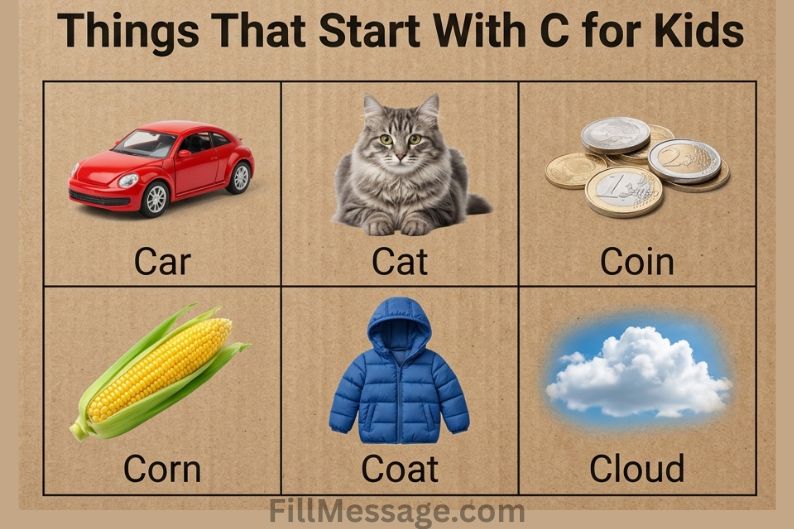
Short words, familiar objects, easy to spell — these are the best starting points for early learners:
- Cap — A brimmed hat worn to shade the face outdoors.
- Car — A four-wheeled vehicle driven on roads.
- Cat — A small, furry domestic animal that purrs and meows.
- Coin — A flat, round piece of metal used as money.
- Corn — A yellow vegetable that grows on a long cob.
- Coat — A thick outer garment worn when it’s cold.
- Cloud — The white or gray shapes that float across the sky.
- Cow — A large farm animal that produces milk.
- Crayon — A waxy colored stick used to draw and color pictures.
- Crab — An ocean creature with a hard shell and two claws.
- Cup — A small container used for drinking.
- Cake — A sweet baked food served at parties and celebrations.
Children typically recognize cat and cake earliest because both appear in the first picture books and alphabet cards they encounter. Connecting a letter to something already loved — a pet, a birthday treat — makes the word genuinely memorable rather than just memorized.
10 Common Things That Start With C
- Chair — The piece of furniture found in more places than almost any other object.
- Clock — Every kitchen, bedroom, and classroom has at least one.
- Camera — Used to capture memories in photography and video.
- Computer — Central to work, school, communication, and entertainment.
- Candle — Used in homes, restaurants, places of worship, and ceremonies.
- Calendar — Tracks days, weeks, appointments, and deadlines throughout the year.
- Carpet — Installed in millions of bedrooms and living rooms worldwide.
- Curtain — Hangs at almost every window in homes and offices.
- Cooler — Used at picnics, camping trips, and outdoor events to keep food cold.
- Cushion — Added to chairs, benches, and couches everywhere for comfort.
Cool Things That Start With C
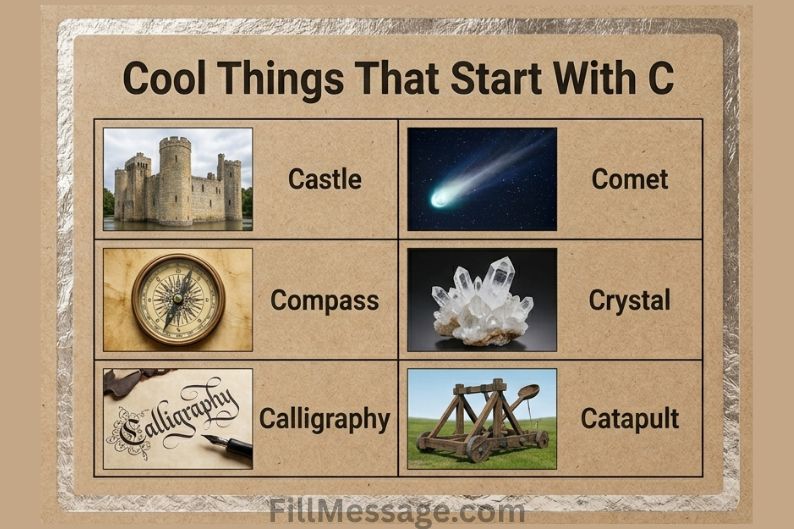
Castle — A stone fortification built in medieval Europe for defense and noble residence. Hundreds still stand — some as tourist sites, a few still privately owned.
Comet — A frozen body of rock, dust, and ice traveling through space. As it approaches the sun, evaporating gases form a glowing tail that can stretch millions of miles.
Compass — A navigational instrument with a magnetized needle that aligns with Earth’s magnetic field to indicate north. Used before GPS by every sailor, explorer, and hiker.
Crystal — Any solid material whose atoms are arranged in a regular, repeating pattern. Table salt, quartz, diamonds, and snowflakes are all crystals.
Calligraphy — The art of producing decorative, expressive handwriting with specialized pens and ink. Practiced in Arabic, Chinese, Japanese, and Western traditions.
Catapult — A mechanical device that uses stored energy — twisted rope, a counterweight, or a bent arm — to hurl projectiles at a distance.
Centrifuge — A laboratory machine that spins samples at extreme speed to separate components by density. Used in medicine, chemistry, and food processing.
Cipher — A system for encoding written information so only the intended recipient can read it. Used in military communications and now in digital encryption.
Cartography — The science and craft of making maps. Modern cartography blends satellite data, mathematics, and design.
Chronometer — An exceptionally precise clock used for navigation. Before GPS, a ship’s chronometer was essential for calculating longitude at sea.
Caldera — A large, bowl-shaped volcanic depression formed when a magma chamber empties and collapses. Yellowstone sits inside a caldera.
Catacombs — Underground burial chambers carved beneath ancient cities. The catacombs beneath Paris hold the remains of over six million people.
Cuneiform — One of humanity’s earliest writing systems, developed in Mesopotamia around 3400 BCE. Characters were pressed into soft clay tablets using a wedge-shaped stylus.
Cryptogram — A puzzle where a message has been encoded and must be decoded through pattern recognition and substitution logic.
Nature Things That Start With C
Canyon — A deep, narrow valley with steep sides carved by a river over millions of years. The Grand Canyon took the Colorado River roughly 5–6 million years to cut.
Cave — A natural hollow formed inside rock or earth. Home to bats, unique cave-adapted insects, and in many cases, ancient human paintings.
Cedar — A large, aromatic evergreen tree. Its wood contains natural oils that repel moths and insects, which is why cedar is used for storage chests and closet linings.
Cliff — A vertical or near-vertical face of rock or earth. Formed by erosion, tectonic movement, or coastal wave action.
Clover — A low-growing flowering plant found in meadows and lawns. Valuable to bees as a nectar source, and the rare four-leaf variety is a long-standing symbol of luck.
Coral — A marine invertebrate that builds calcium carbonate skeletons. Colonies of millions of coral polyps form reefs — the most biodiverse marine ecosystems on the planet.
Cactus — A plant adapted to survive arid environments by storing water in its thick, fleshy stem and protecting itself with spines that also reduce water loss.
Creek — A small, shallow stream of fresh water. Usually feeds into a larger river.
Cloud — Masses of water droplets or ice crystals suspended in the atmosphere. The shape of clouds — cumulus, cirrus, cumulonimbus — signals specific weather patterns.
Current — The directional movement of water in rivers, oceans, or the atmosphere. Ocean currents regulate climate across entire continents.
School Objects That Start With C
Chalk — A soft, calcium-based stick used to write on blackboards and draw on pavement.
Calculator — An electronic device for arithmetic and mathematical operations. Introduced to classrooms in the 1970s and now standard from middle school onward.
Clipboard — A flat rigid board with a spring clip at the top that holds paper in place for writing without a desk.
Calendar (classroom) — A large visual display of the current month used to teach days of the week, date recognition, and planning skills.
Compass (geometry) — A two-armed drafting tool with one pointed leg and one pencil leg, used to draw precise circles and arcs.
Colored pencils — Wax-core drawing tools that produce smoother, more precise color than crayons. Preferred for detailed illustration work.
Composition book — A sewn-spine notebook with a marbled cardboard cover, traditionally used for journaling, notes, and school assignments.
Cubby — A small, individual storage compartment assigned to each student in a preschool or kindergarten classroom.
Chart — A visual display presenting information, data, or processes. Used across subjects from math to science to social studies.
Crayon — A wax-based coloring stick in a paper wrapper. The standard drawing tool for young children in classrooms everywhere.
Clothing Items That Start With C
Cardigan — A knitted sweater that opens at the front, fastened with buttons or a zip.
Cargo pants — Trousers with large patch pockets on the thighs. Designed originally for military use, adopted widely as casual wear.
Chaps — Leather leg coverings strapped over trousers. Worn by horse riders and ranchers to protect legs from brush, rope, and saddle wear.
Chelsea boots — Ankle-height boots with elastic side gussets and a low heel. Originally made for equestrians, popular in mainstream fashion since the 1960s.
Cloak — A loose, sleeveless outer garment fastened at the neck and worn draped over the shoulders.
Camisole — A lightweight sleeveless top with thin shoulder straps. Worn as an undergarment, a layering piece, or a standalone top in warm weather.
Cufflinks — Small decorative fasteners that close the cuffs of formal dress shirts, replacing buttons.
Cap — A soft hat with a forward-facing brim. Worn for sun protection, sport, or casual style.
Outdoor Things That Start With C
Campfire — An open fire built in a pit or ring outdoors. Used for warmth, cooking, light, and atmosphere. Smells like every good camping memory.
Cart — A wheeled open vehicle used for moving goods. Garden carts carry soil, tools, and harvested vegetables.
Climbing wall — An artificial surface mounted vertically with handholds and footholds for practicing rock climbing techniques.
Cobblestone — Small, rounded stones set into pavement. Found in older European city centers and historic districts. Extremely difficult to walk on in heels.
Community garden — A shared plot of land where neighborhood residents grow vegetables, herbs, and flowers together.
Courtyard — An unroofed, enclosed outdoor space surrounded by buildings or walls. Common in Mediterranean and Middle Eastern architecture.
Crosswalk — Painted stripes on a road surface that designate a safe pedestrian crossing point.
Cricket pitch — The rectangular central strip of a cricket field where the bowler and batsmen operate.
Musical Instrument Things That Start With C
Castanet — A percussion instrument consisting of two concave wooden shells clicked together rhythmically. Fundamental to Spanish flamenco.
Cello — A bowed string instrument larger than a viola, played upright between the player’s knees. Produces a deep, resonant tone.
Chime — A set of suspended tubes, bars, or bells that produce musical tones when struck or moved by wind.
Clarinet — A single-reed woodwind instrument with a cylindrical bore. Produces a clear, warm tone used in classical orchestras, jazz bands, and marching ensembles.
Concertina — A small, hexagonal free-reed instrument in the accordion family. Produces sound by pushing and pulling the bellows while pressing buttons.
Conga — A tall, barrel-shaped Afro-Cuban hand drum. Usually played in pairs or triplets.
Cornet — A valved brass instrument similar to the trumpet but slightly shorter with a more conical bore, giving it a mellower, rounder sound.
Cymbals — Round, thin metal discs struck together in pairs or hit with a drumstick. The crash cymbal and hi-hat are both essential parts of a drum kit.
Travel and Transport Things That Start With C
Cabin — A private enclosed room on a ship, aircraft, or train. Also a small, simple dwelling in a rural or woodland setting.
Canoe — A narrow, lightweight boat propelled with a single-bladed paddle. Used for recreation, sport, and traditional transport in many cultures.
Caravan — A vehicle fitted out for living in while traveling, towed behind a car. Common in European and Australian road travel culture.
Carry-on — A bag or suitcase compact enough to store in an overhead compartment on an airplane, eliminating the wait at baggage claim.
Checkpoint — A controlled point of inspection at a border, airport, or secure facility.
Coach — A long-distance bus, or the economy cabin class on a train or airplane.
Concourse — The wide corridor inside an airport terminal connecting gates, shops, and passenger services.
Cruise ship — A large ocean-going vessel designed for multi-day leisure travel, with restaurants, entertainment, and accommodation onboard.
Currency — The official money system used in a country. Travelers exchange their home currency when crossing borders into countries with different monetary systems.
Unique and Unusual Things That Start With C
Words that rarely appear on standard vocabulary lists but are genuinely worth knowing:
Clavichord — A small keyboard instrument from the 14th–18th centuries. Softer than a harpsichord, it was used for quiet private practice and composing.
Czar — A title used by Russian emperors from Ivan III until the 1917 revolution. Derived from the Latin Caesar.
Cobalt — A hard, lustrous blue-gray metallic element. Gives blue glass and ceramics their color, and used in lithium-ion battery production.
Caldera — Already covered above in Nature Things.
Corsage — A small floral arrangement pinned to a lapel or worn on the wrist. Traditional at formal events like proms and weddings.
Cornea — The transparent outer layer of the eye that covers the iris and pupil. Plays a major role in focusing light.
Clavicle — The collarbone — the long, slender bone connecting the sternum to the shoulder blade.
Conveyor belt — A continuous moving band used in factories, warehouses, and airports to transport items from one point to another.
Calico — A loosely woven, unbleached cotton fabric. Also refers to a cat with a three-color coat pattern — white, orange, and black.
Canopy — A covering suspended above a space. A forest canopy is the uppermost layer of tree branches; a bed canopy is the fabric draped over a four-poster frame.
Carnelian — A reddish-brown semi-precious gemstone used in jewelry and historically used for carved seals and signet rings.
Compass rose — The decorative diagram on maps showing the cardinal directions — north, south, east, west — and their intermediate points.
Things Around the House That Start With C — A Room-by-Room Look
Rather than repeating items already described above, here are C objects organized by where you’d encounter them, featuring words not yet covered:
Kitchen: Crockpot, Cleaver, Casserole dish, Cookbook, Corkscrew, Creamer, Chopsticks
Living room: Console table, Coffee table, Controller (TV remote), Comic book, CD player
Bathroom: Cotton balls, Cotton swabs, Cologne, Conditioner (hair)
Bedroom: Comforter, Crib, Canopy (bed), Closet, Cedar chest
Garage/Storage: Crowbar, Chain, Clamp, Crate, Cord (extension)
Entryway: Cubby (shoe storage), Coat hook, Ceramic pot (decorative)
Additional C Words Not Covered Above
Cage — An enclosure of bars or mesh for housing animals or birds.
Canal — A man-made waterway constructed for irrigation, transportation, or drainage.
Cape — Either a sleeveless outer garment worn over the shoulders, or a narrow headland of land extending into a body of water.
Caramel — A confection made by slowly heating sugar until it melts and browns.
Cartridge — A sealed container holding ink for a printer, or a casing containing ammunition for a firearm.
Cavern — A large underground chamber within a cave system, often with dramatic rock formations.
Ceramic — A hard material shaped from clay and fired at high temperatures. Used in pottery, floor tiles, and dental crowns.
Chain — Interconnected metal links forming a flexible, strong line. Used in locks, bicycles, anchors, and jewelry.
Chandelier — A decorative branched ceiling fixture with multiple light sources, typically found in formal rooms and grand halls.
Chisel — A hand tool with a beveled cutting edge used in woodworking, stone carving, and metalwork.
Cider — A drink pressed from apples, available as sweet (non-alcoholic) or fermented (alcoholic) versions.
Cinema — A building where films are shown on a large screen to a paying audience.
Circuit — A closed path through which electric current flows from a power source, through components, and back.
Clay — A natural, fine-grained earth material that becomes malleable when wet and hardens when fired. Used in pottery and sculpture.
Clog — A shoe with a thick wooden or rigid rubber sole. Originally workwear in Northern Europe.
Cobweb — A tangled, irregular web spun by a spider, often found in undisturbed corners.
Cockpit — The forward section of an aircraft containing the pilot’s controls, instruments, and seating.
Coil — A length of wire, tubing, or rope wound in a series of loops.
Collar — A band of fabric around a garment’s neckline, or a strap worn around an animal’s neck.
Column — A tall vertical structural element in architecture used for support or as a decorative feature.
Comic — A narrative told through sequential illustrated panels, usually with dialogue in speech bubbles.
Cone — A geometric solid with a circular base tapering to a point. Ice cream cones and traffic cones both use this shape.
Container — A broad term for any vessel used to hold or store other items — boxes, bins, tanks, jars.
Copper — A reddish-gold metallic element and one of the first metals used by humans. Conducts electricity and heat exceptionally well.
Cord — A flexible, covered wire for conducting electricity, or a length of thick twisted string.
Cotton — A natural fiber harvested from the cotton plant’s seed pods. The world’s most widely used natural textile fiber.
Crate — A rigid slatted box used for shipping, storage, or housing animals during transport.
Crossbow — A ranged weapon with a horizontal bow mounted on a stock, firing bolts or short arrows.
Crown — A circular headpiece worn by monarchs as a symbol of royal authority. Also the top surface of a tooth.
Crutch — A mobility aid placed under the arm to support walking when a leg is injured or weakened.
Cubicle — A small, partitioned workspace within a larger open-plan office.
Cylinder — A three-dimensional shape with two parallel circular faces and a curved side connecting them. Found in engines, cans, pipes, and geometry textbooks.
Cymbidium — A genus of orchids with long arching leaves and clusters of waxy, long-lasting flowers.
Fun Activities Using C Words
Home scavenger hunt — Give children a written list of ten household C words (cooler, cushion, curtain, comb, coat rack) and a time limit to find each one. Ages 3–8 work well for this.
30-second draw — Say a C word aloud and have children draw it before time runs out. Easy words (cloud, car) for younger kids; harder ones (compass, caldera) for older students.
Story chain — One person starts a sentence with a C word; the next person must continue the story using a different C word. Keeps going until the story collapses into absurdity, which usually happens around word four.
Category sort — Write 20–25 C words on separate cards. Have children sort them into piles: things you eat, animals, things you find indoors, things you find outdoors. A good discussion starter when words could fit more than one category.
Alliteration sprint — Set a 60-second timer and challenge children to write or say as many C words as possible. Compare lists and discuss any unusual ones.
Read more:
250+ Things That Start With A: Words, Objects, Animals, and Ideas
200+ Things That Start With B — Words, Objects, Animals, Foods & More
FAQ’s on Things That Start With C
What are the best C words for young children to learn first?
Start with simple words children already know from daily life, such as cat, car, cap, cup, cake, and cow. These are short, easy to sound out, and easy to connect with pictures and real objects.
Why does the letter C have two different sounds?
C can sound hard like /k/ in cat and carrot, or soft like /s/ in city and celery. In many words, C becomes soft when it comes before e, i, or y.
How can I help children remember C words?
Use pictures, flashcards, scavenger hunts, and drawing games. Children remember words better when they can see, say, and use them in real situations.
What are some unusual Things That Start With C?
Interesting examples include comet, caldera, cryptogram, cuneiform, and catacombs. These words introduce science, history, and geography in a fun way.
Why are letter-based word lists useful for English learners?
They organize vocabulary into manageable groups. Learning words by letter helps improve spelling, pronunciation, and memory while making new words easier to review.
The letter C turns out to be far more productive than most people expect when they first sit down to list it out. From the simplest words a toddler says to the precise vocabulary of geologists, navigators, and musicians, C covers an extraordinary range of human experience. That’s what makes it worth exploring carefully — not just for children learning their alphabet, but for anyone who wants language that’s precise, vivid, and genuinely useful.

Marco Jr. is Author at fillmassage.com,
He explores the world of words and their meanings, helping readers understand language clearly. Passionate about explanations that guide and inform, he creates insightful content that educates, engages, and supports curious minds every day.