Looking for another word for freedom? The best choice depends on what kind of freedom you mean. Freedom can describe legal rights, personal independence, emotional relief, or the ability to make your own choices. Using a more specific word helps your writing sound clearer and more natural.
This guide goes beyond simple synonym lists. You’ll find practical alternatives, easy explanations, and examples that help you choose the right word for the right situation. Whether you’re writing an essay, story, article, or speech, there’s an option that fits.
What Freedom Really Means (The Short Version)
Freedom is the state of not being controlled, restricted, or owned by an outside force. But it also carries emotional weight that shifts with context. A prisoner’s freedom, a nation’s freedom, and a child’s summer freedom are three completely different feelings wearing the same word.
That’s exactly why synonyms matter here more than almost anywhere else.
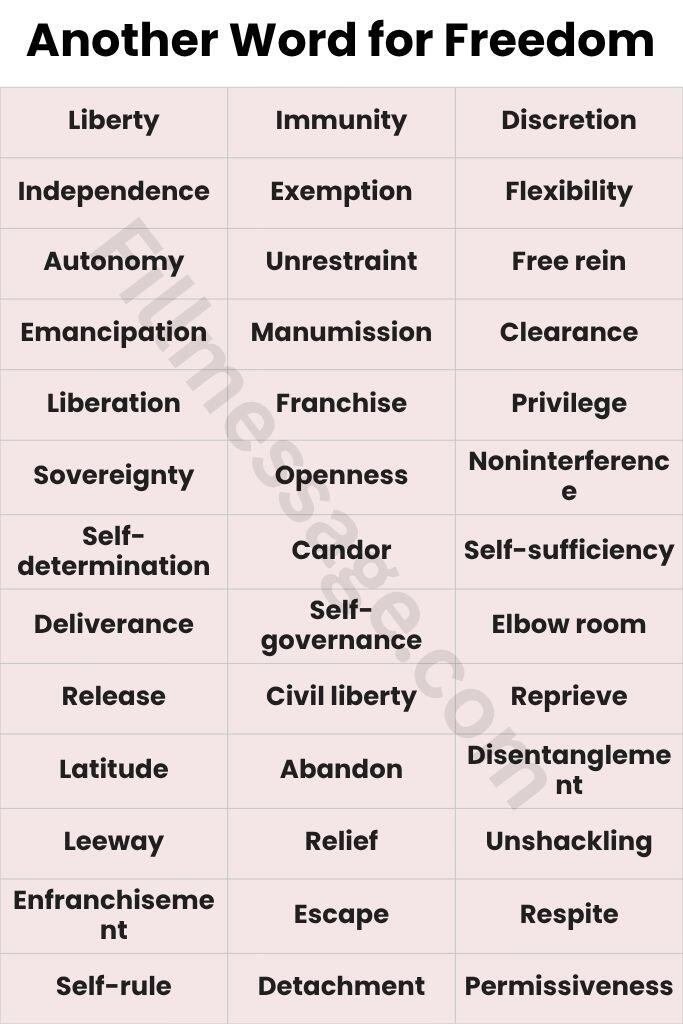
Another Word for Freedom Quick List
Organized by context so you can scan and land on the right one fast.
| Word | Tone | Best Used When |
| Liberty | Formal, dignified | Political writing, civil rights, legal documents |
| Independence | Neutral, clear | Nations, personal life, professional decisions |
| Autonomy | Academic, precise | Psychology, healthcare, ethics, self-governance |
| Emancipation | Historical, serious | Slavery contexts, legal release, social movements |
| Liberation | Active, passionate | Revolutions, personal transformation, struggle |
| Sovereignty | Legal, official | International law, national power, governance |
| Self-determination | Political, empowering | Human rights, indigenous rights, group governance |
| Deliverance | Spiritual, poetic | Religious writing, emotional rescue, poetry |
| Release | Gentle, quiet | Emotional relief, endings, creative writing |
| Latitude | Professional, measured | Workplace decisions, creative flexibility |
| Leeway | Casual, practical | Informal talk, everyday decisions, tolerance |
| Enfranchisement | Formal, civic | Voting rights, political inclusion |
| Self-rule | Accessible, direct | Governance by the people, national identity |
| Immunity | Legal, protective | Exemption from laws, legal protection |
| Exemption | Neutral, factual | Rules, taxes, official exceptions |
| Unrestraint | Literary, expressive | Creative or emotional writing contexts |
| Manumission | Rare, literary | Historical fiction, academic texts only |
| Franchise | Civic, historical | Voting rights, legal entitlement |
| Openness | Warm, accessible | Expression, communication, cultural freedom |
| Candor | Interpersonal | Freedom of honest speech in conversation |
| Self-governance | Formal, political | Democratic systems, autonomous communities |
| Civil liberty | Legal, rights-based | Constitutional law, individual rights |
| Abandon | Literary, emotional | Carefree freedom from social restraint |
| Relief | Personal, emotional | Freedom from worry, pressure, or pain |
| Escape | Narrative, active | Physical or emotional freedom from something bad |
| Detachment | Philosophical, calm | Freedom from emotional or material attachment |
| Discretion | Professional, quiet | Freedom to decide without explanation |
| Flexibility | Practical, modern | Scheduling, work arrangements, options |
| Free rein | Idiomatic, casual | Complete freedom to act as one chooses |
| Clearance | Official, procedural | Permission granted by authority |
| Privilege | Social, formal | A freedom granted, not inherent |
| Noninterference | Political, neutral | Freedom from outside control or meddling |
| Self-sufficiency | Practical, grounded | Financial or personal independence |
| Elbow room | Very casual, physical | Space to act without restriction |
| Reprieve | Temporary, legal | A short pause from consequence or pressure |
| Emancipation | Historical | (See #4, avoid repeating) |
| Disentanglement | Formal, descriptive | Freedom from complex obligations or ties |
| Unshackling | Poetic, dramatic | Breaking free from a long-held restriction |
| Deliverance | Spiritual | (See #8) |
| Respite | Gentle, temporary | Brief freedom from difficulty or burden |
| Permissiveness | Social, descriptive | A culture or environment allowing free behavior |
| Free will | Philosophical | The capacity to choose without external force |
| Carte blanche | Formal, idiomatic | Unlimited freedom to act as you choose |
| Birthright | Emotional, powerful | A freedom one deserves simply by being human |
| Unfettered access | Formal, compound | Full freedom to reach or use something |
| Open license | Modern, digital | Freedom to use, share, or modify something |
| Emancipation from | Specific phrasing | Freedom specifically named as release from X |
| Self-ownership | Philosophical, bold | The idea that a person belongs to themselves |
| Liberation from | Active phrasing | Used when the struggle matters as much as the result |
| Unconstraint | Literary | Complete absence of limitation, often in poetry |
Freedom Meaning Clusters: Which Type of Freedom Do You Mean?
This is where most guides fall short. They list words but never tell you what kind of freedom each one actually describes.
Freedom From Something Oppressive
These carry weight. Use them only when the situation earns them.
Emancipation points to formal, legal release, almost always from slavery or serious legal bondage. It belongs in historical writing. Using it for small personal wins can feel tone-deaf.
Liberation is the active version. The struggle is part of the word. Armies liberate cities. People liberate themselves from toxic situations. It implies that something was fought for, not simply given.
Deliverance goes deeper than politics. It carries a spiritual charge, the feeling of being rescued from darkness, not just restriction. It works in poetry and religious contexts but can feel heavy in professional writing.
Freedom to Make Your Own Choices
Autonomy is precise and clinical. Doctors, psychologists, and ethicists use it constantly. It means the right to decide for yourself without needing permission. If you’re writing about healthcare, education, or personal rights, this is usually your strongest option.
Independence is the same idea made accessible. Everyone understands it. No jargon, no baggage. A teenager wants independence. A startup celebrates its independence. Use it when clarity matters more than nuance.
Self-determination lives in human rights documents and political theory. It describes a group’s right to decide its own future. More collective than autonomy, more specific than independence.
Freedom of Space and Action
Latitude is professional. A boss gives employees latitude. A teacher gives students latitude in how they approach an assignment. It means room to make choices within a larger structure.
Leeway is casual latitude. More forgiving, less formal. “Give him some leeway” means tolerate the small stuff. It’s the word for everyday flexibility.
Carte blanche is the extreme version. Unlimited latitude. No conditions. Use it carefully because it implies total trust was handed over.
Freedom in an Emotional or Spiritual Sense
Release is a quiet exhale. The tension ends. There’s no triumph in it, just relief. It fits endings in stories, difficult conversations resolving, or emotional weight lifting.
Respite is temporary. It doesn’t claim freedom completely, just a pause from the pressure. Honest word for situations where full freedom isn’t possible yet.
Abandon is freedom from self-consciousness. To dance with abandon. To laugh with abandon. It’s joyful, a little reckless, and completely informal.
Another Word for Freedom Sentence Rewrites: Watch the Tone Shift
Original: She finally felt freedom after years in that job.
- Formal essay: Her resignation represented a reclaiming of professional autonomy.
- Casual: She finally had the leeway to do things her own way.
- Poetic: Something like deliverance settled in her chest the morning she left.
- Passionate: The liberation she’d waited years for was finally real.
Original: The country fought for freedom for decades.
- Political: The nation’s pursuit of sovereignty stretched across generations.
- Historical: After prolonged colonial rule, independence finally arrived.
- Passionate: The liberation they bled for could no longer be denied.
- Civic: Their demand for self-determination echoed through every protest, every vote.
Original: The new rules gave workers more freedom.
- Professional: The revised policy expanded employee latitude in daily decision-making.
- Casual: The new rules gave everyone a bit more leeway.
- Legal: Staff were granted greater discretion over operational choices.
Three sentences. Three very different readers. Same core meaning.
Another Word for Freedom Formal vs. Informal: The Practical Split
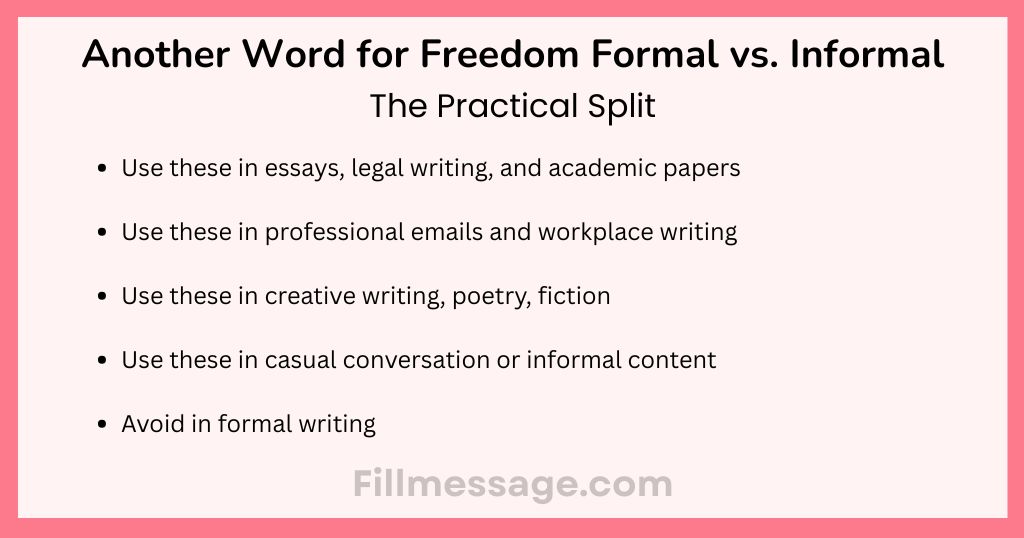
Use these in essays, legal writing, and academic papers: liberty, autonomy, sovereignty, emancipation, self-determination, enfranchisement, civil liberty
Use these in professional emails and workplace writing: latitude, discretion, autonomy, independence, flexibility
Use these in creative writing, poetry, fiction: liberation, deliverance, release, abandon, unrestraint, unshackling, birthright
Use these in casual conversation or informal content: leeway, elbow room, free rein, openness, flexibility
Avoid in formal writing: elbow room, free rein, leeway, abandon. They work in conversation but look out of place in serious documents.
Common Mistakes to Avoid about Freedom Synonyms
Treating liberty and freedom as perfect swaps. Liberty implies a recognized, often legal right. Freedom is the broader human experience. A bird has freedom. A citizen has liberty. In constitutional writing, this distinction matters.
Reaching for emancipation in modern, light contexts. It carries the weight of historical trauma. Using it to describe quitting a gym membership borrows meaning it hasn’t earned.
Mixing up autonomy and independence. Independence is freedom from external control. Autonomy is internal authority over your own decisions. A person can be independent from a company but still lack autonomy within their own household.
Overusing liberation in commercial writing. This word belongs in serious contexts. Brands use it so often to sell products that it’s started to feel hollow. When you do use it, make sure the context earns it.
Using latitude and leeway interchangeably. Latitude reads professional and measured. Leeway is informal and implies tolerance for small errors. Wrong register in the wrong sentence breaks the tone quietly.
Freedom Fighter: What Word You Use Reveals What You Think
When describing someone who struggles for freedom, word choice carries a political angle.
- Revolutionary wants to change the whole system
- Liberator is what you call them after they succeed
- Activist works through protest and public pressure
- Resistance fighter operates against an occupying force
- Patriot ties the struggle to national identity
- Dissenter challenges power through voice, not arms
The same person gets different labels depending on who’s telling the story. Be deliberate.
Freedom Words From Other Languages Worth Knowing
The English word freedom doesn’t translate perfectly into other languages, and that gap reveals something useful.
The German Freiheit leans toward inner freedom, the freedom to think and be, not just to move. The Arabic hurriya holds both personal and collective freedom at once, individual liberty and the freedom of a people, without separating them. The Urdu word azadi carries independence, protest, and national memory together in a way no English synonym fully captures. French liberté is almost impossible to separate from the revolution that made it famous.
Understanding what other languages do with this concept helps you use English synonyms more precisely, because you start to see which specific aspect of freedom each word is pointing to.
Freedom Related Words That Aren’t Synonyms
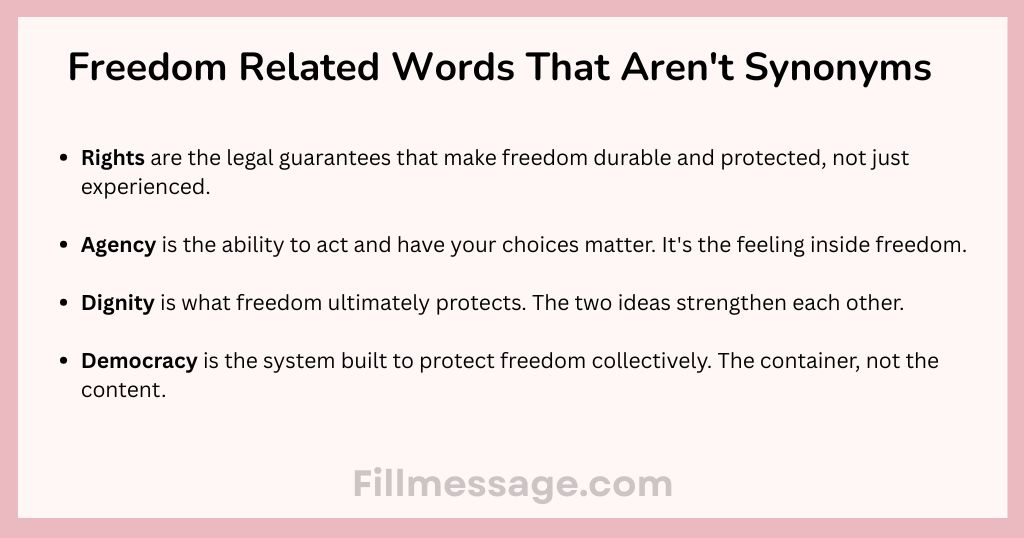
These words live near freedom but mean something different:
Rights are the legal guarantees that make freedom durable and protected, not just experienced.
Agency is the ability to act and have your choices matter. It’s the feeling inside freedom.
Dignity is what freedom ultimately protects. The two ideas strengthen each other.
Democracy is the system built to protect freedom collectively. The container, not the content.
Using these alongside your synonyms adds depth without repetition or overlap.
Freedom Opposite Words for Freedom
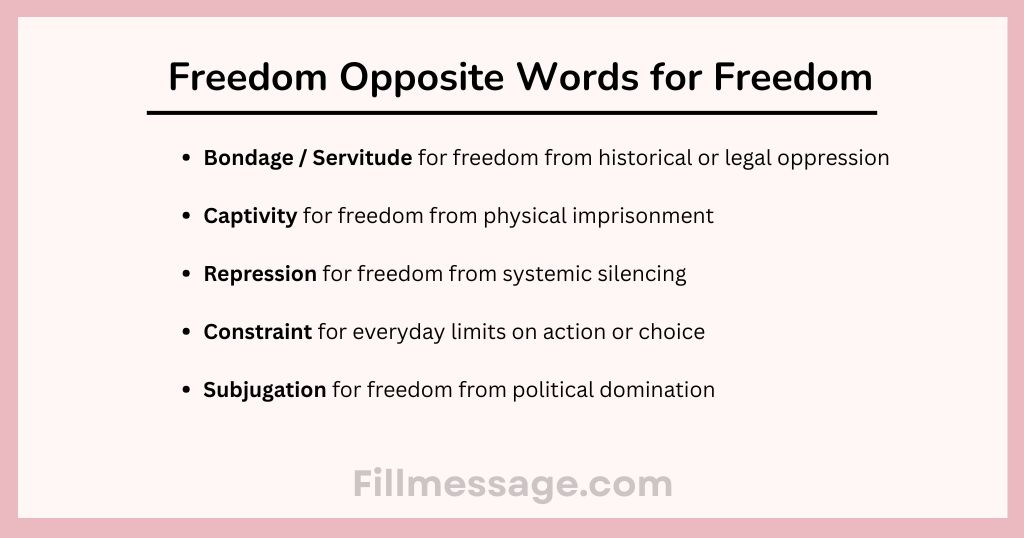
Knowing the antonym helps you pick the right synonym by identifying what the freedom you’re describing pushes against.
- Bondage / Servitude for freedom from historical or legal oppression
- Captivity for freedom from physical imprisonment
- Repression for freedom from systemic silencing
- Constraint for everyday limits on action or choice
- Subjugation for freedom from political domination
If the freedom in your sentence is escaping captivity, release fits better than autonomy. If it’s escaping a system, liberation or sovereignty lands stronger. The antonym tells you the direction.
Read more posts: 250+ Things That Start With A: Words, Objects, Animals, and Ideas
FAQs about Another Word for Freedom
Is liberty always more formal than freedom?
Mostly yes, but the bigger difference is what they imply. Liberty suggests a protected, recognized right. Freedom is the broader human experience of not being restricted. In legal and political writing, liberty is the stronger, more precise choice.
Can autonomy describe a country, not just a person?
It can, but it feels unusual at the national level. Sovereignty and independence work better there. The exception is autonomous region, a standard political term for areas with partial self-governance.
What’s the most powerful synonym for emotional freedom?
It depends on the emotion. Deliverance for spiritual depth. Liberation for something that was fought for. Release for quiet relief. Abandon for joy without self-consciousness.
Why does “freedom” still sometimes feel like the best word?
Because it’s direct, universally understood, and carries no unintended political or historical baggage on its own. Synonyms are tools, not upgrades. Use them when they serve the sentence. Use freedom when nothing else fits better.
Choose by What Kind of Freedom You Mean
Before you reach for a synonym, ask one question: what kind of freedom is this?
Freedom from oppression or control? Liberation, emancipation, deliverance, release.
Freedom to decide and act? Autonomy, latitude, leeway, discretion, carte blanche.
Freedom as a legal or political right? Liberty, sovereignty, self-determination, civil liberty.
Freedom as a personal, emotional feeling? Release, relief, abandon, respite, openness.
Freedom that was earned through struggle? Liberation, self-rule, birthright, unshackling.
Match the type first. Match the tone to your audience second. That’s how the right word finds the right sentence.

Marco Jr. is Author at fillmassage.com,
He explores the world of words and their meanings, helping readers understand language clearly. Passionate about explanations that guide and inform, he creates insightful content that educates, engages, and supports curious minds every day.